Gaussian Blur and Feather drew through a filter layer whose blur works on
a coarser grid tied to the canvas: the blurred art moved by up to about
a pixel, and its steps showed, as the view moved by parts of a pixel
(scrolling, zooming about the pointer). They now blur the content's own
pixels on the CPU, as the Photoshop-style effects already do: the same
look wherever the view is, cached while only the view moves.
Co-Authored-By: Claude Opus 5.5 <noreply@anthropic.com>
Raw app.quit closed the window and answered null at once, so a client
couldn't tell that a save prompt was waiting. It now runs the menu's
Quit: {"pending": "saveChanges"} while a modified document is asked
about, as file.close and file.closeAll answer and the protocol
documentation says; otherwise null, and the window closes.
Co-Authored-By: Claude Opus 5.5 <noreply@anthropic.com>
The effect versions of Offset Path, Zig Zag and Roughen showed Joins and
Points as free text fields. They now pick Miter, Round or Bevel and
Smooth or Corner, as Object > Path > Offset Path does. A size's
Relative / Absolute (Roughen, Zig Zag, Tweak) is a pair of radio
buttons, and the effect dialogs' other on/off options are checkboxes
that show when they are off too (they were invisible unchecked).
Co-Authored-By: Claude Opus 5.5 <noreply@anthropic.com>
Illustrator EPS and .ai type is made whole from the file's text
document, shown or hidden: point type, area type (a story in several
frames as threaded type that flows when the file opens) and type on a
path, with its fonts, size, leading, tracking, scaling, baseline shift,
fill and stroke colours (grey, RGB or CMYK), alignment, indents and
paragraph spacing. The page's drawing of that type, often in pieces, is
left out; where the text document can't say, type that shows still
comes from the page.
Co-Authored-By: Claude Opus 5.5 <noreply@anthropic.com>
The output multiplied the glow's colour by its opacity a second time, so outside the shape (where
the glow sets the opacity) it darkened as it faded and showed as a grey rim over a light
background. The test now checks that the fading glow keeps the edge's colour.
Co-Authored-By: Claude Opus 5.5 <noreply@anthropic.com>
The edge filter read `y * w + x` for x = w (the next row's first pixel)
and y = h at the raster's right and bottom edges; it now reads
transparency there, as the module documents. A test checks a solid square
glows alike on every side. Formatted with rustfmt, and the test uses
as_chunks for clippy 1.99.
Co-Authored-By: Claude Opus 5.5 <noreply@anthropic.com>
The report kept a placed document's LINKED FILES and FONTS inside its parent's list. Each document
now gets its own sections, the packaged one first and unchanged (no Document: line), then each
placed document's, headed by its file. Drops a debug_assert and an unneeded mut, runs rustfmt, and
documents the nested packaging in docs/mcp.md and the ROADMAP.
Co-Authored-By: Claude Opus 5.5 <noreply@anthropic.com>
package.rs: the collector takes main's font lookup (fonts found by any of their names, in the
version the type names, a missing style shown in its closest one, files named by packaged_name).
Co-Authored-By: Claude Opus 5.5 <noreply@anthropic.com>
Add Fonts adds only files a folder search found.
- macOS declares .suit as the extension of a font suitcase
(com.apple.font-suitcase), and the font scan reads a suitcase
whatever its name. A search considered only suitcases without an
extension. It now also considers files whose extension is .suit, in
any letter case, and reads one only when it is a suitcase font.
- Add Fonts copies at most 256 MB a file. A search also read larger
font files, and a search that found one for a font could end before
it found a smaller copy. A search now skips font files over 256 MB.
Docs: docs/mcp.md.
A folder search reads at most 8 MB of each font file. The suitcase
reader reads a suitcase font's resource fork whole, up to 256 MB.
Before this change, the search applied its limit to each font only
after that read. One search thread could read 256 MB from a single
suitcase and hold a copy of its fonts as well. The search now reads a
suitcase font only when its resource fork is 8 MB or less. The font
scan still reads each suitcase font's resource fork whole, up to
256 MB.
Docs: docs/mcp.md.
When a document opens with fonts that aren't available, fonts used
only in its symbols included, VectorCraft lists them in a Missing
Fonts dialog after the missing linked file questions, one document at
a time, with Find Fonts and Close. Find Fonts opens Type › Find Font
on the first missing font of the layers' type, to replace it. After
Find Fonts or Close the dialog doesn't open again for that open; when
another dialog replaces it, it opens again once that dialog closes.
Search Fonts Folder (the Fonts folder File › Package writes next to
the document) and Find in Folder… search a folder and its subfolders
for the fonts' files, and Add Fonts copies the files the user chooses
into a Fonts folder next to the preferences. The desktop app and
vectorcraft-cli read that folder with the system's font folders. Type
› Find Font has a Find in Folder… button too when fonts the document
uses are missing. The web app shows no dialog; a status message says
how many fonts aren't available.
- text.missingFonts lists each missing family and style once,
whatever version the document's type names, and leaves out CSS
generic families such as sans-serif. text.findFontFiles searches a
folder on up to 8 threads and returns at once; text.findFontFiles {}
reports the search, and {stop: true} stops it. A search reads only
what the font scan reads of font files (their table directories and
name, fvar and OS/2 tables) and, on macOS, of suitcase fonts, and
lists a file for a font only when the file makes the font resolve
exactly. It does not enter app packages, the Program Files and
ProgramData folders, the system's folders at the root of a volume,
the Shared and Public folders in Users, a home folder's Library,
AppData, Applications, snap and dot folders, a Library folder's app
data folders or the folders the environment names for apps, and it
skips other hidden folders and does not follow links below the
picked folder. It ends after 60 s by default, after 10,000,000
entries listed, with more than 1,000,000 folders waiting, after
10,000 font files read or 1,000 kept, or once every font has a file;
Stop and Close end it too.
- text.addFontFiles copies only files the last search found. Of
those, it copies only regular .ttf, .otf, .ttc, .otc, .woff and
.woff2 files and suitcase fonts with their resource fork, at most
256 MB a file and 1 GB in all. It never replaces a file: a file with
the same contents is kept, and when another file has that name, the
copy gets a number (Name 2.otf). The fonts are then scanned again,
and type set in them redraws.
- ui.missingFontsDialog and ui.findFontsInFolder open the dialog for
agents; docs/control-protocol.md lists its fields.
- File › Package gives a font file whose name has no font extension
the extension that matches its data (.ttf, .otf or .ttc).
- vectorcraft-text adds set_app_font_dir, which system_font_dirs
reads, WantedFonts, which reads a font file's names as the font scan
does, is_font_file and is_suitcase. #762 split its face reader, which
now takes read budgets: file_face_names_within tries the suitcase
reader first, and reader_face_names_within applies the budgets to
each font. vectorcraft-format adds write_new_with.
Docs: docs/mcp.md, docs/control-protocol.md, ROADMAP.
The PDF part of an .ai stands in for the editable document, whose art crossing
the artboard edge isn't clipped, so it keeps opening whole and editable (#646).
Plain PDFs still get the clip to the crop box. path_count is back to counting
every path: no clipping paths appear in the .ai cases it counts.
Co-Authored-By: Claude Opus 5.5 <noreply@anthropic.com>
A clip to the page box is dropped as redundant (by hayro, and by
push_clip_path), so art a file hides outside the page - a mock-up backdrop
thousands of points across, say - came in unclipped: it showed, and it sized
Fit to Artwork Bounds and CropTo::Bounding to metres. Viewers show a page
through its crop box, so each object reaching past it now keeps its own clip
to it, with a warning. Art inside the page is unchanged (no clip groups).
Co-Authored-By: Claude Opus 5.5 <noreply@anthropic.com>
A letterhead saved by Illustrator 28 without PDF compatibility wouldn't
open: "its editing data can't be read (it ends inside a layer)". Its
layer starts with a /ForeignObject (non-native art: the content of a
placed PDF), whose /Data entry is the PDF as ASCII85 in comment lines.
ASCII85 includes `_`, so about one line in 85 starts with `%_`, which
the lexer reads as hidden tokens; a `(` in such a line opened a string
that swallowed the dictionary's end, the rest of the art and the
layer's LB.
The reader now skips to the data's `~>` after `/Data ,` in a
/ForeignObject, as it already did for a /Binary dictionary's ASCII85,
and leaves the non-native art out with a note (nothing draws its PDF
from the editing data yet).
Co-Authored-By: Claude Fable 5.1 <noreply@anthropic.com>
Claude-Session: https://claude.ai/code/session_017ZwZjADUZP4VzvrFGpiZch
- Fit to Artwork Bounds fits the art exports draw: hidden objects and
layers, guides and template layers don't count, and the bounds stop at
a layer's clip.
- The comparison with the page catches an object one draws that the
other doesn't (pixels whose neighbours all differ, away from type), a
light colour against white, and, for an EPS whose page is its art's
box, art the layers print outside it.
- textAs: outlines opens a .ai whose type shows from its PDF part, which
has the outlines.
- document.open takes editingData: false to open an Illustrator EPS or
.ai as its page or PDF part only, for print pipelines.
Part of #637.
Co-Authored-By: Claude Opus 5.5 <noreply@anthropic.com>
On a desktop with a Ryzen integrated GPU without a monitor and an NVIDIA
card driving both monitors, Automatic (power saving on Windows) picked
the integrated GPU; Windows presented every frame across adapters and
the integrated GPU's driver reset, losing the graphics device or taking
every monitor down for minutes (same bug as pdfcraft#378).
Automatic now asks the system which GPU drives which display (Windows:
EnumDisplayDevices through winsafe; Linux: /sys/class/drm) and ranks the
GPU driving a display, and among those the primary display's, ahead of
the power preference. Where the system can't say, or no adapter's PCI
ids match (OpenGL, Metal), the order is the power preference's as
before, so nothing gets worse. Power Saving and High Performance chosen
by the user, and WGPU_POWER_PREF, keep ordering by kind alone.
The log now lists the display GPUs, which adapters drive a display, and
the adapter drawn on with the reason, the first question in every
black-window report. Tests cover the device-id parser, the rankings
(desktop with all monitors on the discrete GPU, hybrid laptop, a monitor
on each GPU, no match), the sysfs reader and a live EnumDisplayDevices
call.
Co-Authored-By: Claude Fable 5.1 <noreply@anthropic.com>
Claude-Session: https://claude.ai/code/session_017ZwZjADUZP4VzvrFGpiZch
The styles were stored on the text and written to SVG's text-decoration,
but the type was drawn without the lines. vectorcraft_text::decorations
now gives each underlined or struck-through stretch of a run on a line
its bar, placed and sized from the font's own underline and strikeout
metrics (with fallbacks for fonts that have none). The canvas, Create
Outlines, PDF export (outlined and real text) and SVG's outlined text
draw them in the run's paint.
Co-Authored-By: Claude Opus 5.5 <noreply@anthropic.com>
hyphenation_exceptions_override_the_pattern failed when the round-trip
test set the process-wide list at the same moment: words missing from the
thread's override fell through to the shared store.
Co-Authored-By: Claude Opus 5.5 <noreply@anthropic.com>
swatch.library.copyToUser {library} copies a library loaded from
another folder into the user library folder of the desktop app. A
.vcswatches, .gpl or .ase file is copied as it is; the swatches of a
document and a library loaded from the data or dataBase64 parameter are
written as a .vcswatches file. The copy gets a name that no file in the
folder has, and when a file with the same extension and bytes is
already there, that file is used. The library is then listed as User
Defined only. Until the app quits, commands given its loaded id use the
copy, unless another library is loaded under that id. Without a user
library folder (the web and headless sessions) the command is disabled.
A file with the same extension and bytes as a User Defined library
opens as that User Defined library. The unchanged original of a copied
.ase file is one such file. Graphic style libraries open the same way.
An ellipse kept pie angles in its model, but nothing drew or set them. Now
the Transform and Properties panels show Ellipse Properties with Pie Start
Angle, Pie End Angle and Invert Pie, as in Illustrator, and
object.setLiveShape takes {pieStart, pieEnd, invertPie}. The pie runs
counterclockwise on screen from the start angle (0 at 3 o'clock) to the
end angle and closes through the centre; 0 to 360 is the whole ellipse,
an end of 0 means 360, and Invert Pie swaps the angles to show the other
part. One undo step each; a bad angle is an error. The labels are
translated in every complete language. The on-canvas pie widget is still
to come.
Co-Authored-By: Claude Opus 5.5 <noreply@anthropic.com>
The toolbar's All Tools drawer listed the tools' names as plain buttons.
It now shows each tool with its icon and name in a grid, under the
toolbar's group headings (Select, Shapes, Draw, Modify, Type, Navigate,
Color) and headings for the tools only the Advanced toolbar shows
(Perspective, Symbols, Graph, Artboards, Slices). The active tool is
highlighted, a tool's tooltip gives its name and shortcut, and picking one
selects it and closes the drawer. The headings use labels translated
already.
Co-Authored-By: Claude Opus 5.5 <noreply@anthropic.com>
The toolbar and the dock's icon column scroll when the window is too
short for them. Their scroll bar was egui's floating one, which widens to
10 pt while scrolled or dragged and covered the group labels and the
icons' right edge. It now stays at most 4 pt wide (2 pt at rest), at the
column's edge.
Co-Authored-By: Claude Opus 5.5 <noreply@anthropic.com>
A font library can hold two versions of one family and style (a new
Montserrat-Bold.ttf beside an old montserrat.ttf). The font database kept
only the first one loaded, so type set in the other couldn't be matched
when a PDF or .ai was opened: it came in as outlines. Now every version
loads (the first stays the one family and style resolve to), PDF import
tries the other versions when the glyphs differ, and type set in a version
the family and style alone wouldn't pick names it in CharStyle::font_version
(left out when None, so documents without it are unchanged). Layout,
shaping, the substituted-glyph highlight, Find Font, Package and Document
Info follow it; changing the font clears it.
Co-Authored-By: Claude Opus 5.5 <noreply@anthropic.com>
Japanese now translates the status-bar and error messages (`@msg`
templates) like Spanish, French, Italian, Russian and Ukrainian do:
556 rows at the end of ja.tsv, the 498 message literals the test scan
finds plus the 58 that the other catalogs also carry (web start-up,
relinking, export notes, PostScript read errors).
`ja` joins COMPLETE_MESSAGES, so complete_languages_translate_every_message
keeps it complete. The registry comment, docs/development.md and the
ROADMAP line now list Japanese with the other five. The messages
themselves stay English for agents and MCP.
Co-Authored-By: Claude Sonnet 5.5 <noreply@anthropic.com>
- Artboard Options listed its fields by key (Height, Name, Width); it now
lists Name, then Width and Height.
- One-key tool and command shortcuts (V, P, X, D…) matched the character
typed, so with a layout without Latin letters (Persian, Arabic, Russian,
Greek…) they did nothing. When the text typed holds no ASCII character,
the key's position stands in: the V key selects the Selection tool
whatever it types. Latin layouts (AZERTY…) keep the letter typed.
Co-Authored-By: Claude Opus 5.5 <noreply@anthropic.com>
key_equivalents_run_through_the_normal_shortcut_path_once failed about one
full ui-egui run in four ("the menus weren't read again", 5 vs 4). Each
app mirrors its shortcut overrides into a process-wide store every frame,
bumping shortcut_editor::GENERATION, and the plug-in registry's revision is
process-wide too. Tests running alongside with other shortcuts flip them,
which rightly makes the menus read again. The test now checks two idle
frames during which those generations held still (trying up to 50 times),
so it still fails if idle frames re-read the menus on their own.
Co-Authored-By: Claude Opus 5.5 <noreply@anthropic.com>
As in Illustrator, the Pen shows its continue cursor over an end of any
open path, selected or not, and a click there selects the path and draws
on from that end (reversing it from its first end). While drawing, it
shows a join cursor over an end of another open path, and a click joins
the two into one path, in one undo step, which finishes the path.
path.join takes {ids: [a, b], ends: ["first"|"last", "first"|"last"]}
to join the ends asked for (the Pen's join); without them it joins the
selected paths' nearest ends as before. Joining a path with itself, or
anything that isn't a path, is an error.
Co-Authored-By: Claude Opus 5.5 <noreply@anthropic.com>
Object › Crop Image and the image's Crop Image buttons (Control bar,
Properties) now show a crop box on the selected image, as Illustrator
does, instead of cropping straight to the artboard (which did nothing for
an image inside its artboard). The box starts on the image's part over its
artboard; its handles and its inside drag it, always within the image, and
the image outside it is dimmed. The Control bar shows its X/Y/W/H with
Apply and Cancel; Enter applies and Escape cancels, both back to the
Selection tool. Apply runs object.cropImage {rect}, one undo step.
- tools: the Crop Image tool (cropimage.rs), with crop_box shared by the
tool and the Control bar.
- ui: ui.cropImage (enabled with an image selected), the Control bar's
crop fields and buttons, "Apply" translated (es, fr, it, ru, uk, ja,
zh-hans, zh-hant).
Co-Authored-By: Claude Opus 5.5 <noreply@anthropic.com>
craft-fonts main holds only Noto Sans Arabic so far (the other eleven are in
storytold/craft-fonts#11), and releases pin an older craft-fonts commit, so
say which builds list them.
Co-Authored-By: Claude Opus 5.5 <noreply@anthropic.com>
#763 landed beside #771 with five chunks_exact(4) calls in
crates/affinity/tests/raster.rs, which clippy 1.99's chunks_exact_to_as_chunks
rejects, so cargo xtask ci failed at clippy on main.
Co-Authored-By: Claude Opus 5.5 <noreply@anthropic.com>
File › Package and Document Info › Font Details looked fonts up with
FontDb::face and compared the face's family with the name the document
stores. A font a document named by another of its names (a PostScript
or localized name, as SVG and PDF files do) was reported as not
available and left out of the package, although the canvas drew it and
exports embedded it.
- Package and Font Details resolve fonts with FontDb::resolve, as
text.fonts and the renderer do. A style the family lacks is still
copied as its closest style; the report now names the style it
copies, and Font Details lists the font as substituted, with that
style's file and permission.
- FontFace::embeddable reads fsType as exports do (Embedding), so fonts
that allow bitmap embedding only (bit 9), or that set the restricted
bit together with reserved bit 0 (0x0003), are no longer copied.
Document Info's permission labels follow the same rule: when a font
sets more than one usage bit, the label names the most permissive
one.
- The Package dialog and its status line name the fonts it didn't copy.
The source audit linked commercial template listings and other pages it
didn't use, and described the environment it ran in. Keep the two sources
the corpus uses, say in a sentence what kinds of sources were left out and
why, and state plainly that reopening our output in Affinity is still to do.
Co-Authored-By: Claude Opus 5.5 <noreply@anthropic.com>
The font scan read only the macOS font folders and the Additional
Fonts Folder, so fonts that apps and font managers register with
CoreText from their own folders were missing from the font menus, and
exports set such type in the fallback font. CoreText's font manager
lists them with the installed fonts.
- `mac_fonts.rs` lists the files of the fonts the font manager has
available (`CTFontManagerCopyAvailableFontURLs`, through
objc2-core-text), keeping only file URLs as `open_documents.rs` does
(#433). The desktop app and `vectorcraft-cli` install it as they
install the DirectWrite lister on Windows, and the scan reads the
files outside the font folders in place.
- The scan leaves out faces with no outlines the font engine draws (no
glyf, CFF, CFF2 or VARC table), on every platform. CoreText lists
Apple's PingFang UI interface font (macOS 27), whose outlines are in
an hvgl table; if the scan cataloged it, PingFang SC would count as
installed, and Chinese characters in fallback text, Japanese kanji
included, would draw blank.
- Tests: the list holds the installed fonts by full path, a font
registered from another folder is listed while it is registered, and
a face without outlines the engine draws isn't cataloged.
The Save Swatch Library dialog lists Swatch Exchange (.ase) as a
format, and swatch.library.save takes format: "ase" or a path ending
in .ase. Each solid color keeps its model (RGB, CMYK, Lab or Gray) and
its type (spot, global or process), and color groups stay groups.
Gradients and patterns are left out, and a tint swatch is written as
the color it shows. Without a path or user: true, the command returns
the file as dataBase64.
A swatch exchange library opens under the name of its file. When Save
Swatch Library or Save Graphic Style Library saves to a file, the save
panel suggests the Name from the dialog as the file name, as a save to
User Defined does, and the web app downloads the file under that name.
A name made only of dots and spaces, such as "...", gives the file name
Library (Library.vcswatches) in place of a hidden file.
palette_io::write returns the file's bytes. A property test writes
generated libraries and reads them back, and an import fuzz test loads
mutated copies of a file the writer wrote.
Clippy 1.99.0 added `chunks_exact_to_as_chunks`, which fails `cargo xtask ci`
at its clippy step. Eight uses of `chunks_exact(_mut)` with a constant size now
use `as_chunks(_mut)` (stable since 1.88, within the 1.95 minimum): four in
crates/affinity, three in crates/effects and crates/engine tests, and two in
xtask's sha256. docs/development.md says the gate targets the current stable.
Co-Authored-By: Claude Sonnet 5.5 <noreply@anthropic.com>
References can share data, so a damaged fork could make the scan copy one
large resource up to 256 times: cap the total copied like the fork itself.
Off macOS no file has a fork, so the scan doesn't look at each font file twice.
Co-Authored-By: Claude Opus 5.5 <noreply@anthropic.com>
With View › Snap to Grid on, a selection moved with the Selection, Group
Selection or Direct Selection tool lands on the grid: on each axis,
whichever of its two edges and its centre is nearest a gridline (every
subdivision, 9 pt by default) moves onto it. Snap to Grid takes over from
Smart Guides and Snap to Point while it is on, as it does for drawn points.
Co-Authored-By: Claude Opus 5.5 <noreply@anthropic.com>
The test took the first installed family that isn't bundled and expected its
PDF text to stay live. The PDF doesn't embed the font, so the page draws a
stand-in and text stays live only where the installed font's glyphs match it.
With suitcase fonts now found, the first family on a Mac is a condensed
display face whose glyphs don't, so the importer rightly kept outlines and the
test failed. Which family comes first depends on the machine's fonts: the test
now tries up to 200 families and checks the first that stays live.
Co-Authored-By: Claude Sonnet 5.5 <noreply@anthropic.com>
Replace the Trunk post_build hook packaging/web/copy-fonts.sh with `cargo xtask web-fonts` (xtask/src/web_fonts.rs), so the web build only needs trunk, the wasm32 target and cargo, with no POSIX shell, and works the same on Windows.
The new task reuses crates/text/build/web_fonts.rs for list parsing and URLs, so build.rs and the copier can't disagree on fonts/<sha16>/<file>. It still does nothing without CRAFT_FONTS_DIR, checks each file's SHA-256 against the manifest, and copies the licence next to each face. A listed face that an older craft-fonts checkout lacks is now skipped with a warning, as build.rs does, instead of failing the build. A relative CRAFT_FONTS_DIR is resolved from the workspace root.
Update the references in Trunk.toml, fonts.rs, build.rs, craft_fonts.rs and web-fonts.txt, and document the web build's requirements in docs/development.md. Add tests for the copy, a hash mismatch and the no-op case.
Signed-off-by: Ahmed Moussa <moussa.ahmed95@gmail.com>
macOS lists fonts such as the ones Microsoft Office installs in
/Library/Fonts/Microsoft (Bookman Old Style, Impact, Georgia, Tahoma, ...) but
their files have nothing in the data fork and no font extension: the fonts are
`sfnt` resources in the resource fork. The font scan only read data forks of
.ttf/.otf/.ttc/.otc files, so those families were never cataloged and a file
using one (an EPS naming BookmanOldStyle-Bold) showed the font as missing.
The scan now catalogs a file with an empty data fork and a resource fork by
the fonts in that fork, and loading reads them the same way. The fork reader
(crates/text/src/suitcase.rs) follows Apple's published resource file format,
caps what a damaged fork can make it read and never panics. macOS only.
Tests: the fork reader on a synthetic fork built around a bundled font,
including truncated and garbage forks; a macOS scan of a suitcase file.
Co-Authored-By: Claude Sonnet 5.5 <noreply@anthropic.com>
Double-clicking the MSI used to flash a progress bar and close, so users couldn't tell it had
installed. It now opens a wizard: Welcome, install folder (remembered across upgrades), Ready,
progress, and a Finish page that says where to find the app with a ticked "Launch VectorCraft"
box. Every page names the full version, pre-release tag included. The wizard art is drawn from
the app icon at package time; msiexec /qn still installs silently.
Co-Authored-By: Claude Opus 5.5 <noreply@anthropic.com>
Each comparison of the layers' art with the page made a new renderer and
drew both again, so the page was drawn and every image decoded once per
text object weighed, plus once more for the final check. The page is now
drawn once, and the layers keep one renderer (with its decoded images)
across their draws. The page's images keep a renderer of their own, as
their keys can match the layers' without their pixels doing so.
Co-Authored-By: Claude Opus 5.5 <noreply@anthropic.com>
The Libraries panel was a placeholder: it invited dragging art onto it,
but nothing happened. It now keeps local libraries (no account, no
cloud), as Illustrator's Libraries panel does:
- drag art off the canvas (or a swatch) onto the panel to add it, or use
+ to add the selection's graphic, fill or stroke colour, character
style or paragraph style;
- drag a graphic onto the canvas (or double-click it) to place a copy,
click a colour to paint the selection through the active Fill/Stroke
proxy, click a style to apply it to the selected type;
- the library picker and the panel menu create, rename and delete
libraries; each is a .vclibrary file in a Libraries folder next to the
preferences (session-only in the web app, headless sessions and runs
without preferences).
Engine: library.list/get/setCurrent/create/rename/delete/add/use/
removeItem. A graphic is stored as a native document with a thumbnail:
adding copies as Copy does and placing pastes as Paste does, resources
and swatch-name conflicts included. Using a style adds it to the
document and applies it in one undo step.
Clipboard::to_document gave its layer the id u64::MAX, which made a
saved copy overflow Document::fix_next_id when read back; the layer now
takes an id above the objects', and fix_next_id saturates.
Co-Authored-By: Claude Opus 5.5 <noreply@anthropic.com>
Desktop builds made with CRAFT_FONTS_DIR now load craft-fonts' 12 Arabic families into the document font database. Noto Sans Arabic comes first and is the fallback for Arabic text. Cairo, Tajawal, Almarai, IBM Plex Sans Arabic, Noto Kufi Arabic, Amiri, Alexandria, Fustat, Reem Kufi, Aref Ruqaa and Gulzar can be picked by name from the font menus.
The web build doesn't embed these fonts because they would make the wasm too large. It fetches them from beside the wasm instead:
- crates/text/web-fonts.txt lists each face as startup or background.
- build.rs turns that list into vectorcraft_text::WEB_FONTS, with each face's URL (fonts/<sha16>/<file>) and SRI hash taken from the craft-fonts manifest.
- packaging/web/copy-fonts.sh, a Trunk post_build hook, copies the font files and their OFL licences there.
- apps/vectorcraft-web/src/fonts.rs fetches Noto Sans Arabic before the app starts, so Arabic text never shows as boxes. It loads the other faces in the background and logs `web font …` for any that fail.
Because fonts can now arrive after startup, the Type tool's layout cache also checks the font database's generation, so text lays out again when new fonts arrive.
_headers and .htaccess serve fonts/* as font/ttf and cache it as immutable. packaging/web/README.md and docs/development.md explain the fonts folder, and ROADMAP.md lists the Arabic typefaces under Type. Also adds Ahmed Moussa to contributors/people.toml.
Signed-off-by: Ahmed Moussa <moussa.ahmed95@gmail.com>
With more documents open than the tab strip holds, the tabs past its
right edge were cut off with no way to reach them. As in Illustrator, a
» button at the strip's right end now lists every open document (the
active one checked) and picks one, and the strip always shows the active
tab, starting later when it has to.
Co-Authored-By: Claude Opus 5.5 <noreply@anthropic.com>
skip_templates, which exports and thumbnails set, left template layers out
but drew guide paths as hairlines. It now skips guide paths too, as the
SVG, PSD and PDF exports and printing already do.
Co-Authored-By: Claude Opus 5.5 <noreply@anthropic.com>
A text matrix that shears the glyphs (type turned and slanted as a whole)
came in as point type turned by the baseline's angle only: the glyphs stood
square on the baseline, so the type drew somewhere else (60 pt type leaning
by 0.25 came back about 10 pt off its outlines). The placement now keeps the
slant (the em's lean along the baseline per unit of its height, the height
measured across the baseline), lines only join glyphs with the same slant,
and the type object's transform shears by it.
Co-Authored-By: Claude Opus 5.5 <noreply@anthropic.com>
The PDF writer defaulted to Convert Text to Outlines, so every glyph of
every page became a path: a text-heavy PDF grew several times larger on
export (a 7-page document went from 27 KB to 226 KB) and its text could
no longer be selected or searched. Illustrator's PDF presets embed font
subsets and keep live text; that is now the default too
(advanced.outlineText: false). Outlining stays available as an option,
fonts that can't be embedded still become outlines with a warning, and
printer's marks (page information) are drawn as shapes as before.
Co-Authored-By: Claude Opus 5.5 <noreply@anthropic.com>
`artboard.setProps {scaleArt: true}` maps the art fully inside a resized
artboard (as Move Artwork with Artboard gathers it) and its artboard guides
from the old rectangle onto the new one, each side by its own ratio, in one
undo step, and returns the ids scaled. Strokes, effects and corners follow
Scale Strokes & Effects and Scale Corners (`strokes`, `corners`), pattern tiles
Transform Pattern Tiles (`patterns`); locked and hidden art follows
`lockedAndHidden` (default: prefs moveLockedWithArtboard). The resolved choices
are journaled, so a replay scales the same objects the same way. A move that
keeps the size scales nothing.
The Artboard tool's `scaleArt` option (saved with `moveArt`) makes handle
drags proportional, as the public help describes, keeps them proportional at
the 1 pt minimum, and leaves the scaled art out of the Smart Guide targets.
Move and Scale Artwork with Artboard are check boxes in the Control bar and
Properties' Edit Artboards; the artboard size fields there and in the
Transform panel pass the option. Translated in the eight catalogs that have
Move Artwork with Artboard. docs/mcp.md and the ROADMAP updated.
Co-Authored-By: Claude Opus 5.5 <noreply@anthropic.com>
During a Selection-tool drag the bounding box and its handles stayed on
screen while the art moved, so the content looked as if it slid inside
a box of its own. The box now hides once a drag moves, scales or
rotates the selection, as in Illustrator, and comes back on release. A
press that hasn't moved, and a marquee, keep it. Tools gain
`transforming()` (Session::tool_transforming) for this.
Co-Authored-By: Claude Opus 5.5 <noreply@anthropic.com>
Designers coming from page layout apps expect Cmd+Shift+B to bold the
text they are editing. Type > Bold and Type > Italic switch the selected
type (or the Type tool's selection) to its family's own Bold or Italic
face, and back to the regular weight or upright face when it already is,
keeping the face's other words (a Narrow face stays Narrow). There is no
fake bold or slant: a family without the face is left as it is and the
status bar says so. While the Type tool edits text, Cmd+Shift+B and
Cmd+Shift+I apply them; elsewhere Cmd+Shift+B still hides the bounding
box. Both can be given other shortcuts in Edit > Keyboard Shortcuts.
Co-Authored-By: Claude Opus 5.5 <noreply@anthropic.com>
The Tabs panel's ruler was a fixed strip in the panel, at no relation to
the text on the canvas, so stops couldn't be placed by eye. Above Text
(Position Panel Above Text) floats the panel just above the selected
text, as wide as its ruler needs to put 0 on the text's left edge and
its marks at the canvas zoom: each stop sits over the column it sets.
Floating panel groups keep a width they are given.
Co-Authored-By: Claude Opus 5.5 <noreply@anthropic.com>
Such a file's PDF part is a placeholder page, which was refused. When
the file carries editing data, it now opens from that alone: its
structure as a PDF-compatible file's, its point type made from the text
document, and type it can't make (area type, type on a path) left out
with a note that marks the import as lossy. Without editing data, or
with pages picked or layers off, the placeholder is refused as before;
damaged editing data says so.
The page-order note is no longer given when the page has no type.
Co-Authored-By: Claude Opus 5.5 <noreply@anthropic.com>
Zstandard frames: the trailing zero padding is trimmed once, not looked
for again before each frame, and at most 4096 frames are read (more is
damaged data). A `]` finds its `[` from a list of where they are rather
than by scanning the operand stack back. Images are read up to 32
million pixels. Tests: thousands of tiny frames, and hundreds of
thousands of unmatched brackets, read in one pass.
Co-Authored-By: Claude Opus 5.5 <noreply@anthropic.com>
The cached entries' key includes two global counters that tests running
alongside bump (shortcut edits, plug-in installs), so the 'kept while the
language stays' check failed now and then. It now compares two lookups
only when the key didn't change between them.
Co-Authored-By: Claude Opus 5.5 <noreply@anthropic.com>
It was grey dashes only, which vanish on the grey pasteboard. It is now
dark dashes over a light line, so it reads on white artboards and on the
pasteboard alike.
Co-Authored-By: Claude Opus 5.5 <noreply@anthropic.com>
The layers reader of the editing copy (operators translated into
PostScript for the interpreter, any file with RGB colours, gradients,
transparency or images falling back to its page) is replaced by a reader
of the whole structure (import/ai): layers and sublayers with their
options, groups, compound paths, clipping groups and layer clipping,
names, hidden and locked objects, RGB, CMYK, grey, named and spot
colours, gradients, transparency, fill rule, overprint, embedded images
with their alpha channel, guides and every artboard, and objects drawn
as their look when they have several fills or strokes, effects or a
brush. Containers: Zstandard, zlib or plain data in EPS and .ai.
The text placement, the comparison with the page and the overwrite guard
stay around it. The page's type takes its text object's place without a
group; the comparison is by lightness, on nothing, without layers that
don't print. Symbols, pattern fills, placed files and unknown operators
make the file come in as its page where they show, and are left out of
layers that don't.
Co-Authored-By: Claude Opus 5.5 <noreply@anthropic.com>
With Line-end Punctuation Half Width, an opening bracket that starts a paragraph now drops the
half-em space before it, as one starting a wrapped line already does (#417): its face starts at
the first-line indent, JLREQ 3.1.5's Figure 71 ① (the principle JIS X 4051 adopts), as decided in
#633. Paragraph-start brackets in documents set with this mojikumi move half an em toward the line
start.
Two mojikumi tests used a bracket at a paragraph's start to test something else (consecutive
brackets, the Japanese–Latin space); they now set it inside the line.
Co-Authored-By: Claude Opus 5.5 <noreply@anthropic.com>
Paragraph panel › Kinsoku Set (with the East Asian options) and `text.setFormat {kinsoku}`, as
decided in #633:
- Hard: today's set, so existing documents don't change; the default, and not saved.
- Soft: as Hard, except that 々, the prolonged sound mark ー (JLREQ cl-10) and small kana (cl-11)
may start a line: JLREQ's level 3 line-breaking rules (Appendix C.3). Half-width forms aren't in
those classes and stay off the line start.
- None: no kinsoku.
The setting reaches every break the composers consider (greedy, every-line and hyphenation
points). Reset Panel returns to Hard.
Co-Authored-By: Claude Opus 5.5 <noreply@anthropic.com>
The engine refuses to write over the file a document was read from when
reading it left something out, unless acknowledgeLoss is passed. In the
app that surfaced as an error naming a parameter. File > Save, Save As,
Save a Copy, Save as Template and Export As now ask instead ("Replace
'a.eps', the file this document was opened from?", with what would be
lost), and OK repeats the command with acknowledgeLoss. Closing a
document whose save asks keeps it open, and so does Package.
Co-Authored-By: Claude Opus 5.5 <noreply@anthropic.com>
The README said 176 public documents in its provenance and 189 in its
limits. The thumbnail fitting was done on 176; the collection has since
grown to 189 distinct documents, and the reader opens all of them (298
files with duplicates, no failures). State both. PhotoCraft's copy of
the reader got the same fix in storytold/photocraft#1607.
Co-Authored-By: Claude Opus 5.5 <noreply@anthropic.com>
Claude-Session: https://claude.ai/code/session_01GQPh8UDgMyARR5Hat9UchC
- a story is read once however many text objects name it; the text objects, their pairs with the
page's type, the pieces of a line and a story's size are capped, and over a cap the layers aren't used
- the ASCII85 of the text document is bounded before it is decoded
- joining the pieces of lines that interleave no longer removes the wrong pieces
- a run length too large for the text saturates instead of overflowing
- a dictionary left open at the end of a layer, and layers nested deeper than are read, make the
file one that comes in as its page (they were silently dropped)
- a file whose editing data can't be decoded says so, and the notes about art that was too much or
too far away count as losses, so writing over the source asks first
- the private data of a .ai is inflated under a cap of its own (the PDF reader's decoder has none)
- the other writers (PDF, selection, office, print) ask before replacing a source that lost things,
and a recovered copy remembers that
Co-Authored-By: Claude Sonnet 5.5 <noreply@anthropic.com>
Type turned to outlines leaves its text object in the file, which the app that
wrote it doesn't draw (it paints every shown text object on the page). A text
object made from the file's text document that shows on the page's area where the
page has no type, and without which the layers look no worse against the page, is
left out, with a note.
Co-Authored-By: Claude Sonnet 5.5 <noreply@anthropic.com>
The pieces joined into one text kept the layout cached for the first piece, so the selection box covered only that piece.
Co-Authored-By: Claude Sonnet 5.5 <noreply@anthropic.com>
- A PostScript font name's shortened style words (Md, Lt, Bd, XBd, Cn, It, ...)
weren't matched to installed faces, so AkzidenzGroteskPro-Md came in as
the condensed face. They are spelled out before the face is looked up.
- A line the page draws in pieces (around kerning) came in as several text
objects ("swe", "ep"); the pieces that add up to one line of the file's
text object now join into one, with the line's spaces between them.
Co-Authored-By: Claude Sonnet 5.5 <noreply@anthropic.com>
Some files write a text object twice, once plainly and once as comments (and
others only as comments). Reading both made a second copy of the type, built from
the text document, over the page's own (wrong size and place). The commented copy
is now skipped when its story has a plain text object.
Co-Authored-By: Claude Sonnet 5.5 <noreply@anthropic.com>
An Illustrator EPS is a flattened page plus, after %%EOF, an editing copy of
the document; a PDF-compatible .ai carries the same in its private data.
Importing only the page lost layer names, order, visibility, hidden layers
and hidden objects and hidden text.
- eps: read the editing copy (Zstandard %AI24_DataStream, older zlib
%AI9_DataStream) into layers, sublayers, groups, compound paths, clip
groups and hidden objects, run by the existing PostScript interpreter.
Falls back to the page, with a warning, when a shown layer uses an
operator that isn't read or the art differs from the page by over 5%.
- eps: read the text document (ate.rs) to place type on hidden layers and
objects; the page's type is matched to the file's text objects by
position (pieces of a line included) and kept with the nearest one when
none claims it. Area type and type on a path are left out with a note.
- pdf/engine: .ai files go through the same reader.
- engine/cli: a file whose import left things out isn't overwritten unless
asked (acknowledgeLoss, --replace-lossy).
- eps: font names re-encoded with a *<n> suffix resolve to their family.
- i18n: es/it/ru for the new import messages; ROADMAP updated.
Container and text-document formats were inferred from user-owned files; the
Adobe file format specification was not read.
Co-Authored-By: Claude Sonnet 5.5 <noreply@anthropic.com>
Laser and cutter software skips HATCH entities, so shapes that were only
filled (type, traced art) reached it as nothing. Each filled area is now
written as its outlines (polylines and splines, in the fill's colour)
followed by the solid hatch; R12 keeps writing the outlines alone.
Co-Authored-By: Claude Opus 5.5 <noreply@anthropic.com>
A PDF or PDF-compatible .ai whose ToUnicode map gives some glyphs U+FFFD (as
some files do for the digits of an embedded CID font) imported those glyphs as
type showing the replacement character, so every digit came in as "�".
U+FFFD now counts as no mapping. Such a glyph takes its character from the
embedded font where it can (Adobe's CID tables for CID-keyed CFF, as before,
then the font program's own cmap), and otherwise keeps its outline from the
embedded font, so it looks as the file draws it. The import warns which font
had characters the file doesn't name.
Co-Authored-By: Claude Opus 5.5 <noreply@anthropic.com>
New from Template... and Save as Template opened their dialog in
~/Documents/VectorCraft Templates. On desktops whose documents folder has
another name (Italian ~/Documenti) or where the folder was never made, the
dialog started in a folder that doesn't exist and showed an error.
- The default Templates folder is now in the user's documents folder: on Linux
and the BSDs the one XDG_DOCUMENTS_DIR names in user-dirs.dirs, elsewhere
~/Documents.
- The folder a dialog starts in is made when missing; where it can't be, the
dialog starts in the nearest folder above it that exists, else home.
Co-Authored-By: Claude Opus 5.5 <noreply@anthropic.com>
A program that re-encodes a font in an EPS sets the copy under a name with a
`*<n>` suffix (`KBKNNM+RollerBabyBV*1`). The suffix was part of the family
name, so the installed font was never found and text fell back to a
substitute. The suffix is dropped when `*` is followed only by digits.
Co-Authored-By: Claude Sonnet 5.5 <noreply@anthropic.com>
The rotate cursor drew an arc with a large triangle under each end, both
pointing straight down and away from the arc, so it didn't read as an arrow.
Each end now has a slim arrowhead pointing on along the arc's tangent, with
the same halo as the other cursors.
Co-Authored-By: Claude Opus 5.5 <noreply@anthropic.com>
A fourth Image Trace mode for flat-colour logos. The existing tracer follows hard pixel
edges, so an outline can only be as good as the pixel grid; here each pixel is read as a
blend of the logo's flat colours, the blend is interpolated smoothly (cubic B-spline), and
every outline is placed where two colours are equally present, to a fraction of a pixel.
Outlines are then cleaned the way a person would:
- corners the blur rounded are put back (line fits either side of a bend, intersected);
- near-straight runs and near-circular arcs become exact lines and arcs (Snap Curves To Lines);
- the rest is fitted with as few cubic Beziers as the tolerance allows (Schneider);
- touching colours overlap by 0.06 px so no hairline gap opens between independent fits;
- shapes are painted biggest first; transparent areas fully enclosed by artwork (letters
knocked out of a badge, the counters of an "o") are painted white so the logo reads the
same on any background, or become real holes with Ignore White (each hole belongs to the
smallest outline containing it);
- an outline whose fit strays more than 1.4 px from the raw contour is fitted plainly.
Colours are found automatically (and completed from pixels no blend of the known colours
explains, so a small accent is not lost) or named with `logoColors: ["#rrggbb", ...]` (white is
always its own class; colours closer than 12 count as one; at most ten). Gradients and photos
are refused with advice to use Color (a flat-colour score of the solid areas, 0.93). A
hard-edged source with no anti-aliasing is softened by under a pixel and fitted with looser
snap tolerances. Images over 1024 px on the long side are averaged down first (further, if
they are busy enough to make the unmixing expensive) and the result is mapped back exactly.
More real outlines than we will fit are refused, not silently truncated.
Also: a "Flat Logo" preset, the mode in the Image Trace panel (Method hidden: it always
stacks), the command docs and MCP prompt, es/fr/it/ru translations for the two new messages
and the mode name, and the ROADMAP.
Never-crash: no unwrap/expect/panic, every size and float is bounded and checked, with
tests for degenerate and extreme input (NaN/infinite parameters, 0x0 and 1x1 images, sparse
outlines, an anchor budget, a 200,000-entry palette) and a 250-run randomised no-panic
property test. The B-spline interpolation follows Unser et al. and Thevenaz et al., and the
curve fitter follows Schneider (Graphics Gems); both are written from the papers.
Measured (local experiment, not in CI): a flat-colour logo's vector original rendered down
to a soft 199x100 px PNG and traced. Mean edge error vs the original at 1600 px wide:
built-in colour presets 2.5 to 3.4 px, Flat Logo 0.78 px (0.48 px from a crisp source);
region overlap 0.88-0.91 vs 0.966. About 0.1 s for a 200 px logo.
Tests: 60 new in the trace crate (unmix, field, contours, geometry, Beziers, corners,
outline fitting, palette, end-to-end on synthetic shapes made in code) and 3 in the engine.
cargo xtask ci passes (fmt, clippy, test, assets, brands, layers, wasm): 4,290 tests.
Co-Authored-By: Claude Sonnet 5.5 <noreply@anthropic.com>
The Transform fields were sized from the row's room, the rotation field was
70 pt, the corner radius 80, Opacity 64, the stroke weight 90 and Keyboard
Increment 80, so the fields didn't line up. One `panels::field_width`, the
Transform fields' width measured from the full row, now sizes all of them (and
the Edit Artboards fields, and the Transform panel's corner radius).
Co-Authored-By: Claude Opus 5.5 <noreply@anthropic.com>
Opening a PDF-compatible .ai (or a PDF saved with Preserve Editing) that has more than one
page showed the Import PDF dialog and imported pages, although the file carries its
VectorCraft document. Opening now restores that document (every artboard and layer) without
asking, as the engine already does when no pages are picked. Placing still asks for the page.
Co-Authored-By: Claude Opus 5.5 <noreply@anthropic.com>
The brands check keeps other products' names out of user-facing text; #694's
SVG warnings called Radial Blur, Smart Blur and Unsharp Mask "Photoshop-style
raster effects". They are "pixel effects" now.
Co-Authored-By: Claude Opus 5.5 <noreply@anthropic.com>
The Shaper fits a hexagon's rotation by scoring 0, 90, 180 and 270
degrees, but a hexagon at 180 is the one at 0 (and 270 the one at 90):
those pairs score the same up to rounding, so the platform's atan2 picked
between them. FreeBSD's libm gave 270 where Linux gives 90, failing
tilted_rectangles_ellipses_and_hexagons_snap_to_their_angle_steps on the
FreeBSD build+test job. Candidates a whole number of periods from an
earlier one are now dropped. A new test reproduces the flip on Linux
with the old code (180 instead of 0 at tilt -9).
Co-Authored-By: Claude Opus 5.5 <noreply@anthropic.com>
Claude-Session: https://claude.ai/code/session_01GQPh8UDgMyARR5Hat9UchC
- A press with a selection tool inside an artboard makes it the active one, as
the Artboard tool's does; before, only the navigator and the Artboards panel
changed it.
- Paste in Place, in Front and in Back take `artboard` (the UI passes the active
one): the objects go where they were on the artboard they were copied from,
on that artboard. Without it, they paste where they were, as before.
Co-Authored-By: Claude Opus 5.5 <noreply@anthropic.com>
Effect › Blur › Radial Blur (spin/zoom, draft/good/best) and Smart Blur
(Normal mode), Effect › Sharpen › Unsharp Mask: Photoshop-style filters in
vectorcraft_effects::pixel, run by the renderer on the object's pixels in
stack order with Gaussian Blur and Feather, cached while panning; lengths in
points, bounded work per pixel. PDF, Expand Appearance and SVG export write
the effected objects as images. Dialogs with preview (method/quality
dropdowns, fields in documented order), menu entries, translations, tests.
Co-Authored-By: Claude Opus 5.5 <noreply@anthropic.com>
Windows shows a window's big icon (ICON_BIG) in the taskbar and Alt+Tab.
eframe sets only the window icon (the small one, in the title bar), so the
taskbar showed a generic window instead of VectorCraft's icon. The app now sets
the big icon from the same 256 px image when the window is created.
Co-Authored-By: Claude Opus 5.5 <noreply@anthropic.com>
Cmd+, is how every Mac app opens its settings. It now opens Preferences on
macOS beside its own Cmd+K, unless a command or one of the user's shortcuts
already has the chord.
Co-Authored-By: Claude Opus 5.5 <noreply@anthropic.com>
The toolbar names its tool groups (Select, Shapes, Draw, Modify...). A new
preference, on by default, turns the names off for a cleaner toolbar: a faint
dash then separates the groups.
Co-Authored-By: Claude Opus 5.5 <noreply@anthropic.com>
Document tabs drew their close box before the title on every platform, the
macOS convention. On Windows, Linux and the web it now comes after the title,
as those platforms' tabs (and Adobe's own apps there) put it; macOS keeps it
before.
Co-Authored-By: Claude Opus 5.5 <noreply@anthropic.com>
- artboard.rearrange takes layout (gridByRow, gridByColumn, row, column;
byColumn stays as an alias of gridByColumn) and order (leftToRight,
rightToLeft); Columns is the row count of a grid by column and is
ignored by row and column. It returns {artboards, rows, columns}.
- A Rearrange All Artboards dialog: Layout and Layout Order toggles drawn
in code (widgets::layout_button, previewing the order), Columns/Rows,
Spacing, Move Artwork with Artboard and the artboard count.
- One click: Rearrange All in the Properties panel (Document section with
several artboards, Edit Artboards' Quick Actions); the Artboards panel's
Rearrange button and menu item now open the dialog too.
- Tests for every layout x order (artboards, art riding along, one undo
step), the dialog, the Properties button; the command sweep covers the
new params. Translations for ja, es, it, ru, fr, zh-hans, zh-hant and
pt-br; ROADMAP updated.
Co-Authored-By: Claude Opus 5.5 <noreply@anthropic.com>
The crate README now spells out the provenance the review on
storytold/vectorcraft#667 asks the owner to decide on: no Affinity
software; afread's MIT description re-described without translating
code; every structure confirmed on public files (CRC-32 per entry,
self-typed fields); semantics fitted to Affinity's own thumbnails; how
the sample documents were licensed; read-only.
Co-Authored-By: Claude Opus 5.5 <noreply@anthropic.com>
Claude-Session: https://claude.ai/code/session_01GQPh8UDgMyARR5Hat9UchC
Conflicts: ROADMAP (main's guides and file-format rows, with the Affinity
items kept); fileio/load.rs (main's physical-size raster documents, kept
visible to the Affinity preview fallback).
Co-Authored-By: Claude Opus 5.5 <noreply@anthropic.com>
Claude-Session: https://claude.ai/code/session_01GQPh8UDgMyARR5Hat9UchC
Preferences > User Interface > Canvas Color offered Match User Interface
Brightness and White only: with a dark interface the first is a high-contrast
dark canvas around the white page, and White hides where the page ends. Light
Gray, Medium Gray and Dark Gray keep the page's edge in view at a gentler
contrast.
Co-Authored-By: Claude Opus 5.5 <noreply@anthropic.com>
VectorCraft found fonts only in the system's font folders (and, on Windows,
those font services activate). A new preference names one more folder, read
with its subfolders after the platform's: its fonts are listed in the font
menus and used as if installed, without installing them.
- vectorcraft_text::set_user_font_dirs / user_font_dirs: folders
system_font_dirs adds to every scan (none on wasm).
- prefs fontsFolder (Type > Options > Additional Fonts Folder), trimmed; when
it changes after the first scan, the fonts are scanned again at once, so the
folder's fonts appear (or go) and type in them lays out again.
- The label is translated where Additional Plug-ins Folder is.
Co-Authored-By: Claude Opus 5.5 <noreply@anthropic.com>
#677 lets one image decode take up to 2 GB, so large print sheets open on the
desktop. wasm32 can address only 4 GB and aborts when an allocation fails, so
the web app keeps the decoder's default 512 MB and reports larger images as an
error instead.
Co-Authored-By: Claude Opus 5.5 <noreply@anthropic.com>
With the Artboard tool, the Properties panel showed the active artboard's name,
position and size but no quick way to turn it between portrait and landscape.
It now has a row with:
- Preset: New Document's saved and built-in presets, by category, matched in
either orientation (Custom when none matches); choosing one sizes the
artboard in its current orientation;
- Portrait and Landscape (the New Document toggle): the other one swaps the
artboard's width and height.
The artboard's top-left corner stays put, so no art moves with it.
Co-Authored-By: Claude Opus 5.5 <noreply@anthropic.com>
A value takes about 40 bytes in memory however few it took in the file,
and a bool array packs eight in a byte, so a small, highly compressed
doc.dat could declare billions of values and make the import abort on
allocation (review on storytold/vectorcraft#667). The parser now counts
fields and array elements against a 2^24 budget before allocating, and
reserves array storage fallibly, returning Error::Limit either way.
The largest of 333 public documents decodes 3.3 million values.
Co-Authored-By: Claude Opus 5.5 <noreply@anthropic.com>
Claude-Session: https://claude.ai/code/session_01GQPh8UDgMyARR5Hat9UchC
Conflicts: README and ROADMAP (both sides kept: the French and Russian
interface with the Affinity sentence; the placed-documents bullet with
the Affinity one); place and swatch libraries (upstream's byte sniffing
and comments, with the preview-only refusal kept).
Co-Authored-By: Claude Opus 5.5 <noreply@anthropic.com>
Claude-Session: https://claude.ai/code/session_01GQPh8UDgMyARR5Hat9UchC
object.cropImage {trim: true} cuts the selected image to the box of its pixels
with any alpha, copying them as they are (no re-render, no resampling) and
placing them where they were. An image with nothing to cut is left as it is
and isn't an error (trimmed: false), so a script can trim every image it
opens. Print-ready PNGs usually carry transparent padding; with this, Fit to
Artwork Bounds can size to the art.
Co-Authored-By: Claude Opus 5.5 <noreply@anthropic.com>
- Performance › Animated Zoom (with GPU Performance, which dims it when
off): the Zoom tool dragged sideways zooms about the press (right in,
left out) and held still zooms on (Alt: out); a click still steps. Off,
a drag zooms to the area dragged across, now drawn as a marquee. The
hint bar says which.
- User Interface › Large Tabs: taller document tabs with larger titles.
- User Interface › Scale Cursor Proportional to UI: off, the tool cursors
keep their size whatever the UI Scaling (OS and painted cursors alike).
- File Handling › Display Bitmaps as Anti-aliased Images in Pixel
Preview: off (the default), Pixel Preview samples images nearest-pixel
(`RenderOptions::smooth_images`).
Co-Authored-By: Claude Opus 5.5 <noreply@anthropic.com>
A selection moved with the Selection or Direct Selection tool that lines
up with nothing along an axis lands as far from its neighbour as two
other objects of its row (or column) are apart, or halfway between its
two neighbours, within the snapping tolerance; the equal gaps are marked
with a line and end ticks in the Smart Guides colour. The objects are
taken as wholes on their layers (groups too), and inside a group holding
the selection, its other objects. Off, moves only line up as before.
Co-Authored-By: Claude Opus 5.5 <noreply@anthropic.com>
On every quit (Cmd+Q, VectorCraft > Quit, the close button) on a MacBook Pro
with a Touch Bar, AppKit threw from -[_NSTouchBarFinderObservation invalidate]
and macOS reported a crash. AccessKit's macOS adapter subclasses the window's
content view and gives it back its own class when the window is torn down;
AppKit's Touch Bar support observes the view under the subclass, so removing
that observation throws (the same cause Zed fixed in zed-industries/zed#65186).
On macOS with accessibility, the app now ends the process at the end of
on_exit, once the preferences are saved, before eframe tears the window down.
Nothing after the window is needed on a normal quit. While the window is still
starting up it doesn't, so a graphics failure still starts the app again on
another adapter (#651).
Co-Authored-By: Claude Opus 5.5 <noreply@anthropic.com>
- The Home screen lists the first six of File > Open Recent Files, each by name
(a click opens it) and folder; one that can't be opened says so in the status
bar. With none, there is no section.
- In New Document, a double-click on a preset card creates the document from
it; a click still only chooses it. The Create buttons no longer overwrite a
create asked for earlier in the frame.
Co-Authored-By: Claude Opus 5.5 <noreply@anthropic.com>
CMYK went to RGB through display sRGB: CMYK -> sRGB (clamped) -> working RGB.
Into a wider space (Wide Gamut RGB, the 1998 primaries) that clipped every
colour sRGB can't hold - CMYK cyan's red channel landed at 99 instead of 0 -
and the black-point compensation setting had no effect (moxcms leaves it
unimplemented). An ICC CMYK profile now converts directly into the RGB
profile: into its primaries with linear curves, where compensation is a
linear remap from the profile's black (found by sending black through the
profile and reading it back), then onto its own curves. The canvas uses the
same conversion into sRGB, so what shows is what an RGB export writes.
Checked against Ghostscript with the same profiles (relative colorimetric,
compensation on and off): exports into Wide Gamut RGB and the sRGB display
agree within 1 level in 255. The built-in CMYK spaces are unchanged (Generic
CMYK compensates in its own model).
Co-Authored-By: Claude Opus 5.5 <noreply@anthropic.com>
A CMYK image with an /SMask, /Mask or colour key was handed to the
interpreter and stored as an RGB PNG, converted with hayro's own bundled
profile (Perceptual) rather than the working CMYK, so it showed 10-30 levels
lighter than other CMYK images and lost its ink amounts. It now keeps its
inks as other CMYK images do (#320), and its alpha becomes a greyscale
opacity mask. PDF export already writes that as a DeviceCMYK image under a
soft mask, so a round trip keeps the inks.
Co-Authored-By: Claude Opus 5.5 <noreply@anthropic.com>
The image decoder can't read a CMYK TIFF with an alpha channel at all
("color type Unknown(0)"); it is now read with the tiff crate, associated
alpha divided back out and the inks converted in the active colour settings.
And a 60 in sheet at 300 ppi (18000 x 6600 px) hit the decoder's 512 MB
default allocation limit; up to 2 GB is now allowed.
Co-Authored-By: Claude Opus 5.5 <noreply@anthropic.com>
An image opened as a document took 1 px = 1 pt whatever its pHYs, JFIF or
EXIF resolution said, so a 300 ppi print file opened at four times its
physical size. It now opens the way Place already sizes it (pt_per_px):
at the resolution it declares, 72 ppi when it declares none.
Co-Authored-By: Claude Opus 5.5 <noreply@anthropic.com>
A pinch already zoomed the canvas and a second finger already cancelled the
first finger's press, but dragging two fingers together did nothing: the
canvas only read wheel scrolls, and a touch screen sends touches. The fingers'
movement (egui's multi-touch translation) now scrolls the canvas under either
Zoom with Mouse Wheel setting, and zoom and scroll apply in the same frame, so
a pinch that also slides pans too. Trackpads send scrolls, so nothing counts
twice.
Co-Authored-By: Claude Opus 5.5 <noreply@anthropic.com>
Layout (vectorcraft-text tests_combos): every pair of ligatures under tracking,
the paragraph composer, vertical alignment, Shrink Text to Fit, per-paragraph
attributes and inline graphics, and all six at once. Commands
(vectorcraft-engine tests_textcombos): Auto Size and Shrink Text with inline
art, paragraphs, composer and alignment; editing and undo across them; a save
round trip with everything on.
auto_height lays the text out in a very tall probe frame; with Center, Bottom
or Justify the lines moved down inside it and the frame grew to tens of
thousands of points.
The fit scaled each run's size, leading and baseline shift but not an inline
graphic's own shift (points), so shrunk symbols sat off the cap-height centre.
align_vertically moved lines and glyphs but not TextLayout::inlines, so inline
symbols in a centred or bottom-aligned area stayed where top alignment put them.
The reflow path for non-rectangular frames also kept the previous pass's
inlines, drawing each symbol twice.
Metal reports no PCI ids, so both GPUs of a dual-GPU Mac had the adapter key
Metal:0000:0000. When the integrated GPU failed at start-up, the restart left
out both and the app quit, although the discrete GPU works. An adapter without
ids is now keyed by its name, so the restart leaves out only the one that
failed.
The failure itself was wgpu's indirect-call validation compute shader, which
OCLP-patched Metal on an Iris Pro can't compile. Nothing in VectorCraft or
egui draws indirectly, so that validation is off (WGPU_VALIDATION_INDIRECT_CALL=1
turns it back on).
Co-Authored-By: Claude Opus 5.5 <noreply@anthropic.com>
Advanced › Create: Fills and/or Strokes, with Stroke (the widest line, px).
With Strokes, each colour's 8-connected parts no wider than the stroke width
(chamfer distance transform) trace as open centre lines instead of filled
outlines: the line is thinned to one pixel (Zhang-Suen with each removal
re-checked, so two-pixel lines survive; staircase corners dropped), its
skeleton becomes runs between ends and junctions (junction pixels merged,
spurs pruned, runs through two-way junctions joined, rings closed), and each
run is simplified and fitted with curves. The stroke width is the line's mean
width (pixels over length). Traced lines get round caps and joins in the
document. Without Fills, wider areas become 1 px stroked outlines.
`imageTrace.make` takes fills, strokes and strokeWidth, and refuses neither
fills nor strokes and a non-positive width.
Co-Authored-By: Claude Opus 5.5 <noreply@anthropic.com>
Color mode's colours now come from a Palette (`palette` in imageTrace.make's
params), shown in the Image Trace panel under Mode:
- Limited: the `colors` best colours (what Color did before; the default).
- Full Tone: median cut until no colour box spans more than 96 (Less) … 8
(More) levels per channel, up to 256 colours, set by `colorDetail` 0-100
(the panel's Colors slider for this palette).
- Automatic: flat art (90% of the pixels in a few tight colours) traces with
exactly its colours, anything else as Full Tone.
- Document Library: the most used (at most `colors`) colours of the
document's swatches or of a swatch library (`library`: "document" or a
library id or name, chosen in the panel's Library list), used as they are;
traced shapes fill with the swatch's own colour, its colour model kept.
The library's colours are looked up at every trace, not saved.
Co-Authored-By: Claude Opus 5.5 <noreply@anthropic.com>
- The Image Trace panel's Advanced options sit under a full-width collapsible
header (widgets::section_toggle, also used by New Document's Advanced
Options); whether it is open is kept with the UI preferences.
- View: Tracing Result, Tracing Result with Outlines, Outlines, Outlines with
Source Image and Source Image, in the panel, the Control bar and the
Properties panel. The view is saved in the Image Trace object's settings
(`trace.view`), kept when it is traced again, set with the new
`imageTrace.setView` command (or `view` on imageTrace.make) and drawn by the
canvas only (RenderOptions::trace_views): exports, printing and Expand keep
the tracing result.
Co-Authored-By: Claude Opus 5.5 <noreply@anthropic.com>
Panels other than Properties, Layers and Libraries live in the dock's icon
column, not as tabs. Dragging one onto the dock lit up the whole dock, tabs
included, and the drop put it back as an icon, so it seemed to vanish. The
drop zone now lights up the icon column for such panels (the whole dock still
for the tabbed ones), and the dropped panel pops out of its icon.
Co-Authored-By: Claude Opus 5.5 <noreply@anthropic.com>
The Artboard tool handled Delete/Backspace in Tool::key, but never claimed
the keys through Tool::claims_key. The UI only routes Delete/Backspace to a
tool that claims them, so the keypress went to the Clear shortcut instead
and the artboard stayed. The existing tests called the tool directly and
missed it.
The tool now claims Delete/Backspace while no drag is in progress and more
than one artboard exists. With only one artboard left, the keys stay with
the shortcut.
Co-Authored-By: Claude Opus 5.5 <noreply@anthropic.com>
Other editors export a document with a single layer without a layer group:
the layer's name goes on the root <svg> (id, or data-name) and its art sits
directly inside. Such a file opened as "Layer 1"; now its one layer takes the
root's name. Files whose top-level groups are the layers are unchanged, and an
Inkscape root's generated id (with inkscape:version) isn't taken as a name.
Co-Authored-By: Claude Opus 5.5 <noreply@anthropic.com>
The panel laid out a row (with its thumbnail and several whole-document
lookups) for every open row each frame. A layer of 5,000 groups of 10 paths,
all open, took about 29 s a frame headless. Now the rows shown are listed once
per document change (with their layer colour and dimming worked out on the
way down) and ScrollArea::show_rows lays out only those in view: 0.4 ms a
frame. A row highlighted out of view is scrolled to.
The open rows move from UI state into the document's state
(DocState::layers_open, OpenRows): a document opens with only its top-level
layers open, and native files save the open rows (Document::layers_open,
written only when not the default, at save time like the view, so opening or
closing rows never marks the document modified).
Co-Authored-By: Claude Opus 5.5 <noreply@anthropic.com>
Top-level groups already opened as layers named from data-name, else their
id. Now that also holds when one more id-less group wraps them (a transform
on all the art, or a <switch>'s chosen group), and hidden objects inside a
<switch> are kept (hidden) instead of dropped.
Nested groups stay groups unless something marks them as layers: the SVG
export now writes data-vc-layer="sublayer" on layers inside layers, and
import makes such a group (or an Inkscape layer group) a sublayer of the
layer holding it, in that layer's colour. A marked group anywhere else
stays a group.
Co-Authored-By: Claude Opus 5.5 <noreply@anthropic.com>
Pixel Preview only switched the pixel grid on from 600%: the art was still
rendered for the screen and drawn with linear filtering, so curves and
strokes stayed smooth vectors. Now, while a document pixel is bigger than a
screen pixel, the canvas renders the visible document pixels one per point
(anti-aliased by coverage), uploads them with nearest filtering and places
them over the document rect they cover, turning with a rotated view.
Co-Authored-By: Claude Opus 5.5 (1M context) <noreply@anthropic.com>
Free Transform's widget (Free Transform, Perspective Distort,
Constrain), the Properties panel's artboard editing (Artboard, Exit)
and Type › Insert Inline Symbol, found by the catalog completeness
tests after the rebase.
Co-Authored-By: Claude Opus 5.5 (1M context) <noreply@anthropic.com>
These labels reach the screen through helpers that translate their
argument (dim_label, dropdown, tl!(CONST)), so the tl! literal scan
doesn't see them: the Libraries panel's empty state, Recolor Artwork's
1/2/3 Color Job presets, Spot Colors' CMYK Equivalents, the
Eyedropper's 3 x 3 / 5 x 5 Average, Print's PDF File destination and
Save PDF's CMYK profile in effect output intent.
Co-Authored-By: Claude Opus 5.5 (1M context) <noreply@anthropic.com>
French now sits between Spanish and Italian (es, fr, it, ru): the
plural rule, the LANGUAGES registry entry (so the Language menu lists
Français before Italiano), the locale tests, the fr() helper and
french_reads_as_french. README, ROADMAP and docs/development.md list
the languages in the same order.
Co-Authored-By: Claude Opus 5.5 (1M context) <noreply@anthropic.com>
Add fr.tsv with the full interface coverage: every menu string, every
tl! literal, the plurals and the status/error messages (@msg).
Registered as complete_menus with the French plural rule (0 and 1 are
singular); every fr-* locale (fr-FR, fr-BE, fr-CA, fr-CH …) resolves
to it. Keeps the product, workspace and perspective preset names in
English like the other complete catalogs.
Tests: french_reads_as_french; fr added to KEEPS_MENU_NAMES and
COMPLETE_MESSAGES; the Latin-script glyph test covers French letters
and the no-break space; locale tests use de-DE as the unsupported case.
Clean-room: written from the meaning of the English labels in the
vocabulary French-speaking users of vector illustration software know
(Plan de travail, Nuancier, Contour, Fond, Tracé, Calque). No other
application's localisation was copied.
Co-Authored-By: Claude Opus 5.5 (1M context) <noreply@anthropic.com>
Character panel menu › Character Alignment gains ICF Top/Right and ICF Bottom/Left, and
`charAlign` takes `icfTop` / `icfBottom`: a character smaller than the largest on its line lines
up its ideographic character face's top (right, vertical) or bottom (left) with the big one's.
`FontFace::icf_margins` places the ICF inside the em box as the OpenType baseline tags define it
(https://learn.microsoft.com/en-us/typography/opentype/spec/baselinetags): `icfb` / `icft` of the
BASE table's horizontal and vertical axes against `ideo` / `idtp` (else the OS/2 typographic
descender and one em), for Han ideographs (else kana, else the first script). Without them, as that
page allows, the average ink box of some ideographs and kana; a face without ideographs uses its
em box.
Co-Authored-By: Claude Opus 5.5 <noreply@anthropic.com>
Type pasted or imported from another app (Illustrator, PDF, SVG) arrives
without cached_bounds, which is not serialized. TextObject::bounds() then
falls back to estimate_bounds(), a rough 0.55 em per character, so the
selection box came up short of the last character and alignment looked off
until the file was saved and reopened (Session::add_document refreshes it).
Refresh the bounds of pasted text in paste_clip, covering paste and paste in
front/back/in place and every clipboard flavour, with a regression test.
In the Fill or Stroke chip's popover (Control bar, Properties ›
Appearance), the Swatch Libraries Menu button at the foot of the
swatches closed the popover and showed nothing, as in the video on
#536; Show Swatch Kinds did the same. egui remembers one open popup per
window: the chip's popover was such a remembered popup, so the button's
menu, opening as another one, closed the popover and itself with it.
The popover now keeps its own open state with widgets::popover (made for
popovers that open menus of their own), so the libraries menu opens over
it and a library chosen there opens in the library panel. Escape, a
click outside and a click on the chip still close it.
Test: tests_paintchips::the_popover_swatch_libraries_button_opens_the_libraries_menu
(fails before this change: the popover closes).
Co-Authored-By: Claude Opus 5.5 <noreply@anthropic.com>
Claude-Session: https://claude.ai/code/session_01K3vVft4VXvvy8SpbbUceTW
Document symbols placed inline in a run of type (beyond Illustrator; like
InDesign inline anchored objects): TextRun.inline holds the symbol, scale and
shift; the run is one U+FFFC laid out as a glyph sized to the art, centred on
the cap height. text.insertInline and Type > Insert Inline Symbol; editing
keeps the graphic whole; canvas, SVG (<use>) and PDF draw the art; Create
Outlines turns it into a symbol instance.
The DirectWrite font lister (#594) was installed in the desktop app only:
`vectorcraft-cli` (convert, run, MCP) didn't see fonts that font services
such as Adobe Fonts load on Windows, so its exports set such type in a
fallback font.
- The CLI shares the app's `system_fonts.rs` and installs it first thing
on Windows (not the win7 build). The text crate stays free of unsafe
code; the CLI denies unsafe code instead of forbidding it, so the
shared module's own allowance applies.
Co-Authored-By: Claude Opus 5.5 <noreply@anthropic.com>
Preferences › Devices › Enable Touch Gestures (on by default) was stored
but nothing read it: no touch gesture was implemented.
- `touch::Taps` follows the fingers egui reports (winit reads them from
the system: WM_POINTER on Windows): fingers down together and lifted
within half a second, none moved more than 16 points, is a tap. Two
fingers undo, three redo, with the preference on.
- egui makes the first finger the pointer too, so it has pressed on the
canvas by the time a second lands: that press is dropped then (its tool
interaction rolled back), and the rest of the gesture presses nothing.
The tap so undoes what came before it, not the first finger's mark.
- A pen is one contact, so pen strokes and taps are unaffected; pinch zoom
is unchanged.
Co-Authored-By: Claude Opus 5.5 <noreply@anthropic.com>
While the Free Transform tool (E) is active, a small box at the canvas's
top left holds Constrain over the tool's three modes: Free Transform,
Perspective Distort and Free Distort. Before, the modes were reachable
only by modifier keys or `tool.setOption`.
- The buttons set the tool's `constrain` and `mode` options through
`tool.setOption`, as agents do. Constrain acts as Shift held and is
greyed in the distort modes, where it does nothing. The modifier keys
keep working while dragging.
- Theme tokens; Constrain shows the link icon, Free Transform the tool's
own icon, the distort modes are drawn in code. Tooltips translated
(cs, es, it, ja, pt-br, ru, zh-hans, zh-hant).
- `ui.inspect` reports where it shows (`freeTransformWidget`).
Co-Authored-By: Claude Opus 5.5 <noreply@anthropic.com>
A browser's Copy Image puts the picture on the clipboard with the image's
address as text (and HTML). Paste takes text before bitmaps, as word
processors offer a picture of copied text, so it pasted the address.
- `clipboard::is_address`: text that is only an address (http, https,
file, ftp, data or blob).
- Desktop paste (Windows, macOS, Linux): such text gives way to the
clipboard's bitmap when it has one. An address alone pastes as text, as
before; nothing is fetched.
- Web: a paste whose text is only an address takes its picture file.
Co-Authored-By: Claude Opus 5.5 <noreply@anthropic.com>
File › Open, Other Library… and the User Defined library folder read
.ase files. Colors keep their model, global and spot colors stay global
and spot, and color groups stay groups. The library readers take a
file's bytes. On the web, File › Open passes a swatch library file to
swatch.library.load as dataBase64 instead of as lossy UTF-8 text.
Swatch and group names in a library are now unique, in .gpl files too.
Add to Swatches puts each color group of a library into one document
group when the document already has a swatch with the group's name.
The library fuzz helpers fail when a command panics.
macOS's Geeza Pro is an AAT font: its morx shaping takes no context from
outside the run, so different_style_arabic_boundary_receives_joining_context
failed on Macs (reported in #610). The tests now use the first candidate
with a GSUB table and skip when there is none.
Co-Authored-By: Claude Opus 5.5 <noreply@anthropic.com>
An anchor was picked within the selection tolerance (3 px), the same reach
as its segments: a press a little off the anchor's 5 px square took the
curve instead.
- `ToolContext::point_tol`: anchors and direction handle ends are picked
within the selection tolerance, but at least 2 px past the drawn point
(4.5 px at the default Size 3, more with a larger Size). Anchors are
tested before segments, so where both are within reach the anchor wins.
- Direct Selection (presses, Highlight anchors on mouse over, blend spine
points and handles), the Anchor Point, Delete Anchor Point and Scissors
tools, and the Pen (its Alt conversions; its close/continue reach stays
5 px unless the points are drawn larger) use it. Segments, objects and
frame edges keep the selection tolerance.
- Of the topmost path with anchors in reach, the nearest anchor is picked.
Co-Authored-By: Claude Opus 5.5 <noreply@anthropic.com>
Each paragraph has its own alignment, indents, spacing, hyphenation, tab
stops and paragraph style (TextObject.paras; para stays paragraph 0's, so
old files and readers work). Layout, editing (split/merge), threads, the
Paragraph/Tabs/Paragraph Styles panels, ranged text.setStyle/setFormat/
tabs/paraStyle.apply, SVG export/import and the fuzzers follow.
#606 adds a second area type (Shrink Text to Fit) to the rich fixture: the
vertical-alignment test now picks the centred area type by its text and
strips verticalAlign from every area for its old-file case, and the
composer test checks the Single-line text and the rest at the default.
Co-Authored-By: Claude Opus 5.5 <noreply@anthropic.com>
VectorCraft asks for a path where it needs one and goes on with it at
once, so its file dialogs ran on the UI thread. Windows and macOS dialogs
run the window's events meanwhile; on Linux nothing answered the Wayland
compositor's pings while a dialog was open, and Hyprland offered to kill
the window as not responding.
- ui-egui `picks`: every file dialog (open, save, folder, place) goes
through one place. With the host's `start_pick` (desktop Linux) the
dialog shows on a thread of its own; what asked (the command, the
dialog's OK, a panel's or dialog's button) gives up for now and runs
again with the picked path when the dialog answers. Another dialog
waits for the open one.
- The desktop app passes its window as the dialogs' parent on Linux (the
portal can then associate its window, "Unhandled parent window type"
before) and Windows; macOS shows them as before.
Co-Authored-By: Claude Opus 5.5 <noreply@anthropic.com>
Area Type Options gain a fit: none, autoHeight (Illustrator's Auto Size:
the frame's height follows the text after every edit, resolved in
refresh_bounds inside the edit so it shares the edit's undo step) and
shrinkText {minPercent} (beyond Illustrator: overflowing text scales its
sizes, leading and baseline shifts down at layout time by the largest
factor, in 0.1 pt steps of the first run, that fits). The Auto Size New
Area Type preference now applies. text.areaOptions and document.inspect
report overflow and the shrink factor; the Area Type Options dialog
offers fit and first baseline as dropdowns.
A `.ai` file's PDF part is what apps that don't read VectorCraft's native
document open. It had no PDF layers: hidden layers and sublayers were left
out of it and everything else was flat page content.
- `.ai` files (Save As, exports, the CLI) write PDF layers unless
`createLayers` is false (a PDF standard still decides for itself).
- createLayers writes sublayers too, as optional content groups listed
under their layer's in `/Order`, hidden ones off with their art.
- A layer's form gets a box round the whole page instead of its art's
bounds, which readers made a clipping group of, gathering a layer's art
and its sublayers' in one group.
- PDF import: art inside a group, clip or form that dissolves into its
parent keeps the layer it was drawn in, so sublayers nested in their
layer's content import as sublayers.
- Save PDF: "Create PDF layers from layers and sublayers" (ja, es, it,
pt-br, ru, zh-hans, zh-hant).
Hidden objects (not layers) still aren't in the PDF part.
Co-Authored-By: Claude Opus 5.5 <noreply@anthropic.com>
Without craft-fonts the CJK text falls back to a system font with its own
em box (Windows: 34.0 instead of 35.2 at 40 pt); the relative alignment
checks hold either way.
Co-Authored-By: Claude Opus 5.5 <noreply@anthropic.com>
#587 and #600 landed together: the fixture's new area type (Every-line,
the default) is a second text object the composer test now sees.
Co-Authored-By: Claude Opus 5.5 <noreply@anthropic.com>
Area Type Options > Align: Top / Center / Bottom / Justify (AreaOptions.verticalAlign,
LayoutOptions.vertical_align). Each row/column cell is aligned on its own; rectangular
cells shift their lines, other frames and text wrap reflow until settled without
losing text. Justify shares the leftover space equally between line gaps. Area Type Options
shows Align and First Baseline as dropdowns (the parameter dialog's choices table).
Font services load their fonts with GDI at run time, from files in their
own folders, without installing them: neither the font folders nor the
registry list them, so the font scan never saw them. DirectWrite's system
font collection holds them since Windows 10 1607.
- vectorcraft-text: `set_platform_font_files` lets the app name font files
the platform knows; each scan and each check for installed fonts asks
again and reads those outside the font folders. A file named by itself
is read whatever its extension (font services keep fonts in files
without one).
- The desktop app lists the local files of DirectWrite's system font
collection on Windows (`system_fonts.rs`, through the windows crate
already in the build), read in place.
- The check for fonts installed while the app was in the background runs
on a thread: DirectWrite's check for updates takes about 50 ms.
Co-Authored-By: Claude Opus 5.5 <noreply@anthropic.com>
Illustrator's Every-line Composer balances the breaks of the whole
paragraph for left/centre/right aligned text too, not only justified
text. VectorCraft only composed justified area text; ragged text was
always broken greedily.
- Model: ParaStyle.composer (vectorcraft_doc::Composer, re-exported by
vectorcraft-text), Every-line by default like Illustrator, saved only
when Single-line. layout() reads it from the object;
LayoutOptions.composer is now an Option override for tests.
- Composer: the justified gate is gone. Ragged lines never shrink (a
line that doesn't fit ends the node), badness is 100*r^3 with r = the
line's leftover space over a rag zone of 1/6 of the width (finite for
lines without spaces); the last line is free unless shorter than 1/3
of the width (measured in zones of 1/3), so a lone short word on the
last line pulls a word down. Hyphens cost 25 in ragged text (50 in
justified). Knuth-Plass fitness classes with adjacency demerits
(justified 10000, ragged 1000). Lines past the last width change
share one node key, active nodes are capped (4096) and paragraphs
over 200k glyphs break single-line, so work stays bounded; ragged
tries a tolerance of one rag zone, then any fitting breaks, then
falls back to greedy.
- text.setFormat {composer: "singleLine"|"everyLine"}; the Paragraph
panel menu's composer items work with a check mark (Reset Panel goes
back to Every-line).
- Tests: ragged Every-line moves "or" down in "Destroy all creatures
with toughness X or less." where greedy leaves "less." alone; the rag
of long paragraphs is no worse than greedy (sum of squared leftover
and of neighbour differences); Single-line is greedy; the 10k-char
layout budget covers ragged text; command test with undo; native
format round trip (rich_session's text is now Single-line).
No existing test needed changing: the justified tests and
hyphenated_layout_adds_hyphens (ragged, now Every-line) still pass.
Auto alignment (start of the paragraph direction) is ragged; a wrapped
line's Mojikumi flush opening bracket gives its half em back to the
composer, as in the line loop; tests cover Auto in both directions.
Layout of 10k chars, release: justified Every-line 5.6 ms, ragged
Every-line 5.8 ms, ragged Single-line 4.8 ms.
The Color panel shows the out-of-gamut and out-of-web warnings under its
proxy only when the colour needs them, so the panel grew and shrank with
the colour. Dragging on the spectrum's pale top edge, a colour out of
gamut added a warning, the spectrum moved down under the pointer, the
pointer then picked white (above the spectrum), the warning went away,
the spectrum moved back up: the colour flipped every frame.
The panel now keeps room for the warnings its mode can show, so its
height no longer depends on the colour.
Co-Authored-By: Claude Opus 5.5 <noreply@anthropic.com>
#583 kept ligatures within +-50/1000 em. Adobe's composers are described
as dropping them past about -8% and +22% of the word space (John Hudson,
www-style, 2012-07): about -20 and +55 for a typical 250/1000 em space.
Condensed type shows a fixed ligature sooner than expanded type does.
Co-Authored-By: Claude Opus 5.5 <noreply@anthropic.com>
The Gradient panel's colour chip opens the stop popover on a click. The
popover closes on a click elsewhere, and the opening click itself, which
is released in the frame the popover first draws and lies outside it,
counted as one: the popover closed at once (a double-click got through,
as the popover lets the double-click that opens it from the canvas pass).
The popover now records the frame it first drew in and only a click in a
later frame closes it.
Co-Authored-By: Claude Opus 5.5 <noreply@anthropic.com>
Add ru.tsv with the full interface coverage: every menu string, every
tl! literal, the plurals (one/few/many) and the status/error messages
(@msg). Registered as complete_menus with the Russian plural rule;
every ru-* locale resolves to it. Keeps the product, workspace and
perspective preset names in English like the other complete catalogs.
Tests: russian_reads_as_russian, russian_plurals_have_three_forms,
russian_glyphs_are_available_without_system_fonts; ru added to
KEEPS_MENU_NAMES and COMPLETE_MESSAGES.
Clean-room: written from the meaning of the English labels in the
vocabulary Russian-speaking users of vector illustration software know
(Слой, Образцы, Обработка контуров, Монтажная область, Обводка,
Заливка), matching the Russian catalog of the sibling app PhotoCraft.
No other application's localisation was copied.
An SVG used as an animation rig lost its hidden alternates and their
rotation pivots: the exporter left hidden objects out (only hidden layers
could be kept), and the importer dropped data-* attributes.
- SVG export: hiddenLayers (on by default for document.save, as before)
now keeps hidden objects too, each written display="none" on its own
element (path, image, text or group). Exports still leave them out
unless asked; the CLI's convert asks, as a conversion keeps the
document.
- An object's own data: ObjectAttributes.data, the data-* attributes in
order (ours, data-name and data-vc-*, aside). The importer keeps them on
the objects and layers they belong to (at most 64 per element), the
exporter writes them back, the native format saves them (missing in
older files), and object.setProps {data: {key: value|null}} sets or
removes them.
Co-Authored-By: Claude Opus 5.5 <noreply@anthropic.com>
file.saveAs and document.save wrote a PDF-compatible .ai, but
document.export (and with it the CLI's run --export x.ai and convert
in.svg out.ai, and MCP's export) refused it as a format that can only be
opened, and --help didn't list it as writable.
The .ai encoder is now shared: save.rs's ai_params and encode_ai (a PDF
of every artboard with the PDF options, carrying the native document,
blank pages with pdfCompatible: false) serve Save As and the exports
alike. The .ai format is writable, so document.formats, --help and the
MCP export tool list it; an export leaves the document's own path alone.
Export As and Export for Screens keep leaving .ai to Save As.
Co-Authored-By: Claude Opus 5.5 <noreply@anthropic.com>
Merging regions united the faces' outlines with a boolean union. Each
face had been refit on its own, so two faces' shared edge could come out
a hair apart: the union then kept the edge between them, or a spur of
it, and a stroked merged shape (unfilled art) showed a stray line inside.
Subtracting the merged shape from the others left slivers along it too.
pathops::FaceMerger merges faces from the planar arrangement itself,
made once per merge: their contours share their edges exactly, so the
edges between merged faces vanish. The Shape Builder builds the merged
shape that way, and what is left of each shape from its faces not merged
(rather than subtracting the merged shape from it). Selections with open
paths keep the old union.
Co-Authored-By: Claude Opus 5.5 <noreply@anthropic.com>
Only real letterspacing (|tracking| > LIGATURE_TRACKING_LIMIT = 50/1000 em)
drops standard ligatures now, and an explicit liga/clig in the character's
features always wins. The OpenType panel's hint follows the same rule.
The Properties panel's Edit Artboards turned on the Artboard tool but the
panel went on showing the document's sections, with no way there to add
an artboard (only dragging on the canvas, which the hint bar names, or
the Artboards panel's button). While the Artboard tool is on, the panel
now shows the active artboard: its name and X, Y, W and H (editable,
artboard.setProps), New Artboard (which becomes the active one), Delete
Artboard (with more than one), and Exit back to the Selection tool.
Co-Authored-By: Claude Opus 5.5 <noreply@anthropic.com>
Hovering a family in a font menu previews it on the selected text. The
menu took its caller's font as the current family, and the caller reads
it from the text, which the preview had just changed: the next frame the
hovered family looked like the current one, so the menu ended the
preview, and the frame after it previewed the family again. The text
switched fonts every frame (and the document's revision ran up with it).
The menu now keeps the family the text had as it opened as the current
one: a preview stays on the text until another row is hovered, the
current family is hovered again, or the menu closes.
Co-Authored-By: Claude Opus 5.5 <noreply@anthropic.com>
The macOS bundle must declare every File › Open extension, and the
packaging of a vector app must not mention raster-editor files. Affinity
Photo documents still open and place: the reader recognizes them by
their content, and a test checks it.
Co-Authored-By: Claude Opus 5.5 <noreply@anthropic.com>
Claude-Session: https://claude.ai/code/session_01GQPh8UDgMyARR5Hat9UchC
With the Selection tool, a click (no drag, no modifier) on one object of a
selection of several makes it the key object (select.key); a click on the
key again lets it go. The key object is drawn with a thicker outline,
Align aligns to it (the Align panel shows Align to Key Object while there
is a key, and choosing Selection or Artboard lets it go), and
object.align without `to` aligns to the key when there is one, so the
Control bar's and the Properties panel's Align buttons do too. With a
spacing, Distribute Spacing keeps the key object still and spaces the
others from it, and it reports too few objects instead of indexing an
empty list.
Co-Authored-By: Claude Opus 5.5 <noreply@anthropic.com>
egui's combo box puts its own scroll area around a combo's list, so the
font menu, which scrolls its families itself, had two scrollbars: once
the families reached their end the wheel scrolled the outer one, taking
the search field and the filters out of view.
The font menu (widgets::combo with searchable) now opens its list in a
popup of its own, drawn like the combo box, without that outer scroll
area: below the button, or above it when there is more room there. The
families list fills the popup's room under the search field and filters,
which stay at the top while the list scrolls.
Co-Authored-By: Claude Opus 5.5 <noreply@anthropic.com>
Exporting one artboard of many to SVG wrote the whole document's art into
that artboard's file, the other artboards' art outside its viewBox: an
editor opening it showed every artboard's art. A file for an artboard
named in the export (Use Artboards with a range or All, Export for
Screens) now holds the objects over that artboard only, at any depth of
layers, as DXF's crop leaves them; objects reaching into it stay whole
and a clipping layer keeps all of its objects. An SVG with no artboard
named (Save As) still holds the whole document.
Part of #546: Export As with a range writes the chosen artboard alone in
SVG, DXF, PDF and PNG, each file with that artboard's art (tested from
the dialogs).
Co-Authored-By: Claude Opus 5.5 <noreply@anthropic.com>
Tracing a 2048 x 2048 photo with High Fidelity Photo made 733,000 paths
and 7.8 million anchors. The selected result's outlines and anchor
squares then made an egui mesh of 1.8 GB, over the GPU's largest buffer:
wgpu panicked while painting and the app quit (or ran out of memory
first, at 6.4 GB).
- Canvas: a selection with more than 100,000 anchors shows its bounds
instead of every outline and anchor, and the hover highlight skips
such an object. The Contextual Task Bar and that outline read the
selection's bounds from a per-revision cache (VectorcraftApp::
selection_bounds): a selected trace drew a frame in 20 ms, not 170.
- Image Trace: the colour layers are traced in parallel (26 s to 1.9 s
for that photo; the web traces them in turn). trace_within stops once
the paths pass an anchor budget; imageTrace.make allows two million
and otherwise reports the trace as too complex, with what to change.
Images over 64 megapixels are refused from their header, before they
are decoded.
- The trace crate's messages are translated (es, it) and scanned.
Co-Authored-By: Claude Opus 5.5 <noreply@anthropic.com>
For users, since 0.6.0:
- Linux: no more startup crash on desktops whose compositor runs on another
GPU (#502, #551); the window renders on the desktop's GPU and retries
the next one instead of crashing.
- Windows: rendering through DirectX 12 first, fixing the black flicker on
Intel GPUs (#545).
- Italian interface (#514).
- macOS: the menus live in the system menu bar.
- Panels, panel groups and the Tools panel undock into floating panels (#495).
- Live Corners on any path's corners: stars, polygons, pen paths (#511).
- Drawing tools snap to Smart Guides as the Selection tool does (#506).
- Pen: Cmd/Ctrl edits the path being drawn, Alt reshapes segments, drags
out of the first anchor always close (#494, #501); Convert buttons for
whole paths (#504).
- Right-click a ruler to change the document's units; the Control bar's
Transform link opens the Transform panel.
- Object > Image Trace > Make traces with the Default preset (#543).
- Edit menu Select All, Cut, Copy and Paste act on a focused field (#516).
- Japanese UI: new type starts top-to-top with em box centre alignment (#432).
- PDF/.ai import keeps type strokes, wrapped lines and layer order (#508);
EPS import fixes (#498, #505).
- macOS 27: only file URLs are opened (#433); Linux: the Paste menu no
longer freezes on an unresponsive clipboard owner (#510).
Co-Authored-By: Claude Opus 5.5 <noreply@anthropic.com>
Make… and Make and Expand… opened the generic parameter form, whose
preset was a text box holding a preset's name (Black and White Logo,
6 Colors), so the other presets looked missing. As in Illustrator, Make
and Make and Expand now trace at once with the Default preset, as the
Control bar's Image Trace button does; the button's arrow and the Image
Trace panel's Preset list choose among the 12 presets. The catalogs drop
the two "…" labels; Czech gets Make and Expand.
Co-Authored-By: Claude Opus 5.5 <noreply@anthropic.com>
Open and Place read Affinity documents natively (.af from Affinity 3,
.afdesign/.afphoto/.afpub from Affinity 1 and 2): layers and sublayers,
groups, artboards with their names and backgrounds, Publisher pages side
by side, curves with live corners, parametric shapes, compound shapes,
clipping by nesting, vector and pixel masks, solid and gradient fills,
strokes, fill layers, artistic and frame text, placed images (their
original JPEG/PNG), pixel layers, embedded documents as their cached
picture, opacity, visibility, locking and blend modes, at the document's
resolution in points. Unsupported content (effects, adjustments, brushes,
master pages, special shapes, Affinity-only blend modes...) is listed in
the import warning, one line per kind. A file whose native data can't be
read opens as its embedded preview with the reason, and that preview
cannot be placed or used as a template or library. Save never writes back
over the Affinity file and there is no Affinity export.
The document semantics were fitted to the thumbnails Affinity embeds in
176 public documents. `cargo xtask corpus --affinity` fetches 22 public
CC0/MIT/Apache-2.0 documents at pinned commits, sha256-verified; the new
engine test renders each and compares it with Affinity's own thumbnail
(0-4.4 of 255 mean difference, per-file ceilings). import_fuzz mutates a
synthetic native document's stream and container through open, render
and export; the fuzz crate gains a stream target.
Co-Authored-By: Claude Opus 5.5 <noreply@anthropic.com>
Claude-Session: https://claude.ai/code/session_01GQPh8UDgMyARR5Hat9UchC
Windows lists each GPU under both backends, and Vulkan came first. On an
Intel GPU its driver made the whole window flicker black while the
pointer moved; the same machine was fine with WGPU_BACKEND=dx12 or gl.
adapter_order now ranks a GPU's DX12 adapter before its Vulkan one, after
the power preference, so the GPU chosen doesn't change, only how it is
driven. Vulkan stays the fallback (a failed DX12 start restarts on it)
and WGPU_BACKEND=vulkan still picks it. Elsewhere there is no DX12
adapter, so nothing changes.
Co-Authored-By: Claude Opus 5.5 <noreply@anthropic.com>
The clipboard keys already went to a focused text field, but on Windows,
Linux and the web the press that opens a menu takes the keyboard from the
field, so Edit > Copy (and Cut, Paste, Select > All) acted on the art.
The menu bar now keeps the field that had the keyboard, and its
selection, while the menus are open; those four commands go to it as the
events their keys send, the frame after the click that chose them, and
give it the keyboard back. Everything else, and those commands with no
field, run as before. The macOS menu bar shares the same helpers.
Tests: Copy, Cut and Paste events in the W field and the Color panel's
hex field edit the text, never the art; Select > All, Edit > Copy and
Edit > Paste clicked in the in-window menus act on the field.
Co-Authored-By: Claude Opus 5.5 <noreply@anthropic.com>
The drawing language is process-wide, so a Japanese frame translated the
tests running beside it (Appearance, Attributes, menus). The test now
checks that each frame hands the engine its language without leaving
English.
Co-Authored-By: Claude Opus 5.5 <noreply@anthropic.com>
Read the native container beyond its preview: the chain of allocation
tables (#FAT, #FT2, #FT3, #FT4) with newest-revision selection, CRC-checked
extraction of stored, zlib and zstd entries with their byte predictors,
and the self-describing tagged object stream in doc.dat as a generic tree
of shared, inline and positional objects.
Every declared size is checked against per-entry and per-import budgets
before allocation; the zstd window is capped at 64 MiB; table chains are
cycle-checked; arrays are checked against the remaining bytes; object
nesting stops at 384 levels.
The header now accepts container versions 8 to 12 and the flag values 4
and 8 that real Affinity 3 files carry (the previous check rejected the
public CC0 Affinity 3 documents); the thumbnail record is the same in all
those versions. Checked against 176 public documents saved by Affinity 1.x
to 3.x: every doc.dat decompresses with a matching CRC and parses with no
bytes left over.
A test-only `synth` feature builds synthetic containers for unit tests
and fuzz seeds; it is not an Affinity exporter.
Co-Authored-By: Claude Opus 5.5 <noreply@anthropic.com>
Claude-Session: https://claude.ai/code/session_01GQPh8UDgMyARR5Hat9UchC
Rust 1.98's clippy adds `chunks_exact_to_as_chunks`, which `-D warnings`
turns into an error, so `cargo xtask ci` fails on main with the current
stable toolchain. The EPS stencil-mask loop and the cursor rasterizer
(and two cursor tests) now use `as_chunks`, which yields fixed-size
arrays; like `chunks_exact`, it skips an incomplete last chunk, so
nothing changes in behaviour.
Co-Authored-By: Claude Opus 5.5 (1M context) <noreply@anthropic.com>
On macOS the menus are in the system menu bar, laid out as a Mac app's (Illustrator on the Mac as
the reference), and the app settings sit in the VectorCraft menu: About, Settings ▸ (one item per
Preferences page, General… ⌘K), Language ▸, Appearance ▸ (UI brightness), Services, Hide
VectorCraft ⌃⌘H (⌘H stays View › Hide Edges), Hide Others ⌥⌘H, Show All and Quit ⌘Q (the app's own
quit, so unsaved documents are asked about); they leave Edit and Help. Window gets Minimize ⌃⌘M,
Zoom and Bring All to Front; Help is the system's Help menu. Windows, Linux and the web keep the
in-window menu bar unchanged; --in-window-menus or VECTORCRAFT_IN_WINDOW_MENUS keeps it on macOS
too, and so does a menu bar AppKit refuses to build.
One menu model: the in-window menus and the native bar draw the same rows (menus::entry), and the
platform-free native_menu module lays them out, decides when to update (a cheap state hash; labels,
enabled and checked in place, a rebuild only when the structure changes) and hands key equivalents
back to egui as the key presses they were, so shortcuts, user overrides and focused text fields
behave as in the window and nothing fires twice. The muda backend (pinned =0.21.1, macOS only, no
unsafe) is apps/vectorcraft/src/mac_menu.rs, mirroring PhotoCraft's. ui.inspect reports
nativeMenuBar. Translations for the new labels in ja, es, zh-hans, zh-hant, cs and pt-br.
Co-Authored-By: Claude Opus 5.5 <noreply@anthropic.com>
The PostScript Language Reference (3rd ed., §3.7.3 "Save and Restore")
has `restore` reset composite objects in local VM to their values at the
`save`. The reader only restored the graphics state, so dictionary
entries changed between `save` and `restore` stayed changed: a program
that counts its open saves in a dictionary and refuses to go past a depth
stopped after that many saves in sequence, and the file fell back to its
preview. EPS files with many images, each drawn between `save` and
`restore`, are a likely case of #505; its reporter hasn't sent a file, so
this is part of it.
- While a `save` is open, `def`, `store`, `put`, `undef` and dictionary
`copy` keep each entry's old value in a journal (counted against the
memory budget); `restore` undoes it, newest change first, down to its
save. A save restored already, itself or through an outer one, is no
longer valid (`invalidrestore`, §3.7.3).
- `cachestatus` reports a device's cache sizes (chapter 8) instead of
zeros: its last value, the most bytes one cached glyph may take, is what
programs divide by.
- Tests (programs written from the reference): 100 saves counted in a
dictionary under a depth limit, each dictionary change undone, saves
restored twice, `cachestatus`'s glyph limit. Mutation-checked: without
the journal or with a zero `cachestatus` the test fails. The import fuzz
vocabulary has saves and restores around dictionary changes.
Co-Authored-By: Claude Opus 5.5 <noreply@anthropic.com>
An image can take one data source per colour component
(MultipleDataSources, or `colorimage` with multi true). The PostScript
Language Reference (3rd ed., §4.10 "Images" and `image`/`colorimage` in
chapter 8) has the operator read the sources in turn, the same amount
from each. The reader drained each source on its own instead: when the
sources are procedures reading one file a row at a time, the first plane
took the rows of every component and the image came out in sheared
horizontal bands, as in #498.
- Data sources are read in turn by one reader, `read_sources`: a procedure
once a round, a file or string a row a round, until each plane is full or
its source ends. Single sources, procedure filters and masked images use
it too; a string source resumes where it left off.
- Tests (`tests_images.rs`, programs written from the reference):
procedures reading one file in the dictionary and `colorimage` operand
forms (fails without the fix), separate string sources, rows padded to a
byte at 1, 2, 4, 12 and 16 bits with an odd width (one and several
sources), Flate PNG predictors with every row filter at an odd width.
The import fuzz vocabulary has several sources reading one file and
sources of uneven lengths.
Co-Authored-By: Claude Opus 5.5 <noreply@anthropic.com>
Two EPS import tests become programs written from the PostScript Language
Reference (3rd ed.), with their own names and structure, covering the
interpreter features the importer relies on:
- `level_2_and_3_probes_read_as_vectors`: a resource category made from
Generic, resources defined and found in it (§3.9), local and global VM
(`currentglobal`, `setglobal`, `gcheck`, §3.7.2), `internaldict` probed
through `stopped`, a halftone dictionary set and restored, `cachestatus`,
`rootfont` and `currentcolorrendering`, drawing with its own procedures.
- `executable_strings_and_integer_keys`: shading dictionaries closed by an
executable string (`(>>) cvx`, or a Level 1 builder with `counttomark`),
procedures kept under integer keys run with `load` through `stopped`,
`cvx`/`cvlit`/`xcheck` on strings.
Each was mutation-checked: making any of findresource, defineresource,
currentglobal, setglobal, gcheck, internaldict, sethalftone,
currenthalftone, currentcolorrendering, cachestatus, rootfont, stopped,
cvx, load, counttomark, cvlit or xcheck unknown fails a test, and so do
strings that `cvx` leaves literal, `load` refusing integer keys and
`gcheck` answering true.
The ROADMAP's EPS paragraph, file-formats row and last-updated line state
the PostScript features the reader supports; the legacy `.ai` comments in
the import module and the interpreter cite that format's published
specification (PRONOM fmt/423) for the `%AI` header comments and `u`/`U`
group operators the reader keys on.
Co-Authored-By: Claude Opus 5.5 <noreply@anthropic.com>
Every drawing tool now asks one snapper (guides::DrawSnap) for the points it
places: the Pen's and Curvature tool's anchors, the Pencil's ends, the shape
tools' start and dragged corner or radius (Rectangle, Rounded Rectangle,
Ellipse, Polygon, Star, Line Segment, Arc, Spiral, the grids), the Type tool's
click and frame and a new artboard's corners. Points land on other objects'
anchors, centres and paths ("anchor", "center", "path") or line up with their
anchors, edges and centres ("align"); hovering shows it before the press, the
Pen's guides end its rubber band, and the Pen lands on the path being drawn
too. Shift keeps a point to its 45-degree step (from Constrain Angle) or a
box's diagonal and slides it along that way into line with a target.
Preferences > Smart Guides > Construction Guides and Angles now act: a drawn
point near a guide through the point it leaves from lands on it.
Before, the Pen snapped only its press and showed nothing, and the shape tools
re-gathered targets on every drag step from the document showing their own
preview, so the dragged corner stuck to where the last step left it.
Performance: targets are gathered once per document state (keyed on the
document's uid and revision, now in ToolContext), from the art in the window,
and sorted, so the anchors, centres and lines near the pointer are found by
bisection. Leaving objects out of the targets no longer looks up each node's
ancestry (quadratic in the document's size): one pruned walk does it, which
also speeds up the Selection tool's moves and resizes.
The direction handles' HandleSnap (#494) is now a DrawSnap holding its own
targets (Targets::for_handle) for the drag: one cache, one lookup.
Co-Authored-By: Claude Opus 5.5 <noreply@anthropic.com>
Corner widgets only ever showed on live rectangles: CornerWidgets::of bailed
out unless the selection's live shape was LiveShape::Rectangle, and
object.setLiveShape only edited rectangle radii. A star is a plain path, so it
had no widgets with either selection tool.
- geom::corners: the corners of any path (anchors without handles between two
straight sides) and the path with them cut round, inverted round or
chamfered, each corner a circle tangent to both sides, its radius no larger
than takes the cut halfway along its shorter side. Rectangles now cut their
corners with it (bit-identical anchors and layout).
- doc::corners::LiveCorners/set_corners: one model for a live rectangle's,
a live polygon's (new radii/kinds) and any other path's corners (new
LiveShape::Path keeping the uncut outline, plain again once nothing is cut);
radii scale with transforms (Scale Corners) and stay circular.
- object.setLiveShape takes anchor indices for `corners` on any path; polygons
keep a shared radius as their sides change.
- Widgets: Direct Selection on any path, Selection on live rectangles and
polygons; placed on each corner's bisector, the drag follows it, the red
limit outline marks corners at their own limit; the angle preference and
View > Hide Corner Widget apply. Corners dialog and the Properties and
Transform panels' Corner Radius (now on polygons too) work on them.
- Tests for the star, the polygon and a pen path in geom, doc, tools, engine
and ui-egui; docs and ROADMAP.
Co-Authored-By: Claude Opus 5.5 <noreply@anthropic.com>
- Italian rows for the strings main gained after the PR's base: the
floating panels of #513 (Float Panel, Dock Panel, the drag hints, two
window.float messages) and the GPU fallback status message of #519, so
the completeness tests pass on current main.
- File > Document Setup... reads "Imposta documento..." like the dialog
title and the Properties button, instead of "Impostazione documento...".
- The Properties panel's quick action "Arrange: Bring to Front" reads
"Porta in primo piano": "Disponi: Porta in primo piano" was clipped at
both ends of its fixed-width button.
- OpenType figure style "Proportional Oldstyle" reads "Proporzionali stile
antico", matching "Tabulari stile antico".
- Blank line between the Italian test and the next item; ROADMAP's
"Last updated" lists the Italian interface (#514).
Co-Authored-By: Claude Opus 5.5 <noreply@anthropic.com>
Adds an Italian catalog (crates/ui-egui/src/i18n/it.tsv, 3,549 rows in
es.tsv's order) covering every menu string, every tl! literal, the
plurals and every status/error message, at the same scope as Spanish.
Standard Italian in sentence case, written clean-room from the meaning
of the English labels; the product, workspace, perspective preset and
language names stay in English as in es and ja.
Registered as "Italiano" with the one/other plural rule and
complete_menus; every it-* locale resolves to it. Tests: it joins
KEEPS_MENU_NAMES and COMPLETE_MESSAGES, italian_reads_as_italian checks
vocabulary and plurals, tags_map_to_languages the locale tags, and the
bundled-font glyph test covers Italian accents and guillemets. README,
ROADMAP and docs/development.md list the language.
Co-Authored-By: Claude Opus 5.5 <noreply@anthropic.com>
Claude-Session: https://claude.ai/code/session_011iayep93edeimiAE8oSfaT
The Control bar's underlined Transform link opens the Transform panel as a
popover under it (reference point, X/Y/W/H, Rotate and Shear with their icons
and angle presets, flips, shape properties, Scale Corners, Scale Strokes &
Effects), as the Stroke link does the Stroke panel. X/Y/W/H stay inline while
the bar has room.
The reference point locator is now nine squares with the outer eight joined
around the box; the old outline was inset off the squares' centres.
Co-Authored-By: Claude Opus 5.5 <noreply@anthropic.com>
- Type left unfinished when a layer's marked content ends, and a clip that closes in a later layer,
stay in their own layer (no stray "Page N" layer, no art moved to the next layer).
- Top-level layers stack as the pages mark them, so a layer whose art starts on a later page keeps its
place; layers marked with no art come in empty.
- A stroke written as each glyph's outline stroked, right after (or before) the type, becomes the type
object's stroke above (or below) its characters: the type stays one editable object.
- Spaces read from gaps wider than a space get their own tracking where even tracking would put the
glyphs after them more than a tenth of an em off (barcode digit groups); lines are measured to their
last visible glyph, so a wrapped line's trailing space no longer spreads into the tracking.
- Lines wrapped in a frame (each wrapped line ending in a space, one left edge, font, size and leading,
with an optional paragraph spacing) come back as one area type object, left aligned or justified,
only where laying it out breaks the lines exactly where the file does.
Co-Authored-By: Claude Opus 5.5 <noreply@anthropic.com>
- The worker reads the clipboard only while nothing is copied in the app
and a document is open (as the in-line check did before), and idles on
a channel otherwise; it sends a verdict and wakes the UI only when the
answer changes.
- The in-line check (Windows, macOS, web) keeps its short-circuit: it
doesn't open the system clipboard after an in-app copy or without a
document, as before the PR.
- A dead worker hands the check back to the UI thread instead of
freezing the last verdict.
- Dropping the app wakes the worker and waits (250 ms at most) until it
has let go of its clipboard handle: on X11 the last arboard handle
alive hands what the app copied to the clipboard manager, and a
detached worker holding it would lose that handover at exit.
- The factory stays in `Services` until the first frame takes it (no
extra app fields); main.rs installs it with `cfg!(target_os = "linux")`.
- Tests trimmed from five to three that share tests_sysclip's helpers:
the frame never waits on a slow clipboard and only the probe thread
reads it (nothing read without a document), the probe rests after an
in-app copy and lets go of its handle when the app drops, and a dead
probe falls back to the in-line check. The in-line case is already
covered by tests_clipboard.
- ROADMAP (Last updated, Platforms, Shipped so far) and
docs/development.md (Linux: clipboard owners that never answer).
Co-Authored-By: Claude Opus 5.5 <noreply@anthropic.com>
`has()` on an X11 clipboard owner that never answers can block for
seconds; the app called it every 0.25 s on the UI thread to decide
whether Paste is enabled, so a stuck owner froze the frame loop (the
window stopped drawing and could not be closed).
`clipboard_probe` owns a second clipboard handle on a worker thread,
publishes its verdict over a channel and wakes the UI only when it
changes; the frame reads the latest verdict without ever blocking.
Without a factory the check stays in line, throttled, exactly as before
(the web shows SVG text only; hosts that don't install one keep the old
path).
The factory is installed on Linux only for now (the environment the bug
reproduces in); other platforms keep the in-line check, so this cannot
change their behaviour.
Tests: a fake clipboard whose `has()` blocks on a gate, a probe factory
sharing a recorder, and a headless frame whose elapsed time is measured.
They assert the frame does not wait on the clipboard and that the check
runs on the probe thread, that the probe's verdict reaches `system_paste`
and the Paste menu, that dropping the app stops the probe, and that the
in-line check (no factory: the web, older hosts) still works.
Read only the indexed PNG thumbnail observed in version-12 Affinity containers. Bound and validate the PNG before decoding, warn about omitted native content, clear the source save target, and reject auxiliary imports that cannot display that warning. Add malformed-input, lifecycle, property and optional native-oracle tests plus a fuzz target. Editable native layers and Affinity export remain unsupported.
As decided in #432 (option 2): while the interface is in Japanese, new type starts with em box
top-to-top leading and em box centre character alignment; other languages keep the Roman
baseline, so Latin area type doesn't move.
- The UI tells the engine the language it is drawn in each frame (`Session::ui_language`); without
a UI, an explicit `interfaceLanguage` preference counts (`Session::japanese_interface`).
- `text.create` and `text.createInPath` (the Type tools' clicks and drags) apply it, and take
`leadingModel` / `charAlign` to choose; the values used are journaled, so a replay does the same
in any language.
- `paraStyle.new` / `charStyle.new` made from nothing (no `attrs`, no text selected) carry them.
- Imported text (PDF, SVG, DXF…) keeps the Roman baseline. Saved documents keep what they say.
- docs/mcp.md (New type in a Japanese interface) and the ROADMAP note it.
Co-Authored-By: Claude Opus 5.5 <noreply@anthropic.com>
Reported: Alt-click with the Pen should toggle an anchor between corner and smooth, and the
Control bar had no way to make a corner anchor smooth.
v0.5.0 already has Pen + Alt as the Anchor Point tool (#473) and the Control bar's and the
Properties panel's Convert buttons for direct-selected anchors, the path being drawn included (its
last anchor is selected). The remaining gap: with Direct Selection, the Pen, the Curvature or the
anchor tools, a path selected as a whole shows all its anchors selected, yet the Convert buttons
only appeared once anchors were direct-selected.
- chrome::anchor_controls decides what the Control bar and the Properties panel show: Convert and
Anchors for direct-selected anchors (as before), Convert alone for paths selected as a whole
with a tool that edits anchors (path.convertAnchors already converts every anchor of those);
Remove and Cut still wait for anchors direct-selected, as they act on those only.
- Tests: the Control bar and the Properties panel offer Convert for a whole rectangle with Direct
Selection and the Pen, not with the Selection tool, and smooth converts every corner; Pen + Alt
on the path being drawn makes a smooth anchor a corner (click) and a corner smooth (drag), and
drawing goes on. ROADMAP.
Co-Authored-By: Claude Opus 5.5 <noreply@anthropic.com>
Reported: closing a shape by pressing on the first anchor and dragging out a curve flickered, and
releasing at the wrong moment left the shape open.
The press decided to close (path.close preview), but every move asked again which path was being
drawn: the closing preview leaves the path closed, so no longer one the Pen extends, and the move
fell through to "first anchor of a new path" (a path.create preview), the next move back to a
close of a path that no longer existed in the preview... The release committed whichever was last.
- The press now records what it placed (Place: the anchor, the path it goes on, none for a new
path, and whether it closes it), and the drag only shapes that anchor's handles: a close stays a
close, symmetric by default and Alt breaking the handles, and the release closes the path wherever
it ends. The first anchor of a new path no longer depends on the selection either.
- Tests: tools (the drag sees the closed path), engine (closed throughout a 12-move drag, symmetric
handles at the release), MCP headless pointer_gesture. ROADMAP.
Co-Authored-By: Claude Opus 5.5 <noreply@anthropic.com>
Reported: with the Pen there was no way to edit curves in place as Ctrl does in Illustrator on
Windows (Cmd on the Mac), segments couldn't be grabbed, and the curve-editing tools felt slow and
sometimes didn't take a handle.
- Cmd/Ctrl held at a press with any tool but a selection tool now borrows the selection tool in the
engine (Session::pointer), not in the canvas: the selection tool chosen last, or Direct Selection
for the Pen, Curvature and anchor tools until one is chosen. The tool lent to isn't deactivated,
so the Pen goes on drawing its path after the release while that path stays selected; it no
longer draws on another open path selected meanwhile. Agents reach it with pointer_gesture
mods.cmd. With Cmd held the pointer is the borrowed tool's. Choosing a tool or switching
documents mid-gesture gives the tool back first.
- Pen + Alt over a segment of a selected path reshapes it, as the Anchor Point tool does.
- The handles shown are the handles that drag (one helper for Direct Selection, the Anchor Point
tool and Pen + Alt): Direct Selection now drags the handles of a path selected as a whole (as
the Pen leaves it, so Cmd + drag of a handle while drawing works), the Anchor Point tool no
longer grabs handles that Show handles when multiple anchors are selected hides, the nearest
handle wins, and a handle shorter than the tolerance leaves its anchor to be picked. The anchor
tools pick within Selection & Anchor Display > Tolerance instead of a fixed 4 px.
- path.reshapeSegment keeps a smooth anchor at either end smooth (its other handle turns with the
moved one) instead of kinking it.
- A dragged handle gathered its smart guide targets from the whole document on every pointer move
(21 ms per move on 20,000 paths): HandleSnap now gathers them once per drag (1 ms).
vectorcraft-cli perf measures handle and segment drags on a 5,000-anchor path.
- catalog::is_selection_tool and catalog::edits_anchors replace the UI's own lists.
- Tests in tools, engine and MCP (headless pointer_gesture); docs/mcp.md, control-protocol.md,
ROADMAP.
Co-Authored-By: Claude Opus 5.5 <noreply@anthropic.com>
0.5.0 asked wgpu for the low-power adapter everywhere (#306). On a Linux
desktop whose KDE Wayland compositor runs on an NVIDIA GPU, wgpu sorted the
Ryzen's integrated RADV GPU first: it reports that it can present to the
window, but KWin can't import the buffers it allocates ("importing the
supplied dmabufs failed"), which is a fatal Wayland protocol error. The next
surface configuration then got ERROR_SURFACE_LOST_KHR and egui-wgpu panicked
("The surface isn't supported by this adapter", winit.rs:129).
- Preferences > Performance > Graphics Processor gains Automatic, the new
default: power saving on Windows and macOS as #306 wanted, and on Linux the
system's order, where Mesa's device-select layer puts the GPU the desktop
runs on first. Values are now automatic / lowPower / highPerformance; 0.5.0
saved powerSaving for everyone, which reads as automatic.
- The app picks the window's adapter itself (apps/vectorcraft/src/gpu.rs,
eframe's native_adapter_selector): only adapters that present to the
surface, WGPU_ADAPTER_NAME first, hardware before software, native backends
before OpenGL, then the power preference. Every adapter and the pick are
logged.
- run_native runs under the engine guard. When the graphics fail during the
first frames (a wgpu error, or a panic in wgpu, egui-wgpu or naga), the app
starts again without that adapter (exec on Unix, so an AppImage stays
mounted; a new process on Windows), passing the failed adapters in
VECTORCRAFT_GPU_SKIP, and says so in the status bar. When none is left it
logs why and exits with an error, never a panic.
- docs/development.md, README and ROADMAP: the new default, the restart and
the escape hatches (WGPU_POWER_PREF, WGPU_ADAPTER_NAME, WGPU_BACKEND,
MESA_VK_DEVICE_SELECT, DRI_PRIME).
Co-Authored-By: Claude Opus 5.5 <noreply@anthropic.com>
A right-click on either ruler (or the origin box) now opens a context
menu listing the ten document units, the current one checked. Choosing
one runs document.setUnits — the same one-undo-step change as
Preferences ▸ Units ▸ General / Document Setup.
The guide-drag interact on each ruler becomes click-and-drag so the same
widget both drags out guides (left) and opens the unit menu (right); the
origin box gets its own click interact. checked() reports the active unit
so the menu shows the check-mark; the unit labels are already translated
as the Units preference choices.
Co-Authored-By: Claude Opus 4.8 (1M context) <noreply@anthropic.com>
`application:openURLs:` can pass URLs that aren't files, and on macOS 27 `to_file_path()` returns
the path of an https URL ("/a.svg"), so it was queued as a document. Keep the file URLs
(`isFileURL`) before converting; `opened_files_wait_for_the_ui` passes again on macOS 27.
Co-Authored-By: Claude Opus 5.5 <noreply@anthropic.com>
Adobe's Terms of Use forbid reverse engineering, including observing a program's inputs and
outputs to recreate it. The agent rules allowed black-box observation of the running app; they
now forbid running, automating, screenshotting or measuring any Adobe application, reading an
Adobe install, and copying Adobe-authored code or text (procsets, prologs, sample files) into
the repo, tests included. Behaviour comes from public documentation and published specs only.
Co-Authored-By: Claude Opus 5.5 <noreply@anthropic.com>
Nothing could be undocked: the dock's tabs only switched panels, the icon
column only popped its panels out next to it, and only tool flyouts
(#437) could float.
- A dock tab, a panel icon or a popped-out panel's title dragged out of
the dock floats that panel inside the app window; the strip right of
the dock's tabs floats the whole Properties | Layers | Libraries group.
- A floating group moves by its title bar (or the strip right of its
tabs); a tab dragged out of it floats on its own; dropped on another
group's title bar or tabs it stacks with that group; dropped on the
dock, which lights up under the pointer, its panels go back where they
live in the dock (tabbed group or icon column). Its x does the same.
- The Tools panel floats by its title bar or grip and docks again on the
window's left edge, which lights up the same way.
- window.panel.float {panel, x?, y?, onto?, group?} and window.panel.dock
{panel, group?} (panel "tools" for the Tools panel) for the control
channel and MCP; every panel menu ends with Float Panel / Dock Panel;
window.panel on a floating panel shows its tab.
- Floating groups and the Tools panel's position are kept with the
preferences and in user workspaces (built-ins dock everything),
sanitized on load, and clamped into a smaller window when drawn.
- One move state in egui temp memory drives every drag, so a tab torn off
keeps following the pointer; per frame the work is a lookup per panel.
- Icon buttons can be drawn for a caller's response (paint_icon_button),
so the column's icons keep their ids when one above them floats.
- Translations (ja, es, zh-hans, zh-hant; cs and pt-br for the commands),
es @msg rows, docs/control-protocol.md and ROADMAP.
Co-Authored-By: Claude Opus 5.5 <noreply@anthropic.com>
* Release: Flatpak x86_64/aarch64 bundles, AppImage zsync updates, README Downloads
- New `flatpak` matrix job (ubuntu-24.04 and ubuntu-24.04-arm) repackages each Linux tarball
into vectorcraft-<ver>-linux-<arch>.flatpak via packaging/linux/flatpak-bundle.sh and the
new ai.storyteller.vectorcraft.bundle.yml; packaging-lint keeps its runtime and finish-args
identical to the from-source Flathub manifest.
- AppImages embed gh-releases-zsync update information and ship a .zsync beside them; the
Linux job checks both.
- Jobs that sign nothing (version, linux, flatpak, freebsd, web) leave the `release`
environment, so a branch workflow_dispatch is a dry run; the draft-release job still needs
the signed macOS/Windows jobs.
- README: a Downloads section listing every build; docs/releasing.md updated.
Co-Authored-By: Claude Opus 5.5 <noreply@anthropic.com>
* Release: read AppImage update info without extract-and-run
With APPIMAGE_EXTRACT_AND_RUN=1 the runtime forwards --appimage-updateinformation to the app,
which then tries to open a window and fails on the headless runner.
Co-Authored-By: Claude Opus 5.5 <noreply@anthropic.com>
---------
Co-authored-by: Brandon Thomas <shared2@storyteller.ai>
Co-authored-by: Claude Opus 5.5 <noreply@anthropic.com>
- packaging/macos/dmg/generate.py writes background.tiff and DS_Store on any OS (resvg with
the repo's fonts; ds_store and mac_alias, as dmgbuild uses). Both are byte-reproducible and
carry nothing from the machine that made them.
- DS_Store: same window, icon size, positions and background alias as before, without the
bookmark (pBBk/pBB0) and the alias's disk-image record, which held the author's boot volume
UUID and name, its creation date and temporary paths.
- background.tiff: the same pixels as before (checked), now opaque RGB with Deflate (1.8 MB to
1.0 MB) and LittleCMS's built-in sRGB profile instead of an HP profile with no open licence;
no file names or software tags.
- background.svg: drop an unused pattern and the xlink namespace (renders the same).
- ASSETS.md rows for the three files; README, docs/releasing.md (volume name) and ROADMAP.
Co-Authored-By: Claude Opus 5.5 <noreply@anthropic.com>
The DMG opened as a plain Finder window. It now shows the app icon's figure on
the VectorCraft colour, with VectorCraft.app and the Applications link side by side.
- packaging/macos/dmg/: background (SVG source, 1x + 2x HiDPI TIFF) and the
Finder view settings (DS_Store: window, icon size 128, positions, background).
- package.sh copies them into the staging folder. The image is still built with
hdiutil makehybrid: no mounted device and no Finder scripting on CI.
- The volume name drops the version: .DS_Store finds the background through an
alias that includes the volume name. The DMG file name keeps the version.
Co-Authored-By: Claude Opus 5.5 <noreply@anthropic.com>
The grip at the bar's left end now drags the bar anywhere on the canvas
(grab cursor), which always holds it whole, also when the window shrinks.
Unpinned, the bar keeps that offset as it follows the selection (in the
document it was moved in); the "…" button opens a More Options menu with
Hide Bar, Pin Bar Position (checked while pinned: the bar stays where it
is across selection changes and the handle still moves it; unpinned it
follows the selection again from there), Reset Bar Position (unpinned,
back under the selection) and Show Properties Panel, as in Illustrator.
As there, the position and the pin last for the session only.
- UI commands window.taskBar.pin {pinned?} and window.taskBar.reset, so
the control channel and MCP reach them; ui.inspect reports taskBar
{pinned, rect}.
- One opt_bool helper reads the {key?: bool} params of the toggling window
commands (toolbarColumns, floatTools, collapseDock, taskBar.pin).
- New strings in ja, es, zh-hans, zh-hant, pt-br and cs; the dropped
"Hide Contextual Task Bar" tooltip and per-key es messages removed.
- Headless egui test: dragging the grip moves the bar, the offset follows
the selection, pin holds it across selection changes and a shrinking
window, unpin follows from there, reset restores.
Co-Authored-By: Claude Opus 5.5 <noreply@anthropic.com>
- A press inside a dialog the popped-out panel opened (Swatch Options from its
menu, say), or on a modal dialog's backdrop, put the panel away under the
dialog. The press now counts as away only when it lands on no foreground
layer (the flyout itself, dialogs, palettes) and not on the modal backdrop
(`dialogs::modal::backdrop`), as the popovers decide a click elsewhere.
- A press in the expanded dock's panel group left the flyout open: only the
icon column is spared now (its icons swap or close the flyout themselves),
so a click in another docked panel puts it away, as a click anywhere else in
the workspace does in the reference app.
- The test covers a click in a dialog, on its backdrop and in the docked group.
Co-Authored-By: Claude Opus 5.5 <noreply@anthropic.com>
Preferences › User Interface › Auto-Collapse Iconic Panels was stored
and never read: a panel popped out of the icon column stayed until its
» or its icon. On, a press away from the flyout now puts it away. A
press on the icon column is left to the icons (they swap or close the
flyout on release, so acting on the press would reopen the one being
closed), and a press in a popup the flyout opened (a panel menu, a
dropdown) keeps it. Off by default, as in Illustrator.
Developed with AI assistance (Claude Code); reviewed and tested locally.
Co-Authored-By: Claude Fable 5.1 <noreply@anthropic.com>
The option tells points from picas, where a bare `12` could be either: the
reference app dims it unless a unit is Picas, and it starts on. A number typed
with no unit into a field in picas is now read in points with it on (the
default again, as before #486), and in picas with it off; fields in any other
unit read it in their unit either way, as there. The Preferences dialog dims
the checkbox unless one of the Units is Picas.
The fields learn the preference when it changes, through
`prefs_dialog::apply_runtime` as Scrub Numeric Fields does, rather than from a
write into the egui context every frame. Tests for picas and other fields, the
wiring and the dimming; docs/mcp.md and ROADMAP say so.
Co-Authored-By: Claude Opus 5.5 <noreply@anthropic.com>
Preferences › Units › Numbers Without Units Are Points was stored and
never read. On, a number typed with no unit into any length field
(`num_field`, `opt_field`, and so the spin fields built on them) is read
in points whatever the field's unit; a typed unit (`12 mm`, `1in`)
still wins, and the field keeps showing its value in its own unit. The
app sets the frame's rule from the preference in `logic`, the fields
read it through the egui context (`widgets::typed_unit`), so none of
the 45 callers change.
The default flips from true to false, which is Illustrator's default
and the behaviour the fields had while the option was unread.
Developed with AI assistance (Claude Code); reviewed and tested locally.
Co-Authored-By: Claude Fable 5.1 <noreply@anthropic.com>
Preferences › General › Show The Home Screen When No Documents Are Open
was stored and never read: the Home screen always replaced the canvas
while no document was open. Off, the window is now empty while no
document is open (as when Illustrator's option is off), and the Home
button (`app.home`) still shows the screen; closing the last document
returns to the empty window. `menus::home_showing` is the one place
that decides, for the canvas and the Home button's lit state.
Developed with AI assistance (Claude Code); reviewed and tested locally.
Co-Authored-By: Claude Fable 5.1 <noreply@anthropic.com>
The wheel did nothing over numeric fields. As in Illustrator, once a numeric
field has the focus, turning the wheel over it steps its value like Up/Down:
a notch a step, Shift ten, Ctrl/Cmd a tenth, applied at once with the new value
selected.
- widgets::step_value (was step_with_arrows) reads the arrows and the wheel
through one path for num_field, plain/mixed fields and the spin fields built
on them (panels, the Control bar, dialogs, the Font Size and Leading combo
boxes), and now opt_field (Stroke dash/gap) too. Trackpad and fine-wheel
points add up to notches; the rest carries to the next turn.
- While the pointer is over the focused field the panel under it doesn't
scroll; an unfocused field, or the pointer anywhere else, leaves the wheel to
the panel and the canvas as before.
- The dialogs' and preferences' egui drag values become the same recessed
number fields (widgets::range_field: clamped to their range, rounded to their
precision), so they type, step and scroll like every other numeric field.
- Headless tests for the wheel (units, modifiers, points, focus and pointer),
and for the panel scrolling or not; docs/control-protocol.md and ROADMAP.
Co-Authored-By: Claude Opus 5.5 <noreply@anthropic.com>
A Shift-drag marquee only ever added to the selection, so there was no way to
take some of the selected objects out with it. As in Illustrator, Shift-drag
now toggles what the marquee reaches: the selected ones are deselected, the
others selected, the rest of the selection stays.
- Selection tool: the Shift marquee runs select.toggle, which now also takes
{ids} (each one toggles).
- Direct Selection and Group Selection: the Shift marquee toggles the anchors
inside it (select.anchorsMany mode "toggle"); a path left with none leaves
the selection, one with all of them is selected whole again.
- select.anchorsMany takes mode "set"|"add"|"toggle"|"subtract" (add: true is
still mode add). Adding anchors of a path selected whole keeps it whole, and
anchor references outside the path are ignored.
- Lasso: Shift adds and Alt subtracts through the same command, so an Alt lasso
no longer drops selected type, groups and other non-path objects.
- Tests at the tool, engine (Session::pointer) and MCP (pointer_gesture) levels,
command sweep cases for the new modes; docs/mcp.md and ROADMAP.
Co-Authored-By: Claude Opus 5.5 <noreply@anthropic.com>
Bounding-box resizes with the Selection and Free Transform tools already lined
their edges up with the other objects (#355, after v0.4.0), but a handle never
landed on another object's anchor point, nothing was labelled, and the Rotate,
Scale, Shear and Reflect tools didn't snap their drags at all.
- Targets::snap_scale: the dragged corner (free, or along its diagonal with
Shift) or side lands on the nearest anchor or centre within the snapping
tolerance, labelled "anchor"/"center"; alignment snaps keep their line and
now say "align", as an artboard's resize handle does. Alt (from the centre)
and rotated boxes work the same way.
- The transform tools start a drag from the anchor or centre they grabbed (the
point a click would set) and snap the pointer as drawing tools do (Smart
Guides, the grid, pixels or Snap to Point), so a corner dragged onto another
object's anchor scales exactly onto it.
- Factor the nearest anchor/centre lookup (Targets::nearest_point) and the
transform tools' drag teardown (end_drag).
Co-Authored-By: Claude Opus 5.5 <noreply@anthropic.com>
Pens on KDE Plasma 6.3+ under Wayland don't reach the app: winit 0.30 binds no
Wayland tablet protocol (zwp_tablet_v2), and since Plasma 6.3 KWin no longer
emulates pointer input for such clients (kwin!6336), so the pen moves KWin's own
cursor while the window gets no motion or presses. The fix is upstream (winit
0.31's tablet input, winit#4318, once eframe moves to it). docs/development.md
and the README give the workarounds: run under XWayland (WAYLAND_DISPLAY=), or
set KWIN_WAYLAND_EMULATE_TABLET=1 for the session.
On our side, a pen or finger (winit Touch, emulated as a mouse by egui-winit)
lifts with an egui PointerGone in the same frame. A tap whose press and lift
arrived in one frame had no hover position, so the canvas ignored it, and a
drag ending without a pointer position ended at the canvas's centre. The press
and double-tap now fall back to the interact position, and the release to the
last position seen during the drag. Headless frame tests replay the events a
pen produces: a stroke with pressure reaching Use Pressure Pen, and a one-frame
tap that selects without moving (fails without the fix).
ROADMAP: Last updated, the Platforms row, the hardening gap and the graphics
processor/input bullet (pen pressure reaches the tools on Windows only).
Co-Authored-By: Claude Opus 5.5 <noreply@anthropic.com>
The pixel grid draws through the document grid's `grid()`, which assumed an
unrotated view: with Rotate View its lines stayed upright on screen, in the
wrong places, or vanished. It now spans the box round the canvas's corners in
document space and draws each line through the view, so the pixel grid and
the document grid (lines and dots) turn with the art. The lines are iterated
rather than collected, capped, and computed by multiplication instead of
accumulating a step.
Co-Authored-By: Claude Opus 5.5 <noreply@anthropic.com>
Preferences › Guides & Grid › Show Pixel Grid (Above 600% Zoom) was stored and
never read. On (the default), in View › Pixel Preview at 600% zoom and above the
canvas draws a translucent line at every document pixel over the art, so the
pixels the art rasterizes to can be seen; nothing below 600%, out of Pixel
Preview, or with the option off. Drawn by the same `grid()` as the document
grid, at a 1 pt spacing.
A headless frame test counts the pixel grid's lines at 800%, 500% and 600%, in
and out of Pixel Preview and with the option off, and checks they are drawn
over the art.
Co-Authored-By: Claude Fable 5.1 <noreply@anthropic.com>
Preferences › General › Anti-aliased Artwork was stored and never read. Off, the
canvas renders the art with `AntiAlias::None` — a pixel is painted when the art
covers at least half of it, raster effects and pattern tiles staying smooth — and
on (the default) with `AntiAlias::Art`, as before. The preference is part of the
canvas's cache key, so changing it re-renders. Exports keep their own
Anti-aliasing option.
A headless frame test reads the art's raster back out of the frame's texture
upload: edge pixels partly covered with the option on, none off, and smooth
again once it is back on.
Co-Authored-By: Claude Fable 5.1 <noreply@anthropic.com>
- Type is picked on the baseline of any of its lines (point type and area
type, besides area type's frame), as in Illustrator, not only the first
one: the layout's baselines are cached with its bounds
(`TextObject::cached_baselines`, from `TextLayout::baselines`), with the
first one across the bounds as the fallback. Vertical type's runs down
each column's centre line.
- Type in perspective is picked where it is drawn (through its projection).
- The bounds rule type out before its path is built, so hovering stays
free of allocations away from type.
- The Type tools still edit type clicked among its characters (they made
new type there with the preference on), and the Eyedropper still samples
it there, as it does inside fills with Object Selection by Path Only.
- Tests for all of it; docs/mcp.md and ROADMAP say so.
Co-Authored-By: Claude Opus 5.5 <noreply@anthropic.com>
Preferences › Type › Type Object Selection by Path Only was stored and never read.
On, the Selection tools pick type on its type path only — point type's baseline
(the line the selection marks under it, across its layout's width), area type's
frame, type on a path's path — within the selection tolerance; a click among the
glyphs or inside the frame selects nothing. Off (the default), anywhere in the
type's bounds selects it, as before.
`HitOptions` gains `type_path_only`, set by the tools' context (`hit_options()`)
and the canvas's `hit_at` from the preference, so the Selection tools, Cmd-click
behind, object highlighting and the context menu agree. Tests at the hit-test
level (point, area and on-path type) and through the Selection tool with
`prefs.set`.
Co-Authored-By: Claude Fable 5.1 <noreply@anthropic.com>
egui reports a modifier's own key press (ShiftLeft, ControlLeft…) as a key event, and the
recorder took the first key press it saw, so pressing Shift+A saved `ShiftLeft` as the chord: a
shortcut that can never fire. The recorder now skips modifier key presses, so the chord completes
on the first other key with the modifiers held (Esc still cancels). A modifier is never a chord's
key in the shortcut parser either, so `shortcuts.set` refuses one, and overrides saved that way by
older versions are dropped on start, giving the default back.
Co-Authored-By: Claude Opus 5.5 <noreply@anthropic.com>
Stock EPS files saved in the Illustrator 8 format failed with "typecheck in `a
dictionary`": its gradient procset builds shading dictionaries with `bd` …
`ed`, where `ed` is `(>>) cvx` (or a Level 1 dictionary builder as a
string), and `cvx` left a string literal, so `shfill` got a string. Its
`discard` procedure also `load`s procedures by integer keys, which `load`
refused.
- Executable strings: `cvx` makes a string executable (`xcheck` true,
`cvlit` back, still a `stringtype` for `length`/`get`/`forall`/
`getinterval`); run by name or met in a procedure, it runs its text as a
program, every time (an executable file shares the same runner).
- `load` takes any key (integers, booleans), as `where` already did.
- Test: an Illustrator 8-style gradient procset with both `ed` forms and
`discard`; the import fuzz vocabulary has executable strings and integer
keys. An Illustrator 2026 file saved in the Illustrator 8 format (made
here, not committed) now opens as vectors with its radial gradient.
Co-Authored-By: Claude Opus 5.5 <noreply@anthropic.com>
Discord feedback: "EPS files are always rasterized: they open as bitmaps, in
other programs as vectors". Every EPS saved by Illustrator 2026 fell back to
its TIFF preview (`gcheck` was unknown), and cairo/Inkscape files stopped at
their first image (`status`), dropped masked images (ImageType 3) and failed
on mesh gradients; the warning didn't say where the program failed.
Fallback never silent:
- The warning names the PostScript error, the operator that raised it and
the named procedures it ran in, innermost first ("a PostScript error
(typecheck in `add`), in `inner` in `outer`"); errors caught by `stopped`
aren't reported. It reaches the status bar, document.open, app.open and
file.open (which now return document.open's result, so MCP's open_file over
the control channel gets it), and `vectorcraft-cli info` ("warnings").
- A file whose PostScript can't be read opens as its TIFF preview, else its
Windows metafile preview (as vectors, scaled to the bounding box), else its
EPSI bitmap. es @msg rows for the new messages.
Interpreter:
- Operators programs probe or use: gcheck/scheck, rootfont,
currentcolorrendering, currenthsbcolor, status, token, read,
bytesavailable, fileposition/setfileposition, resetfile, write*, pdfmark
(marks dropped, as Ghostscript does), execform, nulldevice, strokepath,
pathforall, user paths (ufill/ueofill/ustroke/uappend/upath/setbbox, the
encoded form too), setcachedevice2, findcolorrendering, cache, device and
VM queries, revision; (%stdout) (w) file gives a sink.
- `//name` is replaced by its value when read, inside procedures too.
- Tiling patterns become pattern swatches (their PaintProc drawn in pattern
space, one cell; uncoloured ones in the colour under them; makepattern
copies share one swatch); nested patterns stop at 8 levels.
- Type 3 fonts draw their glyphs (BuildGlyph/BuildChar, widths from
setcachedevice/setcharwidth) as outlines grouped per string, spaced by
ashow/widthshow/awidthshow/xshow/yshow/xyshow/kshow; glyphshow and
stringwidth/cshow use them.
- Shadings of types 1 and 4-7 become gradient meshes (data from arrays,
strings or files, packed or not, flags sharing edges), as fills through a
shading pattern too; sampled functions (type 0) are evaluated;
GradientMesh::coons/triangle are shared with PDF import.
- ImageType 3 masked images, interleaved by sample, by row or in separate
sources; ReusableStreamDecode reads its data when made; Flate/LZW PNG and
TIFF predictors.
- Bounded: DeviceN at 32 inks, sampled functions at 2^24 samples and 32
outputs, 4096 patches a shading, strokepath ignores dashes finer than 1e5
pieces, Type 3 glyphs nest 8 deep (a glyph that shows itself overflowed the
stack before the limit), 64-bit index maths for 32-bit targets.
Tests: a synthetic program per generator (cairo/Inkscape, its Type 3 fonts,
matplotlib, CorelDRAW, Affinity, LibreOffice, Ghostscript eps2write,
Illustrator procsets), meshes and function shadings, masked images, fault
messages, probing operators, metafile/EPSI previews, `//name`, user paths,
hostile patterns/glyphs/shadings (run against main, 12 of the 14 generator
and feature tests fail; CorelDRAW- and LibreOffice-style programs already
read there). The import fuzz vocabulary covers the new operators. Checked
against real files made here with Inkscape 1.4 (cairo) and Illustrator 2026
(its own format and the CS-to-CC compatibility formats; all fell back or
stopped early on main and open as vectors now; its Illustrator 8 format
needs the next commit); those files aren't committed.
Co-Authored-By: Claude Opus 5.5 <noreply@anthropic.com>
The two tools had hand-drawn nibs that didn't match the Pen tool's icon and read as distorted
next to it. They now use Lucide's pen-tool (the Pen tool's own icon) with a plus or minus badge,
so the Pen group reads as one family; the Remove Anchor Points buttons pick up the minus one.
Co-Authored-By: Claude Opus 5.5 <noreply@anthropic.com>
Presentation Mode hides the menus and panels, had no Escape and was saved with the
preferences, so it came back on every restart with no way out. Escape now leaves it (as in
Illustrator), F from it goes back to Normal Screen Mode, and the screen mode is no longer
saved: the app always starts in Normal Screen Mode, and preferences saved in Presentation
Mode by older versions open normally. ui.inspect reports `screenMode` on its own.
Desktop file drags carry no pointer position or modifiers (winit 0.30 on Windows, macOS
and X11), so every drop on a window with a document open was taken for the middle of the
canvas and placed. Where the platform doesn't say, a dropped document (native, SVG, PDF,
.ai, EPS, DXF, EMF/WMF) now opens as a tab of its own and a picture or text is placed in
the middle of the view; pictures dropped together with documents are placed first, so the
last document opened is shown. The web, whose drag events give the position, keeps
Illustrator's choice: placed on the canvas, opened off it (the tab bar).
Illustrator's PDF-compatible part leaves out art outside the artboards (it lives in the
private data alone, which isn't read), so it can't open; importing a file with that
private data now says so in a note. Off-page art a PDF does draw already opens on the
pasteboard; a test keeps it so.
Co-Authored-By: Claude Opus 5.5 <noreply@anthropic.com>
- The Paragraph panel menu's Burasagari submenu reads None / Regular / Force, as the reference
app's help names them (`text.setFormat` keeps "none"/"standard"/"forced", its scripting names);
Reset Panel goes back to new type's Regular.
- The full-width ,.and half-width 、。 hang too; Latin commas and full stops never do, so Latin
text keeps its breaks and composer with new type's default (tested). The spaces after a hanging
mark stay on its line.
- docs/mcp.md: a Burasagari section. ROADMAP: wording, Last updated.
Co-Authored-By: Claude Opus 5.5 <noreply@anthropic.com>
- New type (the Type tools, `text.create`, area type and type on a path) takes Standard
burasagari, Illustrator's default (observed in its Paragraph panel menu). Documents from before
it and imported text keep None.
- Only a paragraph with a Japanese comma or full stop is composed line by line, so Latin text keeps
the every-line composer with the new default (tested).
Co-Authored-By: Claude Opus 5.5 <noreply@anthropic.com>
Paragraph panel menu › Burasagari › None / Standard / Forced (with the East Asian options) and
`text.setFormat {burasagari}`:
- None: a comma or full stop that doesn't fit goes to the next line with the character before it.
- Standard: one that doesn't fit hangs outside the line; one that fits stays inside.
- Forced: one ending an area type line always hangs, and the rest of the line fills the measure.
Only 、 and 。 hang (closing brackets don't), in the width their mojikumi gives them. Horizontal
and vertical. Saved only when not None; new type keeps None. Paragraphs with burasagari are
composed line by line.
Co-Authored-By: Claude Opus 5.5 <noreply@anthropic.com>
Discord feedback: Alt with the Pen didn't move a direction handle on its own, and there was no
way to break a path at an anchor and pull the ends apart.
- Pen: Alt held over a handle end or an anchor of a selected path (the one being drawn too) hands
the gesture to the Anchor Point tool, with the convert cursor: dragging a handle moves it alone,
clicking a smooth anchor makes it a corner, dragging an anchor pulls out symmetric handles.
Drawing goes on afterwards. Handles hidden by a partial anchor selection aren't grabbed.
- path.cutAtAnchors cuts at the direct-selected anchors in one undo step: a closed path opens
there, an open one becomes one path per piece, and one anchor of each cut stays selected so a
drag pulls the path apart. It answers {ids} and refuses (no undo step) when only open ends are
selected. path.convertAnchors checks `to`, skips stale anchor refs instead of indexing past
them, and keeps a smooth anchor's handles when converting to smooth.
- SubPath::cut_at and SubPath::smooth_anchor (geom) now back path.split, path.cutAtAnchors,
path.convertAnchor and path.convertAnchors, replacing three copies of that logic.
- Control bar and Properties panel: "Convert:" corner/smooth and "Anchors:" remove, connect
(Join), cut buttons when anchors are selected; Cut Path on the task bar and the context menu.
New original icon dc-anchor-smooth.svg (ASSETS.md row).
- ja, zh-hans, zh-hant and es strings (cs for the context menu item), es @msg rows; docs/mcp.md
section; ROADMAP.
Co-Authored-By: Claude Opus 5.5 <noreply@anthropic.com>
Discord feedback: Image Trace and the other image options were hidden when an image was
selected; copy, paste, Image Trace should work from the Control bar as in Illustrator.
- Control bar, one image selected: Linked File/Embedded, file name, colour mode and PPI, then
Embed (+ Edit Original) or Unembed…, an Image Trace split button (click: Default preset;
arrow: trace with any preset), Mask and Crop Image, in place of Fill and Stroke.
- Control bar, one Image Trace object selected: "Image Tracing", its Preset (choosing another
traces it again), the Image Trace panel and Expand.
- Properties panel: Image Trace (split), Crop Image and Mask in Quick Actions for an image; an
Image Trace section (Preset, Expand, Release) for an Image Trace object. Embed/Unembed buttons
are shared with the Control bar (place::link_buttons).
- New engine command object.maskImage ("Mask"): clips the selected image with a clipping path
on its outline (rotated with it) and selects that path so its handles crop; one undo step.
- widgets::split_button (flat button with a menu arrow).
- Translations for the new strings (es, ja, zh-hans, zh-hant; "Mask" also pt-br, cs).
Co-Authored-By: Claude Opus 5.5 <noreply@anthropic.com>
The "no log file" message went through eprintln!, which panics when
standard error is a broken pipe; log::warn! reaches standard error the
same way (the file sink has already given up) and never panics.
ROADMAP: the log file in "Shipped so far" and "Last updated".
Co-Authored-By: Claude Opus 5.5 <noreply@anthropic.com>
The desktop app installed no logger, so every log::warn!/log::error! in
the workspace was discarded: the graphics adapter in use, a lost graphics
device, the engine guard's report of a recovered panic. A launch from a
desktop menu has no terminal either, so there was nothing to attach to a
bug report.
apps/vectorcraft/src/logging.rs (no new dependency):
- standard error plus logs/vectorcraft.log next to the preferences
(~/.config/vectorcraft/logs, or under $XDG_CONFIG_HOME); each launch
rotates the previous log to vectorcraft.1.log and .2.log, so the log of
a run that crashed survives the next start; the file is capped at 16 MiB
- records logged before the settings directory is known are buffered
(bounded) and written once the file is attached
- default levels: info for vectorcraft*, warn for everything else;
RUST_LOG replaces them with env_logger-style directives
- never panics: an unusable directory or a failed write leaves standard
error as the only sink
- runs with VECTORCRAFT_NO_PREFS (agents' test runs) log to standard
error only, so they don't rotate away the user's own logs
The logger is installed first in main and the file is opened after
argument parsing (--version leaves no file). Log messages of this crate
drop their "vectorcraft: " prefix, which the record's target now shows.
vectorcraft-cli keeps its own MCP logger (vectorcraft_mcp::logging).
Documented in docs/development.md (Logs, Environment variables).
Legacy PostScript .ai files (Illustrator 3-8, and their EPS) open through
the EPS interpreter, which only recorded what was drawn: every group came
in flattened. In a file in Illustrator's format (its %AI comments, or
Illustrator named as the creator) the `u` ... `U` it writes at the top
level now open and close groups, whatever its prolog defines them as, so
groups come in nested as they were, between and inside clipping groups.
clipnest's Clip carries an optional region: without one it is a plain
group, nested in the same chain as the clips (ids given in opening order,
so a chain of clips and groups sorts by id).
Clips nested without end used to nest clipping groups past the stack
(a stack overflow in EPS and EMF/WMF import): clips and groups now nest
at most 128 deep with a warning, and each object's chain counts against
the EPS reader's drawing budget.
PDF-compatible .ai (Illustrator 9+) can't get the same: its PDF content
draws each object on its own and doesn't mark plain groups (only layers,
clipping groups and groups with opacity, blending or a mask, which
already come back); the groups live only in the private data, which is
out of scope. Documented in ROADMAP and docs/mcp.md.
Addresses Discord feedback.
Co-Authored-By: Claude Opus 5.5 <noreply@anthropic.com>
Discord feedback: type in a frame dragged with the Type tool could not be resized or switched
between area and point type the way the reference app allows.
- The Selection tool shows the type widget beside a single selected point or area type object:
a small circle outside the middle of its bounding box's right side, hollow on point type and
filled on area type (vectorcraft_tools::typewidget, drawn by the canvas from the same geometry).
Hovering it shows the arrow with a type badge; its clicks neither drag nor deselect, and a
double-click runs type.convertToAreaType / type.convertToPointType (the Type menu's commands),
keeping the text and its styles in place, one undo step, reachable over MCP.
- Resizing area type made by dragging already works on main (#252): the bounding box resizes the
type area and the text reflows. A regression test now covers the reported flow.
- docs/mcp.md and ROADMAP.md describe the widget.
Co-Authored-By: Claude Opus 5.5 <noreply@anthropic.com>
Discord feedback.
- Properties panel: the Appearance section's Fill and Stroke rows now use the
Control bar's widgets: the chips with their chevron and swatch/mixer
popover, the underlined Stroke link that opens the Stroke panel as a
popover (stroke::link, shared with the Control bar) and the weight spinner
with its presets (stroke::weight_field, which also follows the Type tool's
selected characters). With nothing selected the Document view shows them
too, as the Control bar does: they set up the next object drawn.
- Window menu panel keys as in Illustrator: Brushes F5, Layers F7, Align
Shift+F7, Transform Shift+F8, Info Cmd+F8, Pathfinder Cmd+Shift+F9,
Symbols Cmd+Shift+F11, Character Cmd+T, Paragraph Cmd+Alt+T, Tabs
Cmd+Shift+T, OpenType Cmd+Alt+Shift+T (beside the existing Color, Color
Guide, Appearance, Graphic Styles, Stroke, Gradient, Transparency and
Attributes keys). The dock's tabs (Properties, Layers, Libraries) join the
panel shortcut table and the Keyboard Shortcuts editor through
state::all_panels, which window.panel's name lookup and the catalog's
label list use too.
- Alt-wheel (Option on the Mac) zooms about the pointer whatever General >
Zoom with Mouse Wheel says: egui spreads a notch over a few frames, and the
rest of an Alt turn scrolled once Alt was up (also over the control
channel's ui.wheel); the turn's own modifiers now decide. Pinch zoom is
covered by the test too.
Co-Authored-By: Claude Opus 5.5 <noreply@anthropic.com>
A screenshot on the clipboard didn't paste everywhere:
- macOS: the Paste menu item (which takes Cmd+V there) was enabled for text
only, so with nothing copied in the app Cmd+V did nothing; and arboard
reads the pasteboard's TIFF only. The pasteboard's types now enable Paste,
and its PNG, else TIFF, pastes as it is.
- Windows: bitmaps came through CF_BITMAP and GetDIBits, which drops alpha.
Paste now reads PNG, else CF_DIBV5, else CF_DIB, decoded with their colour
masks and tables (a BMP file header in front, which image's headerless
decoder gets wrong for masks after a BITMAPINFOHEADER), opaque when the
alpha is zero throughout as screenshots leave it, capped at 32768 px a side.
- Web: only SVG text pasted. The page's paste event now hands the first
picture or file that is art to the app (VectorcraftApp::paste_from_host),
pasted with the chord held, like the desktop's paste keys.
- Linux reads image/png already; its Paste menu item still waits for text
(no cheap way to ask arboard for a bitmap), the paste keys take one.
Bitmaps paste as embedded images at the view centre, as before.
Co-Authored-By: Claude Opus 5.5 <noreply@anthropic.com>
The Properties panel's Font Size and Leading were plain typed fields and the
Control bar had no type controls. All three places now use the shared
editable combo (`widgets::spin_field`: typing, arrow and spinner stepping,
label scrubbing, a preset dropdown in the type unit):
- Character panel: the size and leading grid is shared with the Properties
panel (`character::metrics_grid`), which now shows the font style, Font
Size, Leading, Kerning and Tracking as combos and applies them to the
Type tool's selected characters as the Character panel does.
- Control bar: with type selected or edited, a Character link (the Character
panel in a popover), the font family and style menus and the Font Size combo.
- Presets as Illustrator lists them: sizes 6-72 pt; Leading has Auto first
(`widgets::spin_field_auto`, `text.setStyle {leading: "auto"}`) and then
the size ladder instead of 120% values; Kerning and Tracking -100...200.
- Font Size, Leading, Kerning and Tracking show blank where the selected
text's values differ (`character::shared`); the spinner does nothing on a
blank field instead of jumping to the step size.
Each pick is one `text.setStyle` / `text.setRangeStyle` step, so MCP and the
control channel are unchanged. Translations for the two new strings.
Co-Authored-By: Claude Opus 5.5 <noreply@anthropic.com>
- `Targets::align_rects` tells `snap_point_with` an axis lined up even when
nothing moved or Alignment Guides hide the line, so the "align" label stays.
- Free Transform's move offset is a measurement label (as the Selection
tool's), its scale/rotate readouts Transform Tools; slice move/resize
readouts follow Measurement Labels.
- Snap to Point (Smart Guides off) keeps the default look for moves too, as
for drawn points and guides.
- Test: guides dragged out of a ruler (#451) follow Snapping Tolerance,
Anchor/Path Labels and Measurement Labels; docs/mcp.md.
Co-Authored-By: Claude Opus 5.5 <noreply@anthropic.com>
Color, Alignment Guides, Anchor/Path Labels, Measurement Labels,
Transform Tools, Object Highlighting and Snapping Tolerance are read:
- tools: `guides::GuideStyle` on `Targets` (`styled(cx)`) colours the
lines and labels and leaves them out when their option is off, the
snap itself unchanged; `ToolContext` gains the six fields and
`snap_tol()`, replacing the 5 px literal for every smart guide snap
(drawn points, moves, bounding-box handles, ruler guides, artboards,
reference points). The tools gate their `Overlay::Measure` readouts on
Measurement Labels (drawing, moving, ruler guides, artboards) or
Transform Tools (scaling, rotating, Free Transform, transform tools).
- engine: `with_tool_cx` fills them from `Prefs` (the colour parsed, magenta
as fallback); the colour's default is `#ff3dfc`, what the tools drew.
- ui-egui: the hover outline needs Object Highlighting and Smart Guides.
- Tests in tools (guides, select), engine (tests_prefs) and the canvas;
docs/mcp.md and ROADMAP.
Co-Authored-By: Claude Fable 5.1 <noreply@anthropic.com>
The toolbar went to two columns whenever the window was shorter than the
single column (about 990 pt for Basic, more for Advanced), so on most
screens it was always double and the double arrow and the Window menu item
flipped a flag nothing read. The column count is now the user's choice
alone; a window too short for the tools scrolls them (#84).
- window.toolbarColumns takes {double?: bool} (set or toggle, returns the
new state) and reports `checked`; the double arrow runs it.
- The Window › Toolbars item reads "Double Column" with a check mark;
catalogs updated (cs, es, ja, pt-br, zh-hans, zh-hant) and an es @msg row
for the new error.
- Headless tests: the arrow and the command toggle the column count in a
700 pt window (both fail on main).
Co-Authored-By: Claude Opus 5.5 <noreply@anthropic.com>
Guides dragged out of a ruler did not snap at all (only Shift to the ruler's
ticks): they now go through the engine (`Session::ruler_guide`, a
`NewGuide` previewing `guide.add`, one undo step) and snap as a moved guide
does: with Smart Guides to the edges, centres (so the sides' midpoints) and
anchors of the art and of the artboards, labelled; with Smart Guides off,
View > Snap to Point pulls new and moved guides onto anchors. Moving art
with the Selection tool already snapped flush to artboard edges and centres
with Smart Guides on; a test now covers it.
Artboard guides: `Guide.artboard` holds an artboard id (written only when
set, so canvas guides save as before and older files open unchanged).
`guide.add {artboard}` makes one, `guide.list` reports it; a guide dragged
out of a ruler with the Artboard tool belongs to the active artboard. It is
drawn, picked and snapped to across its artboard only, moves with it
(`artboard.move`, a pure move in `artboard.setProps`, `artboard.rearrange`),
is copied with it (`artboard.duplicate`, Alt-drag copy) and deleted with it
(`artboard.delete`, the guide selection kept in step).
Guides as Layers rows with their own lock and hide (part d) stay open: ruler
guides are not layer nodes; Lock Guides locks them all, and Make Guides
paths are Layers rows already. Listed in the ROADMAP parity row.
Co-Authored-By: Claude Opus 5.5 <noreply@anthropic.com>
With the Artboard tool chosen, Copy and Cut take its artboard together with
the art fully inside it (when Move/Copy Artwork with Artboard is on), and
Paste brings both back in one undo step: Paste right of the last artboard,
Paste in Place / in Front / in Back where it was, into this or another
document, the art going back into the layers it came from (Paste on All
Artboards pastes the art alone). The clipboard carries the artboard
(Clipboard::artboard); a pasted artboard keeps its name when it is free.
Duplicate Artboards (the Artboards panel menu, and now a row dragged onto
New Artboard) copies the art too: artboard.duplicate {index?, art?} defaults
to the Artboard tool's artboard and moveArt option and reports the copies.
It shares copy_artboard with the Alt-drag copy (artboard.move {copy}).
New commands reachable over MCP: artboard.copy and artboard.cut
{index?, art?}; edit.copy / edit.cut run them while the Artboard tool is
chosen (and are enabled then with nothing selected). Docs (mcp.md), the
tool and panel docs, translations of the new labels and the ROADMAP follow.
Co-Authored-By: Claude Opus 5.5 <noreply@anthropic.com>
Over the canvas the window hid the system cursor and painted the tool's
cursor glyph into its own frame. That glyph reached the screen only after
the frame was rendered, queued (two frames by default) and composited, so
on Windows it visibly trailed the real pointer, on any GPU: the "sluggish
mouse" of the report. Frame times were not the cause (0.4 ms empty,
1.5 ms median on a 20 000-path document, and no repaints while idle).
- cursors: the glyphs are collected as shapes, tessellated by egui and
rasterized into straight-alpha RGBA bitmaps (anti-aliased, hotspot on a
pixel corner), cached per cursor and display scale so the same Arc is
handed over every frame and egui-winit keeps its OS cursor.
- canvas: on Windows and Linux the tool cursor goes to the OS through
ctx.set_cursor_image; the system moves it itself. macOS (bitmaps sized
in points) and the web (no bitmap cursors in eframe) keep painting it.
- app: the wgpu surface queues one frame instead of two (LOW_LATENCY):
the GPU only composites the CPU-rendered canvas, so everything drawn in
the window follows the pointer a frame sooner.
Co-Authored-By: Claude Opus 5.5 <noreply@anthropic.com>
Live rectangles drew elliptical corners after an uneven scale in v0.4.0;
inconsistent on a rectangle that isn't square:
- doc: LiveShape::fold_scale moves an uneven scale left in `xf` (files
saved before #291) into the size and radii; `transform` uses it, and
`folded()`/`corner_style` give Live Corners document units.
- engine: object.setLiveShape folds that scale first, so setting a radius
or kind (fields, dialog, widgets, MCP) gives circular corners on such
shapes instead of keeping the ellipses.
- geom: max_corner_radius/fitted_corner_radius are the one limit every
corner shares (half the shorter side).
- tools: corner widgets sit at the centres of the corners as drawn (a
radius past the limit put them off the arc, further in along the long
side), drag in document units on stretched shapes, and outline the
edited corners in red at the limit, as the reference app does.
- svg: CSS export writes the drawn radii (CSS would draw a radius past the
limit when its neighbours leave room).
- docs: mcp.md Live Corners, ROADMAP.
Co-Authored-By: Claude Opus 5.5 <noreply@anthropic.com>
The scan read only the platform's font folders, once per session (or on
Character panel menu > Refresh Font List). Fonts Windows registers outside
its font folders (installed as shortcuts, or by programs into their own
folders) never listed, nor did fonts installed while the app was open.
- Windows: the font files registered under the local machine's and the
user's Fonts registry keys outside the scanned folders are scanned too
(windows-registry, the windows-rs project's safe registry API).
- Linux/BSD: the XDG data folders' fonts (XDG_DATA_HOME, XDG_DATA_DIRS:
Flatpak, Snap, NixOS, Guix) and a Flatpak sandbox's host fonts
(/run/host/fonts, local-fonts, user-fonts); macOS: /Network/Library/Fonts.
- The global database looks the platform's paths up again at each scan,
and a scan's roots may be font files as well as folders.
- FontDb::installed_fonts_changed compares the folders the last scan read
(their modification times, and the paths it started from); the app
checks it when its window comes back to the front and rescans
(text.rescanFonts) only when fonts were installed or removed meanwhile.
Co-Authored-By: Claude Opus 5.5 <noreply@anthropic.com>
Alt already deleted regions and pieces of open lines, but erase mode had
no edges of closed shapes, no distinct pointer, highlighted regions in the
merge-mode grey, only noticed Alt on a mouse move, and an erase drag could
flip mode at release. Like the reference app's erase mode:
- pathops::shape_builder(shapes, edges) returns a BuilderArrangement; with
`edges` it also cuts the outlines of closed (and filled open) paths
wherever other paths meet them. pathops::cut_out removes such a piece
from a path: a closed subpath opens there, an open one splits or
shortens, a piece all the way round takes its subpath, and a filled open
path's invisible closing edge never comes back as a visible segment.
Specks where paths only touch cut nothing; a zero-length input is no
longer the source of edges running through it. encloses_area is shared
with the tool's closing of filled open paths.
- BuilderMap (with_edges) hit-tests edges like line pieces (nearest wins);
an erase gesture that crosses an edge into a region deletes the region,
not the edge (erased_edges).
- shapeBuilder.merge {erase}: deletes the edges touched within tolerance
(from every shape along them), after the regions; returns `edges`.
shapeBuilder.regions lists `edges` (bounds, source). One undo step.
- Shape Builder tool: Alt held switches to erase mode and back on release:
red mesh/edge highlights of what will be deleted, a minus pointer
(Cursor::ShapeBuilder / ShapeBuilderErase, a plus in merge mode); a drag
keeps the mode it started in. The canvas re-hovers the tool when a
modifier changes, so the highlight follows Alt without a mouse move.
Co-Authored-By: Claude Opus 5.5 <noreply@anthropic.com>
- A click on a flyout's tear-off bar, or the release of the long press
that opened it over the bar, tears the flyout off too, as in
Illustrator; dragging it still does.
- window.floatTools {tool, floating?} floats or puts back the group
holding a tool, for the control channel and MCP's invoke_menu.
- Floating strips are part of user workspaces; the built-in ones float
none, so Reset puts them back.
- Loaded preferences keep one strip per group, of known tools.
- No per-frame clone of the strips or copy of the active tool's id.
- docs/control-protocol.md, ROADMAP, Float Tool Group translations.
Co-Authored-By: Claude Opus 5.5 <noreply@anthropic.com>
A press on a single tool's button no longer schedules the repaint that
would open a flyout it doesn't have. The ROADMAP's UI list and Last
updated line name the right and corner press.
Co-Authored-By: Claude Opus 5.5 <noreply@anthropic.com>
A grab bar runs down the right side of a tool group's flyout. Dragging it
tears the flyout off: the group floats as a strip of its tools' buttons
(the active one lit, each tool's name and shortcut in its tool tip), with
the bar on its right. The same bar moves the strip, and the × at the top
of the bar puts the group back in the toolbar. While a group floats, the
presses that would open its flyout (right, long or corner press) raise
the strip and flash its border instead, so a group is never both a
flyout and a floating strip. Floating strips are kept with the UI
preferences and kept on screen.
Co-Authored-By: Claude Opus 5.5 (1M context) <noreply@anthropic.com>
A right press opens the flyout on the press instead of on the release,
including on the active tool's button, and the release leaves it open. A
primary press on the button's corner triangle opens it at once without
picking the tool; a plain click in the middle still picks it. The long
press keeps scheduling the frame where it becomes long.
Co-Authored-By: Claude Opus 5.5 (1M context) <noreply@anthropic.com>
Illustrator documents two drop targets in the Layers panel's bottom bar:
dragging items to Create New Layer duplicates them, to the Delete icon
deletes them. Dropping rows on New Sublayer or Make/Release Clipping
Mask no longer creates a sublayer or clips the row's layer; those
buttons only act on a click, and the new test checks a drop on New
Sublayer changes nothing. The trash and New Layer share one drop loop,
and the drag ghost paints its colour bar and thumbnail with the row's
own helpers.
Co-Authored-By: Claude Opus 5.5 <noreply@anthropic.com>
Dragging a row shows a dimmed copy of it (colour bar, thumbnail, name)
under the pointer. A row dropped on Delete, New Layer, New Sublayer or
Make/Release Clipping Mask runs that button on the row's layer, as a
click would: Delete removes the row itself and New Layer duplicates it,
as in Illustrator.
Rows dragged onto the trash weren't deleted. The trash took the drop as
a target-circle payload first, and egui's take discards a payload of
another type, so the rows reached the second check as nothing. It now
peeks at the type before taking. The trash is also outlined while rows
or a target circle are over it, like the other drop buttons.
Co-Authored-By: Claude Opus 5.5 (1M context) <noreply@anthropic.com>
Each preset in the Color dropdown has a chip of its colour before its
name; Custom has none, its name aligned with the others.
Co-Authored-By: Claude Opus 5.5 (1M context) <noreply@anthropic.com>
Type on a path could only be repositioned by Type on a Path Options, whose menu item sent
`{start: 0}`, so OK threw the text to the start of its path; nothing showed or dragged its
brackets. Now, as in Illustrator:
- Type on a path flows between a start and an end bracket (`TextKind::OnPath { end }`, None:
the end of the path or once round a closed one; `TextKind::path_span`). Flipping
(`TextObject::flip_on_path`) reverses the path keeping a closed path's first anchor and swaps
the brackets, so the type keeps its stretch of the path.
- Type on a Path Options gains Align to Path (ascender, descender, center, baseline) and
Spacing (glyphs spaced as if set that far above the path: closed up round the outside of
curves, opened up round the inside), laid out by the text engine.
- `type.pathOptions {start?, end?, flip?, effect?, alignToPath?, spacing?, ids?}` sets them in
one undo step; with none of them it queries. The menu item opens the dialog with the selected
type's Effect, Flip, Align to Path and Spacing (dropdowns for the choices) and leaves the
brackets alone, so OK as opened changes nothing.
- The Selection and Direct Selection tools show selected type on a path's path and its start,
centre and end brackets (`tools::pathtype`, with a bracket cursor): dragging the start or end
bracket sets where the type runs, dragging the centre bracket slides it along the path and,
across the path, flips it (Cmd/Ctrl held: it only slides). Each drag is one undo step.
- Arc-length measuring moved to `vectorcraft_geom::ArcPath` (layout, the tools and
`text.createInPath` share it). SVG export outlines path type whose end bracket, alignment or
spacing `<textPath>` can't express.
- docs/mcp.md documents the command and the drags; ROADMAP updated; dialog strings translated.
Co-Authored-By: Claude Opus 5.5 <noreply@anthropic.com>
The popover kept its open flag while its anchor was hidden (panel closed, selection changed), so
it came back open the next time the row was drawn. It now remembers the last frame it was open in
and counts as closed after a frame without it, as egui's remembered popups do. ROADMAP: the
Appearance panel's Opacity popup.
Co-Authored-By: Claude Opus 5.5 <noreply@anthropic.com>
- The pt ladder stays 0.25 … 10, 20, 30 … 100 pt (the dropdown's documented 20/30/40 pt steps).
- Feet, yards and meters returned the pt ladder converted as if it were in that unit (a 100 m
stroke); they now get the pt ladder in points.
- weight_presets returns a fixed array (no allocation per frame); the pica ladder is stored in
points; 0.325 in is 0.375 in (the eighths ladder).
- Fields keep three decimals in points, pixels and picas (595.276 pt) and show four in mm, cm,
inches and larger units (8.2677 in, 0.0078 in).
- ROADMAP: the Stroke panel's per-unit presets.
Co-Authored-By: Claude Opus 5.5 <noreply@anthropic.com>
egui remembers one open popup at a time, so opening the blend-mode
dropdown or the opacity slider inside the Opacity popup closed the popup,
and the dropdown or slider with it. A new widgets::popover keeps its own
open state and closes only on Escape, its anchor, or a click outside it
and the popups it opened. The Opacity popup and the Stroke popover (which
holds dropdowns too) use it.
Co-Authored-By: Claude Opus 5.5 (1M context) <noreply@anthropic.com>
The Stroke panel weight dropdown converted one pt-based preset list into
whatever Units > Stroke was set to, which produced ugly rounded values like
0.088 mm, 0.265 mm, 10.583 mm from the pt ladder. Each unit now has its own
native ladder (observed from Illustrator's running dropdowns and typed in),
converted to pt once at use. Points, Millimeters, Centimeters, Inches,
Pixels and Picas each get Illustrator's actual values; the exotic Unit
variants (Feet & Inches, Meters, Yards, Feet) fall back to the pt ladder.
Picas round-trip to exact pt weights (1 pt, 12 pt, 60 pt …) but display as
decimal picas until Unit::number learns 0p1 / 1p3 notation; that is a
system-wide formatter change left for a separate PR.
Also bumps Unit::number precision from 3 to 4 decimals so Illustrator's
sub-eighth-inch strokes (0.0078, 0.0156, 0.0313, 0.0625 in) show their
authored values instead of rounding to 0.008 / 0.016 / 0.031 / 0.063.
Trailing zeros are still trimmed, so 1 pt stays "1".
Co-Authored-By: Claude Opus 4.7 <noreply@anthropic.com>
Dragging a numeric field's label left or right steps the field's value,
as Photoshop's scrubby labels do (beyond Illustrator): one unit every
2 points, ten with Shift, a tenth with Ctrl/Cmd (counts stay whole), in
the field's unit and precision. The panels apply each value as they
apply a typed one, so the art follows live and the caller's limits
hold (dragging back from a limit changes the value at once).
- scrub.rs: the label zone over the label noted just before a field
(dim_label, label_row, widgets::field_label, the Character and
Paragraph panels' icons, the Transform and Properties rotate/shear
icons), the ↔ cursor on hover, a click on the label focuses the
field. The text box itself never scrubs; a field without a label
doesn't. num_field, plain_field, mixed_field (and the spin fields)
and opt_field take part.
- Engine: undo groups (Session::begin_undo_group / end_undo_group). The
edits made in a group, commands and committed live drags alike, are
one undo step, journaled one by one; a cancelled group is undone and
dropped from the journal. The app opens one while a label is dragged,
so a scrub is one undo step whichever path the panel applies values
by (app.run, session.execute, live_run), and Escape cancels it
(shortcuts leave Escape to the drag, so it doesn't close a dialog or
deselect).
- Preferences > General > Scrub Numeric Fields by Dragging
(`scrubNumericFields`, on by default), translated in ja, es, zh-hans,
zh-hant and pt-br.
- Tests: label drags with Shift/Ctrl, limits, counts and units, Escape,
the preference, the cursor, click-to-focus, no scrub on the box or
without a label, and in the app one undo step for a W drag.
- ROADMAP and docs/mcp.md.
Co-Authored-By: Claude Opus 5.5 <noreply@anthropic.com>
The modal dialogs were anchored to the window's centre, so none of them
could be moved. They now share one modal frame (dialogs/modal.rs): the
band from the window's top edge down to its heading moves it, as a title
bar would, with a grab cursor; it stays on screen and keeps where it was
moved (per dialog, for the session). The shared dialog frame, New
Document (and More Settings), Preferences, Keyboard Shortcuts,
Workspaces and Find Font all use it; About moves by its title bar.
The form dialogs drew every string field as a text box, so Offset
Path's Joins had to be typed. Their choice fields are now dropdowns
(Joins: Miter, Round, Bevel; Average's axis; Shear's and Reflect's
axis), the fields follow the dialog's order (Offset, Joins, Miter Limit;
Rows, Columns, Gutter) instead of alphabetical, and Offset Path has a
Preview that Cancel rolls back.
The axis labels are translated in a new "axis" catalog context: the
plain Horizontal and Vertical rows mean writing direction in Japanese.
ja, es, zh-hans and zh-hant get the axis rows (Horizontal, Vertical,
Both) and Joins, Miter, Bevel, Offset and Axis.
Headless tests drag the heading of four dialog windows (moves, a drag
below the heading doesn't, kept on screen, reopens where it was left),
open the Joins dropdown and choose Round (same result as the command
with round joins), and check the axis dropdowns and the preview.
Co-Authored-By: Claude Opus 5.5 <noreply@anthropic.com>
Switching to CMYK separates RGB greys through the CMYK profile into
four-colour greys and a rich black, as Illustrator does; only Gray
colours stay on the black plate. The command catalogue said "greys stay
greys", which read as if R = G = B colours went to K only.
- file.documentColorMode (and its alias) and document.open {colorMode}
take grays: "profile" (default, unchanged) | "black". With "black",
RGB greys with R = G = B convert to K only, K = their grey value (the
inks Edit Colors > Convert to Grayscale before the switch gives);
other colours convert as before. Swatches, tints, gradient stops and
pattern tiles follow the same rule.
- Pattern tiles are now converted with the rest of the document (they
kept RGB colours in a CMYK document before), as the command said.
- The command catalogue, docs/mcp.md and the ROADMAP say what happens to
Gray colours and RGB greys.
- Tests: the profile path (four-colour greys, rich black, pattern tiles,
Gray kept), grays: "black" over art, swatches, tints, gradients and
patterns, document.open, and the issue's file over MCP through a PDF
export and back.
Co-Authored-By: Claude Opus 5.5 <noreply@anthropic.com>
The import walks each page's content to learn which optional content
group each marked-content sequence belongs to, and stopped after 2,000,000
operators. Past that, art went to the page's "Page N" layer, visible and
printable, so a layer that was off (or didn't print) showed and printed;
an Illustrator drawing of about a million paths lost 6 of its 15 layers.
- The walk now reads up to 64 million operators a page (it reads about
15 million a second, twice as fast as the interpreter draws them; the
issue's 2.1-million-operator file imports in 3 s, a 10-million one in
15 s). Marked-content tags are kept as 64-bit hashes rather than byte
vectors, and at most 4 million a page, so the walk's memory stays
bounded on hostile input.
- When the walk is cut short (or the interpreter and the walk otherwise
part) and some group is off or doesn't print, art in marked content
whose group can't be told goes to a hidden, non-printing "Page N
(unsorted)" layer instead of the page's layer, and the warning says
so (and that the page was too large to read, when it was). Art drawn
past the limit inside a group already open stays in its group; art
outside any group stays on the page's layer. Files whose groups all
show and print keep the old fallback.
Tests (with the limit lowered): a hidden, non-printing group past the
limit lands on the hidden unsorted layer while the open group keeps its
art and the page's art stays shown; with every group shown, art goes to
the page's layer as before.
Co-Authored-By: Claude Opus 5.5 <noreply@anthropic.com>
A top-level <g id> becomes a layer only when it was plain, so an Inkscape
layer (or our own export of a layer with a clipping mask) carrying a
clip-path came in as a clip group, and a file whose layers were all
clipped to one frame opened as one "Layer 1" of clip groups with the
layer names lost.
A top-level group that does nothing but clip its art (no mask, filter,
opacity or blend) is now a layer too: its clip path becomes the layer's
clipping mask (the clipping path first, as Make Clipping Mask in the
Layers panel leaves it), a clip path clipped in turn nesting a clip
group inside the layer as before. The clip building is shared with clip
groups. Top-level text that joins a clipping layer (before or after it)
isn't in its clip: the mask then becomes a clip group inside the layer
and the text sits beside it. A clip path with no shape leaves the layer
empty.
Tests: the issue's Inkscape layers (names kept, each a clipping layer,
drawn as resvg draws the SVG), a nested clip on a layer, the export ->
import round trip of clipping layers, and text joining clipping layers.
Co-Authored-By: Claude Opus 5.5 <noreply@anthropic.com>
Dragging direct-selected anchors never snapped: the anchor drag sent the raw
pointer delta. Now the anchor pressed on (or the pointer on a straight segment)
snaps and the other selected anchors follow by the same delta:
- Smart Guides: onto other anchors (including the anchors of its own path that
stay put), onto path segments ("path", new segment targets gathered only for
anchor drags, lines exactly on straight segments), else into line with
anchors, edges, centres and artboards ("align"). The anchors that move, their
segments and the reshaped paths' bounds are no targets, so an anchor can't
snap to itself. Targets are gathered once when the drag begins, capped.
- Smart Guides off: Snap to Point pulls it onto anchors and ruler guides within
its distance; Snap to Grid / Snap to Pixel apply as for drawn points.
- Shift keeps the 45-degree constraint unsnapped.
Group Selection and Direct Selection's whole-object moves now snap like the
Selection tool: its move snapping moved into a shared `MoveSnap`, and
`snap_with` into a reusable `PointSnap` that caches its targets per drag.
Co-Authored-By: Claude Opus 5.5 <noreply@anthropic.com>
With Line-end Punctuation Half Width, an opening bracket starting a
wrapped line now loses the half-em space before it (JLREQ 3.1.5), so its
face lines up with the line's start and the line has that much more room.
A paragraph's first line keeps the bracket full width.
Also fixes upright glyphs in vertical type that lost their leading space
(consecutive opening brackets, and now the line start): they moved up the
column but also half an em across it, because the turning point moved
instead of the glyph. The tests now check the position across the line.
Co-Authored-By: Claude Opus 5.5 <noreply@anthropic.com>
Fourteen more Preferences options that were stored but read by nothing now
act, for the mouse and for agents (prefs.set, then pointer_gesture,
press_key or the commands):
- Selection & Anchor Display: Snap to Point and its distance (with Smart
Guides off, View > Snap to Point lands a dragged selection's grabbed
point, drawn points and reference points on anchors and ruler guides);
Move Locked and Hidden Artwork with Artboard (artboard.move, the Artboard
tool and Rearrange; off, hidden art now stays too); Enable Rubber Band for
the Pen and Curvature tools; Handles (solid, hollow, large);
Show handles when multiple anchors are selected (canvas and Direct
Selection's handle picking); Hide Corner Widget for angles greater than.
- General: Transform Pattern Tiles is the default of a new `patterns`
param on object.transform/move/rotate/scale/reflect/shear/transformEach
(journalled when the art uses a pattern), and the transform dialogs get a
Transform Patterns checkbox; Select Same Tint % (off, Select > Same
Fill/Stroke Color takes every tint of a global or spot swatch).
- Type: new type.step {attribute, by} steps size, leading, tracking, kerning
and baseline shift by the Size/Leading, Tracking and Baseline Shift
increments; Increase/Decrease Font Size (Cmd+Shift+. and Cmd+Shift+,);
the Type tool's Alt+arrows (kerning at a caret or tracking, leading,
Shift for baseline shift, Cmd/Ctrl for five steps). Enable Missing Glyph
Protection keeps characters a new font lacks in the font that had them
(text.setStyle, text.setRangeStyle). Fill New Type Objects With
Placeholder Text: type the Type tools place starts with placeholder text,
selected (text.create / text.createInPath take `placeholder`).
Units > General, Stroke and Type were already the single source of truth
(units.rs). Auto Size New Area Type, Show Font Names in English and
Highlight Alternate Glyphs need subsystems the app doesn't have yet and
stay open with the rest of #394.
Co-Authored-By: Claude Opus 5.5 <noreply@anthropic.com>
- The inspect_document tool (and the control channel's document.inspect)
take {depth?, childLimit?}, so MCP clients get the skeleton without
going through run_command; the tool description points at the
drill-down path.
- document.find rejects a filter of the wrong type instead of dropping
it (which widened the search); one opt_u64 helper parses limit, depth
and childLimit.
- docs/mcp.md spells out find's matching rules; control-protocol.md
and ROADMAP updated; MCP and engine tests cover the new paths.
Co-Authored-By: Claude Opus 5.5 <noreply@anthropic.com>
document.inspect takes the same {depth?, childLimit?} slicing as
document.node (a depth-0 read is the layer skeleton), and document.find
{name?|kind?|text?, limit?} locates nodes across the tree with their
ancestor paths and a total. docs/mcp.md documents the drill-down recipe;
the CLI stdio sweep covers both.
Custom macOS larger runners in a runner group do not pick up jobs; the
built-in M2 Pro label does. Only release.yml uses it, and the
actions_macos_xl budget caps the monthly spend.
Co-Authored-By: Claude Opus 5.5 <noreply@anthropic.com>
Guides dragged out of the rulers could not be touched again: no tool hit-tested
them, so a click on a guide went to the art under it.
- The Selection, Direct Selection and Group Selection tools pick a ruler guide
within the selection tolerance (over the art; Direct Selection takes an
anchor on it first) through a shared tools::rulerguide::GuideEdit. A drag
moves the selected guides in one undo step (Alt copies them, Shift snaps the
dragged one to the ruler's ticks, otherwise it snaps to pixels, the grid or,
with Smart Guides, the art's edges, centres and anchors); dropped off the
canvas onto its ruler, the guide is deleted. Hidden or locked guides can't be
picked; the pointer shows which way a guide moves.
- Selection::guides holds the selected guides (on their own, like slices); the
canvas draws them in the selection colour. Delete/Backspace (edit.clear)
delete them, the arrow keys (object.nudge) nudge them, Lock Guides and Hide
Guides deselect them.
- Commands for agents: guide.list, guide.select {indexes, toggle?},
guide.move {dx?, dy?, copy?} (besides {index, pos}) and guide.remove {index?};
guide positions out of range are refused. Documented in docs/mcp.md.
- Shift while dragging a new guide out of a ruler snaps it to the ticks too
(Unit::ruler_step, shared with the rulers' drawing).
Co-Authored-By: Claude Opus 5.5 <noreply@anthropic.com>
The standard macOS runners are shared with all CI and queue for an hour or
more. The macos-release runner (GitHub-hosted M2 Pro) is in a runner group
usable only by release.yml on the release branch, with a monthly spend cap
on the actions_macos_xl SKU.
Co-Authored-By: Claude Opus 5.5 <noreply@anthropic.com>
Follow-up to #370: Hangul Compatibility Jamo (U+3130–318F, ㄱ ㅏ) and
half-width Hangul (U+FFA0–FFDC) counted as Japanese letters, so a Latin
letter next to them took the quarter em. They are left out like Hangul
syllables; the test covers both.
Co-Authored-By: Claude Opus 5.5 <noreply@anthropic.com>
Fifteen Preferences options were stored but read by nothing. They now act,
through the existing plumbing (ToolContext for the tools, the prefs read by the
canvas for the view), and reach agents through prefs.set:
- General: Show Tool Tips (off: no widget's tool tip comes due), Double Click
To Isolate, Zoom with Mouse Wheel (the wheel zooms about the pointer,
Shift-wheel scrolls up and down, Cmd/Ctrl-wheel sideways), Use Precise
Cursors (Pen, Eyedropper, Slice and Blend pointers become a crosshair).
- Selection & Anchor Display: Tolerance (objects, anchors and handles, in
place of the fixed 3 and 4 px), Object Selection by Path Only (compound
paths too), Command Click to Select Objects Behind (cycles down the objects
under the pointer; not when Cmd only borrows the selection tool), Zoom to
Selection (Zoom In/Out centre the selection), anchor Size, Highlight anchors
on mouse over (Direct Selection).
- Type: Number of Recent Fonts (up to 15 Recent Fonts slots).
- Guides & Grid: guide and grid Color and Style (lines or dots), Grids In Back.
The canvas's context menu, panel drops and hover highlight pick objects like
the selection tools. The control channel gets ui.wheel (with modifiers held
like ui.click) so agents can turn the wheel. The rest of #394 stays open.
Co-Authored-By: Claude Opus 5.5 <noreply@anthropic.com>
* About: contributors compiled in from contributors.json (grab bag + table, sortable, name toggle)
Help > About VectorCraft gains Contributors and Models tabs next to the existing About
content, following the craftrules standard (standards/contributors.md):
contributors/contributors.json is generated by craftrules/scripts/contributors.py and baked
into the binary by crates/ui-egui/build.rs as static tables (credits.rs). Each contributor
line: @username, opt-in display/real name, PRs, commits, lines +/-/delta, binary assets +/-,
first/last commit. Sortable by every column; alphabetical ignores case and the leading @.
Labels are translated (ja, zh-hant, pt-br catalog rows).
Co-Authored-By: Claude Opus 5.5 <noreply@anthropic.com>
* Contributors docs: craftrules is two levels up (../../craftrules)
Co-Authored-By: Claude Opus 5.5 <noreply@anthropic.com>
* Contributors: self-submitted names in contributors/people.toml; AGENTS.md credit-yourself section
build.rs reads contributors/people.toml next to the generated contributors.json and shows a name only
for entries the generator verified as written by that person (craftrules standards/contributors.md).
Co-Authored-By: Claude Opus 5.5 <noreply@anthropic.com>
* Contributors: regenerate (verified people.toml entries)
Co-Authored-By: Claude Opus 5.5 <noreply@anthropic.com>
* i18n: credits labels for catalogs added on main since this branch
Co-Authored-By: Claude Opus 5.5 <noreply@anthropic.com>
* Contributors: regenerate after rebase onto main
Co-Authored-By: Claude Opus 5.5 <noreply@anthropic.com>
* Contributors: regenerate (verified people.toml entries)
Co-Authored-By: Claude Opus 5.5 <noreply@anthropic.com>
---------
Co-authored-by: Claude Opus 5.5 <noreply@anthropic.com>
Under Wayland the window is native but arboard was built without its
data-control backend, so it read the X11 clipboard through XWayland,
which only holds what X11 apps copied: Paste found nothing and reported
an empty clipboard (egui's text paste into fields uses smithay-clipboard,
which is why that worked). arboard now has `wayland-data-control`, the
same as PhotoCraft; it falls back to X11 where the compositor lacks the
protocol (GNOME's Mutter).
The reporter's clipboard also held text/uri-list: with a file copied in a
file manager, Paste would have taken the path as text before the bitmap.
Copied files now paste first, as the first one that is art (SVG, PDF,
EMF/WMF or a bitmap), told from its first 4 KiB by the engine's format
detection (`clipboard::file_flavour`): text/uri-list through arboard on
Linux and macOS (a trailing CR from CRLF lists trimmed), CF_HDROP on
Windows, read with the clipboard closed again.
Dropping files on the window can't work under Wayland yet: winit 0.30,
which eframe 0.36 runs on, has no Wayland drag and drop (winit#1881,
added in 0.31), so no dropped_files arrive. docs/development.md documents
it and the workarounds (copy and paste the files, File > Place, or run
under XWayland with `WAYLAND_DISPLAY=`).
Co-Authored-By: Claude Opus 5.5 <noreply@anthropic.com>
`depth` / `childLimit` without `summary: true` used to return the whole
full-JSON subtree silently; it is now an invalid-params error. docs/mcp.md
describes the slice parameters and childCount, the engine test covers
fractional values, unsliced reads and limits past the tree, and the CLI
stdio sweep reads a sliced group through run_command.
Co-Authored-By: Claude Opus 5.5 <noreply@anthropic.com>
Find Font and the Glyphs panel were widgets::font_dropdown's last
callers; the font menu's own tests cover searching and Enter. ROADMAP:
the Glyphs panel and Find Font's Replace With use the font menu, without
its live preview.
Co-Authored-By: Claude Opus 5.5 <noreply@anthropic.com>
text.setRangeStyle takes charAlign, so the panel menu works on the
characters selected with the Type tool (it routes there while text is
edited, and charAlign alone was answered with "nothing to change").
One char_align_param parses it for both commands. The menu shows with
Preferences › Type › Show East Asian Options, like Mojikumi Set and
Top-to-Top Leading. Rows in the Simplified Chinese, Spanish and
Brazilian Portuguese catalogs; the Japanese Em Box Center names the em
box. ROADMAP: the gating, the range command, and ICF top/bottom still
missing.
Co-Authored-By: Claude Opus 5.5 <noreply@anthropic.com>
Both switch from widgets::font_dropdown to font_menu::font_menu, so they
get the same samples, favourites and filters as the Character and
Properties panels. They only pick a font: the new font_menu::picked
returns the choice and toggles stars, and never previews on the document.
Follow-up to #339 as suggested in #364.
Co-Authored-By: Claude Opus 5.5 <noreply@anthropic.com>
Claude-Session: https://claude.ai/code/session_01BRE8ZD3p8QgYctENhnJDz3
Characters of different sizes on one line all sat on the Roman baseline.
Japanese layout usually lines them up by their ideographic em boxes
instead (a 16 pt 第一回 next to 32 pt 雅楽 centred on it, not sitting on
its baseline). The Character panel menu now has Character Alignment:
- `CharStyle.char_align`: Roman Baseline (as before, the default), or the
em box Top/Right, Center or Bottom/Left: a character smaller than the
line's largest moves so that its em box top, centre or bottom lines up
with the largest's (the em box from the font's vertical metrics, else
0.12 em below the baseline to 0.88 em above it). Vertical type the
same across the column (top → right). Written only when not Roman
Baseline.
- `text.setFormat {charAlign: "romanBaseline"|"emBoxTop"|"emBoxCenter"|
"emBoxBottom"}`; the menu shows the selection's setting; catalog rows
in ja and zh-hant.
- Not yet: aligning on the ICF (average character face) top and bottom.
Co-Authored-By: Claude Opus 5.5 <noreply@anthropic.com>
The Fidelity slider names its ends, Accurate and Smooth, through a
shared form::slider_ends that the Color Guide Options' Less/More now use
too. The dialog's strings get Spanish rows (complete catalog), and
Accurate rows in every catalog. ROADMAP: the Drawing tools row lists
what the freehand Tool Options still lack (Keep selected, Alt to the
Smooth tool, Blob Brush Merge Only with Selection, brush angle and
roundness).
Co-Authored-By: Claude Opus 5.5 <noreply@anthropic.com>
The five freehand tools keep options (Fidelity, fill, the two
tolerances, the brush size) that last across tool switches and are
saved with the preferences, but nothing in the window showed or changed
them: a double-click on the tool's button answered "the pencil tool has
no options", which the toolbar drops. It now opens a Tool Options dialog
with the options the tool has, and OK sets them with tool.setOption. The
dialog's strings are in the Japanese, Chinese (both scripts) and
Brazilian Portuguese catalogs.
Co-Authored-By: Claude Sonnet 5.5 <noreply@anthropic.com>
Select All (Cmd/Ctrl+A) now follows the keyboard, as in Illustrator:
- macOS menu bar: the system menu takes Cmd+A/X/C/V before the window
sees them, so a focused panel, dialog or search field got the document
command. `menus::invoke_from_system_menu` (used by `NativeMenu::poll`)
hands Select All, Cut, Copy and Paste to a focused text field as the
events its keys would send; clicks on those menu items follow the same
rule. Other commands, and these with no field focused, run as before.
- Type tool: `select.all` itself selects all of the text being edited
while the Type tool edits (returns {editing, start, end}), so the menu,
the shortcut, the control channel and headless MCP (`press_key`) agree.
The UI's own Select All interception and the Type tool's hard-wired
Cmd+A are gone; Cmd+A reaches it through the Select All shortcut.
- Windows, Linux and the web already left Cmd+A to a focused field; now
covered by headless app-frame tests (field, Type tool, canvas).
Docs: docs/mcp.md (Select All while editing type), ROADMAP. Not yet:
Select All across threaded frames (one frame's text is selected).
Co-Authored-By: Claude Opus 5.5 <noreply@anthropic.com>
SVG import kept a <text>'s nominal font-size and left the scale of the
transforms and viewBox above it in the type's transform, so the Character
panel showed one size and the canvas drew another (7 pt under scale(3)
drew at 21 pt).
The importer now moves that scale into the type: the scale across the
baseline (the mean scale for type on a path) multiplies the size,
leading, baseline shift, character stroke weights and dashes and the
text path, and the transform keeps only the rest (a stretch along the
baseline, a skew, a rotation or a reflection). The type draws exactly as
before. Paints resolve in the grown text space, non-scaling strokes and
the stroke under the characters are worked out before the fold, the
factor is rounded to 6 significant digits (usvg's transforms are single
precision) and never pushes sizes past the Character panel's
0.1–1296 pt (the rest stays in the transform).
Tests: a group's, the text's own and a viewBox scale; rotated and scaled
text equal to the same text written at twice the size; stretch and skew;
type on a scaled path; the size limits; gradients on scaled text; SVG
export → import of scaled type (stable over two round trips).
Co-Authored-By: Claude Opus 5.5 <noreply@anthropic.com>
When the browser dropped the page's WebGPU device or WebGL context, the
editor kept running but nothing it drew reached the screen: Chrome and
WebKit showed a frozen, stale canvas and Firefox a blank page, while
edits and Save went on.
- ui-egui: new `graphics` module. `GraphicsLoss` carries a loss report
from any thread (wgpu's device-lost callback, the canvas's
`webglcontextlost` event) to the UI thread. `VectorcraftApp::
graphics_lost` writes Data Recovery copies of the modified documents at
once. The app now notices when the host hands it a new egui context and
uploads everything again (fonts and theme, the canvas, place cursor
thumbnails); every per-thread texture cache (layer, symbol, swatch,
style, asset and glyph thumbnails, previews, font samples, Navigator,
Flattener Preview) is a `TexCache` that empties for a new context.
Without this, the moved app drew stale or wrong textures and egui
panicked on its missing font families.
- web: the shell watches both loss signals; on a loss it puts a fresh
canvas in place of the dead one and starts the same `WebRunner` again,
handing over the same app (documents, undo, panels), with services made
for the new context and a status-bar note. If no new graphics can be had
(or after three losses) it removes the stale canvas, lets go of the
recovery copies and says to reload.
- engine: `recovery::leave` lets go of a session's area but keeps its
copies, so the reloaded page offers them at once instead of after the
heartbeat goes stale.
- desktop: eframe can't give a window a new device, so a lost device
(driver reset) is logged, the copies are written and the status bar says
to save and restart; closing then skips the Save Changes question it
can't show.
- Tests: loss reporting across threads, `TexCache` emptying, the app
uploading the canvas, a cached preview, theme and fonts again in a new
context (fails without the fix), copies written on loss, and
`recovery::leave` offering copies at once with both lock and heartbeat
stores. docs/development.md (web section) and ROADMAP updated.
Co-Authored-By: Claude Opus 5.5 <noreply@anthropic.com>
A live rectangle stored four corner radii but drew them all with the largest,
and the corner widgets always rounded all four corners, so one corner could not
be rounded on its own.
- geom: rectangle_with_corners draws each corner with its own radius and kind
(Round, Inverted Round, Chamfer); a sharp corner is one anchor, a cut one two.
Uniform corners keep the exact rounded-rectangle anchors.
- doc: LiveShape::Rectangle gains `kinds` (saved only when a corner isn't round;
older files read as round), plus helpers mapping anchors to corners.
- engine: object.setLiveShape takes `corners` and `kind`; without `corners` it
edits the Direct-Selected corners, else all four, and keeps the selected
corners selected as their anchors change.
- tools: with Direct Selection, only the selected corners show widgets and a
drag rounds just those; Alt-click cycles the corner kind; double-click opens
the new Corners dialog (also `ui.corners`).
- ui: Properties/Transform radius fields show and set the selected corners;
CSS export keeps per-corner radii and skips cut-in corners.
- docs: mcp.md (Live Corners), control-protocol.md (Corners dialog), ROADMAP.
Co-Authored-By: Claude Opus 5.5 <noreply@anthropic.com>
An object Illustrator writes as a fill of its outline left open and then a
stroke of it closed imported as two objects: a filled path and a separate
stroke-only path. A fill and a stroke of the same outline (equal once every
subpath is closed) now become one path with the fill and a live stroke
(width, cap, join, miter limit, dash, paint), taking the stroke's outline.
Layers: a group whose view state is off (/Usage /View /ViewState /OFF, with or
without an /AS view event) comes in as a hidden layer with its art, as groups
off in the default configuration already did. The configuration's /Order
nesting (inline or as its own object, labels skipped) makes sublayers, which
take their top-level layer's colour; nesting depth, entries and groups are
capped. Splitting a page's art by group is no longer quadratic, so thousands
of layers import quickly.
The 6D art pen (rotation-aware brushes) is a separate feature, now on the
ROADMAP gap list.
Co-Authored-By: Claude Opus 5.5 <noreply@anthropic.com>
The Shape Builder only used the filled areas of the selected paths, so a
stroke-only line or open path across a shape did nothing. Like the
reference app's Shape Builder, open paths now act as cutting edges:
- pathops::shape_builder: with an open path in the selection, the
regions are the Live Paint planar map's faces (every path an edge), so a
line across a shape splits it and lines can enclose a region of their
own; it also returns each open path cut where other paths meet it. Closed
shapes alone, more than SHAPE_BUILDER_MAX_SEGMENTS segments, or a map
that can't be built fall back to the filled-area arrangement.
- Filled open paths count as closed (an invisible closing edge) where that
encloses an area; unfilled open paths and straight lines stay edges.
- shapeBuilder.merge: merging or deleting regions on both sides of a line
piece removes that piece (the line is split, its other pieces kept); an
area only lines enclose takes the current fill and the front-most
object's look. Alt (erase) within `tolerance` of a line piece deletes it.
Returns `lines` (pieces deleted).
- shapeBuilder.regions also lists the line pieces.
- The tool shares BuilderMap/Touched with the command, highlights the line
piece under the pointer while Alt is held and passes its tolerance.
Co-Authored-By: Claude Opus 5.5 <noreply@anthropic.com>
`command.batch` rolls a failed batch back through each document's interaction, which restored the
art, the selection, the current layer and isolation but not the highlighted Layers panel rows. A
batch whose `layer.setCurrent` step ran before a later step failed left that layer's row
highlighted, so a following Collect in New Layer collected the layer instead of the selected art.
The failed batch isn't journaled, so replaying the journal gave a different document: the
`journal_replay_reproduces_document` property test failed whenever it drew that sequence.
The interaction now keeps the highlighted rows too, which also puts them back when a drag is
cancelled.
Co-Authored-By: Claude Opus 5.5 <noreply@anthropic.com>
A heartbeat alone can't tell a crashed tab from one whose timers stopped in
the background, so another tab could discard (or restore) the copies of a
still-live document once its heartbeat went stale.
- Recovery stores without locks can now announce an area for as long as the
app runs (RecoveryStore::announce/announced). The web shell implements it
with the browser's Web Locks (navigator.locks through js_sys::Reflect): a
tab holds a lock named after its area, which the browser releases only when
the tab is gone. Lock snapshots are refreshed every 10 s (once before the
first frame); a snapshot over a minute old counts every area as held.
- An area is gone only when no announcement holds it and its heartbeat is
stale. Where the store can't tell (no Web Locks), the owner repairs: each
heartbeat (also its first frame after a pause) and each recovery save write
again the copies missing from its area, and a heartbeat newer than the one
another tab wrote when taking the area over marks it running again.
- MemoryStore::announcing models Web Locks in tests; engine and UI tests cover
the issue's sequence. Native folder locks are unchanged.
Co-Authored-By: Claude Opus 5.5 <noreply@anthropic.com>
- The em box top that Top-to-Top Leading asks of every glyph's line metrics parsed the font's
cmap and vertical metrics per glyph on every layout: each face now reads it once.
- The Paragraph panel menu shows Top-to-Top / Bottom-to-Bottom Leading with the East Asian
options (Preferences › Type), as the Mojikumi Set does, and Reset Panel goes back to
Bottom-to-Bottom Leading, the default.
- Saved as `leading_model`, like the other paragraph attributes in files.
- Simplified Chinese (landed since) translates the two menu items.
Co-Authored-By: Claude Opus 5.5 <noreply@anthropic.com>
Japanese layout measures leading from the top of one line's ideographic
em box to the next (the right side, in vertical type), not from baseline
to baseline. The Paragraph panel menu now offers both:
- `ParaStyle.leading_model`: RomanBaseline (as before, the default) or
EmBoxTop. With EmBoxTop a line's leading is the space below it — the
next line's em box top is this line's plus its leading, and the next
baseline hangs from there by that line's tallest em box — and area
type's first line touches the top of the frame (its em box top on the
frame's top, at least Area Type Options' minimum). With baseline
leading a line's leading stays the space above it.
- Lines of one size are exactly as far apart either way; the models
differ for mixed sizes and for the first line of area type (fonts
whose ascent isn't the em box top: Hiragino's nearly is).
- The em box top comes from the font's vertical metrics (#343), else
0.88 em. Written only when EmBoxTop.
- `text.setFormat {leadingModel: "romanBaseline"|"emBoxTop"}`; menu items
Top-to-Top Leading / Bottom-to-Bottom Leading (checked as set); catalog
rows in ja and zh-hant.
Co-Authored-By: Claude Opus 5.5 <noreply@anthropic.com>
The Rotate, Scale, Reflect and Shear tools answer Enter with their
dialog, but the shortcut handler only applied what a tool asks of the
UI for the keys it claims, so the request was dropped and Enter did
nothing. It now applies it for Enter, and consumes the key when a
dialog opened, since a dialog takes Enter as its OK in the same frame.
The Selection, Direct Selection and Group Selection tools open the
Move dialog the same way, on Enter and on a double-click on their
toolbar button (`tool.options`), as Object > Transform > Move does.
With nothing selected neither opens anything.
Co-Authored-By: Claude Sonnet 5.5 <noreply@anthropic.com>
Opening a PDF whose fonts aren't installed keeps the text live in the fallback font (as
Illustrator substitutes and highlights missing fonts), and opening said so, but every export
then wrote the fallback font silently ("warnings": []), so a headless convert re-set the type
without a word.
- Exports that draw type now say so in their warnings, naming the missing families and the
fallback font: PDF (outlined or real text, also .ai and Save As), EPS, EMF/WMF, raster images
and SVG with outlined or embedded fonts. Live SVG text, DXF, text and native files name the
font itself and don't warn. Replacing the font (Find Font) clears it.
- The fonts a document uses (text.fonts' scope, Package's font list) come from one helper.
- textAs: outlines already keeps the glyphs the PDF draws (its embedded font program, installed
or not): now covered by a test with an embedded serif font that isn't installed, checked
against the installed font's and the fallback's outlines.
- docs/mcp.md and ROADMAP describe the warning.
Co-Authored-By: Claude Opus 5.5 <noreply@anthropic.com>
A PDF's DeviceCMYK image opened as RGB (the interpreter's pixels as a PNG),
so every export wrote it as DeviceRGB or ICC RGB, silently. Images now keep
their CMYK samples, as CMYK colours already did:
- Model: CMYK images are blobs holding CMYK samples, a four-component JPEG
(Adobe's inverted samples) or a Deflate CMYK TIFF. vectorcraft-doc's cmyk
module reads their ink amounts (ImageBlob::is_cmyk, ::cmyk, capped at 64
megapixels) and writes the TIFF (ImageBlob::cmyk_tiff).
- PDF import: DeviceCMYK, CalCMYK and four-component ICC images keep their
samples. A JPEG with Decode [1 0 1 0 1 0 1 0] is kept byte for byte; any
other is decoded (8 or 16 bits, its Decode array applied) and stored as a
CMYK TIFF. Masked CMYK images and 1/2/4-bit ones open in RGB with a warning.
Placing a CMYK TIFF keeps it CMYK too.
- PDF export: CMYK images are written in CMYK (DeviceCMYK, or ICC-based with
the CMYK profile when colours are tagged: PDF/X-3, PDF/X-4, PDF/A). A CMYK
JPEG neither resampled nor recompressed passes through unchanged; others are
resampled in CMYK and compressed as ZIP or as a CMYK JPEG (jpeg-encoder,
which also replaces the ZIP fallback and its warning for images converted to
CMYK). Output conversion treats them like CMYK colours: Preserve Numbers and
PDF/X-1a keep their numbers, Convert to Destination converts them to another
CMYK profile or to RGB through a 17^4 lookup table (cms::CmykLut, now also
behind the renderer's ink table). A CMYK image that can't be decoded is
reported in the warnings.
- Canvas: CMYK images show through the working CMYK profile, as CMYK fills
do, and paint their own inks in ink planes (CMYK raster exports, CMYK
blending). SVG export writes TIFF images as PNG.
Illustrator's Output › No Conversion keeps colour data as it is
(https://helpx.adobe.com/illustrator/using/pdf-options.html).
Co-Authored-By: Claude Opus 5.5 <noreply@anthropic.com>
A PDF-compatible .ai paints the editor's page (an opaque white rectangle the
size of the page) before its first optional-content layer and outside every
layer. It came in as art: an extra "Page 1" layer with a page-sized white path
behind the artwork, which hid white art and gave SVG/PNG/PDF exports an
opaque background.
For pages with the editor's private data (the way the importer already tells
a .ai from a PDF), the first art outside every layer, painted before any
layer, is dropped when it is a plain fill-only rectangle in an opaque,
non-spot white, with normal blending, equal to the crop box (0.5 pt
tolerance). Plain PDFs keep such a rectangle as art (as the reference app
does when opening a PDF), and so does anything else: grey, smaller or larger
rectangles, strokes, translucency, white inks, fills over the layers.
The white-cover test the soft-mask reader used is now a shared helper.
Co-Authored-By: Claude Opus 5.5 <noreply@anthropic.com>
Adds a Spanish catalog (crates/ui-egui/src/i18n/es.tsv) covering the whole
interface like Japanese and Traditional Chinese: every menu string, every
tl! literal, the hint-bar fragments, plurals and the runtime strings the
other complete catalogs carry. It is written from the meaning of the
English labels in neutral, international Spanish (Latin American usage)
with the vocabulary users of vector illustration software know (Mesa de
trabajo, Muestras, Trazo, Relleno, Trazado, Pluma, Selección directa,
Buscatrazos, Motivo, Preajuste); no other application's localisation was
copied. Like Japanese it keeps the product, OpenType, the built-in
workspace names and the perspective grid preset names in English.
The language is registered with complete_menus (so the completeness
tests enforce it) and the one/other plural rule; every es-* system locale
(es-ES, es-MX, es-AR, es-419 ...) resolves to it.
Tests: es locale tags, Spanish vocabulary and plurals, Spanish letters in
the bundled UI fonts, and a new check that catalogs written with spaces
keep the leading/trailing spaces of joined fragments. ROADMAP, README and
docs/development.md list the language.
Co-Authored-By: Claude Opus 5.5 <noreply@anthropic.com>
- Drop the workspace [patch.crates-io] and restore windows-link's crates.io
source and checksum in Cargo.lock, so every normal build keeps the
checksum-verified crate. windows7.ps1 now applies vendor/windows-link with
--config, checks that only windows-link's lock entry moved, builds and tests
with --locked, checks the patched crate is the one in use, and restores
Cargo.lock afterwards.
- windows7.yml runs on demand and weekly instead of on every PR, pins every
action by commit SHA, and leaves the dependency check and host tests to the
script (-Test) so the Cargo arguments live in one place.
- ROADMAP, README, NOTICE and docs: experimental, unsupported, not verified by
maintainers.
Co-Authored-By: Claude Opus 5.5 <noreply@anthropic.com>
With Alt down at the press, the four transform tools opened their
dialog at once, so an Alt-drag did nothing: no transform and no copy.
They now decide on release: a click made with Alt still sets the
reference point and opens the dialog, and a drag made with Alt
transforms a copy about the reference point, as it does in
Illustrator.
Co-Authored-By: Claude Sonnet 5.5 <noreply@anthropic.com>
The Up/Down stepping of #357 now serves every numeric field through one
helper: num_field (lengths, in their unit) and plain/mixed fields
(degrees, percent, counts, at their precision: a count ignores the
Ctrl/Cmd tenth), as in Illustrator's panels and dialogs. After a step
the new value is selected, so typing replaces it. The select-all code
the dialog focus and focus/double-click already duplicated becomes one
helper, and the tests move to tests_numfields.rs with its field harness
(which can now run with the window unfocused). ROADMAP.md notes it.
Co-Authored-By: Claude Opus 5.5 <noreply@anthropic.com>
With Alt held, a press on a path's stroke selects the whole path and
an Alt-drag copies it, as before #363 and as Group Selection does in
Illustrator; only a plain press on a segment selects its anchors and
reshapes it. Records the segment drag in ROADMAP.md.
Co-Authored-By: Claude Opus 5.5 <noreply@anthropic.com>
Tab is the Panels shortcut (show/hide all panels), but egui's own
focus navigation read the same Tab press at the start of the frame and
moved the keyboard focus on to a field. The shortcut handler returns
early while a field has the keyboard, so after one Tab a second Tab,
tool letters and Ctrl chords did nothing until a click or Esc, and in
the Type tool the letter typed after a Tab was lost. When no field has
the keyboard, the handler now cancels the focus move for that frame;
in dialogs, the command palette and panel fields, Tab still moves
between fields.
Co-Authored-By: Claude Sonnet 5.5 <noreply@anthropic.com>
Panel number fields (num_field: X, Y, W, H, corner radius, stroke
weight, font size...) only parsed their text on Enter or focus loss,
so the arrow keys did nothing. With the field focused, Up/Down now
step the value by one of the field's unit (Shift: ten, Ctrl/Cmd: a
tenth), from the value shown, and apply it at once, as in the
reference app.
The field's focus is read from egui's memory, as its highlight and its
typing do: Response::has_focus also needs the window to report
keyboard focus, which the running app's window doesn't always do.
Co-Authored-By: Claude Opus 5.5 <noreply@anthropic.com>
Co-Authored-By: Claude Sonnet 5.5 <noreply@anthropic.com>
Any hit on a path's stroke took the "select the whole path" branch, so
dragging a segment moved the whole path. Now a press on the stroke of
a path that isn't selected as a whole selects the segment's two
anchors (unless they already are), and the drag bends the segment
with path.reshapeSegment when it's curved, else moves the selected
anchors (a straight edge moves, the rest stays), as in the reference
app. The fill, Shift-click and a path selected as a whole keep their
behaviour.
Co-Authored-By: Claude Sonnet 5.5 <noreply@anthropic.com>
Finder, Open With, a drop on the Dock icon and `open -a` failed with "VectorCraft cannot open
files in the PDF document format":
- The release Info.plist declared no document types, so Launch Services refused the files before
the app saw them. Info.plist.in now declares every format File › Open reads (the engine's
OPEN_EXTS; a test keeps them in step): VectorCraft owns its own documents and templates and is an
alternate for the others, so it takes over no other app's files. `cargo xtask bundle` now fills
in the same template instead of its own, shorter plist.
- macOS delivers such files as open-document events, not arguments. winit 0.30's application
delegate has no `application:openURLs:`, so AppKit fell back to NSDocumentController, which
refuses every file of a non-NSDocument app (the error in both issues). The new
`open_documents` module adds that method to the delegate's class when the app is about to finish
launching (before AppKit delivers launch files), queues the paths and wakes the UI, which opens
them with `io::open_path` like command-line files; errors go to the status bar too.
New direct macOS dependencies `objc2-foundation` 0.3 and `block2` 0.6 were already in Cargo.lock
(through winit, muda and rfd). The module allows `unsafe_code` for the Objective-C runtime call.
Fixes#354
Co-Authored-By: Claude Opus 5.5 <noreply@anthropic.com>
The web reads dropped files asynchronously, and the place inbox only kept
the drop point, so a file dropped on document A was placed into whatever
document was active when its bytes arrived. A drop on a canvas now carries
place::DropAt (the document's uid, the point, embed), and drop_files makes
that document active again before placing; when it has closed meanwhile,
nothing is placed and the status bar says so. The native drop path is
synchronous and goes through the same code, so it is unchanged in effect.
Test: a drop pending while another document opens lands in the first one
at the drop point; one whose document closes is not placed anywhere.
Co-Authored-By: Claude Opus 5.5 <noreply@anthropic.com>
Simplified Chinese is a complete catalog, so the strings added the same day need rows: Delete
Anchor Points, Edit Selection and the 25 Saved Selection slots, Paragraph Direction and the
Mojikumi Set. Remove Anchor Points reads 移除锚点, apart from Delete Anchor Points (删除锚点), as in
Traditional Chinese.
Co-Authored-By: Claude Opus 5.5 <noreply@anthropic.com>
Add a linked Star History chart at the bottom of the README so readers can see the repository star count over time. Use the date view with a top-left legend.
- Taiwan vocabulary left over from the zh-hant rows #303 started from is
replaced with the mainland's, about 560 rows: 档案 → 文件, a Taiwan 文件
(document) → 文档, 工作区域 → 画板, 笔画 → 描边, 色票 → 色板, 遮色片 → 蒙版,
渐层 → 渐变, 偏好设定 → 首选项, 快速键 → 快捷键, 按一下 → 单击, 描述档 → 配置文件,
品质 → 质量, 汇出/汇入 → 导出/导入, 连结 → 链接, 点阵 → 栅格, a row 列 → 行,
「」 → “”, half-width parentheses; tool names that collided or were wrong
are fixed (Selection Tool 选择工具, Scale Tool 比例缩放工具, Warp 变形,
Puppet Warp 操控变形, Divide 分割, Exclude 差集, the 直排 type tools).
- 42 rows for strings that landed after #303 (Layers panel, graphics
processor preference, panel collapse, the font menu's filters).
- A catalog header documenting the format and the vocabulary, and a test
that zh-hans has no Traditional characters or Taiwan terms.
rows were the better base (hand-adjusted mainland terms in the menus and
dialogs), so no rows were taken from #316.
Co-Authored-By: Claude Opus 5.5 <noreply@anthropic.com>
The zh-hans catalog, registered as 简体中文: zh-CN, zh-SG, zh-Hans-* and
a bare zh locale resolve to it (tested), and it claims complete menus.
NOTICE lists the craft-fonts faces of the current manifest (Noto Sans CJK
SC and Noto Sans Arabic were missing).
Landed from #303 (catalog, registration, locale tests and the NOTICE
line only). Its horizontal CJK composition, UI font fallback by weight,
dock, New Document, Brushes panel and preference-migration changes are
left for separate pull requests.
New type's Auto alignment is saved as the alignment it has in the
paragraph direction (Right for right to left, else Left) plus an
optional `justify_auto` flag, so builds without Auto parse the file
and lay it out the same; this build reads Auto back. Paragraph styles
keep Auto as one `justify` attribute.
Co-Authored-By: Claude Opus 5.5 <noreply@anthropic.com>
Illustrator sets a paragraph's direction (Left-to-Right / Right-to-Left
Paragraph Direction in the Paragraph panel, with the Middle Eastern
options) and keeps its alignment buttons physical; it has no automatic
alignment toggle. So:
- ParaStyle.direction (None: from each paragraph's first strong
character, as before; written only when set), the Paragraph panel's two
direction buttons with Show Indic Options (original icons), and
text.setFormat {direction: "auto"|"leftToRight"|"rightToLeft"}. The
layout uses it as the base direction.
- The Automatic alignment check box is gone. Justify::Auto stays as the
start of the paragraph's direction, set on new type only (text.create,
the Type tools, with the mojikumi default in one new_type_para()):
TextObject::point is Left again, so importers (PDF, SVG, DXF, EMF) keep
their own alignment. The alignment buttons show what Auto resolves to.
- Bidi only where there is something right to left: plain paragraphs skip
the algorithm (no per-layout allocation), it runs once per paragraph
(shaping takes the paragraph's levels instead of recomputing them; path
type computed it four times), and the shaper keeps Han, Hiragana,
Katakana and Bopomofo in one segment (splitting at every change of
script cost Japanese text a shaper call per kana-kanji switch).
- Vertical type keeps its logical order, so its glyphs and lines are not
marked right to left (the caret no longer runs backwards down a column).
- PDF import puts Hebrew and Arabic, which PDFs (and VectorCraft's own
export) draw in visual order, back in logical order with the direction
that shows it as drawn; with bidi layout it came back mirrored.
- SVG import pins the direction SVG implies (left to right unless
direction: rtl); SVG export also outlines right-to-left paragraphs.
- Docs (development.md), ROADMAP (folded into the Type entry, Type core
row) and README updated; catalog rows for the new labels.
Co-Authored-By: Claude Opus 5.5 <noreply@anthropic.com>
Laying out type (show, stringwidth, cshow) costs about 300 operations plus
64 a character, measured, and now counts that much against MAX_OPS: a
300-byte file running cshow over a 4 MB string took 60 s, and
{ (a) stringwidth pop pop } loop ran for over 5 minutes (already the case on
main); both now stop with "the program runs too long" within seconds.
Tests: executable filters run inside themselves stop at the nesting limit
(directly, mutually and under stopped), currentfile cvx exec runs nothing
twice, cshow over a long string is refused; the hostile PostScript fuzz
tokens gain self-recursive filter execution, currentfile filters, cvlit and
cshow.
Co-Authored-By: Claude Opus 5.5 <noreply@anthropic.com>
- Unicode bidi (unicode-bidi, unicode-script, unicode-general-category):
each paragraph's direction from its first strong character, Hebrew and
Arabic shaped right to left, embedded Latin and numbers keep theirs,
lines wrapped in logical order and reordered per line by whole
clusters; source text, undo and style ranges stay logical.
- Caret, hit testing, selection and the arrow keys follow the visual
order.
- New text aligns automatically: right-to-left paragraphs right, others
left (Justify::Auto, text.setStyle {justify: "auto"}); the Paragraph
panel highlights the resolved alignment and has an Automatic alignment
toggle. Explicit alignments, and older documents', are kept.
- SVG export outlines bidirectional text (with a warning) until it can
be written as directional live text.
A file's saved selections are untrusted: on load at most 25 are kept, names
are trimmed, capped at 255 characters and unique, and ids the document
doesn't have are dropped (after fix_next_id such an id would select whatever
object is drawn next). Save and Edit Selection cap names the same way. The
limit, the name cleanup and the default "Selection N" live on
SavedSelection, shared by the engine, the Save Selection dialog and the
Select menu's slot table. docs/mcp.md documents the select.save /
savedList / recall / editSaved commands; ROADMAP counts 13 stubbed menu items
and names what's still missing (Update Selection, the Layers panel menu).
Co-Authored-By: Claude Opus 5.5 <noreply@anthropic.com>
normalize_panel walks DockTab::ALL and ICON_PANELS instead of repeating the
dock tab ids. vectorcraft://object/{id} turns only a missing object into
-32602; no document or an unreachable app stay backend errors, as before.
docs/mcp.md documents document.node's summary flag and the panel names
open_panel takes; control-protocol.md the window.panel names. The ROADMAP
states the measured speed-up (a leaf read on 2,000 objects: ~20 ms to ~0.06 ms).
Co-Authored-By: Claude Opus 5.5 <noreply@anthropic.com>
- A preview whose menu has gone (the panel isn't drawn: text deselected,
panel closed) or is closing (Escape, a press outside the menu) is undone
at the start of the frame, before the canvas sees the input: a canvas
drag no longer runs inside the preview's interaction and gets rolled
back with it. The menu also ends the preview in the frame it closes.
- The list fits the popup (it was taller than the popup, which then
scrolled too), so the current family is centred in view on opening;
↑/↓ scroll only as far as needed.
- Type › Font (in-window menu bar): each item keeps room for its sample
after the name, so long family names no longer run under it.
- Rows are listed again only when the query, filters, expanded families,
favourites or font list change, not every frame.
- Samples: one budget per frame across every menu (Type › Font gave each
item its own), at most 8 rendering at once, the worker asks for a
repaint when it is done instead of polling, the cache holds 512, and
one function draws a sample for both menus.
- Font menus use menu_family_list (the hidden-family rule lives there);
FontClass::label is gone (the menu's translated labels are the only
ones).
- Tests: a preview left by a menu that is gone is undone; a press
outside the open menu ends the preview in that frame.
Co-Authored-By: Claude Opus 5.5 <noreply@anthropic.com>
- 28 rows for strings that landed on main after #317 was written (Layers
panel menu and options, Release to Layers, the Graphics Processor
preference), so the Japanese catalog stays complete.
- Fixes: Live Paint Bucket is ライブペイントツール (was the selection
tool's name), the File Info rating stars read {n} つ星 (were "rays"),
Flare Tool Options and Symbol Sprayer match their tool names, Rectangular
Grid matches its tool (長方形グリッド), recovery data is 復帰用データ
throughout, (今後対応予定) for every roadmap note.
- Consistent spelling: フォルダー, 切り替え, Web サイト, 英語 (米国), and
a half-width colon after every field label, as in the other 200 rows.
- tests: KEEPS_MENU_NAMES gets its own doc comment instead of taking
MENU_KEEP_AS_IS's.
- ROADMAP and docs/development.md: Japanese ships complete, Czech covers
the menus.
Co-Authored-By: Claude Opus 5.5 <noreply@anthropic.com>
The Paragraph panel's mojikumi control is one of the panel's options
(hidden with Hide Options) and appears when Preferences > Type > Show
East Asian Options is on, as Illustrator shows its Mojikumi and Kinsoku
sets; it is labelled Mojikumi Set. ROADMAP notes where it lives.
Co-Authored-By: Claude Opus 5.5 <noreply@anthropic.com>
Add Snapping to the Artboard Tool
Merged with the Artboard tool's Alt-drag duplicate (#348): a copy snaps too, and to the artboard
and art it leaves behind (a move skips them).
Co-Authored-By: Claude Opus 5.5 <noreply@anthropic.com>
- Text in fonts that aren't installed comes in as live type in the fallback font again, named as
before (Helvetica-Bold → Helvetica Bold), not outlines plus pink copies on a non-printing layer.
- The installed face that matches a PDF font is decided once per font from its first comparable
glyph, not per glyph (loading up to 64 faces each time, and switching style mid-line).
- Kangxi radicals are unified only for text from Adobe's CID tables, not ToUnicode maps.
- A line is laid out again only when tracking changed it.
- CidText::of is tested on data that isn't a CID-keyed CFF (embedded fonts are untrusted).
- NOTICE: Adobe CMap resources (BSD-3-Clause) bundled through hayro-cmap.
Co-Authored-By: Claude Opus 5.5 <noreply@anthropic.com>
Add the crates/ui-egui/src/i18n/pt-br.tsv catalog (Brazilian Portuguese):
every menu label, every tl! literal of the shell and the plural messages
(2533 strings + 13 plurals), written clean-room in ordinary Brazilian
Portuguese computing vocabulary, placeholders and trailing ellipses kept
in lockstep with the English source.
Register the language in i18n::LANGUAGES (code pt-br, native name
"Português (Brasil)", one/other plural rule) so the Language menu, the
preference and the system-locale match (pt_BR → pt-br) pick it up.
Extend the menu-label test to pt-br: it covers every menu label like cs
and ja, and keeps the MENU_KEEP_AS_IS strings (product name, language
names, workspace names, perspective grid presets) in English.
Update docs/development.md and ROADMAP.md accordingly.
The log queue is process-wide. Any server draining it after a request, whether or not its client
called logging/setLevel, could take another session's records; under parallel tests that made
log_records_go_out_as_notifications_once_asked_for flaky.
Co-Authored-By: Claude Opus 5.5 <noreply@anthropic.com>
Each sample can take ~370 KB of texture; 3000 of them could hold about a gigabyte.
Co-Authored-By: Claude Opus 5.5 <noreply@anthropic.com>
(cherry picked from commit d2daeefb6ef442a472696e78498deeedc03ca823)
A file can hold any number of saved selections; the duplicate-name check and the name lookup were quadratic.
Co-Authored-By: Claude Opus 5.5 <noreply@anthropic.com>
(cherry picked from commit 9bcb695ad3904565ed84b7562aa99dd818604cec)
Line-end Punctuation Half Width now also spaces Japanese from Latin
letters and digits (JLREQ 3.2.2): a quarter em of the Japanese
characters' size between a kana/kanji (or full-width letter) and a
Latin letter or digit, either way round — 雅楽 2026 年, not 雅楽2026年 —
horizontal and vertical (around sideways Latin).
- Not next to punctuation or symbols, not inside or around a
tate-chu-yoko block (it is set as one Japanese character), and none
left at the end of a line.
- Mojikumi None (older documents, imported text) is unchanged.
Co-Authored-By: Claude Opus 5.5 <noreply@anthropic.com>
Choosing a perspective tool shows the grid, but the canvas also re-selected the tool after a
Cmd-drag with the borrowed Selection tool, so a grid hidden with the tool chosen came back after
any Cmd-drag. `Session::switch_tool` (and the app's `restore_tool`) switch without choosing; the
temporary-tool return uses it.
Co-Authored-By: Claude Opus 5.5 <noreply@anthropic.com>
The grid was drawn whenever its `visible` flag was set or a perspective
tool was active, and choosing the Perspective Grid tool (Shift+P) didn't set
the flag. So with the tool chosen, View > Perspective Grid > Hide Grid
(perspective.grid.show) turned the hidden flag on instead of off and the
grid stayed on screen however it was toggled.
Choosing a perspective tool now shows the grid (sets `visible`, view state,
no undo step), and the grid, its widget and the Perspective Grid tool's
handles are drawn only while it is visible. Hide Grid hides it with the
tool still chosen; choosing the tool again shows it.
Co-Authored-By: Claude Opus 5.5 <noreply@anthropic.com>
While a tool was busy (a drag in progress) the shortcut handler passed
only Up and Down to it, so the Rectangular and Polar Grid tools never
saw Left/Right, which add and remove columns (radial dividers). All four
arrows now go to the busy tool; the tools that use arrows for something
else (Gradient, Perspective Selection) ignore them while busy.
Co-Authored-By: Claude Opus 5.5 <noreply@anthropic.com>
- Parity: Object › Path › Remove Anchor Points now runs the new command (`path.removeAnchors`,
the menu's feature name) instead of `path.deleteAnchors`, which deleted the anchors with their
segments and opened closed paths; that stays the Delete key's command ("Delete Anchor Points",
off the menu). No second "Smart" item.
- Geometry: the refit moves to `vectorcraft_pathops::remove_anchor` on the existing least-squares
fitter (fixed end tangents, a golden-section search for where the curve passes the removed
point) instead of a ~1,000-candidate grid search in geom (about 4 ms per anchor, now well under
0.1 ms). Two straight sides stay one straight side (a rectangle loses a corner and becomes a
triangle), as Illustrator does; non-finite input leaves the handles alone.
- The Delete Anchor Point tool (`path.removeAnchor`) uses the same function, replacing its
heuristic handle stretch; the explicit id/anchor and `fit` params of the new command are dropped
as duplicates of it. The command is enabled by direct-selected anchors (`has_anchors`), not a
UI override.
- The Control bar shows an icon button (the Delete Anchor Point icon, tooltip "Remove Anchor
Points") instead of a 204 pt text button; the labels reuse the translated "Remove Anchor
Points"; zh-hant gains "Delete Anchor Points". The Pen test that pinned Alt-click as plain Pen
(Illustrator's Alt over an anchor is Convert Anchor Point) is dropped.
- Tests for the refit, closed paths, straight sides and bad input; docs/mcp.md and ROADMAP.
Co-Authored-By: Claude Opus 5.5 <noreply@anthropic.com>
path.smartRemoveAnchor stays. Object › Path, the Control bar, the contextual task bar, Properties, and the canvas context menu run it on direct-selected anchors. The Pen no longer uses Alt/Option for this, so that key stays free for Convert Anchor Point.
- A dragged handle no longer snaps to its own path's bounds and centre, which move with the
handle; the path's anchors are point and alignment targets instead.
- Shift steps 45° from the Constrain Angle preference, like the cut and gradient tools.
- snap_draw and snap_handle share one pixel/grid/smart-guides switch.
- A test that a smooth anchor's opposite handle turns with a Shift-dragged handle and that Alt
still breaks it, and the tools' module docs (both from #338).
Co-authored-by: theironchef <6278036+theironchef@users.noreply.github.com>
Co-Authored-By: Claude Opus 5.5 <noreply@anthropic.com>
Dragging a direction handle with Direct Selection or the Anchor Point tool
sent the pointer position straight to path.setHandle: Shift did nothing and
the handle never snapped, while the Pen already constrains the handles it
pulls out.
guides::snap_handle places a dragged handle: with Shift at a multiple of
45° from its anchor (the Pen's constraint, keeping the dragged length),
otherwise snapped as a drawn point is (smart guides, the grid, pixels).
Both tools use it and show the smart guides while the handle moves.
Co-Authored-By: Claude Opus 5.5 <noreply@anthropic.com>
Rotate, Scale, Move and the other form dialogs opened with no field
focused, so a typed value went nowhere and Enter applied the default (a
Rotate by 0 degrees). The frame a dialog opens on (after the window's
measuring frame), its first text or number field takes the keyboard
focus with its text selected, so typing replaces it and Enter applies
it, as in the reference app.
Co-Authored-By: Claude Opus 5.5 <noreply@anthropic.com>
Use the paint owner, as a dropped swatch does. The Asset Export panel's drop zone uses
the shared art_drop too. Note the new drag and drop in the ROADMAP.
Co-Authored-By: Claude Opus 5.5 <noreply@anthropic.com>
artboard.move with copy and artboard.duplicate now make the copy with one helper: a
new id that can't overflow and a name of its own (`<name> copy`, then `<name> copy 2`…,
so two copies of one artboard no longer share a name). `moved` lists the copies a copy
moved rather than the originals it left. Test it with and without moveArt, and note
Alt-drag in the ROADMAP.
Co-Authored-By: Claude Opus 5.5 <noreply@anthropic.com>
As in Illustrator, double-clicking an artboard's number goes to it (fits it in the
window) and double-clicking the name renames it. A row's Options button chooses the
Artboard tool on that row's artboard, clicking a row moves the Artboard tool to it
while it is chosen, and an artboard clicked with the Artboard tool becomes the active
one the panel highlights. Note it in the ROADMAP.
Co-Authored-By: Claude Opus 5.5 <noreply@anthropic.com>
Illustrator's Alt-click on a layer's eye hides the other layers and, once they are
hidden, shows every layer again; the lock column does the same with Lock Others and
Unlock All Layers. Reuse the panel menu's commands (one undo step each, named as the
menu items) instead of toggling the row's siblings, so a sublayer's or an object's row
stands for its top-level layer. Document it in the ROADMAP and docs/mcp.md.
Co-Authored-By: Claude Opus 5.5 <noreply@anthropic.com>
The engine kept its own copy of Document::next_layer_name after #353; the
document's now counts sublayers too, so the engine uses it.
Co-Authored-By: Claude Opus 5.5 <noreply@anthropic.com>
Art dragged off the canvas and released over the Swatches panel becomes
a pattern swatch of a copy of it (object.pattern.make without entering
pattern editing; the art stays), and over the Brushes panel an Art brush
(brush.new, as the panel's New Brush button makes). A brush dragged out
of the Brushes panel (PanelDrag::Brush, with a preview chip) is applied
to the path it is dropped on (brush.apply). The art drop zone helper
moves to widgets, shared with the Symbols panel.
Co-Authored-By: Claude Opus 5.5 <noreply@anthropic.com>
Alt-dragging an artboard moved it like a plain drag. artboard.move now
takes copy: it leaves the artboard (and the art it carries) where it
is and moves a copy, named "<name> copy", with copies of that art. The
Artboard tool previews it while Alt is held, as "Duplicate Artboard"
(Alt pressed or released mid-drag switches between copy and move),
and makes the copy the active artboard, as in the reference app.
Co-Authored-By: Claude Opus 5.5 <noreply@anthropic.com>
The panel kept its own selection (a pstate nothing else read), so a
click only highlighted the row: the status bar navigator, Fit Artboard
in Window and Actual Size stayed on the previous artboard. The panel's
selection is now the view's active artboard (View::artboard): a click,
Move Up/Down and New Artboard set it, and the highlight follows the
navigator, per document, as in the reference app.
Co-Authored-By: Claude Opus 5.5 <noreply@anthropic.com>
In the Layers panel an Alt-click on an eye or lock now applies to the
other items beside that row (the other layers for a layer) in one
object.setProps step: it hides or locks them while any of them is shown
or unlocked, else shows or unlocks them all, as in the reference app. A
plain click still toggles only that row.
Co-Authored-By: Claude Opus 5.5 <noreply@anthropic.com>
A new sublayer was named "Layer {node_count}", counting every object, so
an empty document's first sublayer was "Layer 1" like its parent and a
document with five objects got "Layer 6". Top-level layers counted only
top-level names and could repeat a sublayer's. Document::next_layer_name
now counts every layer, sublayers included, and skips any layer's name;
layer.newSublayer uses it too.
Co-Authored-By: Claude Opus 5.5 <noreply@anthropic.com>
The Line Segment family (Arc, Spiral, Rectangular Grid, Polar Grid)
ignored Space while drawing, as the shape tools did before #302. Both
tools now share shape::space_moves. A headless canvas test presses Space
for real in the middle of a Rectangle and a Pen drag: the shape and the
anchor move and the view doesn't pan. Adds the ROADMAP entry.
Co-Authored-By: Claude Opus 5.5 <noreply@anthropic.com>
The Pen's Auto Add/Delete had its own copy of the anchor and segment hit
tests and of the path.insertAnchor / path.removeAnchor actions the Add
and Delete Anchor Point tools build. draw2 now exposes anchor_in /
segment_in (the hit tests over a given set of paths) and insert_anchor /
remove_anchor, which both tools use. Adds the ROADMAP entry.
Co-Authored-By: Claude Opus 5.5 <noreply@anthropic.com>
The shape tools (Rectangle, Rounded Rectangle, Ellipse, Polygon, Star,
Line Segment) ignored Space during a drag. While Space is held once the
drag has begun, the drag's start now moves with the pointer, so the
shape being drawn moves at its current size; letting go of Space resumes
sizing from there.
Co-Authored-By: Claude Opus 5.5 <noreply@anthropic.com>
Between paths, the Pen now adds an anchor where a click lands on a
segment of a selected path and deletes the anchor a click lands on,
with the add and delete cursors while hovering, as in the reference
app. The ends of a selected open path still continue it. Shift held,
or General > Disable Auto Add/Delete (a stored preference nothing read
until now, passed to tools as ToolContext::auto_add_delete), starts a
new path instead.
Co-Authored-By: Claude Opus 5.5 <noreply@anthropic.com>
While drawing, a click on the last anchor appended a second anchor at
the same spot, keeping the old outgoing handle, so the path got a
zero-length curve that showed as a spike. Now a click there retracts
the anchor's outgoing handle (the next segment leaves it as a corner)
and a drag pulls a new outgoing handle out on its own, with a convert
cursor (^) over it, as in the reference app. A one-anchor path no
longer closes on itself when its anchor is clicked again.
Co-Authored-By: Claude Opus 5.5 <noreply@anthropic.com>
The Pen ignored Space during a drag, so the anchor being placed stayed
where the button went down and its handles swung round it. Space held
now moves the anchor, handles and all, as far as the pointer moves
(the handle Alt kept moves along too); releasing Space goes back to
shaping the handles round the new place, as in the reference app.
Co-Authored-By: Claude Opus 5.5 <noreply@anthropic.com>
Pressing Alt while dragging out a smooth point set its incoming handle to
the anchor itself, so the segment just shaped turned straight. The Pen
now remembers the incoming handle it last previewed and keeps it while
Alt is held, so only the outgoing handle follows the pointer: a corner
with curves on both sides, as in the reference app. Alt held from the
start of the drag still gives an outgoing handle only.
Co-Authored-By: Claude Opus 5.5 <noreply@anthropic.com>
- Five app screenshots retaken from the current build at 2240x1400 (UI at
1.6x): the hero shows the Outer Glow settings in the Appearance panel, the
Live Blends shot shows the new Layers panel rows, and a new shot shows a
two-point Perspective Grid scene (examples/perspective-city.vectorcraft,
built through the command API).
- "A look around" is a 2x2 grid; captions and alt texts follow the shots.
- The "Made in VectorCraft" art is re-rendered with vectorcraft-cli (the
radial Repeat's gradients now turn with each instance).
- Every image is losslessly optimised with oxipng (7.2 MB -> 4.4 MB,
pixel-identical).
- ASSETS.md rows for the new screenshot and example.
Co-Authored-By: Claude Opus 5.5 <noreply@anthropic.com>
The resize snap skipped a bounding box standing at an angle. It now works
on the page whatever the angle: a corner handle takes the target's x, y or
both, and a side handle (or a proportional corner) slides along its own
direction until the handle or an end of its side is on a target. A target
the side runs almost along is skipped, so the handle stays near the pointer.
Co-Authored-By: Claude Opus 5.5 <noreply@anthropic.com>
Claude-Session: https://claude.ai/code/session_013j16ENkbsNYyHSCDhxYkYR
Dragging a bounding-box handle with the Selection or Free Transform tool
now lands the edges it moves on the edges and centres of the other objects
and artboards, with the guide line, as a move already did. A proportional
scale snaps the closer axis only; a turned bounding box doesn't snap.
Co-Authored-By: Claude Opus 5.5 <noreply@anthropic.com>
Claude-Session: https://claude.ai/code/session_013j16ENkbsNYyHSCDhxYkYR
Japanese full-width punctuation is half a mark and half a space (an
opening bracket's space before it; a closing bracket's, comma's or full
stop's after it). Set solid, 」「 or 。」 show a full em of air between
the marks, and a line ending in 。 stops half an em short of the edge.
- `ParaStyle.mojikumi` (Paragraph panel › Mojikumi): None, or Line-end
Punctuation Half Width, which (JLREQ 3.1.4) lets consecutive
punctuation share one half-em space — a closing mark followed by
punctuation loses the space after it, an opening bracket after another
the space before it — and sets a closing mark ending a line half
width. Only full-width marks (advance an em) are touched, never inside
a tate-chu-yoko block; vertical type the same way down the column.
- New type (`text.create`, Area/Path Type) takes Line-end Punctuation
Half Width, the usual default of Japanese layout; documents from
before it and imported text keep None (written only when set, so
older files and older apps are unaffected). `text.setFormat
{mojikumi: "none"|"lineEndHalf"}`.
- Builds on #344: on justified lines the room it frees is spread
between the characters.
- Catalog rows in ja and zh-hant.
Co-Authored-By: Claude Opus 5.5 <noreply@anthropic.com>
Rows at every depth highlight on click (Shift range, Ctrl toggle) and make
their layer current; selection squares select a row's art and drag the
selection to another row; eye and lock on every row with drag-down-the-column
in one undo step and Ctrl-click for Outline; Alt-click triangles; drag and drop
rows above, below or into layers and groups with a drop line (Alt copies);
Delete key; the full panel menu, Layer Options and Panel Options dialogs.
Co-Authored-By: Claude Opus 5.5 <noreply@anthropic.com>
Art in a sublayer is now selected as objects (clicks, marquee, Select All, the
Select menu), sublayers select in their own colour, and hidden, locked or
template sublayers block clicks. Layer Options gain Preview (per-layer outline)
and Dim Images. New and fixed layer.* commands for the Layers panel: setCurrent
and highlight (rows at any depth), selectAll, move (reparent with cycle and
nesting checks, Alt copies), delete/duplicate rows, merge, flatten, collect,
release to layers, reverse, template, hide/outline/lock others and their
show/preview/unlock all, locate.
Co-Authored-By: Claude Opus 5.5 <noreply@anthropic.com>
The » at the top of the right dock was only painted. Its header strip is
now a click target (hover highlight, "Collapse to Icons" tooltip) that
runs the new window.collapseDock UI command: the Properties | Layers |
Libraries group hides and its three panels become icons at the top of
the icon column, under a « strip ("Expand Panels") that expands them
again. While collapsed, those icons and window.panel pop the panel out
next to the column like the other icon panels (dock-width flyout, Layers
and Properties given a height that keeps them on screen); expanding with
one popped out shows its tab.
The flyout now follows the icon column's real left edge (recorded each
frame) instead of assuming a 300-point dock, so it also tracks a resized
or collapsed dock. The collapsed state is kept with the UI preferences
and in user workspaces; the built-in workspaces expand the dock.
Co-Authored-By: Claude Opus 5.5 <noreply@anthropic.com>
Justify (last line left, centred or right) widened only word spaces, so
a Japanese line, which has none, stayed set solid and the right edge of
a justified Japanese paragraph was ragged by up to almost a character
(only Justify All spread the characters). Following JLREQ 3.8, the room
left on a line now goes to the gaps next to a CJK character, shared
with any word spaces:
- not inside a Latin word or a tate-chu-yoko block, nor next to a tab;
- lines without CJK characters are justified as before;
- vertical type too (the same code, in line space).
Co-Authored-By: Claude Opus 5.5 <noreply@anthropic.com>
Upright glyphs in vertical type advanced one em (or their horizontal
advance, if wider) and turned about a fixed point 0.38 em above the
baseline. Fonts that carry vertical metrics now place them as they ask:
- `FontFace::vertical_glyph`: a glyph's advance down the column (`vmtx`)
and the height of its vertical origin (`VORG`, else the glyph's top
plus its top side bearing, as in TrueType fonts); `None` without
`vhea`/`vmtx` or with values outside a few ems.
`FontFace::ideographic_centre`: the em box centre from an ideograph's
cell, else 0.38.
- The layout advances an upright glyph by its vertical advance and hangs
it from its vertical origin; tate-chu-yoko blocks and point type's
anchor use the font's em box centre. Fonts without vertical metrics
are laid out exactly as before.
- Hiragino's tables give the values the layout assumed (one em, origin
0.88 em), so Japanese vertical type in it renders pixel for pixel the
same; this is the base for proportional vertical metrics (`vpal`) and
for fonts whose em box sits elsewhere.
- `test_fonts::vertical_font`: Source Sans 3 with `vhea`/`vmtx` (and
optionally `VORG`) built in code, one glyph 1.4 em tall hanging from
1.1 em; tested with and without `VORG`.
Co-Authored-By: Claude Opus 5.5 <noreply@anthropic.com>
The Character and Properties panels' font menu was a plain searchable
list of names. With hundreds of installed families (and Japanese names
that say little to someone who can't read them) a name isn't enough.
- Each row shows the family's name and a sample of the selected text set
in it (a generic sample when the font lacks its characters). Samples
are rendered off the UI thread, a few per frame, and only for the rows
in view (the list is virtualised).
- The row under the pointer or reached with ↑/↓ previews its font on the
selected text, as one live interaction with nothing in the history; a
click or Enter applies it as one step, Escape or closing the menu puts
the text back. The current family is highlighted and scrolled into
view, also when the document names it in another language.
- Filters by script (Japanese, Latin) and kind (serif/Mincho, sans
serif/Gothic, rounded, script/brush, monospaced, decorative), from the
font's OS/2 classification and, for CJK fonts whose tables seldom say,
its names. `FontTraits`/`FontClass` in the text crate; installed
families get them from the same scan as their names.
- ▸ (or →/←) lists a family's styles; a style row previews and applies
that style.
- ☆ stars a family; the ★ filter shows only the favourites (kept with
the UI state).
- Preferences › Type › Enable in-menu font previews and Font Preview
Size now turn the samples off and size the rows; the in-window Type ›
Font menu (Windows, Linux) shows a sample beside each name.
- Families whose name starts with a dot (the system's own) are hidden.
- Catalog rows for the new labels in zh-hant (complete) and ja.
Co-Authored-By: Claude Opus 5.5 <noreply@anthropic.com>
Japanese PDFs and PDF-compatible .ai files often set text in CID fonts
with no ToUnicode map, in vertical columns, and in fonts the reader
doesn't have. They came in as outlines (or as the wrong characters).
- CID fonts without ToUnicode: the character comes from the font's CFF
charset through the standard CMaps (hayro's `embed-cmaps`); Kangxi
radicals that some generators map to are unified with their ideographs
(⿓ → 龍).
- A glyph becomes live type only when the installed font draws the same
glyph: compared by box with the font of the PDF's PostScript name, or
the closest style of its family (a variable font's named instances),
whose style the type then takes. Otherwise it keeps its outline.
- Vertical columns (WMode 1, glyphs with no horizontal advance) come back
as vertical type, letter spacing as tracking; a single upright glyph is
vertical type too. Horizontal lines get tracking from the glyph
positions the same way.
- Text in a font that isn't installed keeps its outlines (what prints),
with an editable copy in a substitute font, drawn pink, on a
non-printing layer named after the missing fonts (stroke-only glyphs
included).
- Marked content other than a layer's (spans with actual text,
artifacts) no longer ends a line of type: 篳篥・龍笛・笙 came back as
three objects when one character was in a span.
- Tests in tests_live_text.rs and tests_realtext.rs.
Co-Authored-By: Claude Opus 5.5 <noreply@anthropic.com>
On hybrid-graphics laptops (an integrated GPU driving the display plus a
discrete one), egui-wgpu's default power preference is HighPerformance, so
VectorCraft rendered on the discrete GPU and its frames were copied to the
display through the integrated one. On an Asus ZenBook with Intel Iris + Arc
the window flickered whenever the mouse moved over it (#306, #305).
The canvas is rasterized on the CPU (vello_cpu) and the GPU only composites
the canvas texture and draws the UI, so the integrated GPU is plenty. The
desktop app now asks wgpu for the power-saving adapter by default.
Single-GPU machines are unaffected.
- Preferences > Performance > Graphics Processor (`gpuPreference`:
powerSaving, the default, or highPerformance), with a note that it
applies after a restart. The app reads it from the saved preferences
before the window opens. WGPU_POWER_PREF still overrides it.
- Help > About and `ui.inspect` (`graphicsAdapter`) name the adapter in
use, and it is logged at startup, for future GPU bug reports.
- Docs (README, docs/development.md) and ROADMAP updated.
Co-Authored-By: Claude Opus 5.5 <noreply@anthropic.com>
#249 made the reduced repros of #234 open, but a real file saved by the
reference app (version 30) still fell back to its screen-resolution preview
with "typecheck in `a dictionary`". Running its prolog to the end needed:
- The standard dictionaries (systemdict, userdict, globaldict, statusdict,
errordict, $error) as values in systemdict, so `/globaldict where
{ /globaldict get begin } if` gets a dictionary, not an operator.
SharedFontDirectory names the font directory too. errordict has a
handleerror for prologs that wrap it.
- `dictstack`, `internaldict`, `currentsystemparams` and
`currentuserparams` (with the cache sizes programs `get`), and `cshow`.
- Executable files: `cvx` and `cvlit` set a file's attribute, `xcheck`
reads it, and executing one runs its data as a program, as the prolog
does with `(...) 0 () /SubFileDecode filter cvx exec`.
- SubFileDecode with a count of 0 and an empty end string passes its
whole source through instead of nothing.
- `flushfile` on a filter over the program's data skips that data (the
file's XMP packet). A filter chained from a pending one leaves it
nothing to skip, so the writer's own `VCsrc flushfile` is unchanged.
The interpreter empties its standard dictionaries when it finishes, since
systemdict now holds itself. Both real files tested now import as 15
vector paths in CMYK with no warnings, and round-trip through SVG and PDF
pixel for pixel. The EPS fuzzer exercises the new operators.
Co-Authored-By: Claude Opus 5.5 <noreply@anthropic.com>
The font database made one style per font file, so a variable font
such as Figtree[wght].ttf listed only its default instance (Light).
Faces now also yield their fvar named instances, each a style of the
family named by its subfamily name (the default instance is the face
itself; unnamed or duplicate instances are left out; axes and
instances read are capped). The system font scan reads the fvar table
beside the name table, so installed instances are listed before the
file is loaded and found by name and by PostScript name.
An instance face carries its axis settings: skrifa draws its outlines
and reads its metrics and advances at that location, harfrust shapes
with a ShaperInstance, so layout, the canvas, Create Outlines and hit
testing all use the instance. PDF export embeds it through krilla's
Font::new_variable, SVG @font-face through subsetter's
subset_with_variations: both write a static font of that instance.
Tests build a small variable font in code (test_fonts, via
write-fonts; no font file is committed) and check listing, resolving,
glyphs and advances, PDF and SVG export and damaged fvar/gvar tables;
Bahnschrift and Segoe UI Variable are checked where installed.
Co-Authored-By: Claude Opus 5.5 <noreply@anthropic.com>
On the in-window menu bar (Windows and Linux) each top-level menu needed
its own click: with File open, moving the pointer onto Edit or Object did
nothing. Now, as on a native menu bar, while one menu is open a moving
pointer that reaches another title opens that menu instead (ported from
PhotoCraft). A pointer resting on a title doesn't switch, and a tall menu
that covers the bar doesn't switch to the title underneath it. The native
macOS menu bar is unchanged.
Also adds a regression test for #292: the Simplify, Offset Path, Move,
Rotate, Split Into Grid and Average dialogs are 366 pt wide in a 1600 pt
window (already fixed by #239).
Co-Authored-By: Claude Opus 5.5 <noreply@anthropic.com>
A live rectangle kept every transform in its `xf`, so a non-uniform scale
(a bounding-box drag, Object > Transform > Scale) stretched the rounded
corners built in untransformed space into elliptical arcs. Scale Corners
off divided the radii by the mean scale, which only compensated uniform
scales.
LiveShape::transform now folds a scale along the rectangle's own sides
(any rotation or reflection, no shear) into w/h and keeps only rotation,
reflection and position in `xf`, so the radii are document lengths and the
path is regenerated with circular corners. Radii scale by the mean scale
(sqrt|det|), which keep_corners undoes for Scale Corners off. Shears and
plain moves keep composing into `xf` as before, so files saved with a
scale in `xf` keep their exact geometry until next scaled or rotated.
A corner-widget drag starts from the radius as drawn (clamped to fit).
Co-Authored-By: Claude Opus 5.5 <noreply@anthropic.com>
Save Selection… asks for a name and keeps the selection in the document (saved with
the file, undoable, at most 25) instead of in session memory keyed by the title.
Each saved selection is listed at the bottom of the Select menu and a click selects
its objects again. Edit Selection… opens a dialog with the list to rename or delete
them, applied together on OK as one undo step (select.editSaved takes `edits`).
The menu stub count in the ROADMAP goes from 16 to 15.
Closes#217. The Japanese catalog now covers every menu string and every
tl! literal, so `complete_menus` is on for `ja` and the tests keep it
complete.
- ja.tsv: about 2,300 rows added after the existing menu rows, which are
unchanged: panels, dialogs, tooltips, the hint bar, document tabs,
status messages and the strings built at run time (section lists,
counts, `@plural` rows). Written from the meaning of the English
labels in the vocabulary Japanese users of vector illustration
software know; product and format names stay in Latin letters, the
trailing "…" is kept, and placeholders appear in both columns.
- Kept in English, as before: the product name, OpenType, the built-in
workspace names and the bracketed perspective preset names.
- tests: the languages that keep those names in English (`cs`, `ja`) are
listed once (`KEEPS_MENU_NAMES`), and the completeness test skips the
kept names for them, so a language can keep them and still be
complete.
Co-Authored-By: Claude Opus 5.5 <noreply@anthropic.com>
Bump the workspace version 0.3.1 -> 0.4.0 (cargo xtask version set 0.4.0).
Minor release: 50 pull requests since v0.3.1 (#128-#289).
What changes for users:
- Interface languages: VectorCraft > Language picks Automatic or a
language; Traditional Chinese covers the whole interface, Czech and
Japanese every menu.
- Vertical type: kinsoku, tate-chu-yoko and upright CJK glyphs, each
character in its own cell down the column.
- Area type resizes its frame with the Selection tool's handles and is
reshaped with Direct Selection; the text reflows at its size.
- Canvas and tools: right-click context menu, guides dragged out of the
rulers, Cmd+Space / Cmd+Alt+Space zoom, Cmd drags with the selection
tool used last, double-clicking type places the caret, tool
double-clicks (Hand, Zoom, Rotate, Scale, Reflect, Shear), Free
Transform distort and shear by the keys held during a drag, the status
bar's artboard navigator, Symbols panel drag and drop, Shift+punctuation
shortcuts.
- Live Paint treats every path as an edge; Effect > Pathfinder works on
several objects.
- Files: EPS files from other apps open; PDF/.ai import finds fonts by
PostScript name, brings type on a path back as type on a path and keeps
each artboard's art on its own page; DXF Fit/Aligned text.
- MCP: prompts, resource templates, completions and logging; tool
descriptions and replies match the engine.
- Platforms: FreeBSD and Windows on ARM64 release packages; Japanese
fonts come from craft-fonts at build time.
Co-Authored-By: Claude Opus 5.5 <noreply@anthropic.com>
A regression test for non-ASCII paths. It saves to a Japanese file name, with
full-width brackets and a middle dot, inside a Japanese folder. It checks the
document's title, reopens the file with its Japanese text, and exports SVG, PNG
and PDF to Japanese names.
Co-Authored-By: Claude Opus 5.5 <noreply@anthropic.com>
A file with several artboards writes, on each page, the art of its
neighbours that reaches the page's box, shifted by its own artboard
spacing. Kept, those copies drew over the art of the page they came from
(a hologram over its card's stripes and title). With several pages, art
wholly outside a page's box now stays with the page it belongs to.
Co-Authored-By: Claude Opus 5.5 <noreply@anthropic.com>
Art dragged off the canvas and released over the Symbols panel's list
becomes a new symbol (symbol.new with the dragged ids), and a symbol
dragged out of the panel (PanelDrag::Symbol) is placed on the canvas
centred where it is dropped (symbol.place), showing its thumbnail at
the pointer on the way.
Co-Authored-By: Claude Opus 5.5 <noreply@anthropic.com>
The Selection tool's double-click on text only switched to the Type
tool, which then had nothing being edited, so typing went to the tool
shortcuts (X swapped the text's fill and stroke). After such a switch
the canvas passes the double-click on to the Type tool as a click, which
starts editing the type with the caret where it was clicked.
Co-Authored-By: Claude Opus 5.5 <noreply@anthropic.com>
egui reports the character a key types, so Cmd+Shift+[ arrives as
Cmd+Shift+{ (], / likewise as }, ?) and Shift+` as the text ~, and these
default shortcuts never matched: Bring to Front, Send to Back, Search
Commands and the Curvature tool. Command chords now also take the
shifted character, single-key tool and command shortcuts also look up
Shift+<typed text>, and the Keyboard Shortcuts editor records such a
chord as its key (Cmd+Shift+], not Cmd+Shift+}), so conflicts show.
Co-Authored-By: Claude Opus 5.5 <noreply@anthropic.com>
The path rebuilt through the glyphs ended where the last glyph ends, so
rounding in the spacing could push that glyph past the end, where type on
a path stops ("OFFICIAL ISSUED" lost its D). The path now runs an em
further.
Co-Authored-By: Claude Opus 5.5 <noreply@anthropic.com>
Held Space always panned, whatever else was held, so the temporary Zoom
tool keys did nothing. Held Space is now the Hand tool and Cmd+Space the
Zoom tool (Alt: out), whatever the active tool, for the press and the
cursor.
Co-Authored-By: Claude Opus 5.5 <noreply@anthropic.com>
The canvas always switched to the Selection tool for a Cmd press with a
non-selection tool. The UI state now remembers which of Selection,
Direct Selection and Group Selection was used last, and the temporary
switch uses it, so Cmd-dragging an anchor while drawing with the Pen
after using Direct Selection moves that anchor, not the whole path.
Co-Authored-By: Claude Opus 5.5 <noreply@anthropic.com>
Apps write type on a path one glyph at a time, each placed and turned along the
curve. The importer joined glyphs into a line only while they kept the first
glyph's direction. Type on a gentle curve was flattened into straight lines, and
type on a tighter curve fell apart into one object per glyph.
A glyph that starts about where the previous one ends, turned a little from it
(under about 20°), now continues the line. A line whose baseline turned more than
about 3° becomes type on a path: its path is a smooth curve (Catmull-Rom as cubic
Béziers) through the glyphs' baseline origins and the end of the last glyph.
Spaces between words are measured along the last glyph. Straight type, rotated or
not, imports as before.
Test: "ARCHING" written glyph by glyph along an arc imports as one
type-on-a-path object with that text and a curved path; slightly rotated straight
type stays point type.
Co-Authored-By: Claude Opus 5.5 <noreply@anthropic.com>
Dragging a bounding-box handle of area type with the Selection tool now
resizes the type area: the text reflows at its own size (threads too)
instead of being scaled, and History says "Resize Type Area". With other
objects selected they scale as before while the area type resizes its
frame. Direct Selection picks the frame's corners and edges and reshapes
the area ("Reshape Type Area", new command text.reshapeArea), and the
selected frame's anchors and outline show. Area Type Options gains Width
and Height. Point type, rotation, Object > Transform > Scale, the Scale
tool and the Transform panel still transform the type.
Root cause: every handle drag previewed object.transform, which folds the
matrix into the text's xf (TextObject::transform), so area type scaled its
glyphs; and Direct Selection's anchor hit test only looked at paths, so the
frame's corners could not be picked. object.transform now takes
typeAreas, which reshapes the frame in text space (xf^-1 * m * xf), and
the tools use it and text.reshapeArea.
Co-Authored-By: Claude Opus 5.5 <noreply@anthropic.com>
In vertical type every character now sits in its own cell down the column:
"10" and "22" in 「10月22日」 stand side by side in one em, centred on the
column, and 月/日 start right after them. Justified (Justify All) columns
no longer split a tate-chu-yoko block, and tracked or justified upright
characters stay on the column's centre line instead of drifting across it.
Root cause: in 0.3.1 (the reporter's build) upright glyphs were placed by
the font's ascent rather than the ideographic em box, so a font with a tall
ascent (Noto Sans CJK JP, 1.16 em) drew each upright character ~0.28 em
down into the next cell, onto the sideways digits; #208 (after 0.3.1)
replaced that with em-box placement and tate-chu-yoko, which this commit
locks in with regression tests. Two defects of the same kind remained:
Justify All added its inter-character gap inside a tate-chu-yoko block
(the block's second digit slid down the column, away from the first), and
upright glyphs turned about the middle of their advance, which tracking and
justification lengthen, instead of the middle of their own cell.
Tests: the issue's layout with bundled glyphs (cells one after the other,
every ink inside its cell and no overlaps, 2-3 digit blocks one em and
centred, single digits and 2026 on their side advancing by their length,
spaces), the issue's string with craft-fonts' Japanese face (skips without
craft-fonts), Justify All with a block, tracking.
Co-Authored-By: Claude Opus 5.5 <noreply@anthropic.com>
The tool chose scale, distort, perspective or shear from the modifiers at
the press only, but a Cmd press on the canvas is the temporary Selection
tool, and the documented gesture is to start dragging and then hold Cmd.
A handle drag now follows the modifiers held during the drag; when the
operation changes, the interaction restarts so the undo step is named
after what was done.
Co-Authored-By: Claude Opus 5.5 <noreply@anthropic.com>
The navigator's buttons were painted only and its number was always 1,
and Fit Artboard in Window and Actual Size always used the first
artboard. The per-document View now keeps the navigator's artboard; the
new view.goToArtboard UI command (an index, or first / previous / next /
last) sets it and fits it in the window, and the four buttons call it.
Co-Authored-By: Claude Opus 5.5 <noreply@anthropic.com>
A double-click on a tool button runs tool.options, which only knew a few
tools, so the common double-clicks did nothing: the Hand tool now fits
the artboard in the window, the Zoom tool shows 100%, and Rotate, Scale,
Reflect and Shear open their Object > Transform dialog (when something
is selected, like the menu items).
Co-Authored-By: Claude Opus 5.5 <noreply@anthropic.com>
The export tool's description, the docs' open_file and export rows and the
CLI's run/convert usage listed only some formats. The CLI usage now prints
the writable extensions next to the readable ones, both generated from the
format table (export_extensions), the export tool points to its generated
format enum, and the docs name EPS, DXF, EMF, WMF, SVGZ and templates.
Co-Authored-By: Claude Opus 5.5 <noreply@anthropic.com>
It ran document.save, which keeps the document's own file and format (or
takes the format the path's extension picks), but described itself as a
native .vectorcraft save. The description now says so, with the formats
generated from SAVE_FORMATS, and points to export for the others.
Co-Authored-By: Claude Opus 5.5 <noreply@anthropic.com>
paint.proxies gives swatch-linked paint as {type, color, swatch, tint};
document.inspect gives it as a label such as "G1 40% (#ff9999)". The tints
section and the inspect_document row now say so.
Co-Authored-By: Claude Opus 5.5 <noreply@anthropic.com>
A type node's fill, stroke and strokeWidth now come from its first run, as
paint.proxies and its strokeOptions already did; fills and strokes of the
type object itself are reported apart as objectFill, objectStroke and
objectStrokeWidth.
Co-Authored-By: Claude Opus 5.5 <noreply@anthropic.com>
document.exportSelection (the MCP export tool's `selection: true`) now
replies with `format` and the encoder's `warnings`, the same list a
whole-document export gives: lossy WebP written lossless, blend modes left
out of SVG Tiny 1.2, PDF layers at 1.4 and the rest. A selection export
that approximates nothing replies with an empty list.
Root cause: export_selection encoded with `encode`, which drops the
warnings encode_with_warnings returns, and its reply carried only path,
bytes and bounds. The params doc and docs/mcp.md now describe the reply.
Co-Authored-By: Claude Opus 5.5 <noreply@anthropic.com>
The rulers were only painted. A drag from the top ruler now previews a
horizontal guide and adds it with guide.add where the button is released
on the canvas; the left ruler makes a vertical one. Released anywhere
else, nothing is added. Guides are shown when one is made this way.
Co-Authored-By: Claude Opus 5.5 <noreply@anthropic.com>
Japanese covered 36 menu labels after #145; every other label stayed
English. ja.tsv now holds all 556 interface menu labels, in menu order,
including both readings of every toggle, plus the labels added since: the
Language menu's Automatic and the canvas context menu's. #145's 36 entries
are unchanged. Kept in English, as for Czech: the product name, language
names, OpenType, the built-in workspace names and the bracketed perspective
grid presets.
The Czech coverage test becomes menu_catalogs_translate_every_menu_label,
run for Czech and Japanese. ROADMAP and docs/development.md say both cover
every menu label.
Ported by the maintainers from the Rust table of the original PR onto the
catalog framework (#205): the placeholder labels of recent-file, recent-font,
user-preset and user-library slots are left out (the menus show the names).
Co-Authored-By: Claude Opus 5.5 <noreply@anthropic.com>
The command palette caches its entries per language and plug-in set
(#243), but each entry also shows its shortcut: after editing shortcuts
the palette kept showing the old ones until the language changed. The
cache key now includes the shortcut editor's generation. From #242.
Co-authored-by: WildfootW <wildfootw@wildfoo.tw>
Co-Authored-By: Claude Opus 5.5 <noreply@anthropic.com>
A line that is not a JSON object with a string `method` (an HTTP request
line, other non-JSON text, a JSON array, invalid UTF-8, a line over 4 MiB)
now gets one error reply and the connection is closed, so a browser's
cross-origin fetch can't smuggle a command in its body. Connections are
capped at 16. Same transport as LightCraft (storytold/lightcraft#129) and
FilmCraft (storytold/filmcraft#123).
The Type tool passed `y + 12` to `text.create` for a dragged frame, and
`text.create` puts the frame's top-left at (x, y), so every frame landed
12 pt below the marquee the user dragged.
Co-Authored-By: Claude Opus 5.5 <noreply@anthropic.com>
#226, #227 and #243 landed without their ROADMAP lines: Shipped so far now
says DXF Fit and Aligned text span their two points, Effect > Pathfinder
groups several loose objects first, and names are never translated; the
Last updated line counts the 2026-10-07 issue fixes. Scores unchanged.
Co-Authored-By: Claude Opus 5.5 <noreply@anthropic.com>
EPS files the reference app saves (its procsets in the prolog, a binary header with a TIFF
preview) now open as editable art instead of failing with "undefinedresource in Generic". When
their PostScript still can't be read, the palette preview they carry is placed with the usual
warning instead of the file being refused.
Root cause: five interpreter gaps and one preview format. The Generic and Category resource
categories didn't exist, so categories couldn't be made from Generic (now Category holds the
standard categories, defineresource in Category makes new ones, undefineresource is added);
clipsave/cliprestore were unknown (now a clip stack in the graphics state); systemdict's
languagelevel was the operator, not the integer 3; getinterval copied arrays and strings
instead of sharing their storage, so astore into a subarray was lost (arrays and strings are
now views into shared storage, and readstring/readline return the part they fill); and
resourceforall was unknown (now enumerates matching names with * ? \ templates). The preview
is an 8-bit palette TIFF with an alpha sample, which the image crate can't decode: a small
bounds-checked reader handles that layout (either byte order, any strips).
Co-Authored-By: Claude Opus 5.5 <noreply@anthropic.com>
A press only started a selection inside the text being edited; on other
type it waited for the release, which placed the caret at the press and
ignored the drag, so the first drag across a word never selected it.
A press on type now starts editing it there (the same code a click used
on release), so the drag selects at once; a plain click still just
places the caret.
Fixes#245.
Co-Authored-By: Claude Opus 5.5 <noreply@anthropic.com>
release.yml's comments sent readers to docs/releasing.md, which never
existed: the workflow was ported from a sibling app without its document.
docs/releasing.md now covers how a release is cut (version bump with
cargo xtask version, the release branch, the draft, publishing, test runs
with a version override), what each job builds and how (macOS universal
signing and notarization, Windows x64/x86/arm64 with the PE checks and the
two signing options, Linux packages and the glibc 2.35 floor behind the
ubuntu-22.04 runners, FreeBSD in a VM, the web build, craft-fonts), the
draft release job and the signing secrets. Every detail is checked against
this repository's workflow and packaging scripts. The README links it.
Co-Authored-By: Claude Opus 5.5 <noreply@anthropic.com>
panels::label_or_name and dialogs::shown_names applied the same rule; it
now lives once as i18n::label_or_name (explicit language, testable) and
both delegate to it. zh-hant gains the two normal text style names the
Character and Paragraph Styles panels translate.
Co-Authored-By: Claude Opus 5.5 <noreply@anthropic.com>
Panels passed names to the translating widgets, so a name that happened to
be a catalog key was translated (a font style "Regular", a workspace called
"Layers"). Font styles, pattern names, recent URLs, ICC profiles, saved
width profiles, user and loaded libraries, plug-in effects and their
parameters, Document Info's artboard/style/font/image rows, text-object
contents in Layers, user text styles in brackets, the Artboard tool's
canvas label and the app-bar workspace switcher now show names verbatim;
built-in entries (Working CMYK, (closest), built-in libraries and effects,
[Normal ... Style]) still translate. Formatted tips around a name are
translated as templates only (panels::label_or_name, library_name).
Co-Authored-By: Claude Opus 5.5 <noreply@anthropic.com>
Lists and headings that mix our labels with names no longer send the
names through the catalog, so a preset, printer or plug-in called
"Regular" or "Black" keeps its name in every language.
- dialogs::shown_names / mixed_dropdown: translate only a list's built-in
entries and show the rest with widgets::dropdown_names (same indices).
- Artboard lists (Save for Office, Save for Web, save options) and
plug-in choices: dropdown_names.
- Mixed lists translate only their built-in entries: Recolor's Limit to
Library, Save for Web, Print, Save PDF and Export for Screens presets,
printers (Default Printer, PDF File), colour profiles and flattener
presets (profile_pick, flatten::preset_dropdown), perspective presets,
New Document's preset cards and Size, and the shortcut set.
- Plug-in dialogs and plug-in effects are headed by the plug-in's name as
it is; plug-in parameter labels are not translated.
- The confirm dialog shows its message and detail as given, and the
shared frame no longer translates headings again: each heading is
translated by its spec. File > Revert translates its template before
filling in the document's name.
Co-Authored-By: Claude Opus 5.5 <noreply@anthropic.com>
Follow-ups from the review of #205.
- Names that are user, file or system data are shown as they are: menu
items for recent files, saved views, recent fonts and Type > Font,
user swatch and graphic style libraries, saved perspective presets,
custom workspaces (and Reset <name>) and plug-ins no longer go through
the catalog (menus::shows_a_name). widgets::dropdown_names,
menu_item_name and dim_name are the non-translating forms of the shared
widgets, for the panels and dialogs that list such names.
- The command palette builds its entries (shown label, search text) once
per language and plug-in set instead of translating ~700 labels every
frame while a query is typed.
- The locale probe (reg.exe / defaults) runs on a background thread at
startup instead of on the first frame.
Co-Authored-By: Claude Opus 5.5 <noreply@anthropic.com>
Strings in code stay English and are the lookup keys; `crates/ui-egui/src/i18n`
maps them to display text at render time from one `*.tsv` catalog per language
(`LANGUAGES` registry, `tl!`/`t`/`tr`/`tr_ctx`/`tr_id`/`tn`/`fmt`). Command ids,
menu paths, `ui.menu.list`, the control channel, the CLI, MCP, status messages
and undo labels never see translated text, so agents, scripts and the existing
tests are unaffected (under `cargo test` the UI is always English).
Wired: in-window menus and the macOS native menu (rebuilt on a language change),
dynamic labels (Undo X, Reset X, Last Effect: X as templates), the command
palette (matches English and translated text), dock tabs, panel tooltips, the
toolbar (category names now cut by characters, not bytes), the dialog frame, the
shared widgets, the Preferences dialog, the shortcut editor, the hint and status
bars, the Home screen, and the literals of every panel and dialog.
Preference `interfaceLanguage` (User Interface › Language): `auto` or a code.
`auto` follows `VECTORCRAFT_LOCALE`, `LC_ALL`/`LC_MESSAGES`/`LANG`/`LANGUAGE`,
the macOS preferred languages and, on Windows (which sets no `LANG`), the user
locale from `HKCU\Control Panel\International`. `zh-TW`/`zh-HK`/`zh-MO`/
`zh-Hant-*` resolve to `zh-hant`; Simplified locales stay English until a
`zh-hans` catalog exists.
`zh-hant.tsv` (~2,850 rows) is clean-room, in the vocabulary used in Taiwan;
terms shared with PhotoCraft reuse its wording, vector terms use everyday
vector-drawing vocabulary. Tests: catalog well-formedness (placeholders,
ellipses, command ids, no Simplified characters), locale resolution, and two
coverage tests that fail when a menu string, panel/tool/preference label,
dialog button, hint-bar fragment or `tl!` literal has no row in a language
marked `complete_menus`. `VECTORCRAFT_I18N_DUMP=file cargo test -p
vectorcraft-ui-egui dump_source_strings` lists the strings for translators.
Also: two clippy findings under rustc 1.97 fixed in passing.
Integrated with main (squashed onto it, 42 commits on): the Czech interface
(#213) moves from its Rust table to `i18n/cs.tsv` on the registry (all 556
rows, Czech plural rule, its menu-coverage and glyph tests kept); Find Font's
resolution notes and the canvas context menu's labels are translated and
covered by the catalog tests (`menus::CONTEXT_LABELS`); the glyph test checks
CJK text only when the craft-fonts build input is embedded (#220 moved the
Japanese fonts out of this repository); a language saved by an older version
carries over to `interfaceLanguage`; Windows' locale lookup runs reg.exe by its
full path.
Co-Authored-By: Claude Fable 5.1 <noreply@anthropic.com>
Co-Authored-By: Claude Opus 5.5 <noreply@anthropic.com>
The server answered tools/* and two fixed resources and nothing else, and
resources/templates/list returned an empty array. This adds the rest of the surface a
client can actually use, against 2025-06-18.
- prompts/list and prompts/get: five workflows (poster, icon-set, recolor,
trace-and-style, export-set) with templated arguments. A missing required argument
is -32602 and names itself.
- resources/templates/list, and resources/read for the templates: object/{id},
command/{id}, effect/{id}, swatch/{name}. Reading one thing at a time instead of
vectorcraft://document/json, which on a real document is thousands of lines an agent
pays for again on every change.
- completion/complete for prompt arguments and template variables, ranked prefix
first, capped at 100 with total and hasMore. The values are read live, so a suggested
format, effect id, command id, trace preset, swatch or object id is one the engine
has.
- logging/setLevel and notifications/message. Nothing installed a log::Log before, so
the engine's log::debug! calls went nowhere; this is the sink, silent until asked.
Installing it is vectorcraft-cli's job rather than the library's, so an embedder
that already has a logger keeps it.
docs/mcp.md gains a Protocol section with the capability table and a Not implemented
section: subscriptions, progress, cancellation, sampling, elicitation and Streamable
HTTP all need the transport to interleave reads, which this one does not — handle_line
answers a line with a reply, so it neither reads an incoming cancellation nor can write
progress before the reply it belongs to.
62 tests (50 unit, 12 property/fuzz). protocol_props.rs gained five: prompts survive
junk arguments, completion/complete never panics and always answers at most 100
string values with a consistent hasMore, every template reads or fails cleanly, and
prompts/completions/templates are swept with junk params while asserting the document
comes back byte-identical.
ROADMAP: one bullet under Automation in Shipped so far and the changelog line. The
parity table and the gap list are untouched — MCP is agent automation, so feature
parity does not move.
list_says_how_each_font_resolved expected Source Sans 3 Black to be a
substitute, which holds only while the bundled family is the only Source
Sans 3: on a machine with the full family installed (it ships with many
font packs), Black resolves exactly and the test failed. It now asks for
a style no Source Sans 3 has, so the substitute path is tested anywhere.
Co-Authored-By: Claude Opus 5.5 <noreply@anthropic.com>
The OK/Cancel row was laid out right to left at the full available
width, and a dialog without a maximum width may use the whole window:
the row, and the window with it, spanned the window (Clean Up, Blend
Options, every generic parameter dialog). The row now spans the fields
above it, at least the dialog's minimum width, so a dialog is sized to
its content.
Fixes#238.
Co-Authored-By: Claude Opus 5.5 <noreply@anthropic.com>
The icon panel flyout was placed by its left edge, 262 points left of
the icon column, at a width of 256: a panel whose content is wider
(Separations Preview, Align, Transform, Stroke, Attributes, Gradient)
grew to the right, over the panel icons. It is now pinned by its right
edge, 6 points left of the column, so a wider panel grows towards the
canvas; panels of the usual width sit where they did.
Fixes#236.
Co-Authored-By: Claude Opus 5.5 <noreply@anthropic.com>
egui counts a press a few pixels outside the canvas as hovering it (its
interaction radius), but the canvas only takes pointer positions inside
its rect, so such a press fell back to the canvas's centre: a click
just below the document tabs or beside the panels selected, typed or
drew in the middle of the view. Presses, and middle-button pans, now
start only on the canvas itself.
Fixes#232.
Co-Authored-By: Claude Opus 5.5 <noreply@anthropic.com>
Conflicts with #214 (fonts by PostScript name): this branch's name index (FaceKeys,
aliases) stays, and #214's `by_postscript_name` (used by PDF import) reads a PostScript
map filled from it, keyed by the same normalized names.
Removed: scanning ~/Library/Application Support/Adobe (CoreSync/plugins/livetype and
Fonts), and the preference that switched it (Type › Include Fonts of Other Design Apps'
Folders). Fonts activated through another vendor's subscription are licensed for use
through that vendor's own sync; reading their files from VectorCraft would go around that
licence, and the project's clean-room rules keep VectorCraft out of other vendors' files.
Fonts the user has installed in the system or user font folders are still found by every
name, as before.
Co-Authored-By: Claude Opus 5.5 <noreply@anthropic.com>
macOS keeps faces for its own interface under family names that start with
"." (".SF NS", ".LastResort", ".Aqua Kana"…); Mac apps don't list them. Since
the font menus list every installed family (#36), they showed 74 of them on a
stock macOS, at the top of every list.
- FontDb::menu_family_list: family_list without names that start with ".",
cached like it. Only a leading dot hides a family.
- Type › Font, the family dropdowns (Character, Properties), text.fontList and
Refresh Font List's count use it.
- Lookups by name still see every family: documents and fallbacks that name
a hidden family still find it (face, has_family, find_family, families,
text.fontList {family}, Fonts in Document's missing check).
- Test: tests_sysfonts::font_lists_leave_out_hidden_system_families_which_still_resolve
(a temporary font folder); the engine and UI font-list tests compare with
the listed families.
Co-Authored-By: Claude Opus 5.5 <noreply@anthropic.com>
Right-clicking the canvas now opens a context menu, as the reference app
does. The object under the pointer is selected first unless it already is.
The menu then lists what applies to the selection: Undo and Redo, Cut, Copy,
Paste, Isolate Selected Group or Exit Isolation Mode, Group and Ungroup,
Join and Average, Make or Release Clipping Mask and Compound Path, Make
Guides, the Transform, Arrange and Select submenus, and Export Selection.
On empty canvas it lists Paste, the zoom commands, the ruler, grid and guide
toggles and Select All. Commands that can't run now are left out (Undo and
Redo stay, greyed out), and a press on the canvas only closes the menu. Agents list the same menu with the
`ui.contextMenu.list` control method.
Root cause: the canvas ignored the secondary button except in the toolbar's
tool flyouts; there was no context menu at all. The menu reuses the menu
bar's items, rendering and dispatch; Object > Transform and Arrange are now
shared lists.
Co-Authored-By: Claude Opus 5.5 <noreply@anthropic.com>
Choosing an Effect > Pathfinder item (Add, Intersect, Exclude, Subtract...)
with several loose objects selected now groups them and applies the live
effect to the group, in one undo step, so the result shows at once and stays
editable. A selection that already holds a group, or a single object, works
as before, and agents get `grouped: true` back when it happens.
Root cause: Pathfinder effects combine the contents of a group or layer.
Applied to loose objects, each one got an effect with nothing to combine, so
nothing visibly changed, while the Pathfinder panel's commands (found by the
command search) act on the selection directly.
Co-Authored-By: Claude Opus 5.5 <noreply@anthropic.com>
Pressing with Shift on an object that was already selected toggled it
out of the selection at once and went idle, so the drag that followed
moved nothing. The toggle now waits for the release: a Shift-click
still takes the object out of the selection, while a Shift-drag moves
the selection constrained, as it already did for unselected objects
and when Shift was pressed mid-drag.
Fixes#224.
Co-Authored-By: Claude Opus 5.5 <noreply@anthropic.com>
Claude-Session: https://claude.ai/code/session_01U9TrG4w49oSRYbP3cqxA3D
DXF text justified Fit now keeps its height and stretches or squeezes
horizontally to run exactly from its first point to its second; Aligned
text scales as a whole, height included, to do the same, its width factor
kept. Attributes justified the same way follow suit. Without a second point,
or with both points the same, the text keeps its size as before.
Root cause: the importer took the angle of the two points and anchored the
text at the first, but kept the text's height and width factor, ignoring the
distance between the points. The text now records that span and, when it
becomes a text object, is measured in the font it is set in, then given the
horizontal scale (Fit) or size (Aligned) that makes it end at the second
point, kept between 1% and 10,000% of its natural length. The import's
bounds estimate uses the same scale.
Co-Authored-By: Claude Opus 5.5 <noreply@anthropic.com>
The Live Paint Bucket now fills areas enclosed by any paths. Crossing
lines enclose faces it can fill, a line across a shape splits that shape's
face in two, and an area enclosed by paths becomes a face even when nothing
fills it (it starts unfilled). Edges are the paths cut wherever another path
meets them, keeping their stroke, so Shift-click paints each piece. Closed
shapes give the same faces as before.
Root cause: Live Paint built its faces from the Pathfinder regions, which
divide the filled areas of closed shapes. An open path counted only as the
area it would fill if closed, which for a straight line is nothing, so lines
divided nothing and the bucket found no face to fill. A new planar map in
vectorcraft-pathops (live_paint) sweeps every path as an edge: an open path
goes in traced there and back, with crossing counts that never cancel; faces
are walked on the resulting graph (holes included), and their fills and the
edges' sources are found geometrically. The sweep runs in an exactly sheared
frame, because it mishandles a horizontal line traced there and back.
Make, Merge, the bucket and Live Paint Selection all use it;
interior_point moves to vectorcraft-pathops with it.
Co-Authored-By: Claude Opus 5.5 <noreply@anthropic.com>
Since 546a65f every release job checks storytold/craft-fonts out at its pinned commit and
builds with CRAFT_FONTS_DIR and CRAFT_FONTS_REQUIRED=1. The FreeBSD jobs do the same inside
the VM, so FreeBSD packages carry the Japanese fonts and their OFL texts. The package check
now requires each expected file (the font licences included) instead of any one of them.
Co-Authored-By: Claude Opus 5.5 <noreply@anthropic.com>
Shippori Mincho (assets/fonts, from #145) moves to storytold/craft-fonts. crates/text/build.rs
embeds the fonts of a craft-fonts checkout when CRAFT_FONTS_DIR is set (web: BIZ UDPGothic
Regular only) as vectorcraft_text::CRAFT_FONTS; unset, it is empty and Japanese falls back to the
installed fonts. Document text gets the Japanese faces after the bundled fonts (Mincho first); the
UI adds them at the end of every egui family (BIZ UDPGothic first), before ui_fonts' system-font
discovery. Release and FreeBSD CI builds check craft-fonts out at a pinned commit; packages carry
the fonts' OFL texts.
Co-Authored-By: Claude Opus 5.5 <noreply@anthropic.com>
Release builds add an arm64 MSI and portable zip, cross-compiled on the x64
runner (signing and WiX as for x64). package.ps1 checks each binary's PE
header before packaging: Machine must match -Arch, the app must be a GUI
program and the CLI a console program. It skips the CLI smoke run when an
ARM64 build can't run on the host. A new Windows ARM64 workflow packages the
ARM64 MSI, installs it on a Windows 11 ARM64 runner, checks both installed
exes are ARM64, runs the CLI, and uninstalls. Ported from printcraft#66.
Co-Authored-By: Claude Opus 5.5 <noreply@anthropic.com>
Builds on the vertical type from #145 (same data, commands and tools).
- Kinsoku (the strict set, horizontal Japanese too): no line starts with a
closing bracket, 、。, a middle dot, colon, !?, the long vowel mark,
iteration marks or small kana; no line ends with an opening bracket.
Hyphenation breaks obey it too.
- Tate-chu-yoko: a run of two or three half-width digits (10月, 第100回)
stands upright across the column as one block one em long, squeezed to
the em when wider; longer numbers stay on their side.
- Upright or on its side by Unicode's Vertical_Orientation: CJK and
symbols upright, marks that need a vertical form on their side when the
font has none; upright glyphs advance at least one em, centred, and turn
about the ideographic em box centre so they sit on the column's centre
line. Point type keeps its anchor on the first column's centre line.
- `vrt2` is no longer requested: its glyphs are already on their side, so
with the layout turning Latin and digits too they came out upside down
(and tate-chu-yoko blocks broke) in fonts that have it, e.g. Hiragino.
- The line→text mapping is one affine (`TextLayout::line_xf`, an exact
quarter turn plus the point-type offset); `logical_point` and
`physical_point` use it. Pixel snapping skips vertical type.
- Tests: kinsoku in both directions, tate-chu-yoko blocks, upright vs
sideways, anchor on the centre line, arrows along columns.
Co-Authored-By: Claude Opus 5.5 <noreply@anthropic.com>
Documents made elsewhere often name a font differently from the family
name VectorCraft lists: a localized family name (ヒラギノ角ゴシック), a
legacy family/style pair (Hiragino Sans + W3) or a PostScript name
(HiraginoSans-W3). FontDb now indexes every name in a face's name table
and resolves a request to the right face, telling the caller whether it
matched exactly, by another name, by substitution or not at all
(FontMatch).
- text: FaceKeys/aliases, FontDb::resolve, canonical, find_postscript;
fix a race where a face loaded by another thread was reported missing.
- engine: text.fonts reports status, the resolved face and missing
glyphs; Replace Font resolves the same way.
- render: substituted-font highlighting uses resolve, so a font found
by another name is no longer shown as missing.
- Find Font notes how each font was found.
- Preferences › Type › Include Fonts of Other Design Apps' Folders
(macOS, on by default).
Co-Authored-By: Claude Opus 5.5 <noreply@anthropic.com>
Typing with an input method (the macOS Japanese IME and the like) used to
insert the raw keys (romaji came in as ASCII): egui's Ime events weren't
handled.
- Tools gain `ime_preedit` / `composing` / `ime_caret`; the Type tool lays
the marked text out in place inside its typing session, underlined (the
clause being converted thicker), and commits it through `text_input`.
Character ranges from the IME convert to byte ranges in one place. A
cancelled composition leaves no empty undo step; an empty clear with
nothing marked never deletes the selection.
- The UI sends Text and Ime events to the tool in order, sends IMEOutput
every frame while text is edited (what lets egui-winit enable the IME
and place its candidate window at the caret, or the converting clause),
and holds back keys, Enter/Escape, clipboard, single-key shortcuts and
menu commands (Undo, Cut, Select All… also from the native menu) while
composing. A click, a tool switch or a style change ends the
composition with the marked text kept as typed; on macOS the IME is
told to discard it (NSTextInputContext.discardMarkedText) so it doesn't
come back in the next input.
- Undo during a typing session also ends the Type tool's session, so its
caret and marked text follow the document.
- Tests: tools (char → byte ranges, underlines and candidate position),
engine (compose → commit is one step, cancel leaves no step, a click
commits, Undo mid-composition is safe), ui-egui (synthetic Ime events:
compose, commit, ⌘Z held back, IME output, click and app switch).
Checked by hand on macOS 27 with the Japanese IME (romaji input, convert,
commit, cancel, Undo/Redo after commit, click away, Latin mode, app
switch). Not checked: Windows and Linux IMEs, the web build.
Co-Authored-By: Claude Opus 5.5 <noreply@anthropic.com>
VectorCraft ▸ Language gains Čeština (`app.language {lang: "cs"}`,
persisted as "cs"). `Language::tr` now picks a table per language.
The Czech table (crates/ui-egui/src/i18n/czech.rs) translates every
menu title, submenu, item and header in the menu tree, plus the labels
toggling items switch to (Show/Hide Guides, Lock/Unlock Grid, Outline/
Preview, Edit Contents/Edit Envelope…). It was written clean-room from the
meaning of the English labels: commands in the infinitive, menus as nouns.
Left as-is on purpose: the product name, language names, OpenType, the
built-in workspace names and the perspective grid preset names.
Tests:
- every Czech (and Japanese) entry is a menu label, toggled labels included;
- Czech covers every menu label except fonts, sizes, plug-in names and
an explicit KEEP_AS_IS list;
- ellipses match their source label, entries are unique;
- the Language menu lists every language; `cs` validates and persists;
- each UI font family's own first font has the Czech letters and
punctuation (no system fonts needed).
Co-Authored-By: Claude Opus 5.5 (1M context) <noreply@anthropic.com>
Fixes the Windows installer: the Start Menu shortcut and Add/Remove Programs icon were blank. Release builds no longer open a console window behind the app.
Co-Authored-By: Claude Opus 5.5 <noreply@anthropic.com>
The MSI Icon id had no .ico/.exe extension, which Windows Installer needs for
advertised shortcuts and ARPPRODUCTICON, so both showed a blank icon. Release
builds of the desktop app are now GUI-subsystem (no console window; the CLI stays
a console program), the shortcut/summary description names what VectorCraft does, and
packaging-lint rejects an Icon id without an extension. Found in printcraft#57.
Co-Authored-By: Claude Opus 5.5 <noreply@anthropic.com>
The appended Interface localization section moves into the roadmap's structure: a
Shipped so far entry, the Type advanced row (45%, CJK composition left), the gap list,
the inventories (16 stubbed menu items; Touch Type the only missing tool) and totals
recomputed from the parity table (75.3%, 211–332 h to feature parity); README Status
follows.
Co-Authored-By: Claude Opus 5.5 <noreply@anthropic.com>
47 of the 83 entries were labels from other apps ("New blank PDF", "Comments panel",
"Read mode"…) that never appear here. A test now walks the menu tree and fails on any
entry that isn't one of VectorCraft's labels.
Co-Authored-By: Claude Opus 5.5 <noreply@anthropic.com>
A document names its fonts by PostScript name, which the importer split at the
first hyphen into family and style. A family with hyphens in its name was never
found: "Rounded-X-Mplus-1c-black" became family "rounded", style
"x-mplus-1c-black", and the text fell back to another font. Common Japanese
families have hyphens in their names.
The system font scan now also indexes each installed face's PostScript name
(read from the same name table it already reads). The importer asks for the face
with that exact name first (`FontDb::by_postscript_name`) and splits the name only
when no installed face has it.
Test: installed faces are found by PostScript name, in any case.
Co-Authored-By: Claude Opus 5.5 <noreply@anthropic.com>
The M8 row is done with what the fidelity pass delivered and what is left; the
Symbols/blends/envelopes/perspective parity row moves from 75% to 88%; feature
parity ~75%; Shipped so far and the README status follow.
Co-Authored-By: Claude Opus 5.5 <noreply@anthropic.com>
- Edit Contents: while an envelope's contents are edited, clicks hit the
content where it sits undistorted and the Selection tool selects it; the
menu item reads Edit Envelope then. No default shortcut: the reference
app's (Shift+Cmd+V) is Paste in Place here.
- A selected envelope shows its mesh (a warp's surface grid, a mesh's own,
a top object's outline) instead of its content's outlines.
- Mesh envelope points get bezier handles (append-only; none stored is the
smooth Catmull-Rom mesh, which the first handle edit fills in exactly
along the grid lines). setMeshPoint takes `handle`; object.mesh.movePoint,
addLine and deletePoint edit mesh envelopes too. The Mesh tool and Direct
Selection drag points and the clicked point's handles (shared MeshEdit);
the Mesh tool adds rows and columns inside mesh envelopes. Reset with
Mesh keeps the shape along the grid with handles; Release returns the
exact mesh.
- Control bar: Edit Envelope / Edit Contents, warp style, orientation,
bend and distortions or mesh rows and columns, Reset, Envelope Options.
Co-Authored-By: Claude Opus 5.5 <noreply@anthropic.com>
The Perspective Grid tool's left and right ground-level points move the whole
grid; the left and right extents are separate (extentRight; Alt drags both,
Shift goes by whole cells); a cell size widget sits up the line where the planes
meet; Shift keeps a vanishing point on the horizon and the ground points and
origin on one axis. The Plane Switching Widget stays put in a corner of the
document window (ViewInfo/ToolContext carry the window as a ScreenFrame), takes
its clicks with any tool while the grid shows (the Perspective Selection tool
too while it's hidden), and 1-4 pick the left, horizontal, right and no plane.
Double-clicking the Perspective Grid tool opens Perspective Grid Options
(show the widget, its corner; perspective.widget.options, kept with the
preferences).
Co-Authored-By: Claude Opus 5.5 <noreply@anthropic.com>
Type and symbol instances attached to a plane keep their art and carry a projection
(Node.perspective.projection, append-only); the canvas and every export draw their outlines
through it (reshape/bake), so they are foreshortened and stay type and symbol instances. Bounds,
hit testing and transforms follow the projection. Object › Perspective › Edit Text
(perspective.editText, or double-clicking with the Perspective Selection tool) shows the type flat
where it is drawn in isolation mode; exiting isolation projects it again. Release with
Perspective keeps their look. Copies, pastes, duplicates and Selection-tool moves keep the
attachment (the art moves as dragged). Flare, spiral and polar grid draw on the active plane, and
so do the click-to-size shape dialogs (perspective.draw `at`: sizes in plane units).
Co-Authored-By: Claude Opus 5.5 <noreply@anthropic.com>
- Images distort as a raster mesh warp: cut by Fidelity into triangles,
each a clipped image under the affine map of its corners (pieces overlap
slightly, no seams; the renderer paints them without clip layers; SVG
writes the pixels once and <use>s them).
- Symbol instances distort as their symbol's art (the renderer's cache
follows edits to the symbol).
- Distort Appearance bakes strokes (filled outlines) and geometry effects
before bending; Distort Linear Gradients bends linear gradients; Distort
Pattern Fills bends the tiles. Opacity masks of the content bend too.
- Bug fix: a rotated, sheared or reflected warp envelope re-warped along
the page axes. Envelopes now keep their own frame (append-only model
field), so the warp turns with the art; move and scale keep it square.
- Live evaluation shares one set of hooks (vectorcraft_doc::live::Hooks,
vectorcraft_effects::{expand_live, expanded_live_group,
expand_live_deep}) between the canvas, Expand and every exporter.
Co-Authored-By: Claude Opus 5.5 <noreply@anthropic.com>
Closed shapes start where they twist least (unless the Blend tool
picked the anchors); dashes, miter limit, arrowhead scale and width
profiles interpolate (caps, joins and brushes switch halfway);
gradients with different stop counts resample to common stops; groups
with different member counts grow the extra members out of a point;
compound steps stay compound paths; type, symbol instances and images
interpolate their transforms, type its colours and sizes run by run.
New blends are knockout groups and the canvas draws them knocked out
as the exports do. Expand and Release keep the blend's name,
transparency, opacity mask and appearance, and Object > Expand expands
blends.
Co-Authored-By: Claude Opus 5.5 <noreply@anthropic.com>
- A compound path's stroke lives on the compound: the tool edits it through
any member, and stroke.widthPoint.* / stroke.widthProfile.set given a member
edit the compound's profile.
- Width points show on every subpath the stroke runs along (not just the
first) for the hovered and the selected stroke.
- Cursors: the Width tool's own glyphs off a stroke, over a stroke (a drag
adds a point) and over a width point or handle (a drag moves or widens it).
- Hint-bar text for the tool.
Co-Authored-By: Claude Opus 5.5 <noreply@anthropic.com>
Holding the brush still keeps Twirl, Pucker and Bloat applying, scaled by the
time held: a new Tool::tick (time supplied by the host: canvas frames, or
`holdMs` on ui.pointer / pointer_gesture events) repeats the last point every
0.1 s, one more dab there. Liquify never touches graphs, meshes, type, symbols,
images, or envelopes, repeats and blends with their contents, nor guides in
selection mode; those under the brush come back in `skipped` with a `warning`
that the status bar shows (UiRequest::Status). A drag applies only the dabs
each new sample adds (the stroke's state is kept between previews), giving the
same result as the whole stroke, so journal replay still reproduces it.
Co-Authored-By: Claude Opus 5.5 <noreply@anthropic.com>
View > Perspective Grid gains Show/Hide Rulers, Snap to Grid (on by default),
Lock/Unlock Grid and Lock Station Point, with flipping labels and checkmarks (and
Show/Hide Grid's label). Lock Grid stops the grid widgets from dragging; Lock
Station Point swings the other vanishing point around the station point; Snap to
Grid lands drawn corners and moved edges on gridlines within a quarter cell
(perspective.draw/move take snap?); Show Rulers draws a ruler up the true height
line in the grid's units. Gridlines draw in the Define Grid colours and opacity.
New commands perspective.grid.lock/lockStation/snap/rulers (view state).
Existing tests that measure exact perspective moves (two in tests_distort.rs,
the persp_session helper of tests_persp_select.rs) turn snapping off first (it is on by
default and would move their exact corners onto gridlines).
Co-Authored-By: Claude Opus 5.5 <noreply@anthropic.com>
The grid keeps per-plane offsets (leftOffset, rightOffset, groundOffset). Each plane has a widget
(a diamond in its colour) that the Perspective Grid and Perspective Selection tools drag: plain
moves the plane, Shift moves the objects on it too, Alt copies them (perspective.plane.move).
Double-clicking a widget, or ui.perspectivePlane, opens the plane's options dialog (location; Do
Not Move / Move All Objects / Copy All Objects). Object › Perspective › Move Plane to Match Object
(perspective.plane.matchObject). New objects attach where the plane is. Grid edits leave
attached art in place as the reference app does; perspective.grid.set {reproject: true} moves it
with the grid.
Co-Authored-By: Claude Opus 5.5 <noreply@anthropic.com>
- Pins show as soon as the tool has art selected: automatic ones at the
centre and the middle of each limb's end (at least three), until pins are
placed. They stay across tool switches while the selection is unchanged and
a new selection starts afresh.
- The pins live in the document (Document.puppet, never saved) with the rest
shape they started from: every warp starts from it, so warps don't stack and
dragging a pin back restores the original; Undo/Redo take the pins back with
the art. Adding and deleting pins are undo steps too.
- object.puppetWarp gains rest: true (the tool's pins); the new query
object.puppetWarp.pins reads them. A click off the mesh adds nothing and
says so (not-allowed cursor, canvas label); the command refuses such pins.
- The mesh grid covers the expanded art, so tiny art with a wide Expand no
longer allocates millions of cells.
- Tests on groups, compound paths and open strokes.
Co-Authored-By: Claude Opus 5.5 <noreply@anthropic.com>
A selected blend shows its spine. Direct Selection drags spine points
and handles, the Pen tool adds and deletes points on a selected
blend's spine (object.blend.spine.moveAnchor/addAnchor/removeAnchor).
The straight spine becomes a path on the first edit, its points pinned
to the key objects (append-only BlendSpec.key_anchors): moving a key
moves its end of the spine and the other way round; spines from older
files and Replace Spine still spread the keys evenly. Direct and Group
Selection pick blend keys on the canvas, edits redraw the blend live,
and Release leaves the spine as a path.
Co-Authored-By: Claude Opus 5.5 <noreply@anthropic.com>
Blend Options is a dedicated dialog (Spacing dropdown with its value,
Align to Page / Align to Path buttons, live preview) opened on the
selected blend's own options, so OK no longer turns Smooth Color into
5 steps; with nothing selected it sets what new blends start with
(object.blend.info reads them). The Blend tool blends from clicked
anchor points (blend spec `starts`), adds keys to an existing blend
instead of nesting it, opens Blend Options on double-click, Alt-click
and its toolbar button, and has its own cursors and hint.
Co-Authored-By: Claude Opus 5.5 <noreply@anthropic.com>
The Perspective Selection tool shows the selection's bounding box in perspective; its handles
scale in plane space (perspective.transform; Shift proportional, Alt from the centre). Alt-drag
moves copies that stay attached, pressing 5 while dragging moves along the plane's normal
(ToolKey::Digit, delivered by the canvas and MCP press_key), and the arrow keys nudge in
perspective (perspective.nudge). Transform Again repeats the last perspective move or scale in
plane space. Attachments (plane and depth) now live on the objects (Node.perspective), so copies,
duplicates and pastes keep them; grids from older files hand theirs over. Homography moves to
vectorcraft-geom. Hint-bar text for the tool.
Co-Authored-By: Claude Opus 5.5 <noreply@anthropic.com>
enveloped_type_exports_distorted_in_every_format compared two exports
byte for byte, and EPS dates its file to the second (%%CreationDate), so
it failed whenever the clock ticked between them. The comparison now drops
the CreationDate/ModDate lines and still checks repeatability and that the
bend shows in every format.
Co-Authored-By: Claude Opus 5.5 <noreply@anthropic.com>
View > Perspective Grid > One/Two/Three Point Perspective list the built-in views
([1P/2P/3P-Normal View], plus Low and High views generated in code) and the saved
presets of each type; Save Grid as Preset... and Define Grid's Preset menu and Save
Preset... save the fields. Edit > Perspective Grid Presets... (previously a
mislabelled reset to the two-point grid) manages them: New, Edit, Delete, Import,
Export (.vcperspective), stored with the preferences. New commands
perspective.presets.list/save/delete/export/import; perspective.grid.preset takes
a preset name. Preset import is fuzzed.
Co-Authored-By: Claude Opus 5.5 <noreply@anthropic.com>
Double-clicking a Liquify tool opens its Tool Options (dialog liquifyOptions):
the shared Global Brush Dimensions (Width, Height, Angle, Intensity, Use
Pressure Pen), the tool's options (Detail, Simplify with its checkbox, Twirl
Rate, Complexity, Brush Affects, Horizontal/Vertical) and Show Brush Size.
The canvas captures pen pressure from pen/touch force, ui.pointer and MCP
pointer events take `pressure`, and object.liquify takes [x, y, pressure].
Fixes: LiquifyParams::to_json now sends affectAnchors/In/Out; Alt-drag sizes
the brush from its current size (Shift keeps proportions) instead of
collapsing it. Hint-bar text for the seven tools. Registers the MCP Liquify
tests file added in M8.2.
Co-Authored-By: Claude Opus 5.5 <noreply@anthropic.com>
- Alt-dragging near (not on) a selected pin turns the art around it; the pin
keeps that turn through later warps. arap::Pin gains an angle constraint and
object.puppetWarp takes angles: [deg|null...].
- Shift-click adds pins to the selection or takes them out; dragging a pin
moves every selected pin. Select All Pins selects them all (it used to
deselect). Alt-click no longer deletes a pin; Delete removes the selection.
- Control bar: Expand (0 allowed), Show Mesh (on by default), Select All
Pins. Hint-bar text for the tool.
Co-Authored-By: Claude Opus 5.5 <noreply@anthropic.com>
Every exporter (SVG, PDF, EPS, EMF/WMF, DXF) evaluated live objects with no
text outliner, so type inside an envelope was written undistorted. They now
share vectorcraft_effects::expand_live_deep, which outlines type per run in
each run's paint, as the canvas now does too (it used the first run's paint
for the whole line).
Co-Authored-By: Claude Opus 5.5 <noreply@anthropic.com>
Make with Warp and Make with Mesh open dedicated dialogs (style dropdown,
orientation, bend and distortion sliders; rows and columns) with live
preview; while an envelope is selected the menu shows Reset with Warp /
Reset with Mesh instead, which switch the envelope's kind and keep its
content (Maintain Envelope Shape samples the current surface). Envelope
Options is a full dialog prefilled from the selection (Anti-Alias,
Preserve Shape, Fidelity, Distort Appearance, Distort Linear Gradients,
Distort Pattern Fills); with nothing selected it sets the defaults for new
envelopes. object.envelope.info reads the settings. Release returns the
warp or mesh shape as a gradient mesh and keeps opacity, blend mode and
mask; Expand keeps name, knockout, isolation and mask; Object > Expand
expands envelopes.
Co-Authored-By: Claude Opus 5.5 <noreply@anthropic.com>
View > Perspective Grid > Define Grid... opens a dedicated `perspectiveGrid` dialog
(ui.perspectiveGridDialog) prefilled from the current grid instead of a generic
form with fixed defaults that forced kind 2. The grid model gains (append-only)
name, viewing angle (the station point), units, scale, plane colours and opacity;
grids with a viewing angle foreshorten each axis as a true camera. New commands:
perspective.grid.get (read-only) and perspective.grid.define (one undo step,
only changed fields apply).
Co-Authored-By: Claude Opus 5.5 <noreply@anthropic.com>
The Width and Puppet Warp tools now claim Delete and Backspace while they
have width points or pins selected, so the shortcut routing (desktop and MCP
press_key) removes those instead of clearing the artwork. With nothing of the
tool's selected the keys still clear the selected objects. Headless Backspace
clears the selection like the desktop app does.
Co-Authored-By: Claude Opus 5.5 <noreply@anthropic.com>
Each tool keeps its options (a table in vectorcraft_tools::settings) when another
tool is chosen, across document switches, and in the saved preferences
(Prefs::tool_settings). The 7 Liquify tools share one set of Global Brush
Dimensions; the Symbolism tools share their brush. tool.setOption takes
{values} and a `tool` (another tool's options are stored for later), returns
the options, and works headless (MCP host command).
Co-Authored-By: Claude Opus 5.5 <noreply@anthropic.com>
`vectorcraft-cli commands | head -1` panicked and exited with status 101:
thread 'main' panicked at library/std/src/io/stdio.rs:1168:9:
failed printing to stdout: Broken pipe (os error 32)
println! and print! panic when stdout is closed. Output now goes through
outln! and out!, which end the program with status 0 on a broken pipe (the
reader has what it wanted) and report any other write error on stderr with
status 1.
Co-Authored-By: Claude Opus 5.5 <noreply@anthropic.com>
Rust 1.99's clippy adds chunks_exact_to_as_chunks, and cargo clippy
--workspace --all-targets -D warnings (cargo xtask ci) failed on its eight
hits in metafile, pdf and eps. as_chunks gives fixed-size arrays, so the
loops read the same bytes without indexing into slices, and encrypt's
CBC loop takes the remainder from as_chunks instead of the iterator.
as_chunks is stable since 1.88.
Co-Authored-By: Claude Opus 5.5 <noreply@anthropic.com>
Claude-Session: https://claude.ai/code/session_01U9TrG4w49oSRYbP3cqxA3D
A spline edge read an optional fit count (97) after its control
points. Files before DXF 2010 have no fit data there, so the 97 that
follows is the loop's count of source objects: the edge took it, then
failed reading fit points where the 330 handles are, and the whole
hatch was dropped without a warning. That is every associative hatch
bounded by a spline from AutoCAD R2000 to R2007.
A fit count is 0 or followed by fit points (11), and a source count
by handles (330), so the edge now only takes the 97 when it is 0 or
points follow.
Fixes#175.
Co-Authored-By: Claude Opus 5.5 <noreply@anthropic.com>
Claude-Session: https://claude.ai/code/session_01U9TrG4w49oSRYbP3cqxA3D
regions() made one linesweeper contour pass per distinct coverage mask,
and each pass walks the whole arrangement, so finding the regions cost
masks x segments. Two crossing blends make thousands of both: the
Ribbons example's EPS export never finished, and Flatten Transparency,
the Flattener Preview, Divide, Shape Builder and Live Paint slowed down
the same way on dense art.
The masks now go into batches whose faces share no vertex (a greedy
colouring of the masks meeting at each vertex), one contour pass per
batch. A face's contours are walked as in its own mask's pass, since
no other face of the batch touches it; each contour's mask is the one
of its batch at its first point (a vertex of the arrangement), and
contours group under the nearest enclosing contour of the same mask,
as grouped() does in that mask's pass. The regions come out identical,
in the same order.
Fixes#173.
Co-Authored-By: Claude Opus 5.5 <noreply@anthropic.com>
Claude-Session: https://claude.ai/code/session_01U9TrG4w49oSRYbP3cqxA3D
Node ids are per document, so a rename left open while another document
came to the front renamed that document's node with the same id. The
panel drops an open rename when the document it shows changes.
Co-Authored-By: Claude Opus 5.5 <noreply@anthropic.com>
Claude-Session: https://claude.ai/code/session_01U9TrG4w49oSRYbP3cqxA3D
The name field asked for focus every frame, which took it back from
Enter, Escape or a click elsewhere, so lost_focus never fired and the
rename was never committed. It now asks only while opening, as the
Artboards panel's name field does.
Fixes#165
Co-Authored-By: Claude Opus 5.5 <noreply@anthropic.com>
Claude-Session: https://claude.ai/code/session_01U9TrG4w49oSRYbP3cqxA3D
Layer and object names, document tabs and any other UI text in scripts the
UI fonts lack now draw in an installed font that covers them, as the canvas
already did.
Root cause: egui only had the bundled UI fonts (Source Sans 3, JetBrains
Mono) and its defaults, none with CJK glyphs. After each frame the UI now
looks at the text it painted; the first time a character the UI fonts lack
appears, a thread finds an installed font covering it through the font
database (the canvas's fallback search, so a font the canvas loaded is
reused, its bytes shared rather than copied) and adds it to every egui
family as the last fallback. Nothing is bundled, Latin-only UIs load no
extra font, and on the web, without system fonts, the boxes remain.
Co-Authored-By: Claude Opus 5.5 <noreply@anthropic.com>
Type > Font, the Character, Properties and Glyphs panels and Find Font list
every installed font by default, as the reference app does, instead of the
four bundled families. The family dropdowns get a search field that filters
the list as you type (Enter picks the first match) and open on the current
font. Show System Fonts, which no longer means anything, becomes Refresh Font
List (text.rescanFonts): it picks up fonts installed since the app started and
redraws type set in them without editing the document. text.fontList lets MCP
agents list the families and a family's styles.
Root cause: the font lists came from FontDb::families(), which only held the
bundled fonts until something scanned the system fonts (fixed with #130). The
Type > Font menu, rebuilt every frame, now builds its items once per font
change, and renderers lay type out again when the fonts change.
Co-Authored-By: Claude Opus 5.5 <noreply@anthropic.com>
Opening, placing, pasting or importing a file, the font menus and MCP now find
the installed system fonts (Arial, Times New Roman...) in a fresh session, so a
file renders the same whatever happened earlier, and PDF import keeps the real
family names (Microsoft YaHei, not "Microsoft Ya Hei").
Root cause: FontDb only consulted the system font catalog, which stayed empty
until a CJK fallback or Character panel > Show System Fonts happened to scan
the font folders. Every lookup by family name (face, families, styles,
has_family) now waits for one cataloging scan per session: the app starts it
in the background, other processes run it on first use. The scan reads only
each file's table directory and name table (about 70 ms for 780 faces here,
instead of reading every font file whole), the catalog is indexed by family,
the family list is cached, and an installed style of a loaded family (a
bundled family also installed with more weights) loads when asked for.
Co-Authored-By: Claude Opus 5.5 <noreply@anthropic.com>
The issue asked for a vector halftone that turns art or an image into
vector dots, lines or shapes by tone, with angle, frequency, shape, mono
or CMYK separations and clipping to the object. Nothing like it existed.
object.vectorHalftone renders the selection offscreen, samples its tone
once per cell of a grid turned by the screen angle and places a shape
whose area follows the tone (circle, ellipse, square, diamond or line).
Mono screens follow lightness in one colour; CMYK screens follow the ink
amounts the CMYK output separates, one screen per ink at the classic
angles, multiplied over each other. Dots are clipped to the art's
outline as real geometry (only the dots crossing it go through a
boolean). It is a command rather than a live effect: the live pipeline
can't sample rendered tone when exporting. Its dialog previews live and
OK keeps it as one undo step.
Co-Authored-By: Claude Opus 5.5 <noreply@anthropic.com>
The issue asked for non-destructive colour adjustments in the Effect menu
and the Appearance panel that work on vector paints, live type and
embedded images. Only the destructive Edit Colors commands existed, and
the live-effect pipeline only knew geometry and raster effects.
Effect > Color Adjustments adds six effects (adjust.*). They recolour,
in stack order, everything an object paints with: fills and strokes
(gradient stops too), type, gradient meshes, embedded images and a
group's members, each colour keeping its model. The Edit Colors walk over
an object's colours moved to vectorcraft_doc::recolor so the commands
and the live effects share it. The renderer draws adjusted art through
its object-effect path (recoloured images cached within a memory
budget), exports bake the adjusted colours (images as recoloured
copies), and Expand Appearance makes them permanent. The effect dialog
shows sliders, a channel menu and a draggable Curves graph, all previewed
live as one undo step.
Co-Authored-By: Claude Opus 5.5 <noreply@anthropic.com>
The issue asked for one-step symmetric shapes, splitting all selected art
along a line and cropping art to a rectangle as real geometry. Only the
freehand Knife and the Scissors existed, and neither works on compound
paths as one shape.
New commands path.mirrorCut, path.lineCut and path.rectCut cut the
selected paths and compound paths (inside groups too) with pathops
booleans against a half-plane or rectangle, and split open paths with
the Knife/Path Eraser helpers. Mirror & Cut reflects the kept half and
unites it with itself (open halves are joined on the axis). The draw2
piece helpers now rebuild compound paths too. Three tools (Eraser group,
original icons) preview the cut live while dragging and commit it as one
undo step; Mirror & Cut's axis and kept side are tool options shown in
the Control bar.
Co-Authored-By: Claude Opus 5.5 <noreply@anthropic.com>
edit.undo cancelled an open interaction (rolling back the typing session
or drag preview without recording it) and then undid the step before it:
one Undo removed two steps, and the typing could not be redone. Undo now
commits the interaction first, so it is the step taken back and Redo can
restore it; commit_interaction does nothing when nothing is open or
nothing changed.
Fixes#159
Co-Authored-By: Claude Opus 5.5 <noreply@anthropic.com>
Claude-Session: https://claude.ai/code/session_01U9TrG4w49oSRYbP3cqxA3D
The Save / Don't Save / Cancel prompt (and every dialog in the shared
dialog frame) is as tall as its text and buttons at every UI Scaling value,
including when the scale changes while it is open, and never wider than the
window: at 2x in a small window the question wraps instead of running off
the left edge.
Root cause: the tall, mostly empty prompt in the report was the shared
frame's button row taking all the window's height, fixed on main by
d3df1bce (M14.1). What remained was the width: the frame's minimum and
maximum widths are in points, and at a large UI scale a small window has
fewer points than the dialog's 466 pt, so it overflowed the window. The
frame now caps both widths to the window.
Co-Authored-By: Claude Opus 5.5 <noreply@anthropic.com>
A right-click on a toolbar button with sub-tools (the small triangle) opens
the flyout and it stays open until a tool in it is chosen or the user clicks
elsewhere. A long press opens it too, and releasing that press no longer
closes it or picks the button's tool.
Root cause: the right-click did open the flyout, but the flyout closes on a
click outside itself, and the release of that same right-click (on the tool
button, outside the flyout) closed it in the same frame. The release of a
long press shorter than egui's click time did the same, and also selected
the button's tool. Clicks on the flyout's own tool button now leave it to
that button.
Co-Authored-By: Claude Opus 5.5 <noreply@anthropic.com>
In a window too short for them, the toolbar (tools, Fill/Stroke, colour
chips, drawing modes, Screen Mode, Edit Toolbar) and the dock's panel icon
column scroll with the mouse wheel, or with the scroll bar that shows while
the pointer is over them, instead of being cut off at the hint bar.
Root cause: both were drawn straight into their side panels with no scroll
area, and the toolbar's only fallback (two columns) runs out below about
760 pt. They now draw inside widgets::strip_scroll, a vertical ScrollArea
next to the menus' widgets::menu_scroll.
Co-Authored-By: Claude Opus 5.5 <noreply@anthropic.com>
The first window opens at 1440 x 900 when the screen has room for it around a
taskbar or Dock, and maximized (with a size that fits once un-maximized)
when it doesn't, as on 1600 x 900, 1366 x 768 or 150% scaled 1080p screens.
The window's size, position and maximized state are saved with the UI
preferences (UiState::window) and restored at the next launch, moved fully
onto a monitor that is still connected and maximized if it no longer fits.
Root cause: main.rs created the window at a fixed 1440 x 900 at the system's
default position, never checked it against the monitor and never remembered
it. The new apps/vectorcraft/src/window.rs places the still-hidden window
from the monitors winit reports (CreationContext::winit_window) and tracks
its geometry every frame.
Co-Authored-By: Claude Opus 5.5 <noreply@anthropic.com>
VectorCraft had an Additional Plug-ins Folder preference but nothing loaded from it. Port
PhotoCraft's wasmi plug-in host (same sandbox, manifest and parameter schema) as the new
vectorcraft-plugins crate (L2), extended for vector documents:
- Object filters read the selected paths and compound paths as JSON (native PathData and
Paint forms: geometry, fills, strokes, gradients, opacity) and return the objects to keep,
change, add or delete; the output is validated in full and applied as one undo step
(plugin.run). A failing plug-in leaves the document untouched.
- Live-effect plug-ins are geometry effects in the appearance stack (effect id
plugin.<id>), re-evaluated (and cached) when the object or parameters change, editable,
exported and baked by Expand Appearance; a missing plug-in leaves the geometry as is.
- plugin.list / info / run / install / remove / reload; the preference folder installs
every *.wasm at startup and when it changes; File > Open of a .wasm installs it (web).
- Object > Plug-ins and Effect > Plug-ins menus with dialogs generated from the parameter
schema (live preview), the Appearance panel's fx menu, docs/plugins.md, an original
example plug-in (Desaturate, a Rust crate outside the workspace) and fuzzing of the
plug-in boundary (engine/tests/plugin_fuzz.rs).
Tool plug-ins and paint-changing live effects are left for later (docs/plugins.md).
Co-Authored-By: Claude Opus 5.5 <noreply@anthropic.com>
Save, Save As and Save a Copy already added the save format's extension to a
name typed in the save panel, but every other write through it (Export,
Export Selection, Save as PDF, text and preset exports, Document Info) wrote
the name as typed, so "art" became an extensionless file.
The save panel's answer now goes through one rule (io::with_extension): kept
when it ends in the suggested name's extension or names a known format, else
that extension is added. The web already downloads under the suggested name
or adds the format's extension in its Save As dialog.
Co-Authored-By: Claude Opus 5.5 <noreply@anthropic.com>
The Transform panel had the link, but kept it in panel-local egui memory;
the Properties panel's Transform section and the Control bar had none, so
size changes there were never proportional.
The link is now the constrainProportions preference (prefs.get/prefs.set),
one toggle shared by the three places (transform::constrain_link), and every
W/H field passes it to object.setBounds as `proportional`.
Co-Authored-By: Claude Opus 5.5 <noreply@anthropic.com>
A `*` or `/` operand had to be a bare number, so `1080/2 px` (the number
replaced by an expression, the field's suffix still there) read as nothing.
The unit after a factor or divisor now measures the whole expression, in
every unit (`Unit::parse`, shared by every unit field). Numeric fields
(num_field, opt_field, plain/mixed fields) select their whole text, unit
included, when they gain focus or are double-clicked, so typing replaces it;
unitless fields gain the same arithmetic (`parse_number`, `45*2°`).
Co-Authored-By: Claude Opus 5.5 <noreply@anthropic.com>
Clicking with the Type tool runs text.create at once, and ending the edit
(Escape, another tool, a click elsewhere) only stopped editing, so every stray
click left an invisible empty text object and a "Type" history step.
The Type tool now remembers the point type its click placed and, when editing
ends with it still empty, runs the new text.discardEmpty command: it removes
the text and, when nothing else changed since the step that created it, drops
those steps so neither the document nor the history keeps a trace. A command
from outside the tool that takes the edited text out of the selection
(Deselect, a Layers panel pick) or removes it now ends the edit too
(Tool::after_command). Dragged area-type frames and type in or on a path keep
their frame.
Co-Authored-By: Claude Opus 5.5 <noreply@anthropic.com>
Rotating an object baked the rotation into its geometry and kept nothing
else, so the bounding box, the handles and the Transform/Properties
panels fell back to the page-aligned box (the Rotate field went back to 0).
Root cause: nodes carried no record of their own axes. Each node now
keeps `bbox_angle` (append-only, written only when non-zero), which every
transform turns with the object (mirroring transforms keep the nearer of
the two possible boxes). The geometry is still baked. The selection's box
(`Document::oriented_bounds`) stands at the angle the selected objects
share. The Selection tool hit-tests and scales its handles in that frame,
and the canvas draws it rotated. `object.setBounds` measures W/H and the
reference point along it. `object.rotate {absolute}` turns the selection
to an angle, which the panels' Rotate field now shows and sets. Object >
Transform > Reset Bounding Box (previously a no-op) clears the angle in
one undo step.
Co-Authored-By: Claude Opus 5.5 <noreply@anthropic.com>
Paste in Place is Cmd+Shift+V, but egui reports every Cmd+V chord as a
Paste event (or, for what isn't text, only the key's release), never as
the key, and the handler ran Paste for every Paste event. A paste now runs
the paste command whose V chord is held (Paste in Place, Paste on All
Artboards, Paste without Formatting; user overrides included), Paste for
the Paste key and Shift+Insert. Envelope Distort > Edit Contents also had
Cmd+Shift+V; it loses the duplicate, and a test checks that no two
commands, tools or panels share a default shortcut.
Co-Authored-By: Claude Opus 5.5 <noreply@anthropic.com>
The control channel attached its modifiers only to the synthetic key and
button events, while most handlers read egui's held modifiers
(i.modifiers), which only the keyboard set. The raw input hook now sets
egui's modifiers (a ModifiersChanged event) for the frames synthetic input
spans: a key's press, text and release, a click, and a drag from press
through its moves to release; the keyboard's modifiers, tracked from the
host's events, come back after. ui.key's text now comes with the press.
Co-Authored-By: Claude Opus 5.5 <noreply@anthropic.com>
The hint bar's segments were hard-coded strings with macOS names (Option,
Cmd) next to one Alt. The hints now write keys as shortcut strings
("Alt+Click") and show them through the menus' pretty_shortcut, and the
fallback hint shows the effective Search Commands shortcut (or the menu
item when it has none).
Co-Authored-By: Claude Opus 5.5 <noreply@anthropic.com>
The shortcut parser mapped "=" to Key::Equals and the matcher only took
that exact key, while egui reports the numpad plus, and + on layouts that
give it its own key (and often Shift+=), as Key::Plus. "+" and "=" now
parse to one chord key, a recorded + is stored as =, and the matcher lets
a = chord take Key::Plus too (also next to the native macOS menu, which
handles only the chord as written).
Co-Authored-By: Claude Opus 5.5 <noreply@anthropic.com>
font_props wrote `bold` for any style whose name contained bold, black
or heavy and nothing for the others unless fonts were embedded, so
Semibold came back Bold and Light or Medium came back Regular. It now
writes the style's numeric weight (font_descriptor, from style_weight)
for every writer: 600 for Semibold, 300 for Light, 900 for Black, `bold`
for 700 and nothing for 400. The SVG import already reads these numbers
back to the matching face.
Co-Authored-By: Claude Opus 5.5 <noreply@anthropic.com>
The text import reads <text> from the XML and never looked at
paint-order, so character strokes always painted over the fill. A text
whose characters all share one stroke painted first now gets that
stroke as the object's own stroke below the Characters row (as the
canvas, SVG and PDF export already draw it), with its gradient or
pattern resolved in the document; characters with differing strokes
keep them and the import warns.
Co-Authored-By: Claude Opus 5.5 <noreply@anthropic.com>
usvg knows vector-effect but drops it from the tree it returns, so every
stroke was scaled by its transforms. The importer now records the shapes
that ask for vector-effect="non-scaling-stroke" in its XML prepass (by id)
and gives their strokes and dashes the width they have on screen; type
does the same on its character strokes. Where the width can't be kept
(art in patterns, markers or <use> copies, stretched or skewed type) the
import warns.
Co-Authored-By: Claude Opus 5.5 <noreply@anthropic.com>
egui 0.36 needs rustc 1.95 (hayro and krilla 1.92), so the declared 1.90 let
cargo fail on dependency versions instead of naming the toolchain. Clippy 1.95
also flagged four collapsible matches that newer clippy no longer does; each is
rewritten without changing behaviour.
Co-Authored-By: Claude Opus 5.5 <noreply@anthropic.com>
The engine's file.new also claimed Cmd+N and engine commands win shortcut
lookups, so the shortcut made a blank document. file.newDialog now owns it,
as the docs already said; file.new stays the headless command.
Co-Authored-By: Claude Opus 5.5 <noreply@anthropic.com>
It used to open the New Document dialog. Now it runs the new app.home UI command:
the Home screen replaces the canvas while the documents stay open as tabs;
choosing a tab, or a document opening, closing or becoming active, returns.
Co-Authored-By: Claude Opus 5.5 <noreply@anthropic.com>
Menu bar menus, their submenus, panel menus, the effects menu groups and library
submenus are as tall as their items down to the window's bottom edge, and scroll
only past that (widgets::menu_scroll), instead of running off screen.
Co-Authored-By: Claude Opus 5.5 <noreply@anthropic.com>
The build job follows the shared template; this branch adds only the package job
and its PR paths.
Co-Authored-By: Claude Opus 5.5 <noreply@anthropic.com>
- packaging/freebsd/package.sh builds vectorcraft and vectorcraft-cli and writes
vectorcraft-<version>-freebsd-x86_64.tar.gz, a /usr/local-style tree (bin/, the
freedesktop desktop entry, MIME type and metainfo, hicolor icons, licences, NOTICE
and ASSETS.md). FreeBSD's install(1) has no -D and uname -m says amd64.
- release.yml: a FreeBSD x86_64 job in the same FreeBSD 14.3 VM; the version, date
and SHA reach the VM through `envs:`. The draft release waits for it.
- freebsd.yml: vmactions/freebsd-vm pinned by commit (v1.5.9), git safe.directory for
the copied checkout, CARGO_BUILD_JOBS=4, and a `package` job that runs the script on
PRs touching FreeBSD packaging and on demand.
Co-Authored-By: Claude Opus 5.5 <noreply@anthropic.com>
Real-file test oracles live in storytold/photocraft-corpus, explained in
craftrules standards/test-corpora.md. Never commit large binary fixtures
here; fetch them pinned and sha256-verified.
Co-authored-by: Claude Opus 5.5 <noreply@anthropic.com>
compatibility "1.3" writes a %PDF-1.3 file (its XMP metadata says 1.3
too) without transparency: a copy of the document is flattened first
with flattenerPreset (stored with PDF presets; empty is High Resolution)
and the flattener options over it, see-through image pixels counting as
transparency and rasterized areas clipped to their regions so no soft
mask is needed. Page groups are left out and the writer refuses a file
that would still have transparency. PDF/X-1a and PDF/X-3 share this
path (their version is now PDF 1.3; 1.4 is still accepted and written
as 1.3), and with it the preset, the header and metadata code and the
transparency check. Passwords at PDF 1.3 encrypt with 40-bit RC4
(revision 2). The Save PDF dialog lists PDF 1.3 and picks the flattener
preset under Advanced.
Co-Authored-By: Claude Opus 5.5 <noreply@anthropic.com>
Embed Page Thumbnails gives every page a /Thumb image: the page drawn on
white, 106 px on its long side, without the layers the page leaves out
(the engine draws them; vectorcraft_pdf::page_areas says what each page
shows; PDF/X files get grey ones). Optimize for Fast Web View writes a
linearised file: the objects are put in linearised order and numbering,
encrypted when a password asks (the encryption dictionary goes with the
catalog, PDF layers' groups too), then laid out with the linearization
dictionary, both cross-reference tables and the page offset and shared
object hint tables (the hint stream encrypted like any other). Their
"not applied yet" warnings are gone. Reading the objects back uses the
lexer of encrypt.rs (syntax.rs adds what rewriting needs).
Co-Authored-By: Claude Opus 5.5 <noreply@anthropic.com>
Advanced > Overprint: Preserve (the default; document.exportPdf
advanced.overprint) writes each overprinting fill and stroke (an object's
own, a character's, a type object's) with a graphics state of /OP true
/op true /OPM 1 (/OPM 0 in PDF/A); Discard writes none. White ones knock out
when Document Setup's Discard White Overprint is on, as in print. Mask art
never overprints. File > Print's composite PDF honours Print > Advanced >
Overprints: Preserve the same way (separations keep multiplying plates).
Each overprinting fill or stroke is drawn as a form marked to overprint
(crates/pdf/src/forms.rs); after writing, its content starts by setting the
overprinting graphics state, and the PDF/X self-check runs on the result.
The engine's "overprint is not written to PDF yet" warning and print's
"overprints print as knockouts in composite output" warning are gone.
Co-Authored-By: Claude Opus 5.5 <noreply@anthropic.com>
Create PDF layers from top-level layers (document.exportPdf createLayers, the
Save PDF dialog's General option) now writes an optional content group per
top-level layer (template layers are left out): named as the layer, off when
the layer is hidden, /PrintState /OFF when its Print option is off, locked
when it is locked, listed top first, with a print auto-state (not under a
standard). The file reopens with those layers.
The PDF writer has no optional content, so each layer is drawn as a form of
its own (no transparency group, so it draws as in place) starting with a mark;
after writing, the uses of the layers' forms are wrapped in /OC ... BDC/EMC
and the catalog gets /OCProperties (crates/pdf/src/forms.rs, through the
shared patch writer and the PDF syntax reader of encrypt.rs). PDF 1.4 and a
knockout page group write plain page content with a warning; the dialog greys
the option at 1.4. The "not written yet" warning is gone.
Co-Authored-By: Claude Opus 5.5 <noreply@anthropic.com>
The pdf crate's PrintSettings gains advanced {printAsBitmap,
overprints: preserve|discard|simulate, flattenerPreset} and
color.profile, all defaulting so saved print_setup values still load.
Composite output discards overprints (no /OP) or simulates them as
Overprint Preview draws them; separations keep them. A printer profile
converts composite colours with the chosen intent (a CMYK one writes
device CMYK) and separations separate with a CMYK one. The engine
flattens transparency with the preset, or renders each printed region
as one image for Print as Bitmap, before PDF or PostScript layout.
The Print dialog's Advanced and Color Management sections show them.
Co-Authored-By: Claude Opus 5.5 <noreply@anthropic.com>
View > Show Print Tiling (view.printTiling) draws the pages of the
document's print settings on the canvas, dashed and numbered, from
print.preview's own layout (print.tiling), so the canvas and the
printed job agree. The Print Tiling tool replaces the no-op tool: a
drag places the first page's imageable corner (print.tiling.set,
saved as print_setup.tileOrigin, one undo step); a double click on
the canvas or the tool button resets it. Tiles start at the origin
and extend to cover the art; the Print dialog shows the tool's
placement with a Reset button.
Co-Authored-By: Claude Opus 5.5 <noreply@anthropic.com>
document.exportPdf {standard: pdfX1a|pdfX3|pdfX4} and the PDF/X presets now
write conforming files instead of being refused:
- every PDF/X file gets a /GTS_PDFX output intent (by default the CMYK
profile in effect, embedded), TrimBox, Trapped, GTS_PDFXVersion (and
GTS_PDFXConformance for X-1a), a title and dates; editing data,
passwords and, in X-1a/X-3, PDF layers are refused
- PDF/X-1a converts every colour and image to a CMYK destination,
untagged, with CMYK spot alternates; X-3 and X-4 tag colours with ICC
profiles
- X-1a and X-3 are written as PDF 1.3 and their transparency is flattened
first (High Resolution preset; images with see-through pixels count,
rasters stay opaque); X-4 keeps transparency, is PDF 1.6 at most and
names the standard in its XMP metadata
- the written file is checked against its standard (soft masks,
transparency groups, opacity, blend modes, RGB in X-1a, fonts not
embedded) and refused rather than mislabelled
- choosing a standard sets the latest compatibility it allows and turns
off what it forbids (engine and Save PDF dialog)
Co-Authored-By: Claude Opus 5.5 <noreply@anthropic.com>
- ROADMAP: a new "Honest assessment (2026-10-05)" section with:
- scores by dimension (breadth, depth, large missing subsystems, interaction
fidelity, look and feel, file interop, bundled content, performance,
robustness, platforms, automation) and how far to trust the self-graded scores;
- the prioritized gap list with one-agent hour sizes;
- the direction (next, then, alongside, 1.0).
- ROADMAP: the parity rows for files, export, print, links and UI chrome are
re-derived after M4 (feature parity ~74% on the rubric, 68–74% honest range;
~230–350 h to feature parity, ~335–520 h to full parity, one agent), the M4 and
M11 milestone rows and the inventories are updated, and "Shipped so far" lists M4
and the robustness work.
- README Status: where we are, what's missing, where we're going.
- AGENTS.md / CLAUDE.md: sessions start from the gap list; landing a task updates
the assessment, the parity row and the README status in the same PR.
Co-Authored-By: Claude Opus 5.5 <noreply@anthropic.com>
file.print {format: "postscript"} (the default for a .ps path) writes the
print job as Level 3 or 2 (level) PostScript instead of a PDF: DSC comments
with %%Pages the page count, one page per sheet with its paper size,
printer's marks in Registration, separations naming their ink (%%PlateColor)
with its halftone screen, a fixed flatness and film negatives. Transparency
is flattened first with flattenerPreset. The answer says which format was
written. In the app, a PostScript job is always saved, never sent to the
printer (the Print dialog's own options are unchanged).
The PDF print's layout is exposed as vectorcraft_pdf::plan (the PDF writer
uses it too); vectorcraft_eps::print draws its sheets with the EPS writer's
document walk, each sheet once however many copies print.
Co-Authored-By: Claude Opus 5.5 <noreply@anthropic.com>
document.open and file.place read .eps files and PostScript by any name
(PostScript .ai opens as artwork, .ait as a new untitled document). An EPS
file VectorCraft wrote restores the document it carries (restored: true);
other files run through a small clean-room PostScript interpreter (paths,
colours and spot inks, gsave/grestore, concat, line state, bind def,
procedures, loops and dictionaries, clips, shadings, images through the
decoding filters, type as point type), and fall back to their TIFF preview
with a warning when the program can't be read. Operation, nesting, memory
and path budgets keep hostile files from hanging or exhausting memory.
The clipping-group nesting the metafile reader used moves to
vectorcraft_doc::clipnest, shared by both readers.
Co-Authored-By: Claude Opus 5.5 <noreply@anthropic.com>
The Print dialog's Print Preset list loads [Default] or a saved preset
(reading [Custom] once the settings differ) and Save Preset... names the
settings as a preset. Edit > Print Presets... lists [Default] (generated,
protected) and the saved presets with how they differ from it; New... and
Edit... open the preset editor (the Print dialog's sections), Delete,
Import... and Export... use .vcprintpresets files, which File > Open also
imports. Commands print.presets.list/save/delete/import/export; the presets
live in Prefs.print_presets and persist with the preferences.
The open-dialog filter count test counts the new Print presets filter.
Co-Authored-By: Claude Opus 5.5 <noreply@anthropic.com>
The Print dialog (Ctrl/Cmd+P) edits the document's print settings in the
sections General, Marks and Bleed, Output, Graphics, Color Management,
Advanced and Summary, with a preview of each printed page under the section
list (drag the art to move its placement). It drives print.setup,
print.preview and file.print; the preview pages now carry their transform,
printed area and trim box. Print sends the job's PDF to the chosen printer
through the new PrintService (lp on macOS/Linux, the shell print verb on
Windows, a hidden frame and the browser's print dialog on the web); without
one, or with PDF File, it saves the PDF. Done only keeps the settings.
UI commands file.print, print.printers and print.printerSetup.
Co-Authored-By: Claude Opus 5.5 <noreply@anthropic.com>
With Convert Text to Outlines off (advanced.outlineText: false), type is
written as selectable, searchable text: each glyph in its font, embedded
as a subset with a ToUnicode map, where its outline would be (rotated,
scaled, skewed and on-path type too; gradients keep their place). Fonts
whose licence forbids embedding, or allows only whole fonts, fall back to
outlines with a warning; a subset threshold below 100% is accepted with a
warning. Laid-out glyphs now carry their glyph id and transform.
Co-Authored-By: Claude Opus 5.5 <noreply@anthropic.com>
Save PDF > Output now applies: colours convert to a destination profile
(destination, or preserveNumbers keeping the numbers of colours already in
its model; grey stays grey; images and freeform gradient images convert
too; printer's marks don't). Profile inclusion writes ICC-based colour
spaces (CMYK with the destination's or the document's profile, RGB as sRGB,
grey), and transparency in CMYK output blends in the CMYK profile's space.
The output intent profile is embedded as the catalog's /GTS_PDFX output
intent with its condition, identifier and registry, and Trapped goes in
the document information (PDF/A keeps its own). A shared patch module
edits written PDFs (Lab spot alternates use it too).
Co-Authored-By: Claude Opus 5.5 <noreply@anthropic.com>
document.export {format: "psd"} writes layered bitmaps (8 bits per channel),
written from the format's public specification: RGB, CMYK (ink amounts) or
grayscale, the resolution and an embedded profile, PackBits channels, and the
merged image (the flat render). layers (default true) draws each top-level
layer alone as a pixel layer, cropped to what it paints, with its name,
opacity and blend mode; a background colour becomes a Background layer.
maxEditability turns layers and sublayers into groups and every object into a
layer named as the Layers panel names it (text by its text); clipping, masked,
knockout or appearance-carrying layers stay one layer. hiddenLayers writes
hidden layers hidden instead of leaving them out; layers: false writes a flat
image on white. At most 30000 pixels a side.
Export As offers PSD with the psdOptions dialog (the PNG Options rows, then
Color Model, Flat Image / Write Layers with Maximum Editability and Include
Hidden Layers, Embed ICC Profile). Tests read the files back with the psd
crate (MIT OR Apache-2.0, a dev-dependency).
Co-Authored-By: Claude Opus 5.5 <noreply@anthropic.com>
The svg crate's new CSS writer (css_rules) gives the CSS web pages style objects
with: rectangles and ellipses as background-color / linear-/radial-gradient(),
border and border-radius; type as font, color, spacing and alignment; shadows,
glows and blur as box-shadow, text-shadow and filter. It shares SVG export's
declarations (transparency, fonts, type spacing, colours, gradient stops), which
moved into svg/src/css.rs. Options: units, absolute position, width and height,
unnamed objects, rasterize unsupported art (as a PNG background-image).
Commands css.selection, css.generate and css.export; UI commands css.copy and
css.exportFile; the CSS Properties panel with a highlighted code view.
Co-Authored-By: Claude Opus 5.5 <noreply@anthropic.com>
Export Selection… (file.exportSelection, a UI command) now collects the
selected objects as assets, one per object (multiple: false makes one),
reusing assets of art already collected, and opens Export for Screens on
its Assets tab with just those checked. document.exportSelection stays the
one-shot export for agents and scripts.
Co-Authored-By: Claude Opus 5.5 <noreply@anthropic.com>
Window > Asset Export lists the document's assets as thumbnails: art
dragged in off the canvas (or added with +) becomes one asset per object,
or one of them all with Alt; Object > Collect for Export does the same.
Assets name their objects, so they follow edits (moving the art moves the
crop) and deleting the art removes it from its asset. Click selects,
double-click renames, the bin removes. The panel's export settings are
Export for Screens' own format rows on the document's shared settings, and
Export writes each asset alone, cropped to its art, into a picked folder
(the web downloads a zip). Export for Screens' Assets tab lists the assets
with checkboxes and exports the checked ones.
Commands: assets.add, assets.remove, assets.rename, assets.list,
assets.export, assets.settings.set; document.exportForScreens takes
assets. Model: Document.assets (ExportAsset {id, name, nodes}).
Co-Authored-By: Claude Opus 5.5 <noreply@anthropic.com>
File > Export > Save for Web (Legacy) (Ctrl/Cmd+Alt+Shift+S) opens a dialog with Original,
Optimized, 2-Up and 4-Up views showing each file's size and download time, and settings for
colour reduction, colours, dither, transparency and matte, interlacing, web snap, lossy GIF,
JPEG quality, the colour table (lock, map to transparent, web shift, sort), image size and
anti-aliasing, Clip to Artboard, sRGB, metadata, slices (all or selected), HTML output and
presets. Preview in Browser opens the HTML page.
Engine: document.exportForWeb, document.exportForWeb.preview (its byte count is the size of
the file Save writes), webExport.settings and webExport.presets.list/save/delete. Saved presets
and the remembered settings are stored in Prefs. Render: quantize_locked, and encode::web for
web snap, colour table edits, lossy GIF and GIF/JPEG comments. PNG files get an sRGB chunk.
Co-Authored-By: Claude Opus 5.5 <noreply@anthropic.com>
document.export {format: "tga"} writes uncompressed true-colour Targa files
through the raster export path (resolution, background, anti-aliasing,
artboard ranges): depth 16 (5-5-5 with a one-bit alpha), 24 (flattened on
white) or 32 (8-bit alpha), rows bottom-up, with the version 2 footer.
Export As offers it with the tgaOptions dialog (Depth).
Co-Authored-By: Claude Opus 5.5 <noreply@anthropic.com>
document.export {format: "bmp"} writes BMP through the raster export path:
depth 1 (black and white), 4 or 8 (a palette by reduction and dither,
optionally RLE4/RLE8), 16 (5-5-5), 24 or 32 (with alpha, a version 4
header); colorModel rgb or gray; fileFormat windows or os2 (a core header);
flipRows writes top-down rows (a negative height). Impossible combinations
are refused as bad params. Export As offers it with the bmpOptions dialog,
which keeps its choices writable together; BMP moves from read-only to read
and write (tests that used .bmp as the unwritable format now use .dwg).
Co-Authored-By: Claude Opus 5.5 <noreply@anthropic.com>
document.export {format: "tiff"} writes baseline TIFF through the raster
export path (resolution, background, anti-aliasing, artboard ranges):
colorModel rgb (transparency as unassociated alpha), cmyk (ink amounts,
CMYK colours keep their inks) or gray, lzw (weezl), byteOrder little (II)
or big (MM), embedIcc, and the resolution tags. Export As offers it with
the tiffOptions dialog; TIFF moves from read-only to read and write.
The TIFF writer is shared: EPS previews now use it (and its PackBits)
instead of their own copy, so eps depends on render (layers allow it).
Co-Authored-By: Claude Opus 5.5 <noreply@anthropic.com>
crates/metafile import: EMF and WMF (placeable or not) records play on a
small device-context model (objects numbered as GDI does, saved DCs, world
transforms and mapping modes, path brackets, the current position) into one
artboard (the picture's frame) and one layer: paths with fills and strokes
(pens with caps, joins, dashes), clipping groups for clips, images from DIBs
(StretchDIBits, BitBlt, StretchBlt, AlphaBlend, StretchDIB, DIBBitBlt) and
point type in the font the file names. Lines drawn one after another join
into one path; a clip around the whole picture is dropped; objects far
outside it are left out; unknown records are skipped with one warning.
document.open and file.place read .emf and .wmf through the shared loader
(Open and Place filters list them). clipboard.importEmf loads a picture into
the clipboard, and Paste takes image/emf from a system clipboard service
ahead of text and bitmaps. The import fuzzer covers mutated and random-record
metafiles opened, placed and pasted.
Co-Authored-By: Claude Opus 5.5 <noreply@anthropic.com>
New crates/metafile (L3, pure Rust): hand-written EMF and WMF writers over
one shared document walk. EMF keeps Bezier paths, solid brushes, geometric
pens (width, caps, joins, miter limit, user-style dashes), clipping masks as
path clips, images (StretchDIBits, or AlphaBlend with transparency) placed by
a world transform, type as outlines; gradients become images clipped to their
shape and pattern fills their tiles clipped to it. The header's frame is the
artboard in 0.01 mm on a 100 px/mm reference device. WMF flattens curves into
polygons in 16-bit units behind a placeable header (with its checksum),
numbers objects as players do, and reports what it leaves out (clipping,
transparency, gradients, rotated images).
document.export {format: emf|wmf} (and serialize, export) writes one artboard,
or one file per artboard with useArtboards (false: the art's bounds); raster
effects are rendered to images first, as for PDF. Export As lists EMF and WMF.
Co-Authored-By: Claude Opus 5.5 <noreply@anthropic.com>
ASCII DXF of any version opens (document.open) and places (file.place) through
a new reader in vectorcraft-cad: lines, LW/2D/3D polylines with bulge arcs,
circles, arcs, ellipses, NURBS splines (exact Beziers up to cubic, fitted
otherwise), solids, solid and pattern hatches, TEXT/MTEXT/ATTRIB as point
type, named blocks as symbols (one per look for by-block art), anonymous
blocks and dimensions as groups, MINSERT arrays, OCS extrusion; layers keep
off/frozen/locked/plot state; ACI and true colour, lineweights, linetypes and
transparency resolve through layers and blocks. The `dxf` option object picks
the layout, ratio or fit, lineweight scaling, centring and merged layers;
document.dxfInfo lists layouts, layers and units. Binary DXF and DWG answer a
clear error. The DXF Import Options dialog (dxfImport) asks on open and place
with a layout preview. Fuzzed in import_fuzz.
Co-Authored-By: Claude Opus 5.5 <noreply@anthropic.com>
- document.save / Save As / Save a Copy to a native or .ai file take
separateArtboards + range (also write <name>-<artboard>.<ext> per artboard
beside the master file, holding that artboard and the art touching it; the
result lists every file), includeLinked (linked images keep their files' own
pixels), embedProfiles (ICC profiles loaded from files that the document is
tagged with; opening installs them where missing) and pdfCompatible (native:
also carry a PDF of every artboard; .ai: false writes blank pages around the
native document). .ai files also take compress (compression.compressText).
- File > Save As to a native or .ai file shows the options dialog (VectorCraft
Options) after the save panel: Save each artboard to a separate file (All or a
range), Include Linked Files, Embed ICC Profiles, Create PDF-Compatible File,
Use Compression, Preview; the web's Save As dialog shows them too. Save, Save a
Copy and Save as Template reuse the options as last saved.
- Format: optional "profiles" and "pdf" members (load_file, pdf_content),
SaveOptions.include_linked/profiles/pdf; files without them are unchanged.
- Changed test: tests_aisave::save_as_ai_writes_a_pdf_that_reopens_editable now
confirms the options dialog Save As .ai shows before writing.
Co-Authored-By: Claude Opus 5.5 <noreply@anthropic.com>
- pdf/src/encrypt.rs encrypts a written PDF with the standard security handler: 128-bit RC4
(PDF 1.4, revision 3; PDF 1.5, revision 4), 128-bit AES (1.6) or 256-bit AES (1.7/2.0,
revision 6), every string and stream, plaintext XMP metadata when asked, the permission bits
(printing none/low/high, five change levels, copy, screen readers). Crypto from RustCrypto
(aes, md-5, sha2: MIT OR Apache-2.0, pure Rust, wasm).
- PDF/A and PDF/X refuse passwords; equal passwords and passwords the algorithm can't take are
refused.
- Opening: the permissions password opens RC4/AES-128 files too; editing data comes back from
an encrypted PDF opened with its password.
- Save PDF › Security: the passwords, permissions and plaintext metadata, the encryption level.
Co-Authored-By: Claude Opus 5.5 <noreply@anthropic.com>
- Every Preferences > File Handling > Data Recovery interval, modified documents
changed since their last copy are written to the recovery store in the
background (the same snapshot and encoder as Background Save; the status bar
shows it). Complex documents (over 20,000 objects) are skipped while Turn off
Data Recovery for complex documents is on.
- A copy goes when its document is saved, reverted, closed or undone back to its
saved state, and when the app quits with nothing unsaved.
- Each running app keeps its copies in an area of its own: a sub-folder whose
.lock file it keeps locked for its lifetime (File::try_lock), or on the web a
heartbeat refreshed every minute. Only areas nobody holds (lock free, or no
heartbeat for three intervals, at least three minutes) are offered, and an
area is held while it is restored or discarded, so a second running instance
never offers or deletes a live instance's copies. Empty leftover areas are
tidied away.
- The next launch after a crash asks with the Recover Documents dialog (Restore /
Discard / Cancel): restored documents open as "<name> [Recovered]", unsaved, and
Save asks where to save them, suggesting their original file; the copy moves
into the new app's area.
- Store: the recoveryFolder preference, else Data Recovery beside the desktop
app's preferences; browser storage on the web (Services::recovery_store);
tests use an in-memory store (with in-memory locks, or heartbeats).
- Engine: file.recovery.save, file.recovery.list, file.recovery.restore {file?},
file.recovery.discard {file?}; DocState.recovered and DocState.recovery.
Co-Authored-By: Claude Opus 5.5 <noreply@anthropic.com>
file.print {settings?, path?} lays the document out on paper and writes one PDF page per sheet:
copies (collated, reversed), artboards (all, a range, ignored), blank artboards skipped, paper
size and orientation (or turned per artboard), transverse, Print Layers (template layers never
print), placement on the imageable area, no scale / fit / custom / tiles of the paper or of the
imageable area with overlap and a tile range; printer's marks and bleed as PDF export draws
them; composite or separations (one grey plate per ink that prints, overprints honoured, spots
as process), emulsion down, negative; rendering intent and preserve numbers. print.preview lists
the pages, tiles, inks and warnings; print.setup saves the settings with the document
(Document.print_setup, one undo step).
PDF export and print share one page writer; the ink separation helpers move from the renderer to
vectorcraft_doc::inks and the range parser to vectorcraft_doc::range so print can use them.
Co-Authored-By: Claude Opus 5.5 <noreply@anthropic.com>
command.batch kept its steps in one interaction of the document active
when it began and journaled itself by committing that interaction. A
step that opened, closed or reverted a document broke both: the switch
cancelled the interaction (throwing away the steps so far), and the
commit then ran in the new document, which had none, so the batch was
never journaled and a replay was missing the new document. An error
after the switch rolled back only the active document.
- Each step runs inside an interaction of the document active when it
starts; a switch leaves it open while a batch runs, so every document
the batch edits gets one undo step when it succeeds.
- The batch journals itself, whichever document it ends in.
- On error everything rolls back: documents the batch opened close, the
ones it closed or reverted come back (Session::batch_stash), each
one's interaction is undone, and the active document and the
Untitled-N count go back too.
- DocState::keep_interaction / undo_interaction share the undo-step and
rollback code with commit_interaction / cancel_interaction.
- Tests: a batch that opens a new document is journaled, replays to the
same documents and keeps one undo step in each; a failed batch closes
the document it opened and restores the one it closed; a failed batch
brings back a document it reverted.
Co-Authored-By: Claude Opus 5.5 <noreply@anthropic.com>
Session::note_journal only kept values noted by the top-level command, so
a command run as a step of command.batch lost them: a save in a batch
stamped File Info's modified date from the clock without recording it,
and object.scale's strokes/corners came from the preferences again on
replay. Replaying such a journal a second later (or with other
preferences) gave a different document.
- Session::execute_step runs a batch step with its own journal notes
(note_depth) and returns its params with what it noted; command.batch
writes those params into its step of the batch's journal entry (steps
that note nothing stay as given).
- journal_for_action strips the replay-only dates from a batch's steps
too, so an action recorded with one still dates the document when it
plays.
- Tests: a save in a batch records its date and a replay with the
recorded date moved lands on it, while an action leaves it out; a scale
in a batch records Scale Strokes & Effects and replays alike with the
preference off.
Co-Authored-By: Claude Opus 5.5 <noreply@anthropic.com>
pasted_pdf_never_panics failed at random (about one run in four at 256
cases): a mutated digit turns a curve coordinate like 245.18535 into
245018535, so the pasted art spans ~1e8 pt, beyond MAX_COORD, and
edit.paste rightly refuses it with "result would exceed the canvas",
leaving the document unchanged. The helper unwrapped that result. The
test is about never panicking, so paste_from_elsewhere now ignores an
Err from edit.paste, with a comment saying why.
Co-Authored-By: Claude Opus 5.5 <noreply@anthropic.com>
New crates/eps (L3): a hand-written EPS writer. A DSC header with
%%BoundingBox and %%HiResBoundingBox (y up from the origin), %%LanguageLevel
and spot colours; paths filled and stroked with caps, joins, miter limits
and dashes (strokes a plain line can't draw as filled outlines, brushes as
their art), clipping groups, linear and radial gradients as smooth
shadings at Level 3 and stepped fills at Level 2 or with compatible
gradient printing, patterns as tiles, freeform gradients and placed images
as images (Flate with masked transparent pixels at Level 3, run-length at
Level 2), type as glyph outlines, spot colours as Separation spaces and
overprints when preserved; RGB written as CMYK on request. A TIFF preview
(1-bit or colour, transparent or opaque) behind the binary header, a PNG
thumbnail and the native document in comments (eps::native and
eps::thumbnail read them back for a later import).
document.export {format: eps} and document.exportEps: transparency is
flattened first with a flattener preset (built-in or saved) and options;
the visible art's bounds, or with useArtboards one file per artboard named
{stem}_{artboard}.eps. Export As lists EPS, then EPS Options
(ui.epsOptionsDialog for agents, remembered between exports).
Co-Authored-By: Claude Opus 5.5 <noreply@anthropic.com>
SVG has no freeform shading: an object's freeform fill or stroke is now
written as an <image> of the colour field over its painted box, sampled
on the grid the canvas uses (twice the box's size in points), clipped to
the shape or to the stroke's outline, with the fill or stroke opacity and
blend mode on the group. Linked image mode writes the PNG next to the
SVG. Character paints keep the linear approximation (with a warning);
gradients along or across strokes stay vector slices. The grid sizing
moved to the colour crate so the canvas and the export share it.
Co-Authored-By: Claude Opus 5.5 <noreply@anthropic.com>
SVG export writes UTF-8, UTF-16 (big-endian with a byte order mark) or
ISO 8859-1 (other characters as character references) and SVG/SVGZ
open in any of them. The Tiny 1.2 profile (simplified) writes
presentation attributes only and leaves out filters, masks, blend
modes and symbols with warnings. embedFonts embeds the fonts type uses
as @font-face subsets of the characters used, honouring the fonts'
fsType (whole when subsetting is forbidden, left out when embedding
is). New options: encoding, profile, embedFonts (SVG Options dialog,
document.formats); document.serialize also returns dataBase64 for
non-UTF-8 files.
Co-Authored-By: Claude Opus 5.5 <noreply@anthropic.com>
Artboards: All, a range or Full Document (one file per format: a PDF of
every artboard, other formats the bounds of all art), Include Bleed
(artboards grown by the document's bleed). Rows size files as a factor,
100w, 100h or 72ppi (suffixes @2x, @100w, @100h), and choose PNG, PNG 8,
JPG 100/80/50, WebP, GIF, SVG or PDF. Create Sub-folders (by size, by
format, or a row's own folder) and the presets Mobile 1x/2x/3x and
Density buckets (ldpi…xxxhdpi sub-folders). The gear opens Format
Settings: per-format options for every row of that format (the raster
and SVG options dialogs' rows, the PDF preset). Open Location after
Export shows the first file. The dialog has Artboards and Assets tabs.
The params of the last export are saved in the document
(Document.export_settings, not an undo step), read with
document.exportSettings, and the dialog reopens on them.
Co-Authored-By: Claude Opus 5.5 <noreply@anthropic.com>
document.exportForScreens takes zip: true to pack every file into one
store-only .zip (returned as dataBase64 without a folder, written there
with one); without a folder the files come back as base64. The engine's
Export for Screens moves to fileio/screens.rs, with a small ZIP writer
(fileio/zip.rs).
The dialog starts in the user's Desktop (else home, on every OS), has a
folder picker button (the Services.pick_folder the Links panel uses) and
stays open when the export fails. On the web it has no folder: OK reads
"Download" (DialogSpec.ok_label) and the files download, several as one
zip. file.exportForScreens with params goes through io::export_for_screens.
Co-Authored-By: Claude Opus 5.5 <noreply@anthropic.com>
document.exportPdf {marks} now draws trim marks (Roman or Japanese, at the
trim mark weight and offset, outside the bleed), a registration target at the
middle of each side, colour bars (process inks, their overprints, the
document's spot inks and black tints) and the page information (title,
artboard, export date in UTC). Marks print in [Registration] (/Separation
/All), the MediaBox grows to hold them and the art is clipped to the
BleedBox. The geometry is the shared vectorcraft_doc::marks::PrinterMarks
(built on TrimMarks) so print can draw the same marks. The "not drawn yet"
warning is gone.
Co-Authored-By: Claude Opus 5.5 <noreply@anthropic.com>
document.exportPdf applies the bleed (the document's with bleed.useDocument,
else the custom values): each page's TrimBox is its artboard and its BleedBox
and MediaBox the artboard grown by the bleed, so art in the bleed is kept.
Layers whose Print option is off are left out unless includeNonPrinting (new
setting, Save PDF › General) or createLayers is on. The bleed warning is gone;
the Marks and Bleeds section shows the document's bleed when it is used.
Co-Authored-By: Claude Opus 5.5 <noreply@anthropic.com>
Optional content groups become layers (in paint order, shared by every page)
with their name, default visibility, print usage and lock; art outside them
goes to a layer per page. Art that is off isn't lost: an update appended to
the file drops its /OCProperties so the interpreter draws every group, and
the marked-content sequences found walking the content (checked by tag) route
the art to its group's layer, which comes in hidden. A form hidden by its own
/OC keeps the file as it is. document.open layers: false keeps one layer per
page of only what shows (Save then asks for a name).
Co-Authored-By: Claude Opus 5.5 <noreply@anthropic.com>
Luminosity soft masks become opacity masks (alpha masks as a white copy of
their art; backdrop colour gives Clip, an inverting transfer function Invert;
the PDF export's backdrop and Difference covers read back as the options; a
constant alpha mask is opacity). Transparency groups keep their /I and /K
flags (read by walking the content as the interpreter does). Tiling patterns
become pattern swatches (one per colour for uncoloured ones). Text becomes
point type, one object per line with a run per font and paint, fonts named
from the file (document.open textAs: text | outlines). Patch and triangle
mesh shadings become gradient meshes; gradients drawn through their grey
opacity mask get stop opacity back; shadings that don't extend clip the art.
A rectangular clip around all its art (a form's box) is dropped.
Co-Authored-By: Claude Opus 5.5 <noreply@anthropic.com>
The Slice tool (Shift+K) drags out a user slice (Shift square, Alt from the
centre, snapping to ruler guides) as one undo step through
object.slice.create. The Slice Selection tool selects slices (Shift
toggles, object.slice.select), moves them (object.slice.move; object
slices move their objects), resizes a user slice by its handles
(object.slice.setRect), opens Slice Options on a double click and deletes
with Delete (object.slice.delete). Hidden or locked slices can't be
picked. Both tools have cursors drawn in code.
Co-Authored-By: Claude Opus 5.5 <noreply@anthropic.com>
Document.slices holds user slices, Node.slice makes an object an object
slice that follows its bounds, and Document.slices_clip_to_artboard picks
the region auto slices fill (the artboards, or the art and the slices).
Object → Slice: Make, Release, Create from Guides, Create from Selection,
Duplicate, Combine, Divide… (dialog), Delete All, Slice Options… (dialog)
and Clip to Artboard; View → Hide/Lock Slices; Select → Object → Slices;
slice.list reads the numbered layout. The canvas draws the slices in the
Slices preferences' line colour with their numbers.
Co-Authored-By: Claude Opus 5.5 <noreply@anthropic.com>
File > Package (saved documents; unsaved changes are saved first) writes
<folder>/<name>/<document>.vectorcraft, the linked files in Links/ (relinked in the
packaged copy), the fonts its type uses in Fonts/ (leaving out fonts whose licence
doesn't allow embedding) and <document> Report.txt, then offers Show Package. Without a
folder (the web, agents) the same files come back as a zip.
Document Info's flyout picks one category (document, objects, styles, spot colours,
patterns, gradients, symbols, fonts, font details, linked and embedded images) and Save…
writes the text report Package shares.
Engine: file.package {folder?, name?, copyLinks?, linksFolder?, relink?, copyFonts?,
report?}; document.info gains category, format: text and sections. Text: FontFace
path, fs_type and embeddable. UI: ui.packageDialog (dialog `package`), file.showPackage,
docInfo.save.
Co-Authored-By: Claude Opus 5.5 <noreply@anthropic.com>
The Links panel lists every image (thumbnail, name, page, missing/modified/embedded
badge) with Show filters, sorting and thumbnail sizes; its buttons and flyout relink
(to a file or a folder), go to, update, edit the original, embed and unembed, show in
folder and open Placement Options. Link Info shows format, colour space, location, ppi
and effective ppi, dimensions, scale, rotation, size and dates. Edit > Edit Original
and the Properties panel's image section reach the same commands.
Engine: links.list, links.goTo, links.embed, links.unembed, links.info and
links.placementOptions; links.relink and links.update now place the new file as the
image's Placement Options say (transforms, bounds, file dimensions, fit, fill, the
alignment point, clip to the old bounds). Model: ImageObject.placement.
UI: links.editOriginal, links.reveal, ui.placementOptionsDialog; Services.open_file
and pick_folder on the desktop.
Co-Authored-By: Claude Opus 5.5 <noreply@anthropic.com>
- With Preferences > File Handling > Enable Background Save / Export on, File >
Save, Save As, Save a Copy and exports encode and write a snapshot of the
document on a worker thread; the call returns at once ({path, background}).
- The status bar shows a spinner and what is being written; ui.inspect lists
the running jobs under `background`.
- The document takes the path and counts as saved as of the snapshot once the
file is written: edits made meanwhile keep it modified.
- Quit and Close wait for running saves; the Save Changes dialog saves at once.
- The host gives a thread-safe writer (Services::write_shared, atomic on the
desktop); without one (web, tests) everything runs at once as before.
Co-Authored-By: Claude Opus 5.5 <noreply@anthropic.com>
- Format v3: optional gzip (Preferences > File Handling > Use Compression, or
document.save {compress}); compressed files open by their magic bytes, legacy
ones too.
- Every file write goes to a temporary file renamed over the target (engine
writes and the desktop app's writer), so a failed save keeps the old file.
- Only the images the document uses are written.
- Document keys from newer versions are kept (Document.extra, flattened).
- Assigned colour profiles are a real field (Document.color_profiles),
migrated from unknown.colorProfiles on load.
- document.save {version: 1|2} writes files older versions open; {preview}
embeds a PNG of the first artboard of at most 256 px.
Co-Authored-By: Claude Opus 5.5 <noreply@anthropic.com>
document.open {path} (and File > Place) find an SVG's relative <image>
links in its folder: raster files stay linked images (LinkInfo with size,
time and hash), SVG files and data: SVGs import as vector art, and a file
that can't be read becomes a placeholder in its box that keeps the link,
with a warning and a missingLinks row (Update Links / Relink read it
later). The SVG library itself reads no file unless given a reader.
Nested clip paths become clip groups in clip groups; undisplayed objects
(display:none) come back hidden; spreadMethod reflect and repeat are
expanded into stops over the painted area (matching resvg). Midpoint stops
and focal points keep folding back as before.
Co-Authored-By: Claude Opus 5.5 <noreply@anthropic.com>
<symbol> with <use> imports as a symbol (named after data-name or its id)
with one instance per <use>; a <use> that shows the symbol differently
(inherited paint, a viewport that cuts it) or that the canvas would paint
differently under its transform stays plain art. feGaussianBlur,
feDropShadow and the usual shadow chains (offset, blur, flood or colour
matrix, composite, merge) become Gaussian Blur, Drop Shadow, Outer/Inner
Glow and Feather effects; other filters are still reported. Export records
the symbol name and the shadow/glow blend mode so export -> import keeps
them. <pattern> keeps importing as a pattern swatch (now tested).
Co-Authored-By: Claude Opus 5.5 <noreply@anthropic.com>
New crates/cad (L3): a hand-written ASCII DXF writer. Layers become DXF
layers (hidden: off, locked, non-printing: not plotted), straight paths
LWPOLYLINE (POLYLINE before R14), curves cubic SPLINEs through every
anchor, fills solid HATCHes (outlines in R12), strokes lines with a
lineweight and a linetype per dash pattern, type TEXT or glyph outlines,
placed images IMAGE entities linked to PNG or JPEG files. Units and
scale ($INSUNITS), scaled lineweights, 8/16/256 indexed or true colour
(420), transparency (440), Preserve Appearance / Maximize Editability,
Alter Paths for Appearance, Outline Text.
document.export {format: dxf} and document.exportDxf; useArtboards
writes one drawing per artboard; selectedOnly (any export) writes the
selection in its layers. Export As lists DXF (then DXF Options,
ui.dxfOptionsDialog for agents, remembered between exports) and DWG
greyed out; document.formats lists DWG and PICT as unsupported with a
hint, and exporting or opening them answers with it.
Co-Authored-By: Claude Opus 5.5 <noreply@anthropic.com>
Colour, greyscale and monochrome (black-and-white) images placed above the
threshold resolution are resampled to the target (average, subsample or
bicubic) and compressed with ZIP, JPEG at the chosen quality, or
automatically (JPEGs stay JPEG, the others lossless); images already as
asked are embedded unchanged. JPEG 2000, CCITT, Run Length and no
compression are written as ZIP with a warning when an image needs them;
images with transparency stay lossless. Images no longer ask viewers to
smooth them in PDF/A files.
Co-Authored-By: Claude Opus 5.5 <noreply@anthropic.com>
Pattern strokes are written as the pattern's tiles clipped to the stroke's
outline (dashes, caps, profile, arrowheads and alignment included) instead
of mid-grey; freeform gradients on fills, strokes and type as an image of
their colour field at the document raster effects resolution, clipped to
what they paint, instead of their average colour. Both read back within
2% of the canvas at 150 ppi with no warning. Text strokes are covered for
cap, miter limit, dash array and alignment; knockout groups keep their
soft-masked form with a warning. The freeform box and grid sampling are
shared with the renderer.
Co-Authored-By: Claude Opus 5.5 <noreply@anthropic.com>
PDF export now renders the shadows, glows, blurs and feathers of groups,
layers, type, images, symbol instances, live objects and single fills and
strokes (and those inside opacity masks, symbol definitions and pattern
tiles) as images at the document raster effects resolution, instead of
leaving them out with a warning. Shadows and outer glows go under the
untouched vector art; a path whose fills or strokes carry effects is
written as one piece per fill and stroke. Expand Appearance shares the
image helpers (moved to rasterfx.rs); effect images now cover what the
renderer paints (members' shadows included).
Co-Authored-By: Claude Opus 5.5 <noreply@anthropic.com>
remote_connect_fails_fast bound a port and dropped it, so another test or
process could take the port before the connect and make it succeed. It now
holds a socket bound without listening (socket2, a test-only dependency):
connections to it are refused and nothing else can bind it meanwhile. It
also checks the failure comes within 5 s.
Co-Authored-By: Claude Opus 5.5 <noreply@anthropic.com>
File Info's dates come from the clock, so documents made or saved a second
apart differed: journal_replay_reproduces_document and
rich_fixture_satisfies_invariants_and_undoes_to_blank failed at random.
One approach for every clock-derived date: it is a command input that
defaults to now, and the journal records the value used.
- file.new takes created? and document.save / file.saveAs take modified?
(Unix seconds, or null for none; default now), through date_param /
clock_date on the one save path (save_with), so Save, Save As and the
UI's save stamp alike; Save a Copy still leaves the dates.
- Their journal entries always record the date used, so replaying the
journal makes the same document whenever it runs. Actions recorded from
the journal (Session::journal_for_action) leave those dates out, so
playing an action later dates the document then.
- Test fixtures date their documents fixtures::CREATED, and the MCP
property test dates its local document as the headless one, so
documents built at different moments compare equal.
Co-Authored-By: Claude Opus 5.5 <noreply@anthropic.com>
- WebP takes lossless and quality; there is no permissive pure-Rust lossy encoder yet, so
lossless: false writes lossless with a warning (the WebP Options dialog says so).
- document.export {format: "txt", encoding: utf8|utf16, lineEndings: lf|crlf,
selectionOnly}: the stories in stacking order (back to front), a thread once, hidden
objects and template layers left out; UTF-16 is little-endian with a byte order mark.
Export As → Text opens Text Export Options.
- File → Save for Office Documents… (document.exportForOffice {ppi, transparent, artboard,
path}): the artboard as a PNG at 72/150/300 ppi on white or transparent, through a small
dialog in the app.
document.formats' writable list and the MCP export tool's enum gain txt.
Co-Authored-By: Claude Opus 5.5 <noreply@anthropic.com>
document.export {format: "png8" | "gif"} reduces the art to a palette of at most `colors`
(2–256) entries: median cut over a 15-bit histogram refined by k-means (perceptual,
selective or adaptive weighting), or the web-safe, black-and-white or grey palettes; art
with that many colours or fewer keeps them exactly. Dithering is Floyd–Steinberg diffusion,
an 8×8 ordered pattern or noise, with an amount. Pixels under half opacity become one
transparent entry; partly transparent edges blend over the matte. PNG-8 is an indexed PNG
(PLTE, tRNS, 1–8 bits per pixel, Adam7); GIF is a GIF89a (optionally interlaced). Both are in
document.formats, Export As (PNG-8 / GIF Options dialogs) and Export for Screens.
document.formats' writable list and the MCP export tool's format enum gain gif and png8
(their tests list them).
Co-Authored-By: Claude Opus 5.5 <noreply@anthropic.com>
document.export {format: "jpg"} takes colorModel (rgb|cmyk|gray), quality 0–100, method
(baseline|optimized|progressive), scans (3–5), embedIcc and imageMap (none|client|server).
JPEGs are written with jpeg-encoder. CMYK files hold ink amounts drawn as the renderer's ink
planes, so CMYK colours keep their inks (black type stays black ink alone). Profiles are made
in code from the CMS (cms::icc_bytes): the RGB spaces from their primaries, the CMYK spaces as
Lab lookup tables sampled from their model, a grey with sRGB's tone curve, and loaded
profiles as loaded. Image maps write <stem>.html or <stem>.map beside the image for objects
with a URL and an Image Map shape. The JPEG Options dialog gains Color Model, Quality 0–10,
Method and Scans, Image Map and Embed ICC Profile; CMYK documents default to CMYK.
Co-Authored-By: Claude Opus 5.5 <noreply@anthropic.com>
Older native files (.drawcraft or an older format version) open as
"<name> [Converted]" and Save asks for a .vectorcraft name instead of
overwriting them (preference appendConverted). Open Recent Files honours the
0-30 preference; empty slots are hidden (the native menu rebuilds when they,
saved views or User Defined libraries change). File > Document Color Mode is
one command, file.documentColorMode, converting through the colour settings;
choosing the current mode is not an edit, and object.convertDocumentColorMode
stays as an alias the command palette leaves out. New File > Show in Folder
(file.reveal; paths with spaces work on Windows). Native files store the view
they were saved with (Document.last_view, written at save time so it never
dirties the document) and reopen there.
Co-Authored-By: Claude Opus 5.5 <noreply@anthropic.com>
Save as Template suggests "<name> template.vctemplate" in the Templates folder
(the new templatesFolder preference; default Documents/VectorCraft Templates,
created by the desktop save panel) and never the source path. New from
Template is an engine command (file.newFromTemplate {path} or {name,
dataBase64}) that opens any readable file as a new Untitled-N document; in the
app, bytes from an agent go straight to the engine, otherwise the open dialog
starts in the Templates folder with template types first. .ait and template
files keep opening untitled.
Co-Authored-By: Claude Opus 5.5 <noreply@anthropic.com>
file.revert reads and decodes the saved file first: if that fails the
document is left as it is, still modified. Otherwise Session::replace_document
swaps the content in the same tab (same place, path, format and uid; history
and selection cleared; saved state), so every tab keeps its zoom. It runs only
for saved, modified documents. In the app, Revert asks first with the shared
confirm dialog, whose OK runs file.revert {confirmed: true} on the engine.
Co-Authored-By: Claude Opus 5.5 <noreply@anthropic.com>
Save As offers VectorCraft, VectorCraft Template, PDF, SVG and SVGZ and asks
for the chosen format's options before writing: SVG Options for SVG/SVGZ, the
Save PDF dialog for PDF (its OK finishes the save); on the web a Save As
dialog first names the file and picks the format. A document opened from or
saved as SVG/PDF remembers its format and options in one place
(DocState.format, save_options: the SVG options, or every Save PDF setting),
so Save writes it again; the result's warnings name what the format loses,
then the encoder's notes. Save a Copy writes "<name> copy.<ext>" and leaves
the path, title and modified state alone. Save is off for a clean saved
document, and Save as PDF... is in the File menu.
Engine: document.save, file.saveAs and file.saveCopy take {path?, format?,
options?, svg?} (SVG options also flat) and write linked images beside an
SVG; file.formatOptions reads a format's options. save_plan/save_with are the
one save path of every frontend, on the shared SVG encoder (one SVGZ path).
The template format is writable. Save panels get per-format filters, a folder
and a suggested name.
Co-Authored-By: Claude Opus 5.5 <noreply@anthropic.com>
Copy and Cut also offer other apps a PNG of the copied objects, a PDF
with On Copy: PDF, and plain text when every copied object is type
(clipboard.flavours; clipboard.exportPng {scale?}, exportPdf,
exportText). Paste outside text editing takes what another app copied:
SVG, then PDF (clipboard.importPdf), then plain text as point text
(clipboard.importText), then a bitmap embedded at the view centre
(clipboard.importImage {dataBase64, mime?, center?}); pasting our own
copy keeps the lossless internal clipboard, and Cmd+V pastes a bitmap
that comes with no text. Services gains system_clipboard
(SystemClipboard: write, holds_ours, read, has): on Windows every
format at once, on macOS and Linux one (the text, else the PNG); the
web keeps SVG text only. With When pasting text: Keep Plain Text, text
the Type tool copied pastes without its formatting.
Co-Authored-By: Claude Opus 5.5 <noreply@anthropic.com>
Built-in presets are generated in code (VectorCraft Default, High
Quality Print, Press Quality, Smallest File Size and PDF/X-1a, X-3,
X-4, the latter listed as not supported yet) and read-only. Saved
presets live with the preferences (Prefs.pdf_presets) and work as
`preset` wherever PDF options are taken: document.exportPdf,
pdfSettings, export/serialize as PDF and .ai saves.
pdf.preset.list / save / delete / export / import manage them
(.vcpdfpresets files; opening one imports it). The Save PDF dialog's
Save Preset… saves its settings under a name; Edit > PDF Presets…
(ui.pdfPresetsDialog) lists the presets with each one's description and
differences from the default, with New…, Edit… (the Save PDF dialog as
a preset editor, ui.pdfPresetDialog), Delete, Import… and Export….
document.pdfSettings now lists what differs from the chosen preset.
Co-Authored-By: Claude Opus 5.5 <noreply@anthropic.com>
Preserve Editing (on in the VectorCraft Default preset) embeds the
native document in the PDF as an embedded file with a hash of the pages
it was written with. document.open of a PDF, .ai or .ait restores it
exactly (restored: true) and falls back to importing the artwork, with a
first warning saying why, when the pages were changed elsewhere or the
data can't be read; SVG and PDF share that fallback and its warnings.
The legacy drawcraft payload name is read too. vectorcraft_pdf gains
editing(), ImportReport.native and PdfOptions.native.
document.save / file.saveAs / Save a Copy write .ai (format "ai" or an
.ai path): every artboard as a PDF that always carries the document and
takes the PDF options; a restored .ai keeps its path so Save writes .ai
again, and .ait templates open their document untitled. The desktop
save dialog lists the formats Save writes. Choosing a standard turns
Preserve Editing off (PDF/A refuses it), Export for Screens and PDFs of
some artboards leave it out with a warning.
Co-Authored-By: Claude Opus 5.5 <noreply@anthropic.com>
file.place of a .txt file takes `text: {characterSet: unicode|ansi, platform: windows|mac,
removeLineReturns, removeParagraphReturns, replaceSpaces}`: Unicode reads UTF-8 or UTF-16 by its
byte-order mark (other bytes as the platform's 8-bit set), ANSI reads Windows-1252 or Mac Roman;
CR LF, CR and LF all break lines; joining lines makes each block one paragraph, blank lines can
go, and runs of spaces can become tabs. The text becomes area type filling `rect`, the replaced
object's bounds, or the artboard less a 36 pt margin (type reflows rather than scaling), as one
undo step. The place cursor and file.place.info take text files too, and File → Place lists them.
In the app, placing a text file (the Place dialog, a drop, file.place without options) opens the
Text Import Options dialog. Its dropdown rows share a form helper with Document Setup.
Co-Authored-By: Claude Opus 5.5 <noreply@anthropic.com>
A linked image (`ImageObject.link`, now a LinkInfo: absolute path, path relative to the document,
size, modification time, hash, page; old path strings still load) keeps a low-resolution preview
(`ImageBlob.proxy`, at most 256 px a side) that a native save writes in place of the pixels of
images only linked images show. Opening a native document reads the linked files again, looking
for each at its path, then relative to the document and by name in its folder: missing files
show their preview, modified ones are read again only with Update Links: Automatically.
`document.open` reports `missingLinks`, `modifiedLinks` and `updatedLinks`.
links.check reports each link's status, links.update reads modified files again and
links.relink points images at another file or at same-named files in a folder (each keeps its
bounds; one undo step). In the app, a document opened without its linked files asks about each
(Replace…, Ignore, Apply to All), then offers to update modified links when the preference asks.
The renderer caches previews apart from the file's pixels; the Eyedropper samples previews in
the object's pixel space.
Co-Authored-By: Claude Opus 5.5 <noreply@anthropic.com>
document.rasterEffectsSettings now also takes and reports colorModel,
background, antiAlias, clippingMask, addAround and preserveSpotColors in one
undo step (Document.raster_effects, RasterEffectsSettings, next to the
existing raster_effects_ppi so old files load unchanged). The raster effect
images of PDF export and Expand Appearance get the extra room and are
finished by the settings (hard edges, grayscale or bitmap, opaque on
white, white only under the art with a clipping mask). Rasterize takes
them as defaults (params override), and its clipping mask puts the image
in a clip group with the art's outline. The settings have their own dialog
(rasterEffectsSettings, ui.rasterEffectsSettingsDialog) and Rasterize…
opens its options prefilled from them.
Co-Authored-By: Claude Opus 5.5 <noreply@anthropic.com>
file.info takes and reports the title, author, author title, description,
keywords, rating, copyright status, notice and URL in one undo step, plus
the read-only created (file.new) and modified (every save to a file) dates;
junk values are refused. Document.metadata (DocMetadata) round-trips
natively. PDF export writes author, subject and keywords to the info
dictionary and XMP, PNG export writes tEXt/iTXt chunks, SVG export writes
<desc> and, with the metadata option, every field as Dublin Core. The File
Info dialog (fileInfo, ui.fileInfoDialog) edits it with keyword chips and
star ratings.
Co-Authored-By: Claude Opus 5.5 <noreply@anthropic.com>
Paste (also without formatting) goes to the centre of the view
(edit.paste {center}); Paste in Front/Back with nothing selected go to
the top/bottom of the current layer, in order; Paste on All Artboards
keeps the objects' offset to the artboard they were copied from.
layer.pasteRemembersLayers {on?} (document flag paste_remembers_layers,
saved, document.inspect) pastes objects back into the layers they came
from by name, making missing ones; the Layers panel now has its menu
with the layer commands and the check item. The Paste menu items are
enabled while the system clipboard holds SVG (looked at once per frame
at most, a few times a second).
Co-Authored-By: Claude Opus 5.5 <noreply@anthropic.com>
Copy keeps the copied objects with every document resource they use
(Session.clipboard: Clipboard {nodes, images, symbols, patterns,
swatches, graphic_styles, char_styles, para_styles, brushes,
source_artboard, source_layers, source_doc}), following symbols,
patterns, graphic styles and text styles into what they use. Every
edit.paste* brings them in within its undo step: identical resources are
reused, missing ones added, different ones of the same name added
renamed (an earlier paste's copy is reused) and the pasted objects
relinked, graphic style links by id. Global and spot swatches that
conflict ask Merge or Add (swatchConflict; clipboard.conflicts lists
them; the app's Swatch Conflict dialog asks one by one, with Apply to
All). Tint swatches, linked gradient stops, Lab spots and the target's
Spot Colors option are honoured; [Registration] is never copied.
Clipboard SVG exports them too.
Co-Authored-By: Claude Opus 5.5 <noreply@anthropic.com>
A PostScript file (a .ai saved in an older format or without PDF
compatibility, or an .eps, plain or with a binary header) is refused by any
name with a clear message instead of a parse error (there is no PostScript
importer yet). An .ai whose pages are only placeholder text over the editor's
private data (PieceInfo AIPrivateData) is detected and refused with advice to
save it with PDF compatibility, instead of opening the placeholder.
vectorcraft-pdf: is_postscript(), PdfError::PostScript / PlaceholderOnly.
Co-Authored-By: Claude Opus 5.5 <noreply@anthropic.com>
DeviceCMYK and CMYK ICC colours import as CMYK and a file painted mostly in
CMYK opens as a CMYK document (with CMYK default swatches); DeviceGray
imports as Gray; Separation and DeviceN inks become global spot swatches
(their 100 % colour from the alternate space: CMYK, RGB, Gray or Lab) that
the art links to at its tint, /All links to Registration and process
colorants make CMYK. Shading stops keep their model and ink links the same
way. Inks mixed in one DeviceN colour, or spaces that can't be told apart,
import as RGB (with a warning for the mix).
document.open takes colorMode (rgb | cmyk) to open any file in that mode,
converted as file.documentColorMode does (its conversion is now shared).
Co-Authored-By: Claude Opus 5.5 <noreply@anthropic.com>
Opening or placing a PDF or .ai with several pages or a password shows the
Import PDF / Place PDF dialog: a page preview with page navigation, Pages
(All or a range) when opening, Crop To (Bounding Box, Art, Crop, Trim, Bleed,
Media) and a password prompt for encrypted files.
- vectorcraft-pdf: ImportOptions.pages / crop / password, CropTo, info()
(pages, sizes, rotation, boxes); NeedsPassword / WrongPassword / BadPage
errors; images keyed by content so placed pages merge safely.
- document.open takes pages, page, cropTo (or crop) and password;
document.pdfInfo (query) lists pages and boxes, reports needsPassword and
renders a page thumbnail.
- file.place and file.place.info read only the page placed and take every
PDF box as crop (art, trim, bleed, media besides crop and bounding) and a
password; the UI's File > Place asks with the dialog when no page is given,
keeping Link, Template and the other place params.
- testkit::pdf writes hand-made PDFs with page boxes and RC4 encryption.
Co-Authored-By: Claude Opus 5.5 <noreply@anthropic.com>
global_override_reaches_shortcut_of_and_tools failed about once in a
hundred full ui-egui runs: the override and workspace-name mirrors
(read by menus and the shortcut dispatcher, which have no app access)
were process-wide, and every frame of any headless test running in
parallel synced its own default UI state into them, wiping the test's
overrides between its sync and its assertions.
- One `ui_mirror!` declares both mirrors: process-wide in the app, one
per thread under cfg(test), so each test only sees the state of the
app it drives.
- New test: a sync from another thread leaves this thread's overrides
and workspace names alone (fails with a shared mirror).
Co-Authored-By: Claude Opus 5.5 <noreply@anthropic.com>
File > Export > Export As... (file.exportAs) picks any writable format and Use Artboards: All
or a range writes one file per artboard, <file>-<artboard>.<ext> (a PDF keeps them as pages);
off, the export covers the bounds of the visible art (an artless document is refused before the
save dialog). The format's options dialog follows: PNG/JPEG/WebP Options, SVG Options, or Save
PDF for artboards as pages. document.export takes useArtboards for raster formats (true: one
file per chosen artboard, default all) and PDF (false: the art's bounds), and the app's exports
return every file written and the encoder's warnings.
Co-Authored-By: Claude Opus 5.5 <noreply@anthropic.com>
PNG is written by an in-code chunk writer with the resolution in pHYs and optional Adam7
interlacing (JPEG stores the resolution in JFIF). document.export takes ppi (72/150/300/other,
wins over scale), background (transparent, white, black or a colour) and antiAlias (none, art,
type: text snapped to whole pixels); Export for Screens rows take them too (plus one top-level
antiAlias, and a row's ppi names its @Nx suffix), and so does object.rasterize. Hard edges stay
hard in every offscreen pass (groups, masks, filters), whatever the thread count.
RenderOptions.anti_alias and render::encode::RasterExportOptions; PNG/JPEG/WebP Options dialog
(pngOptions/jpgOptions/webpOptions) after File > Export As PNG.
Co-Authored-By: Claude Opus 5.5 <noreply@anthropic.com>
The editing data now sits in CDATA inside <metadata> with a hash of the
markup around that element (whitespace between tags and line endings
don't count). document.open restores the native document when the hash
matches (data written without a hash is trusted as before); when another
app changed the SVG, or the data can't be read, it imports the SVG and
says why in its warnings. vectorcraft_svg::editing reports the data and
whether it is intact; editing_data stays. Live effects, symbols and
patterns come back exactly; the import fuzz test now mutates saved SVGs
with editing data and hidden layers.
Co-Authored-By: Claude Opus 5.5 <noreply@anthropic.com>
Symbol instances export as one <symbol> def per symbol and a <use> per
instance. An instance the def can't stand for exactly (stained by its fill,
or a transform under which the canvas paints differently: scaling with
strokes, effects or live objects, turning with effects or brushes, any move
with pattern paints or unlinked masks) is written as its own art, now
stained like the canvas and with its patterns and unlinked masks left on
the page. Symbols nested in themselves stop at a fixed depth.
New SVG option hiddenLayers keeps hidden layers as display:none groups;
document.save (and Save As / Save a Copy) turns it on unless told
otherwise, exports leave hidden layers out. Import shows display:none
layer groups to usvg and marks them hidden, so they reopen hidden
(groups a <use> refers to stay templates). File Info metadata goes through
one Dublin Core list. The symbol stain helper moves to vectorcraft-brush
so the renderer and the SVG writer share it.
Co-Authored-By: Claude Opus 5.5 <noreply@anthropic.com>
Three examples in docs/mcp.md (Flatten Transparency, Flattener Preview,
Object > Expand) had lost their closing fence in earlier merges, so every
section after them rendered inside a code block. The fences are balanced
again and no heading sits inside a block.
Co-Authored-By: Claude Opus 5.5 <noreply@anthropic.com>
Files dropped on the canvas of an open document are placed at the drop point (linked; Shift
embeds); dropped on the tab bar or with no document open they open and join Open Recent Files.
The canvas is outlined while files are dragged over it. On the web, drag events give the drop
point and the files arrive through the inbox.
File > Place picks several files. file.place.queue loads the place cursor (the `place` tool):
a click places the current file at 100% with its top-left corner there, a drag places it at the
dragged size with its aspect kept, the arrow keys cycle the files and Esc discards one; the
previous tool returns after the last. The cursor shows the file's thumbnail and a count badge.
Co-Authored-By: Claude Opus 5.5 <noreply@anthropic.com>
file.place {path | name+dataBase64, link, template, replace, at, rect, page, crop} places a
file as one undo step without touching the clipboard. Raster images come in at 100% of the
resolution their file declares (PNG pHYs, JFIF/EXIF, TIFF, BMP; 72 ppi otherwise), linked to
their path by default; SVG becomes one group with its embedded images; a PDF/.ai page or a
native document's artboard becomes one clipped group. The images, symbols, patterns and
swatches the art uses join the document (renamed on conflict). Replace keeps the replaced
object's stacking place and transform; Template puts the art on a new locked template layer
below the current one. file.place.info and image.info report size, ppi and colour mode.
File > Place picks a file and opens the Place dialog (Link, Template, Replace); the web picks
through the inbox. The Control bar shows Linked File/Embedded, the file name, colour mode and
ppi of the selected image.
Co-Authored-By: Claude Opus 5.5 <noreply@anthropic.com>
File > New opens a New Document dialog in the reference app's layout:
category tabs (Recent, Saved, Mobile, Web, Print, Film & Video, Art &
Illustration, Branding, Social) over cards of presets generated in code
(page-proportioned thumbnail, neutral name, size with units), and a
Preset Details column: name with Save Preset, width with the units
dropdown, height, portrait/landscape toggles, artboards, linked bleed,
Background Contents with its chip, collapsible Advanced Options (colour
mode, raster effects, preview mode), More Settings, Close and Create.
More Settings is the classic form of the same fields (profile and size
lists, artboard layout buttons, spacing and columns, Templates...).
Choosing a preset fills the fields; editing one makes them custom.
file.new takes every setting (preset, name, orientation, artboards with
artboardLayout {layout, columns, spacing, rightToLeft}, bleed,
backgroundContents, colorMode, rasterEffectsPpi, previewMode; sizes may
carry units). file.newPresets lists the categories; file.newPresets.save
and .delete keep user presets in the preferences; Recent remembers the
last sizes. Print presets and plain sizes start in Preferences > Units >
General, screen presets in pixels. Rearrange All Artboards shares the
grid layout code. The Home screen shows the same preset cards.
Co-Authored-By: Claude Opus 5.5 <noreply@anthropic.com>
File > Document Setup is a tabbed dialog over one engine command,
document.setup (no params: a query; any keys: one undo step;
document.setUnits stays as the units alias).
- General: units, bleed (four sides with a link toggle), Edit Artboards,
Show Images in Outline Mode (greyscale pixels under the frame),
Highlight Substituted Fonts/Glyphs (pink boxes on screen only).
- Transparency: grid size and colour presets or custom colours, Simulate
Colored Paper, the flattener preset (built-in or saved) and Discard
White Overprint (Overprint Preview keeps white overprints visible).
- Type: language with its quotes, Use Typographer's Quotes for the Type
tool and Smart Punctuation, superscript/subscript size and position and
small caps size (Character panel position/smallCaps; changing the
setup restyles the text in the same undo step), text export (SVG text
as text or outlines by default).
- The canvas draws a red bleed outline and the grid in the document's
colours and cell size as one textured quad, also in rotated views; a
white Background Contents exports raster formats opaque.
Model: Document.setup (DocSetup, defaulted, skipped when default) and
CharStyle position/small_caps; old files load unchanged.
tests_transparencygrid's helper now finds the grid by its texture (the
grid is one textured mesh instead of per-cell rectangles).
Co-Authored-By: Claude Opus 5.5 <noreply@anthropic.com>
svgz is a writable format with the SVG options (document.export,
serialize, save, Export for Screens): exactly the SVG export, gzipped.
SVGZ is recognised by its extension or the gzip magic bytes and opens,
places and pastes like SVG (clipboard.importSvg takes dataBase64 of SVG
or SVGZ); Export As SVG or Save As to a .svgz name writes it
compressed. Gzip lives in the svg crate (pure-Rust flate2, builds for
wasm) and unpacking stops at 512 MB.
Co-Authored-By: Claude Opus 5.5 <noreply@anthropic.com>
Layer Names writes readable ids plus data-name with the original name
whenever the id differs; Minimal writes only the ids definitions need;
Unique prefixes every id and CSS class with a content hash, so SVGs
inlined in one page never collide. Import names objects and layers from
data-name, inkscape:label, serif:id or aria-label.
Co-Authored-By: Claude Opus 5.5 <noreply@anthropic.com>
Character gradients on live type export as url(#…) spanning the
laid-out text (point, area, on-path and outlined type, as on the
canvas); character stroke gradients span the text grown by half the
weight. Identical gradients share one def, and a swatch gradient takes
the swatch's name as its id. Midpoints are written as extra stops marked
data-vc-midpoint, which import turns back into midpoints.
Co-Authored-By: Claude Opus 5.5 <noreply@anthropic.com>
Every laid-out line of type is written at its own position (wraps,
indents, tabs, hyphenation and all caps as on the canvas): a positioned
tspan per style run and, on justified lines, per word. Centred and
right-aligned lines are anchored at their centre or right end, so they
stay aligned in a viewer whose font differs. Leading comes from the
layout's baselines, baseline shift is written as dy, horizontal scale as
textLength, vertical scale as the size, tracking and manual kerning as
letter-spacing. The fewerTspans option (engine and dialog) writes one
positioned tspan per line.
Co-Authored-By: Claude Opus 5.5 <noreply@anthropic.com>
document.export, serialize and save, and the Save As / Save a Copy UI
commands, take the SVG options flat or as svg: {…}: styling
(presentation, style, entities, css), outlineText, images (embed or
link; linked files are written next to the SVG), objectIds (layerNames,
minimal, unique), decimals 1–7, minify, responsive, useArtboards and
range "all" (one SVG per artboard), preserveEditing (the SVG reopens as
the full document) and metadata. Unknown keys are rejected and
document.formats lists every option with its default. Results carry the
SVG writer's warnings.
Save writes SVG to an .svg path and Save again reuses its options.
Export As SVG and Save As / Save a Copy to .svg open SVG Options (first
use: Internal CSS and Responsive, then the last-used choices) with a
read-only code view. Save a Copy no longer retargets the document.
Co-Authored-By: Claude Opus 5.5 <noreply@anthropic.com>
The General unit is the active document's units: Preferences > Units >
General sets them (one undo step) and is the units new documents start
in (and the unit shown with no document open); Document Setup changes
only the document. The Transform panel, Properties, the Control bar, the
Info panel, rulers, the status bar, Align spacing, Tabs, paragraph
indents, Pattern Options, dialog distances (Move, shape sizes, path
dialogs, Artboard Options, effect distances, Transform Each, parameter
dialogs), New Document and the canvas measurement labels (smart-guide
sizes, moves, the Measure tool, the Live Corners radius) all follow it,
live. Units > Type drives font size, leading and baseline shift; Units >
Stroke also reaches the Appearance panel and the Magic Wand weight
tolerance. Typed units ("5 mm", "12 pt") work in any field; all ten
units are choices; length preferences show in their unit and accept a
unit; offset/simplify/grid/type-size params read typed units. Typed text
starting with a multi-byte character no longer panics the parser.
Co-Authored-By: Claude Opus 5.5 <noreply@anthropic.com>
document.export and document.serialize return the encoder's warnings (PDF:
options not applied yet, features approximated or left out, overprint).
document.pdfSettings lists the options that differ from the defaults and
the warnings (includeDocument adds the active document's own from an
in-memory export); the dialog's Summary section shows both. View PDF after
Saving opens the written file as a file:// URL through Services.open_url;
the status line reports the notes. The PDF writer's raster-effects warning
now names what it leaves out (objects of a kind, fills, strokes) instead of
claiming raster effects are never exported.
Co-Authored-By: Claude Opus 5.5 <noreply@anthropic.com>
PdfSettings (serde, camelCase) is the Save PDF model: Standard, Compatibility
PDF 1.4-2.0, General (Preserve editing, Thumbnails, Fast web view, View after
saving, Create layers), Compression, Marks and Bleeds, Output, Advanced and
Security. PdfOptions = settings + pages, title and date.
document.exportPdf {path?, preset?, artboard?|artboards?|range?, standard?,
compatibility?, ...sections} -> {path|dataBase64, bytes, warnings} applies the
options over the preset (null keeps the preset's value); PDF/X, passwords,
PDF/A-2b at 2.0 and out-of-range values are refused; options accepted but not
applied yet come back as warnings. document.export {format: pdf} and
document.formats take and list the same options.
The Save PDF dialog (file.export.pdf, ui.savePdfDialog) has Preset,
Standard and Compatibility on top and a section list; it runs the export
before asking for a path, so bad options never open a save dialog.
Co-Authored-By: Claude Opus 5.5 <noreply@anthropic.com>
Each <text> is swapped for a placeholder group before usvg runs, so the text keeps its z-order,
parent group, clip, mask, opacity, link and <use> instances, and usvg resolves its gradient and
pattern paints (in text space). <textPath> becomes type on a path (startOffset, side, anchor),
vertical writing-mode type on a vertical path. Per-character x/y/dx/dy/rotate lists become line
breaks (bounded), kerning (absolute x measured against the layout), baseline shift and rotation;
baseline-shift, numeric and relative weights (style names), letter/word spacing, kerning and the
character stroke's cap, join, miter and dashes are kept. The style cascade supports type, #id,
multiple-class, attribute, descendant and child selectors with !important and specificity.
<pattern> paints become pattern swatches. The import fuzz covers the new attributes and CSS.
Co-Authored-By: Claude Opus 5.5 <noreply@anthropic.com>
A pixel (and a unitless user unit) is a point and absolute lengths convert at 72 pt per inch
(`font-size="12pt"` is 12 pt, `1in` is 72 pt); a root size in absolute units keeps the physical
size main already gave it (`210mm` opens as a 595.28 pt artboard, user units being CSS pixels of
it). The document's units follow the unit of the root width (pixels when it has none). Text font
sizes honour their units (em/ex/% relative to the parent size, CSS size keywords), as do text
positions, letter spacing, stroke widths and dashes.
Co-Authored-By: Claude Opus 5.5 <noreply@anthropic.com>
docs/development.md lists the library files import_fuzz now covers, and the
PR template's CI checklist includes `cargo xtask brands`, which main added
after the no-panics branch was cut.
Co-Authored-By: Claude Opus 5.5 <noreply@anthropic.com>
As the branch does for older tests: `panic!("…")` instead of
`unreachable!()` in test code (clippy.toml only allows unwrap, expect and
panic there), and the integration tests main added (CLI file I/O, render
gradient text and stroke geometry, SVG export suites) opt out of the
unwrap/expect/panic lints. No test logic changed.
Co-Authored-By: Claude Opus 5.5 <noreply@anthropic.com>
import_fuzz now also feeds garbage and mutated `.vcswatches`, `.gpl`,
`.vcstyles` and `.vcflattener` files through `swatch.library.load` /
`graphicStyle.loadLibrary` / `flattener.presets.import`, uses what loads
(adds and applies the swatches and styles, previews and flattens with the
presets) and renders and exports the result. The SVG generator gains `<a>`,
Lab colours, mask options (`mask-type`, `data-vectorcraft-mask`) and paint
attributes. `PROPTEST_CASES` now raises the case count as the file's docs
say (an explicit `cases: 64` used to override it).
Co-Authored-By: Claude Opus 5.5 <noreply@anthropic.com>
Same treatment as the branch's `as_chunks` commit (Rust 1.99's
`chunks_exact_to_as_chunks` lint) for the flattener's coverage pass, the
CMYK ink compositor, the Flattener Preview highlight and four test helpers.
Co-Authored-By: Claude Opus 5.5 <noreply@anthropic.com>
The M3/M4 work added ten panic sites the new workspace lints deny:
- doc: the lens/taper width profiles fall back to a uniform profile
instead of `expect` (the presets are a constant table, covered by tests).
- engine: `FlattenOptions::default` builds the medium preset directly
(`builtin`), `apply` skips an empty group instead of `expect`, the
writable-format fallback reports an error instead of `expect`, and the
new-art template's stroke comes back as an `Option` (it always has one)
instead of `expect`.
- tools: the freeform gradient drag returns no actions for a grab it never
starts (was `unreachable!`), and the gradient tool's release takes the
gesture with `if let` instead of `expect`.
Behaviour on the success paths is unchanged.
Co-Authored-By: Claude Opus 5.5 <noreply@anthropic.com>
Shipped code no longer unwraps, expects or panics: every one of the 124
unwrap()/expect()/panic!/unreachable! sites outside tests now handles the
failure (Result/Option, ?, let-else, defaults) and reports errors to the user.
- Lints: workspace clippy denies unwrap_used, expect_used, panic, todo,
unimplemented and unreachable; clippy.toml allows them in tests, and
integration tests, examples and testkit opt out explicitly.
- Safety net (vectorcraft_engine::guard): a panic in a top-level command rolls
the document back and returns EngineError::Internal; a panicking tool is
reset; the MCP server answers with an internal error and keeps serving; the
UI frame and each control request are guarded.
- APIs that hid failures now return them: Rendered::to_png/to_jpeg/to_webp
return Result (JPEG/WebP errors used to write empty files),
FontDb::face returns Option, Region::top returns Option.
- Fuzzing: engine/tests/import_fuzz.rs feeds garbage, hostile and mutated SVG
and PDF through import → render → export (30k cases locally, no panics).
- Docs: AGENTS.md/CLAUDE.md rule, docs/development.md "Robustness" section,
README pointer and a PR template checklist.
Co-Authored-By: Claude Opus 5.5 <noreply@anthropic.com>
New preferences start with Scale Strokes & Effects off, as in Illustrator:
scaling an object keeps its stroke weights, dashes and effect distances unless
the option (or `strokes: true`) is on. Preference files that already store the
option keep their value.
Co-Authored-By: Claude Opus 5.5 <noreply@anthropic.com>
M3 is done: the M3 row, the shipped list (swatches, colour, gradients, strokes,
appearance, masks, transparency, graphic styles, and the title bar) and the
colour, stroke and appearance parity rows cover everything that landed through
#62, with the few known gaps named. M6 notes the Boolean precision fix and M14
the custom title bar and content-sized dialogs. The totals are summed from the
rows again (they had drifted), and the method note records M3's measured pace.
Co-Authored-By: Claude Opus 5.5 <noreply@anthropic.com>
The Gradient panel's Stroke buttons now work: with the Stroke proxy on a
linear or radial gradient they lay it within the stroke (placed on the
page, as before), along the path (start to end of each subpath) or across
it (left edge to right edge; inside/outside strokes span their visible
side). `paint.editGradient {stroke: true, strokeMode}` sets it (new art
too with nothing selected); `document.inspect` reports
strokeOptions.gradientMode. Model: StrokeLayer.gradient_mode (default
Within, not written).
Shared geometry in effects::stroke::gradient: ribs on the bisectors of
the flattened path (fans round sharp corners, widened under arrowheads,
following width profiles) cut slices each painted with a linear piece of
the gradient (Gradient::span). The canvas and raster export clip them to
the stroke's outline and arrowheads, grown a pixel and composited with
copy so there are no seams and translucent stops paint once. SVG and PDF
write the same slices clipped to the outline, with a warning (new
vectorcraft_svg::export_with_report). Outline Stroke and Expand make
gradient meshes clipped to the outline. Mesh quads now grow along their
edges so thin quads show no seams. Dashes, profiles and arrowheads keep
working in both modes.
Co-Authored-By: Claude Opus 5.5 <noreply@anthropic.com>
The engine unit tests share one process, and two colour-management tests
switched the process-wide Color Settings (the working RGB space to the wide
gamut profile, Black Point Compensation off) for a moment. Any test that
showed or rendered a colour at that moment saw it through the wrong profile:
clicking_an_image_samples_its_pixel read #008181 instead of #008080.
- Move the two tests that change the Color Settings to their own test
binary (crates/engine/tests/color_settings.rs), so no unit test can see
non-default settings.
- The image-sampling test compares the stored colour, not its display hex.
- every_command_survives_empty_params toggles the process-wide proof view
(Proof Colors, Overprint Preview, Separations), so it now takes the
colour-management test lock like the tests that read that view.
Co-Authored-By: Claude Opus 5.5 <noreply@anthropic.com>
Window → Color Themes: the Create tab makes a five-colour theme on a
harmony wheel (a harmony rule from the selected colour, colours moving
together; or Custom, each on its own), with a brightness slider, hex
field, current-colour picker and name; the My Themes tab lists saved
themes to edit, add to Swatches as a colour group, or delete. Themes are
kept in the preferences (Prefs::color_themes; no online service).
Commands: colorTheme.list, colorTheme.save {colors | color + rule, name?,
replace?}, colorTheme.delete, colorTheme.addToSwatches. Harmony::theme
and move_on_wheel live in the colour crate; the wheel is now a shared
widget (widgets::harmony_wheel) used by Recolor Artwork's Edit tab too.
Co-Authored-By: Claude Opus 5.5 <noreply@anthropic.com>
The Color Guide's library button opens a Limit to Library popup (None,
Document Swatches, the colour libraries): every harmony colour and
variation snaps to the nearest colour there (CIEDE2000), cached per
inputs so the grid isn't re-snapped every frame. `color.harmony` takes
`limitTo`, `ui.colorGuideLimit` sets the panel's limit, and Recolor
Artwork's Limit to Library also offers the document's swatches (one
shared engine helper, swatchlib::limit_palette).
Edit or Apply Colors opens Recolor with the harmony colours limited to
the same library; with no art selected the colours are the rows and OK
saves them as a new colour group.
Co-Authored-By: Claude Opus 5.5 <noreply@anthropic.com>
Radial gradients show a dashed extent ellipse: its handle across the bar
sets the aspect ratio, the ellipse elsewhere rotates it, and the dot inside
the centre ring drags the focal point (GradientGeom.focal) for an off-centre
radial. paint.setGradientGeom takes aspect (%) and focal ([x,y] | null), and
start/end may be left out; the focal point keeps its place in the ellipse as
the vector, aspect and object transform. It renders as a two-point radial,
exports and imports as SVG fx/fy and PDF two-point radial shadings, expands
to off-centre rings, and travels in gradient params and the native format.
Co-Authored-By: Claude Opus 5.5 <noreply@anthropic.com>
With the Gradient tool on a freeform gradient the selected point shows its
spread as a dashed ring with a handle; dragging either sets the spread. A
point dragged out of the object is removed on release, and double-clicking a
point opens the gradientStop popover, which now edits the selected freeform
point (colour, opacity, spread). In Lines mode successive clicks draw one
smooth line (with a rubber band to the pointer); clicking an existing point
continues the line from it, and Escape or a click off the art ends it.
Co-Authored-By: Claude Opus 5.5 <noreply@anthropic.com>
With nothing selected, Stroke panel edits (stroke.set / stroke.setAdvanced: cap, join, dashes,
arrowheads, profile...) and a graphic style clicked in the Graphic Styles panel
(graphicStyle.apply, add too) set up the next object drawn: its stroke options, fills, strokes,
effects, opacity and blend mode, linked to the style. The Appearance panel's New Art Has Basic
Appearance (appearance.setNewArtBasic, preference newArtBasic, on by default) now works: off,
new art takes the whole appearance of the last selection. paint.default resets the template,
appearance.newArt reports it, and with nothing selected the Stroke panel shows its stroke and
the Appearance panel its rows. PaintDefaults gains the template appearance, opacity, blend
mode and style.
Co-Authored-By: Claude Opus 5.5 <noreply@anthropic.com>
Double-clicking a width point opens Width Point Edit (Side 1, Side 2, Total Width, a link
keeping the sides equal, Adjust Adjoining Width Points, Delete; dialog `widthPoint`, also
`ui.widthPointEdit`). Shift-click selects several width points, which drag and widen together
as one undo step; Alt-dragging a point's centre copies it (`stroke.widthPoint.copy`); dropping a
point onto another makes a discontinuous point (two points at the same t), and the stroke's
width steps there. `stroke.widthPoint.set` takes `adjustAdjoining`, keeps a discontinuous point
when only its widths change, and `stroke.widthPoint.remove` takes `indices`. Flipping a profile
along the path swaps the sides of its steps; `document.inspect` reports `widthPoints`.
Co-Authored-By: Claude Opus 5.5 <noreply@anthropic.com>
A CMYK document that shows transparency is drawn once per ink plane
(complemented C, M, Y; complemented K as a grey) so every blend mode,
opacity, group, knockout and effect composites inks, PDF-style; the
planes' inks are shown through the working CMYK profile (cached 4-D XYZ
table). Cyan multiplied over magenta now shows C100 M100. Opacity masks
keep screen luminance; RGB colours and placed images are separated
first. RGB documents and opaque CMYK documents keep the screen-colour
path.
PDF export of CMYK documents writes its transparency groups with
/CS /DeviceCMYK (luminosity mask groups stay RGB) and puts top-level
transparency in a non-isolated page-wide group so it blends in CMYK too.
Flatten Transparency composites CMYK documents ink by ink and makes CMYK
regions. Non-separable modes no longer give NaN for greys.
Co-Authored-By: Claude Opus 5.5 <noreply@anthropic.com>
Double-clicking a colour group's folder in the Swatches panel, or the options
button (Edit or Apply Color Group) while a group is selected, opens Recolor
Artwork on the group: without art the rows are the group's colours and OK
rewrites the group; with art selected the art is reduced to the group's size,
takes its colours, and art and group change in one undo step. New
swatch.editGroup {group, colors, rename?} rewrites a group in order (art linked
to its global swatches follows); recolor.apply takes group, groupColors and
rename.
Co-Authored-By: Claude Opus 5.5 <noreply@anthropic.com>
Recolor Artwork keys colours by identity (model and exact values), so CMYK
colours stay CMYK and lookalikes stay apart. recolor.reduce groups the
selection's colours into rows (k-means in Lab, weighted by use; tints of a
global swatch share its row) with Preserve White/Black/Grays and Limit to
Library; recolor.apply maps rows by Exact, Preserve Tints, Scale Tints, Tints
and Shades or Hue Shift; recolor.randomize shuffles or varies new colours.
The dialog has Assign (rows with merge, separate, exclude, randomize, method,
library) and Edit (hue/saturation wheel with linked or unlinked handles,
brightness, harmony rules) tabs, and Edit Colors gains Recolor with Preset
(1/2/3 Color Job, Color Library). Colour parameters accept colour keys.
Co-Authored-By: Claude Opus 5.5 <noreply@anthropic.com>
Fourteen dialog openers (swatch, colour, style, flattener, expand, effect and
parameter dialogs) are drawn on a 1000 pt and a 2000 pt tall screen; each
dialog must be the same height on both, so nothing inside one fills the
available height again.
Co-Authored-By: Claude Opus 5.5 <noreply@anthropic.com>
With Use Preview Bounds on, the Transform panel, Properties and Control bar
X/Y/W/H, the Selection tool's bounding box, Align, Distribute and
Distribute Spacing measure visual bounds (the whole stroke). setBounds sets
the visual box, scaling the path so that kept or scaled strokes land on
the typed size. object.align/distribute/distributeSpacing take
bounds?: "preview"|"geometric"; the Align flyout item shows and toggles the
preference through prefs.set.
Co-Authored-By: Claude Opus 5.5 <noreply@anthropic.com>
Scaling with Scale Strokes & Effects on now scales stroke weights, dash
lengths and dash offsets and every distance parameter of object, fill and
stroke effects (groups and layers too), from new length metadata in the
effects catalogue. Off, nothing painted changes size and type keeps its
character strokes' weight. Scale Corners off keeps live corner radii.
object.scale/transform/transformEach take strokes?/corners? (default: the
preferences) and journal the values they used. The Scale dialog and a new
Transform Each dialog get both checkboxes, kept as the preferences on OK;
the panels' toggles go through prefs.set.
Co-Authored-By: Claude Opus 5.5 <noreply@anthropic.com>
Colours gain a CIE Lab model (`Color::Lab {l,a,b}`, serde tag `lab`), handled through the
CMS (display, separation, conversions, gamut), tints (toward paper white), keep_model, harmonies,
recolouring, blends, Info and the Color panel. Swatch Options gets a Lab mode
(`swatch.edit {mode: "lab"}` / `{color: {l,a,b}}`), and colour params accept `{l,a,b}`.
Swatches panel → Spot Colors… (`ui.spotColors`, dialog `spotColors`) runs `swatch.spotOptions
{useLab}` (Document.spot_use_lab, default on): Lab spot colours show and separate from their Lab
values, or art linked to them takes their working-CMYK equivalents, as one undo step. PDF export
writes Lab spot inks as Separation spaces with a Lab alternate (tint function from paper white),
or a DeviceCMYK one with CMYK equivalents.
Co-Authored-By: Claude Opus 5.5 <noreply@anthropic.com>
[Registration] is a built-in swatch that prints 100% on every plate: Separations
Preview shows it on each process and spot plate and PDF export writes it as
/Separation /All. It can't be edited, moved, duplicated, merged or deleted;
swatch.list shows it after None and the Swatches panel applies it as a swatch.
Object > Create Trim Marks strokes the marks in Registration and marks every
artboard when nothing is selected ({style?, allArtboards?}). The preference
japaneseCropMarks (General) switches to Japanese marks: double lines at the
trim and bleed edges plus centre marks. Effect > Crop Marks (cropMarks) is a
live effect whose marks follow the object; rendering, SVG/PDF export and
Expand Appearance draw them. The mark geometry lives in doc::marks.
Co-Authored-By: Claude Opus 5.5 <noreply@anthropic.com>
Window > Attributes (Cmd+F11) shows Overprint Fill/Stroke, Show/Don't Show
Center, Reverse Path Direction Off/On, the non-zero / even-odd fill rule,
Image Map, a URL field with recent URLs and a Browser button, and a note.
New commands attributes.set and path.setFillRule; path.reverse takes ids and
reversed; attributes.info reports every value. Objects keep the attributes in
Node.attrs. SVG export wraps linked objects in <a>, and import reads links
back. The canvas draws the centre point of selected objects that show it.
Co-Authored-By: Claude Opus 5.5 <noreply@anthropic.com>
The sweep compares a curve with another segment over a y-span shorter than
its tolerance by bounding boxes only, so an edge rising by less than that
tolerance (e.g. a rectangle edge cut through a circle's cap, whose computed
intersection end sits ~1e-12 off the horizontal) was mis-ordered and the
result lost a corner: xor/difference/area disagreed by up to 10%. Every
sweep input now snaps on-curve y values within the tolerance to one level
(handles follow and are levelled with their anchor), so such edges become
exact horizontals, which the sweep handles exactly.
- tests/regressions.rs: the six minimal failures found by the properties,
the root cause in isolation, and the self-crossing "star" polygon.
- The star-polygon strategy rejected no angular step of half a turn or
more, so it sometimes drew self-crossing polygons (the shoelace failure).
- Property suites run from a fixed seed (PROPTEST_CASES / PROPTEST_RNG_SEED
still override), so CI cannot fail at random.
Co-Authored-By: Claude Opus 5.5 <noreply@anthropic.com>
Object > Expand… opens a purpose-built dialog (Object, Fill and Stroke
checkboxes, disabled when the selection has nothing for them; Expand
Gradient To: Gradient Mesh or Specify N Objects, default 255). Every
option now does something:
- Object: type to outlines, live shapes to paths, effects baked.
- Stroke: strokes outlined into filled paths.
- Fill: linear/radial gradient fills become N solid rectangles or
concentric ellipses, or a gradient mesh with lines where the colour
changes, inside a clip group shaped like the object; freeform
gradients become a mesh shaped like the object. Colours keep their
stops' colour model. With Fill off gradient fills stay live.
object.expand {} defaults match the dialog (stroke now defaults on);
new query object.expand.info and UI command ui.expandDialog.
Create Gradient Mesh on a gradient-filled object takes the colours the
gradient paints at each point (GradientMesh::for_path_with, from_grid,
highlight).
Co-Authored-By: Claude Opus 5.5 <noreply@anthropic.com>
Paint given to a clipping path (paint commands with its id) now shows: its
fill paints inside the clip behind the clipped art and its stroke over the
art, unclipped, on the canvas and in SVG and PDF. Node::clip_paint splits the
clipping path into its fills and its strokes (type: its characters' too) for
all three outputs; the renderer caches the parts per clipping path. Clip group
visual bounds take in the stroke. Make Clipping Mask still leaves the clipping
path unpainted, as the reference app does; Ungroup no longer wipes a painted
clipping path's appearance (Release already kept it).
Co-Authored-By: Claude Opus 5.5 <noreply@anthropic.com>
view.transparencyGrid {on?} -> {on} is now an engine command (DocState.
transparency_grid; not undoable, doesn't dirty the document), so agents can
turn the grid on headless and each open document keeps its own setting. The
menu item, its Show/Hide label, the shortcut and the Properties panel button
use the same id; the canvas draws the grid for the active document only.
Co-Authored-By: Claude Opus 5.5 <noreply@anthropic.com>
Exported masks carry data-vectorcraft-mask="noclip invert" (the options that
differ from clipping, not inverted). Import restores the flags and the original
mask art, dropping the backdrop rectangle and inverting filter group that draw
the options in SVG; a single mask object comes back as itself, not wrapped in a
group. Masks from other apps import as before.
Co-Authored-By: Claude Opus 5.5 <noreply@anthropic.com>
transparency.viewOpacityMask {on?, id?} shows only the opacity mask on the
canvas as greyscale coverage (luminance, clip and invert applied; the rest of
the art hidden) and enters mask editing; called again it shows the artwork and
keeps editing. The Transparency panel's mask thumbnail runs it on Alt-click and
is outlined in the accent colour while the mask is viewed. The state is
DocState.mask_view (shown while that mask is edited: DocState::shown_mask) and
reaches the renderer as RenderOptions.mask_view.
Co-Authored-By: Claude Opus 5.5 <noreply@anthropic.com>
Window > Graphic Style Libraries and the Graphic Styles panel's library button open
read-only libraries of original styles generated in code (Shadows and Glows, Outlines
and Rules, Hand-Drawn, Gradient Finishes, Shape Effects, Blends and Transparency) in
the shared library panel. Clicking a style adds it and applies it to the selection as
one undo step (Alt: on top). Save Graphic Style Library writes .vcstyles JSON (styles
unlinked from swatches, with the patterns they paint with) to the user library folder
(User Defined) or a file; Other Library loads one, or another document's styles.
Commands: graphicStyle.libraries, graphicStyle.library, graphicStyle.addFromLibrary,
graphicStyle.saveLibrary, graphicStyle.loadLibrary; UI: window.graphicStyleLibrary
(.other), ui.saveGraphicStyleLibrary, window.userGraphicStyleLibrary1-10. The user and
loaded library bookkeeping is shared with swatch libraries.
Co-Authored-By: Claude Opus 5.5 <noreply@anthropic.com>
Paths and compound paths now measure their visual bounds along their shape:
the body (inside/outside alignment, the width profile's widest point), the
tips of the miter spikes the limit keeps, projecting caps' corners and the
arrowheads' reach. A rectangle's right-angle miters stay within half the
weight (Fit to Selected Art, Rasterize and all-art SVG export get tighter,
exact boxes); Appearance::outset is the conservative reach for anything else.
Clicks hit what the strokes paint: outside strokes outside the path (0.8 x the
weight out), inside ones inside, the profile's width where clicked, caps,
spikes and heads. Click culling keeps a cheap box (hit test 0.34 ms per click
on the 50k-path budget). The subpath/tangent helpers move from the stroke
geometry into vectorcraft_geom::bez so both share them; a cross-check test
holds every painted point of the real stroke geometry inside the bounds and
hittable.
Co-Authored-By: Claude Opus 5.5 <noreply@anthropic.com>
Arrowhead gains 30 original shapes generated in code, appended after the first
ten so saved names stay stable: Barbed, Half Arrow (left/right), Concave,
Double Arrow, Chevron, Feather, Swallowtail, Reverse Triangle, Triangle to Bar,
Kite, Leaf, Drop, Half Circle, Oval, Target, Tag (+ open), Diamond (open),
Hexagon (+ open), Star, Cross, Plus, Double Bar, Dot on Bar, Slash, Double
Slash, Bracket and Fork. Each is drawn in local units of the head's weight
inside the usual 4 x 4 box, with its own stop for the stroke under it.
Arrowhead::label() names them in the menus. The Stroke panel's arrowhead
dropdowns render every head as the canvas draws it (cached textures, a shared
widgets::doc_preview that the Brushes panel now uses too) in a scrolling list.
Co-Authored-By: Claude Opus 5.5 <noreply@anthropic.com>
The Stroke panel's Profile list now holds saved profiles next to the built-ins,
kept with the preferences (Prefs.width_profiles). Add to Profiles… names the
selected stroke's variable width, Delete Profile removes the selected stroke's
saved one (built-ins can't be deleted), Reset Profiles removes them all.
Three more generated built-ins (Pinch, Teardrop, Wave). The dropdown (Stroke
panel and Control bar) lists saved profiles and draws a custom profile's own
silhouette. Commands: stroke.widthProfile.add/delete/reset/list; stroke.set
{profile} takes a built-in id or a saved name.
Co-Authored-By: Claude Opus 5.5 <noreply@anthropic.com>
flattener.preview {highlight, overprints?, preset?|options?, ids?} reports, without changing the
document, the transparent and affected objects, patterns, outlined strokes and type, rasterized
complex regions, all rasterized areas and flat-colour regions (FlattenReport, worked out by the
flattener's own plan without rendering images). The panel previews a snapshot taken on Refresh,
greyed with the chosen highlight in red, zoomable (click, Alt-click, drag, double-click); its
Overprints, preset and options (Show Options) set how it flattens, and its menu saves them as a
preset. ui.flattenerPreview drives it; the settings persist with the UI state.
Co-Authored-By: Claude Opus 5.5 <noreply@anthropic.com>
Saved presets live in Prefs.flattener_presets (persisted with the preferences) beside the
built-in High, Medium and Low Resolution ones, which stay read-only. New commands:
flattener.presets.list / save / delete / import / export (a .vcflattener JSON file; opening one
imports it). Any saved preset name works as `preset` wherever flattener options are taken
(Session::flatten_options). The manager dialog lists the presets and edits the selected saved
one in place; the Flatten Transparency dialog lists saved presets and gains Save Preset….
Co-Authored-By: Claude Opus 5.5 <noreply@anthropic.com>
The dialog offers the built-in presets, the raster/vector balance, both resolutions and the
outline and preserve switches; Preview flattens on the canvas through the interaction and OK
keeps it as one undo step (object.flattenTransparency). The options editor is shared for the
preset manager and the Flattener Preview panel. Drivable as dialog `flattenTransparency`
through ui.flattenTransparencyDialog.
Co-Authored-By: Claude Opus 5.5 <noreply@anthropic.com>
Applying a gradient swatch records it as the gradient's swatch (the Swatches panel highlights
it and the Gradient panel's swatch menu marks it). A stop given a global or spot swatch (and a
tint) in paint.editGradient / a gradient paint's stops, dropped from the Swatches panel or
picked in the stop popover stays linked: editing the swatch recolours it, in art and in
gradient swatches, deleting it unlinks it. Spot stops separate on their plate, and a gradient
whose stops are all tints of one spot ink (or paper white) exports to PDF as a Separation
shading; gradients mixing models are written in one colour space (the PDF writer requires it;
mixed models used to abort the export).
Co-Authored-By: Claude Opus 5.5 <noreply@anthropic.com>
A colour linked to a global or spot swatch keeps a tint (Paint::Solid.tint, 1 by default and
left out of files at 100 %): paint.setFill/setStroke {swatch, tint} apply the swatch at that
percentage, swatch edits recolour every linked colour at its own tint, and Color::tinted
resolves it (CMYK and Gray inks scale, RGB mixes toward white). swatch.new saves a tint as a
tint swatch ("Ink 40%") linked to its base. Spot tints separate as that percentage of their
plate (Separations Preview, PDF Separation value) instead of an ink-ratio guess. Adjust Color
Balance's Global mode (tint) shifts the tints of linked colours. The Color panel shows Tint
mode (the swatch chip, its name and a T slider) for linked colours; the Swatches panel
highlights the tint swatch in use. Gradient stops get the same link and tint fields (the
swatch walks cover them), so GradientStop is no longer Copy.
Co-Authored-By: Claude Opus 5.5 <noreply@anthropic.com>
effect.expandAppearance now expands the whole appearance: each visible fill becomes a
path of its own and each stroke its outline (a brushed stroke its brush art), grouped
in paint order under the object's id and transparency; geometry effects are baked and
raster effects become an embedded image (shadows below the art, blur/feather/inner glow
replacing it). Type with effects or its own fills is outlined, and a group's or layer's
own fills and strokes are expanded among its members. The command is enabled whenever
an appearance isn't basic. Builds on bake_leaf (effects::expand_leaf / expand_art) and
shares the raster-effect image code with PDF export.
Co-Authored-By: Claude Opus 5.5 <noreply@anthropic.com>
Clicking a Layers panel target circle runs `layer.target {id}`: a layer gets its art
selected and becomes the target (`Selection.target`) of the appearance, effect,
transparency and opacity-mask commands, which then edit the layer itself; the
Appearance panel lists it. Dragging a circle onto another runs
`appearance.transfer {source, target, copy?}` (Alt copies), dropping it on the trash
clears it. Filled dots also mark groups and layers with fills of their own, masked
objects get a dashed underline, and while an opacity mask is edited the panel lists
only an `<Opacity Mask>` entry and the tab says so.
Co-Authored-By: Claude Opus 5.5 <noreply@anthropic.com>
Double-clicking the Eyedropper opens Eyedropper Options (dialog
eyedropperOptions): raster sample size (point, 3x3, 5x5) and Picks Up /
Applies trees (transparency; focal fill colour, transparency, overprint;
focal stroke colour, transparency, overprint, weight, cap, join, miter,
dash; character and paragraph attributes). The options live in the
preferences (Prefs::eyedropper, eyedropper.setOptions, prefs key
eyedropper) and replace the earlier appearance/transparency switches.
appearance.copyFrom takes pickUp/apply overrides, reverse (Alt-click:
the selection's attributes onto the clicked object) and append
(Shift+Alt-click: add the source's fills and strokes). Type copies font,
size and paragraph attributes to type. Clicking an image samples its
pixels; sampled colours keep their colour model.
Co-Authored-By: Claude Opus 5.5 <noreply@anthropic.com>
The Control bar and Properties Fill/Stroke chips show the proxies' paints
("?" for mixed selections) and open a popover with the Swatches panel body
(Shift-click or the toggle: the Color panel's mixer); a click brings the
chip's proxy forward through paint.toggleActive {fill}. The Properties
panel offers Recolor for multi-colour selections. Window panel shortcuts
(Color F6, Color Guide Shift+F3, Appearance Shift+F6, Graphic Styles
Shift+F5, Stroke Cmd+F10, Gradient Cmd+F9, Transparency Shift+Cmd+F10)
run window.panel {panel}, show in the Window menu and are editable.
paint.invert / paint.complement and the "?" state honour the Appearance
panel's active item; objects without bounds still show their paints.
Co-Authored-By: Claude Opus 5.5 <noreply@anthropic.com>
The mark left of Home (and in the About box) is now the VectorCraft app icon,
the engraved dragon from assets/app-icon/ (128 px PNG, include_bytes!), decoded
once per context into a mipmapped texture and drawn at 22 pt with the icon's own
rounded corners. The old code-drawn gradient square with a pen nib is removed.
Co-Authored-By: Claude Opus 5.5 <noreply@anthropic.com>
The window is undecorated off macOS and the app bar is the title bar: Minimize,
Maximize/Restore and Close caption buttons (46 pt, drawn in code, Close hover red)
at the far right, empty bar space drags the window and double-click toggles
maximize, and 5 pt invisible edge/corner zones resize it (off while maximized or
fullscreen). Close runs app.quit, so modified documents are asked about first.
The right-side group now fits the space after the menus: Discord drops out and
the search box becomes an icon at narrow widths, so nothing overlaps at 800 pt.
macOS and the web build are unchanged.
Co-Authored-By: Claude Opus 5.5 <noreply@anthropic.com>
Object > Pattern > Tile Edge Color... picks the colour of the tile edge
(a layer-colour preset or a custom colour), stored in the preference
patternTileEdgeColor and passed to the renderer. Pattern Options gains
Show Swatch Bounds: a dashed outline of the part of the tiling the swatch
repeats (the period of brick and hex tilings).
Commands: prefs.set {patternTileEdgeColor}, pattern.options
{showSwatchBounds}, ui.tileEdgeColor. Model: PatternDef.show_swatch_bounds.
Co-Authored-By: Claude Opus 5.5 <noreply@anthropic.com>
Thumbnail, Small List and Large List views; thumbnails rendered on a
square or on type and cached by a hash of each style's look. Merge
Graphic Styles (named in Graphic Style Options), drag to reorder, delete
asks first (Alt-click does not), the right button held on a style shows
it large on the selected object. Styles dragged onto art apply to the
object hit; art dragged off the canvas or the Appearance thumbnail dropped
on the panel becomes a new style. Override Character Color (on by
default) clears type's character fill and stroke when a style with fills
or strokes is applied. Control bar Style picker.
Commands: graphicStyle.merge, graphicStyle.move, graphicStyle.setOptions,
ui.mergeGraphicStyles. Prefs: overrideCharColor.
Co-Authored-By: Claude Opus 5.5 <noreply@anthropic.com>
object.flattenTransparency {preset?|options, ids?} splits the targets into groups of overlapping
objects. Groups with transparency become atomic regions (faces of the arrangement of every fill,
outlined stroke and clipping path) filled with the colour the renderer composites there: blend
modes, group opacity, isolated and non-isolated groups, knockout groups and knockout shapes, over
white or (Preserve Alpha) over nothing. Regions reached by gradients, patterns, images, opacity
masks or raster effects are rendered into one image per group, under the regions, clipped to
them with Clip Complex Regions. The raster/vector balance rasterizes whole groups past its region
budget (all at 0). Options and presets live in FlattenOptions; single visible paints keep their
colour and overprint; text and strokes can be outlined everywhere. One undo step.
Co-Authored-By: Claude Opus 5.5 <noreply@anthropic.com>
paint.freeform.addPoint/setPoint/deletePoint/addLine/splitLine/selectPoint
and the paint.freeform.get query edit the freeform gradient behind the active
proxy (one undo step each; errors on other paints). The session keeps the
selected point. The Gradient tool on a freeform gradient selects and drags
points, adds points on the art (joined in Lines mode) and on lines, and
deletes the selected point. The Gradient panel shows the Draw toggle and the
selected point's colour, opacity, spread and Delete Point; the Color panel
recolours the selected point.
Co-Authored-By: Claude Opus 5.5 <noreply@anthropic.com>
Freeform gradients carry their own points (colour, opacity, spread) and lines
(Catmull-Rom curves through points), blended by inverse-distance weighting
from each disc of pure colour. paint.editGradient {kind: "freeform", mode?}
places 4+ points inside the shape, coloured along the stops (which follow the
points' colours). The renderer samples the field on a cached colour grid
drawn as an image paint clipped by the fill or stroke. Moves, transforms,
box rebases and warps move the points; old files load unchanged.
Co-Authored-By: Claude Opus 5.5 <noreply@anthropic.com>
- Weights and dash lengths show in Units > Stroke in the Stroke panel,
the Control bar and the Properties panel (Session::stroke_unit).
- Values the selected objects don't share show blank (weight, miter
limit, dashes) or light no button (cap, join, align), from a
per-revision cached DocState::stroke_mixed.
- Align Stroke Inside/Outside are disabled for open paths and type.
- The Control bar weight is a preset spinner with a width profile
dropdown, and its Stroke link (and the Properties panel's) opens the
Stroke panel as an anchored popover instead of docking it.
- The panels show a group's first painted object's stroke, as the
Stroke proxy does (Session::shown_stroke).
- stroke.set on a group skips images and symbol instances.
- document.inspect reports each object's strokeOptions (cap, join,
miterLimit, align, dash, dashOffset, alignDashes, arrows, arrowAlign,
profile) in stroke.set terms.
Co-Authored-By: Claude Opus 5.5 <noreply@anthropic.com>
With type selected, stroke.set (without an item) gives every run the
weight, cap, join, miter limit and dashes instead of adding an object
stroke; while the Type tool edits text, the Stroke panel styles the
selected characters through text.setRangeStyle `strokeOptions`, and the
panel reads the first run (or the selection's style).
CharStyle gains stroke_cap, stroke_join, stroke_miter_limit and
stroke_dash (defaulted, skipped when default). Character strokes and
object strokes on type now draw through the shared stroke geometry on
the canvas, in PDF and in SVG (live text writes cap/join/miter/dash and
tspans reset what the first run sets; object strokes are drawn on the
glyph outlines), so every stroke option, opacity and blend applies.
Outlines, the Eyedropper and graphic styles keep the options.
Co-Authored-By: Claude Opus 5.5 <noreply@anthropic.com>
Window > Swatch Libraries > Gradients lists five generated gradient
libraries (Spectrum, Sky, Neutral incl. fades to transparent, Duotone,
Radial Glows); the library panel's menu lists them too.
Swatch Options on a gradient swatch shows its name and the gradient; OK
renames it. Alt-dropping an edited gradient (or a colour) on a swatch of its
kind in the Swatches panel replaces it, via swatch.edit {paint}.
Co-Authored-By: Claude Opus 5.5 <noreply@anthropic.com>
Save Swatch Library… (Swatches panel menu, libraries menu, Window menu)
opens a dialog: name, format and destination. .vcswatches is lossless JSON
(colour models, global, spot, gradients, groups), .gpl an RGB palette with
groups as comment headers, CSS custom properties with escaped names.
Libraries saved to the user library folder show under User Defined.
Other Library… (and opening a .vcswatches/.gpl file) loads a library or
another document's swatches into the library panel.
Commands: swatch.library.save {path?, format?, names?, name?, user?}
(no path returns {data}), swatch.library.load {path?|data?|dataBase64?,
name?}; UI: window.swatchLibrary.other, ui.saveSwatchLibrary (dialog
saveSwatchLibrary), window.userSwatchLibrary1..10.
Co-Authored-By: Claude Opus 5.5 <noreply@anthropic.com>
Window > Swatch Libraries and the Swatches panel's library button open a
read-only, floating library panel (thumbnail and list views, find field,
libraries menu, previous/next arrows). Clicking a swatch adds it to the
document and applies it as one undo step; Shift/Cmd-clicks select swatches
and groups for Add to Swatches. Default Swatches restores missing defaults.
Libraries are computed in code (OKLCH, rounded to 8-bit sRGB): Web Safe 216,
Grays and Neutrals, Earth Tones, Skin Tone Ramps, Pastels, Brights,
Metallic Gradients, Perceptual Scales, Harmony Sets.
Commands: swatch.library.list, swatch.library.get, swatch.library.add
{library, names?, apply?, focus?}, swatch.resetDefaults {replace?};
UI command window.swatchLibrary {library}.
Co-Authored-By: Claude Opus 5.5 <noreply@anthropic.com>
A group's or layer's own fills and strokes paint every member's geometry, below or above the
members as the new contents slot (Appearance.contents_index) says; its geometry effects reshape
the members as one piece and its raster effects apply to the composite (one combined shadow),
respecting knockout groups. Type's own fills and strokes paint under or over its characters.
Render, SVG/PDF (via bake) and Expand Appearance evaluate them alike.
Commands: appearance.* / effect.* take target: "object"|"contents" and layer ids;
appearance.moveItem moves the Contents slot (from: "contents") or an item across it
(contents); appearance.targetContents selects a group's members. Graphic styles applied to a
group now style the group itself. The Appearance panel shows Contents/Characters rows that
drag, and double-click to target the members or edit the characters' paint.
Co-Authored-By: Claude Opus 5.5 <noreply@anthropic.com>
The shared dialog frame's button row took all the height left in the window
(a right-to-left layout fills the available height), and every dialog shared
one window id, so a dialog never shrank and inherited the size of the one
before it: the save prompt showed a tall empty band around its buttons. The
row is now as tall as the buttons and each dialog kind has its own window.
Menu items forced themselves to the popup's full available width, so every
menu opened at egui's maximum menu width. The menu layout already justifies
items, so popups are now as wide as their widest label and shortcut (at least
230 pt).
Co-Authored-By: Claude Opus 5.5 <noreply@anthropic.com>
layer.clippingMask.toggle {id?} -> {clip}: the top object of the current
layer (or of the one selected group, or of `id`) becomes the clipping path,
unpainted and moved to the bottom so art added later is clipped too; pressing
the button again releases the mask and leaves the path unpainted. One undo
step. The Layers panel button runs it and underlines clipping-path names.
Model: NodeKind::Layer.clip (skipped when false). Clipped layers render, hit
test, bound, and export to SVG and PDF like clip groups (Node::clips /
set_clips); the clip-path helpers are shared with Make/Release Clipping Mask.
Co-Authored-By: Claude Opus 5.5 <noreply@anthropic.com>
On screen, a group (or object) with opacity, a blend mode, an opacity mask or
knockout whose content blends is drawn offscreen over a copy of its backdrop
and mixed back in by its opacity, mask and clip (a group blend mode then
applies to the backdrop-free result, as PDF defines it). Isolate Blending keeps
the content starting from transparency. Clip groups no longer isolate their
children (blending content is clipped per drawing), and non-isolated knockout
groups composite their elements against the art below the group. Groups
without blending inside still render as plain layers.
In PDF, such groups are written as non-isolated transparency groups (a
constant-alpha soft mask instead of the writer's isolated opacity group),
knockout groups included.
doc: Node::blends_through / children_blend.
Co-Authored-By: Claude Opus 5.5 <noreply@anthropic.com>
color::blend gains blend_rgb (the 16 blend functions, with the 0.3/0.59/0.11
luminance of the non-separable modes), composite (source-over with blending)
and the shared opacity-mask luminance weights. Exported SVG masks take
luminance from sRGB values (color-interpolation="sRGB"), as the canvas does.
Tests: a per-mode table on the canvas (object, fill and group blend modes,
within 1/255; Exclusion 2/255 in the rasteriser's 8-bit pipeline), the same
table through SVG export rendered by resvg, clip and invert masks against the
canvas, and every mode's PDF name read back.
Co-Authored-By: Claude Opus 5.5 <noreply@anthropic.com>
One shared colour visitor (`colorcmds::Recolor`, used by Edit Colors, Recolor Artwork, the Blend
commands, the proxy Invert/Complement and Document Color Mode) maps solid colours, gradient stops
and text runs as before, and now also:
- gradient-mesh points (with fills); Blend grades meshes by their average and keeps their shading;
- embedded images' pixels (`includeImages?`, default on): the image becomes a recoloured copy under
a content key, the original stays for undo and other objects; linked images are left alone;
- the tiles of pattern fills and strokes (`includePatterns?`, default on): one recoloured copy per
pattern saved as a new pattern swatch ("Dots 2"), the original untouched.
Everything stays one undo step; only nodes that change are copied, in one walk of the tree.
- doc: `ImageBlob::map_rgb` (decode, map each distinct colour once, keep alpha, re-encode PNG),
`ImageBlob::content_key` (now also used by image import) and `ImageBlob::png`.
- `recolor.colors` lists mesh points and pattern tile colours too.
- patterncmds: `add_pattern` adds a pattern and its swatch (shared by Make Pattern and Save a Copy).
Co-Authored-By: Claude Opus 5.5 <noreply@anthropic.com>
- Edit > Edit Colors > Adjust Color Balance... opens Adjust Colors (`ui.colorBalanceDialog`, kind
`colorBalance`): colour mode Grayscale, RGB, CMYK or Global, a slider and field per channel
(-100..100 %), Convert, Fill and Stroke, and Preview.
- Saturate... opens Saturate (`ui.saturateDialog`, kind `saturate`): Intensity -100..100 % and
Preview.
- Both preview through the session interaction (fields changed by `ui.dialog.set` preview on the
next frame too); OK keeps the result as one undo step, Cancel rolls it back.
- `edit.colors.adjustBalance` takes `mode` (rgb|cmyk|gray|global; default from the channels
given). Global mode needs tints of global and spot colours and answers with a clear error until
they exist; the dialog stays open and the colours keep their links.
- Shared dialog helpers: `form::slider`, `form::preview`, `form::commit_preview`.
Co-Authored-By: Claude Opus 5.5 <noreply@anthropic.com>
The harmony rules (Complementary 1/2, Split Complementary, Left/Right Complement, Analogous 1/2,
Monochromatic, Shades, Triad 1-3, Tetrad 1-3, Compound 1/2, High Contrast 1-3, Pentagram) live in
the color crate with our own math, base colour first. The variation grid moves there too
(`harmony::Guide`): a row per harmony colour with the colour in the centre column, shades/cool/muted
to the left and tints/warm/vivid to the right, 1-20 steps and a variation amount.
- `color.harmony {color, rule, steps?, variation?, amount?}` query returns {rule, colors, grid}.
- The panel keeps its base colour until "Set base color" takes the current one; Shift/Cmd-click
selects several cells and Save Colors as Swatches saves them (`swatch.new {colors}`, one step).
- Color Guide Options dialog (`ui.colorGuideOptions`, kind `colorGuideOptions`) with a preview row;
the options persist in `UiState::color_guide`.
Co-Authored-By: Claude Opus 5.5 <noreply@anthropic.com>
Edit > Edit Colors > Overprint Black... opens a parameter dialog (Remove,
Percentage, Fill, Stroke, Include Blacks with CMY, Include Spot Blacks).
edit.colors.overprintBlack takes fill?, stroke?, includeCmyBlacks? and
includeSpotBlacks?; it covers type characters and gradients whose every stop
is black, and records no undo step when nothing changes.
Co-Authored-By: Claude Opus 5.5 <noreply@anthropic.com>
Fill and stroke layers (and type characters' fill and stroke) carry an
overprint flag. object.setOverprint {fill?, stroke?, item?, ids?} sets it
(groups: their contents; type: its characters too; one undo step, none when
nothing changes) and attributes.info reads it back (null where mixed).
Overprint Preview and Separations Preview draw overprinting fills and strokes
with Multiply. The old Document.unknown["overprintBlack"] id list migrates to
the new flags on load; Overprint Black now sets the flags.
Co-Authored-By: Claude Opus 5.5 <noreply@anthropic.com>
The M3 row, the shipped list and the colour, stroke and appearance parity rows
cover Swatches panel depth, Gradient panel depth and rebased gradients, stroke
export parity and Outline Stroke fidelity, corner-fitted dashes, appearance
editing depth and effects on every object kind, knockout and page groups, and
graphic style links. Remaining estimates are recalibrated on the measured
throughput of the first two M3 waves.
Co-Authored-By: Claude Opus 5.5 <noreply@anthropic.com>
Each dash and dot of a profile stroke is as wide as the profile where it sits
along the whole path (before, dashes dropped the profile). Corners of profile
strokes take the stroke's miter (within the miter limit), round or bevel join on
the outer side and stay clean on the inner side, instead of a miter clamped at
4x; smooth points of curves bend round. Canvas, SVG/PDF outlines and Outline
Stroke share the geometry.
Co-Authored-By: Claude Opus 5.5 <noreply@anthropic.com>
With alignDashes every run between corners and path ends holds a whole number of
periods, scaled to fit, with a dash (or dot) centred on each corner and on both
ends of an open path. It lives in the shared dash generator, so the canvas, SVG
and PDF export (as outlines) and Outline Stroke all draw it.
stroke.set: alignDashes and dashOffset edit the current pattern on their own, and
a new dash array keeps the offset and alignment it replaces. The Stroke panel
turns dashes on fitted to corners (or as last turned off), and its Exact/Fit
buttons send only the flag.
Co-Authored-By: Claude Opus 5.5 <noreply@anthropic.com>
The ROADMAP and the MCP docs say Illustrator/Adobe again where they compare
VectorCraft with it (the rewording in #15 and the create_graph row). The
vendor-name gate keeps checking what users and agents read in the app (Rust
string literals, Cargo descriptions, packaging) and the non-Markdown files
under docs/, and no longer scans Markdown pages.
Co-Authored-By: Claude Opus 5.5 <noreply@anthropic.com>
Gradient tool handles (a drawn vector's start and end, the end handle and the moved start) snap to anchors, edges
and smart guides, with the guide overlays; Shift constrains to 45° steps from the Constrain Angle preference
(`ToolContext::constrain_angle`, `constrain_angle_from` in geom). Double-clicking a toolbar button runs the new UI
command `tool.options {tool}`: the Gradient tool opens the Gradient panel, the Eyedropper opens Eyedropper Options
(`eyedropper.setOptions {appearance?, transparency?}`, which `appearance.copyFrom` honours and its params override).
Co-Authored-By: Claude Opus 5.5 <noreply@anthropic.com>
Geometry effects reach objects that aren't paths through their outlines (vectorcraft_effects::
reshape: glyph outlines, evaluated live art, the symbol's art, an image clipped by its reshaped
frame), applied to the whole art as one piece; the renderer caches that art per object and
paints raster effects around it in the same filter layers paths use (shared Renderer::raster_fx,
also used per fill/stroke). Exports bake the reshaped art; SVG writes per-item filters; PDF
warns about raster effects on strokes as well as fills and objects.
Co-Authored-By: Claude Opus 5.5 <noreply@anthropic.com>
A drag released on one of the dragged swatches no longer falls through to
the list's drop zone (which moved them to the end).
Co-Authored-By: Claude Opus 5.5 <noreply@anthropic.com>
A CMYK document (file.new {colorMode: "cmyk"}, Document::new_with_mode)
starts with CMYK default swatches (default_swatches(model)), and RGB
colours and gradient stops applied to it are stored as CMYK (Gray stays
Gray) unless paint.setFill/setStroke get keepModel; the Color panel keeps
the model picked on its sliders. RGB documents keep colours as given.
Harmonies and Color Guide variations keep the base colour's model, Recolor
Artwork the replaced colour's, and Edit Colors blends between models take
the document's, through a shared Color::in_model / keep_model.
Co-Authored-By: Claude Opus 5.5 <noreply@anthropic.com>
New Document.page_isolate / page_knockout, set by
transparency.togglePageIsolatedBlending / togglePageKnockoutGroup {value?}
(one undo step each, saved with the document, reported by
transparency.info) and the Transparency panel menu's check items. The page
renders as an isolated group (top-level blend modes no longer blend with
what lies under the page) and/or a knockout group whose elements are the
layers (neutral layers pass their objects through). PDF and SVG wrap the
page content in an isolated group and write page knockout as soft masks.
Co-Authored-By: Claude Opus 5.5 <noreply@anthropic.com>
The eyedropper (`appearance.copyFrom`), `graphicStyle.new` and `graphicStyle.apply` move placed gradients so they
sit at the same place relative to each target's bounds (type: its layout box in text space) instead of where the
source had them; the paint defaults take the gradient unplaced, so new art fits it. Model: `GradientGeom::rebase`
/ `GradientPaint::rebase` (color), `Appearance::rebase_gradients` (strokes relative to their inflated boxes) and
`GraphicStyle::unit_box`: new styles store placed gradients in unit-box space; styles from older files keep
document coordinates and apply as before.
Co-Authored-By: Claude Opus 5.5 <noreply@anthropic.com>
Both writers now ask the shared stroke geometry how to write each stroke
(effects::stroke::for_writer): a plain stroke where that is exact, else the
canvas's filled outlines (arrowheads, width profiles, dashes fitted to corners,
dots with round or projecting caps), grouped under the stroke opacity when the
line and its heads overlap. Brushed strokes are written as their brush art.
Inside/outside alignment only applies to closed paths, so open paths export as
centred strokes. The PDF outside-stroke clip frame and the SVG outside mask now
cover the whole stroke reach (miter spikes, projecting caps). SVG stroke
gradients use the same paint box as the canvas. The svg crate docs no longer
claim arrowheads, profiles, brushes and effects are dropped.
Co-Authored-By: Claude Opus 5.5 <noreply@anthropic.com>
New Node.knockout_shape (transparency.set / object.setProps knockoutShape,
reported by transparency.info). In a knockout group such an object knocks
out only as much as its opacity and mask let through (a 50% object knocks
out 50%); otherwise its full coverage knocks out. The renderer, PDF and
SVG masks honour it, and the panel's checkbox is now live.
Co-Authored-By: Claude Opus 5.5 <noreply@anthropic.com>
ROADMAP: the M3 row lists what landed (swatches, colour picker and panel,
proxy commands, gradient transforms and annotator, stroke geometry, dotted
lines, arrowheads, appearance targeting, mask reach, clipping by any shape)
and what is pending; a "Paint and appearance" block in Shipped so far; the
colour, stroke and appearance parity rows and the totals re-derived from the
detailed M3 plan, calibrated on its first wave; the reference app is no longer
named. README: the open/export formats from the shared loader and the vendor
name step of cargo xtask ci.
Co-Authored-By: Claude Opus 5.5 <noreply@anthropic.com>
Knockout Group is now Knockout {Neutral, Off, On} (old files' true loads as
On, false as Neutral). In a knockout group each child erases what the
children below it drew where it paints, then adds itself, so it composites
against the group's backdrop; neutral plain groups pass their children
through to the enclosing knockout group. transparency.set / object.setProps
take knockout "on"|"off"|"neutral"|bool; transparency.info reports the
state. PDF and SVG write knockout groups as nested soft masks with the same
look (PDF warns); the Transparency panel has a tri-state checkbox.
Co-Authored-By: Claude Opus 5.5 <noreply@anthropic.com>
New commands: swatch.addUsedColors {selection?, global?} adds a swatch for
each colour the art uses that no solid swatch has (optionally global, the
art linking to them); swatch.unused lists the swatches nothing uses (links,
colours, gradients and patterns in art, symbols, pattern tiles and graphic
styles count); swatch.merge keeps the first colour and relinks the others'
art; swatch.ungroup and swatch.sortByKind (process, spot, gradients,
patterns). Each edit is one undo step; the panel menu items are enabled.
Document::visit_paints walks every paint of a document.
Co-Authored-By: Claude Opus 5.5 <noreply@anthropic.com>
The Appearance panel names the style a linked object uses and its menu offers Redefine
Graphic Style "name", which updates every object still linked (edited objects keep their
look and are unlinked). The Graphic Styles panel breaks links (button and menu), selects
all unused styles, sorts by name, deletes several styles, and opens Graphic Style Options
(rename; links follow) on double-click; New Graphic Style from the menu or with Alt asks
for a name. Select > Same > Graphic Style and Appearance Attribute work, and Document Info
lists the style names.
Co-Authored-By: Claude Opus 5.5 <noreply@anthropic.com>
Engine: effect.move {from, to, fromItem?, toItem?, copy?}; appearance.showAllHidden;
appearance.duplicateItem takes to? and indices?; appearance.removeItem takes indices?;
Appearance::has_hidden/show_all. UI: effect.dialog takes index? (edit in place via
effect.setParams) and opens the effectExists question for an effect already in the list.
Co-Authored-By: Claude Opus 5.5 <noreply@anthropic.com>
Styles now store the object's opacity, blend mode, isolate and knockout and apply them.
New Graphic Style from a group without its own paint captures its topmost object's
appearance, and from type its characters' fill and stroke. Names are made unique.
graphicStyle.apply takes ids and add (Alt-click in the panel adds the style on top of the
existing appearance). graphicStyle.list reports every style. Applying links objects to a
stable style id (Node.graphic_style), which the management commands build on.
Co-Authored-By: Claude Opus 5.5 <noreply@anthropic.com>
The Gradient panel gains the Fill/Stroke proxy, a thumbnail menu of the document's gradient swatches with Save to
Swatches, Angle and Aspect Ratio fields with preset menus (the shared spin field), Show/Hide Options, and a stop
colour row whose eyedropper samples the next colour clicked on art into the selected stop (Eyedropper tool option
`stop`, `paint.sampleColor {stop}`). On the slider a selected midpoint diamond shows and sets its midpoint in
Location, double-clicking a stop opens the shared stop popover, Alt-drag copies a stop and Alt-dropping it on
another swaps their colours (`swap_stop_colors`), and a dropped colour swatch adds or recolours a stop. Clicking a
stop no longer falls through to the add-stop strip. Swatch tiles and the gradient thumbnail drag onto art, which
paints the object under the pointer through `paint.setFill`/`paint.setStroke {ids}`. The panel, the popover and
the Color panel share one stop-writing helper.
Co-Authored-By: Claude Opus 5.5 <noreply@anthropic.com>
Clicking a colour group's folder selects the whole group. Show Find Field
filters the panel by name. Tiles and list rows drag to reorder swatches,
move them into or out of colour groups or reorder groups (new command
swatch.move, one undo step); swatches and Fill/Stroke proxies dropped on
art paint the object under the pointer (paint.setFill/setStroke with its
id), and a proxy dropped on the panel becomes a swatch. List rows show
kind and colour-mode icons and take double-clicks; spot colours get a dot
in the grid. The search field widget is shared with the Layers panel.
Co-Authored-By: Claude Opus 5.5 <noreply@anthropic.com>
Outline Stroke (and the stroke part of Expand) now builds each stroke from the
shared canvas geometry: dash shapes, arrowheads, width profiles and inside/outside
alignment, united into one clean path (pathops::stroke_region). Every stroke item
is outlined in paint order (runs of fills stay on copies of the path), stroke
opacity, blend mode and effects move to the new fill, and brushed strokes become
their brush art. The live Effect > Path > Outline Stroke outlines the stroke it
sits on (on a fill or the object: the top stroke) with that stroke's cap, join,
dashes, alignment, profile, arrowheads and weight: GeomContext now carries the
stroke and the fill rule, built per item by the renderer, export baking and
Expand Appearance.
Co-Authored-By: Claude Opus 5.5 <noreply@anthropic.com>
The encoder kept its own copy of the renderer's pixel budget and checked it after
render::raster_size, so a WebP too wide for its 14-bit sizes reported the generic limit
(fileio test oversized_raster_exports_are_refused). Only the WebP side limit stays local.
Co-Authored-By: Claude Opus 5.5 <noreply@anthropic.com>
The merged dasher clamped negative entries to zero, which turned [-5, 3] into dots instead of the
solid line SVG and PDF draw for an invalid pattern (render test invalid_dash_pattern_strokes_solid).
Co-Authored-By: Claude Opus 5.5 <noreply@anthropic.com>
Adds LICENSE-MIT, LICENSE-APACHE and docs/brand/LICENSE-brand.txt from the Crafting Apps
licensing standard. NOTICE follows the standard template (copyright, licence, brand carve-out)
and keeps the third-party list, now noting the Feather-derived Lucide icons (also MIT) and the
egui default fonts compiled into the app. ASSETS.md gives the docs/brand/ files their trademark
terms and marks the 21 Feather-derived Lucide icons. README uses the standard License and credits
section; AGENTS.md/CLAUDE.md point to the licence and brand files.
Co-Authored-By: Claude Opus 5.5 <noreply@anthropic.com>
Shift-sampling a type object's run gradient projected the document point onto a vector kept in
text space, so placed gradients on moved or turned type sampled the wrong colour. The eyedropper
now reads the paint through Node::proxy_paint and samples in the paint's own space and box (text
space for runs, the stroke-inflated box for strokes).
Co-Authored-By: Claude Opus 5.5 <noreply@anthropic.com>
Lossless gradient params carried a saved gradient's vector (document coordinates of the art it
came from) into swatch applications and the default paint, so a swatch applied elsewhere, or the
next shape drawn, got a gradient placed off the object. Applying a gradient swatch now fits it to
each object (keeping its aspect, on type in text space), and the default for new art keeps all
but the placement. Saving a swatch stays lossless.
Co-Authored-By: Claude Opus 5.5 <noreply@anthropic.com>
A group's own stack now stays empty after Clear (and keeps only the rows it had after Reduce to
Basic), so the proxies keep showing the defaults for it. The Layers target-dot helper no longer
takes over the thumbnail function's doc comment.
Co-Authored-By: Claude Opus 5.5 <noreply@anthropic.com>
The double-click that opens the popover lands outside it in the same frame, so the popover
closed as soon as it opened; only a later click elsewhere closes it now. The selected stop
remembers the document, first selected object and proxy it was picked on (Session::selected_stop),
so selecting other art or toggling Fill/Stroke no longer lets Delete or the arrows edit a stop
on a different gradient.
Co-Authored-By: Claude Opus 5.5 <noreply@anthropic.com>
- A fill row no longer turns stroke edits (stroke.set, setAdvanced, paint.setStroke, gradients) into
a new stroke on a selected group's own stack: an active row only stands for edits of its kind.
- Removing, duplicating or moving items of other objects (`ids`) no longer re-points the active row.
- transparency.set with an item touches the item only for opacity/blend (isolate or knockout alone
is one undo step) and rejects unknown blend modes.
Co-Authored-By: Claude Opus 5.5 <noreply@anthropic.com>
An appearance is basic with at most one fill and one stroke, none hidden or
with its own opacity, blend mode or effects, and no object effects; Reduce
to Basic keeps the topmost visible fill and stroke. The Layers panel fills
an object's target circle for any non-default transparency (blend mode,
isolation, knockout or an opacity mask: Node::has_default_transparency).
A multi-selection whose objects differ shows "Mixed Appearances" with no
rows. The Appearance panel's object row and the Control bar name the
selection from one source, and type objects are "Type". Expand Appearance
is only in the Object menu. Clear Appearance also resets the object's
opacity and blend mode. Tests cover addFill/addStroke, setItem/removeItem,
clear, reduceToBasic and graphicStyle.apply.
Co-Authored-By: Claude Opus 5.5 <noreply@anthropic.com>
swatch.new takes mode and group; swatch.newGroup takes fromArtwork, toGlobal and includeTints and reports the group's swatches and the paints it linked. Adds a shared radio widget and the ui.newSwatch / ui.newColorGroup openers.
Co-Authored-By: Claude Opus 5.5 <noreply@anthropic.com>
Clip groups clip by compound paths (with their holes), even-odd paths, text
outlines and groups (the union of their members) on screen, in raster
export, in SVG and in PDF alike, through one shared region:
Node::clip_outline (the model walk) and effects::clip_outline (text
outlined, several shapes united), cached per clipping path in the
renderer. Nothing to clip by hides the clipped art everywhere, and clicks
hit a clip group only inside its clipping region. Make Clipping Mask takes
a compound path or text object on top (it loses its paint) and Release
gives it back unchanged in kind.
Co-Authored-By: Claude Opus 5.5 <noreply@anthropic.com>
Clicking an Opacity row in the Appearance panel (a fill's or stroke's, or
the object's) opens a popup with the same blend-mode dropdown, opacity
field and slider as the Transparency panel (widgets::opacity_blend), and
edits that item through transparency.set. The blend-mode dropdown draws a
separator between the BlendMode::group() groups, also for the blend-mode
parameters of effect dialogs and inline effect editors. Fills and strokes
of type objects composite with their own opacity and blend mode.
Co-Authored-By: Claude Opus 5.5 <noreply@anthropic.com>
Hollow heads draw as rings (the open arrow as a chevron) and closed paths get
no heads. The stroke stops under each head, so it never shows through a hollow
head or past the tip; stroke.set {arrowAlign: "extend"|"tip"} chooses whether
the tip extends past the end point (default) or sits on it with the stroke
shortened. Line and heads share one paint box (a gradient runs on into the
head) and take the stroke and object opacity once, as one layer on the canvas
and one group in PDF. StrokeLayer.arrow_align is a new defaulted field, so
older files load unchanged. The Stroke panel's Align buttons get two generated
icons and are disabled when the stroke has no head.
Co-Authored-By: Claude Opus 5.5 <noreply@anthropic.com>
The shared stroke geometry now has its own arc-length dash generator: a dash
of length 0 becomes a dot that a round cap paints as a disc and a projecting
cap as a square turned along the path (a butt cap paints nothing). Dashes
restart per subpath, join across the start of closed subpaths, and a pattern
too fine for the path draws solid. The canvas and raster export use it through
line_outline; the stroke.set params doc says how to get dots.
Co-Authored-By: Claude Opus 5.5 <noreply@anthropic.com>
Arrowheads, width-profile outlines and dashed line outlines now come from
vectorcraft_effects::stroke (stroke_pieces, line_outline, width_outline), used by
the canvas and PDF export alike; the renderer caches profile outlines too. Width
profiles are a doc-level catalogue (WidthProfile::PRESETS, preset, preset_id,
id_of) shared by stroke.set and the Stroke panel; stroke.set rejects unknown
profile ids and its params doc lists the arrowhead names.
Co-Authored-By: Claude Opus 5.5 <noreply@anthropic.com>
effect.apply, effect.remove, effect.setParams and the new effect.duplicate
take item (omitted: the Appearance panel's active item, else the object;
null: the object's own effects), so the fx button, the Effect menu, Apply
Last Effect and the effect dialogs (effect.dialog {item}) put the effect on
the selected fill or stroke. effect.list reports each object's item effects
and the active item. appearance.addEffect is an alias of effect.apply.
In the Appearance panel, item effect rows sit under their fill or stroke
with working eyes and inline editors, and can be selected for Duplicate
and Delete; a selected effect row is remembered per object.
Co-Authored-By: Claude Opus 5.5 <noreply@anthropic.com>
While a mask is edited, the Transparency panel and its commands act on the
masked object (Release leaves editing first). Mask commands and
transparency.set take ids and work without a selection; Make Opacity Mask
with one object adds an empty mask and enters editing. Opacity is 0..100 in
every command. transparency.info reports the panel's values with null for
mixed ones, shown blank. Saves and exports never include the editing layer
(Document::without_edit_modes; mask_edit is not serialized).
Co-Authored-By: Claude Opus 5.5 <noreply@anthropic.com>
Text import turns the gap between an absolutely positioned <tspan y> and the previous line into
that many line breaks, with two problems:
- At least one break was added even when the tspan sits on the current baseline. Styled or
kerned runs written with x and y on every tspan (as Illustrator writes them) were split into one
line per run: "Hello <tspan y=same>world</tspan>" came back as "Hello \nworld".
- The count had no upper bound. A tspan with y="1e15" (or any y far below its text) asked for
~10^14 '\n' characters, and opening the file aborted the app, the MCP server or
`vectorcraft-cli` with "memory allocation failed" after eating all memory.
A tspan less than half a line from the current baseline now adds no break, the gap is capped at
10 000 line breaks, and a non-finite gap counts as one; other gaps are unchanged.
Co-Authored-By: Claude Opus 5.5 <noreply@anthropic.com>
VectorCraft writes and reads SVG at 1 user unit (CSS px) = 1 pt, but a root width/height in
absolute units was taken in CSS pixels (96 per inch). An A4 document from Inkscape
(width="210mm" height="297mm" viewBox="0 0 210 297") opened on a 793.7 × 1122.5 pt artboard,
i.e. 280 × 396 mm, with all art 4/3 too large, and its PDF export came out on that page size;
width="8.5in" gave an 11.3 inch artboard and width="300pt" a 400 pt one.
When the root width or height has an absolute unit (in, cm, mm, pt, pc) the import now scales by
72/96 along that axis, so the artboard and the art keep their physical size (595.3 × 841.9 pt for
A4); geometry, stroke widths and text follow through the same transform. Unitless, px, % and
viewBox-only files are unchanged.
Co-Authored-By: Claude Opus 5.5 <noreply@anthropic.com>
Area type was written as one <tspan> per paragraph at the frame's top-left: SVG text never wraps,
so every SVG viewer (and VectorCraft's own import) showed each paragraph as a single line running
out of the frame. Centred and right-aligned area type also got text-anchor="middle"/"end" at the
frame's left edge, so it was centred on (or ended at) that edge instead of inside the frame.
The exporter now asks the text layout for the lines: each line is a <tspan x y> at its baseline,
at the line's left edge, centre or right edge to match the text-anchor, with hyphenated breaks
written with their hyphen and the spaces at soft breaks dropped. The <text> carries the first
line's position too, so importers that place text by its own x/y (ours included) start at the
first line. Re-importing an exported file now reproduces the area type pixel for pixel as point
type with the same line breaks (justified lines lose their extra word spacing).
Co-Authored-By: Claude Opus 5.5 <noreply@anthropic.com>
PNG/JPEG/WebP export renders the artboard at the requested scale with no size check. The CPU
rasteriser addresses at most 65535 pixels a side (and panics at that edge), so a large artboard at
a print resolution, e.g. the maximum 16383 pt artboard at 300 ppi (~68 000 px), or a screenshot at
scale 16, panicked inside vello_common: the desktop app or the MCP server exited and unsaved work
was lost.
`vectorcraft_render::raster_size` checks the pixel size first (at most 32 768 px a side and 268
megapixels, like Rasterize already refuses oversized images) and the export paths return an error
that names the size: `document.export` / `exportSelection` / `serialize`, the MCP `export` and
`screenshot` tools, File ▸ Export and the control protocol's `ui.render`.
Co-Authored-By: Claude Opus 5.5 <noreply@anthropic.com>
A dash pattern with a negative value (for example [-5, 3], from `stroke.set` or a PDF `d`
operator) was handed to the dasher whenever any value was positive. When the values sum to zero
or less the dasher never advances, so rendering the document hung forever (canvas, screenshot,
PNG/JPEG export, `vectorcraft-cli convert`).
PDF (32000-1 §8.4.3.6) and SVG (`stroke-dasharray`) both define such a pattern as invalid and the
stroke as solid. `Dash::is_dashed` now says whether a pattern draws dashes (finite, non-negative,
not all zero), and the renderer, the width-profile outline, the SVG and PDF exporters and the PDF
importer use it, so an invalid pattern is drawn, written and read back as a solid stroke everywhere
(the PDF exporter used to clamp negatives to 0, writing zero-length dashes).
Co-Authored-By: Claude Opus 5.5 <noreply@anthropic.com>
VectorCraft exports type on a path as <text><textPath href="#text-path-N"
startOffset="…%"> with the path in <defs>, but the XML text fallback read
every <text> as point type at the text element's x/y. Text on a path
therefore re-imported as a straight line at (0, 0), above the artboard
and mostly out of view, and lost its path.
Resolve the textPath's href (SVG 2 href or xlink:href) to the <path>,
bake the text's user-space transform (and the path's own transform) into
it, and read startOffset (a percentage, or a length along the path) into
TextKind::OnPath.
Co-Authored-By: Claude Opus 5.5 <noreply@anthropic.com>
Headless `open_file` (and `file.open` through run_command) had its own
loader that stopped at .vectorcraft and .svg, so an agent could not open
a PDF or an .ai file without the desktop app, although the engine and
`vectorcraft-cli` already import them through vectorcraft-pdf.
The headless loader now imports .pdf, .ai and any file starting with
%PDF through vectorcraft_pdf::import_with_report (default options, as
File ▸ Open uses), and returns the import warnings like the SVG path.
The open_file tool description lists the new types.
Co-Authored-By: Claude Opus 5.5 <noreply@anthropic.com>
Clicking a fill or stroke row runs appearance.setActiveItem; the toolbar,
Control bar and Properties proxies and the Color, Swatches, Gradient,
Stroke and Transparency panels show and edit that item, and the gradient
tool's annotator follows it. paint.setFill/setStroke, stroke.set/
setAdvanced, paint.editGradient/setGradientGeom and transparency.set take
item (omitted: the active item, null: the top one). Item edits and the
appearance.* commands address the selected objects' own stacks, so a
group's own fills no longer leak into its contents. Any selection change
clears the active item.
Co-Authored-By: Claude Opus 5.5 <noreply@anthropic.com>
Document::swatches_iter/_mut, swatch_mut, swatch_group_of, remove_swatch and a copy-on-write
walk over linked solid paints (map_solid_paints) cover every colour group.
Co-Authored-By: Claude Opus 5.5 <noreply@anthropic.com>
Edit -> "PDF Presets…"; the clipboard preferences read "Legacy vector
clipboard (no transparency)" / "Legacy vector clipboard" (keys copyAicb and
aicbMode unchanged); the second keyboard shortcut set is "Classic Defaults",
and the old set name is still accepted from saved UI preferences, imported
sets and shortcuts.preset. The MCP server instructions, the apply_effect and
create_graph tool descriptions, the text.createInPath params doc,
docs/mcp.md, the ui-egui crate description and the PDF compatibility docs
no longer name another vendor.
New `cargo xtask brands` (run by `cargo xtask ci`) fails on vendor product
or company names in Rust string literals (labels, params docs, menus,
panels, MCP definitions; comments and test code skipped), Cargo.toml
descriptions and text under docs/ and packaging/; a required legacy alias
is marked `brand-ok`. xtask shares one git file listing between the asset
and brand checks. docs/development.md describes the gate.
Co-Authored-By: Claude Opus 5.5 <noreply@anthropic.com>
Every colour-management test reads or changes the process-wide colour
settings or proof view, so all of them now hold the file's lock; the
legacy-profile-name test switching the RGB working space could otherwise
shift a parallel RGB/CMYK round-trip.
Co-Authored-By: Claude Opus 5.5 <noreply@anthropic.com>
No behaviour change: every command keeps its id, label, menu, shortcut and
params doc.
- Engine: swatch.* -> cmd/swatch.rs, graphicStyle.* -> cmd/style.rs,
appearance.* (incl. copyFrom) -> cmd/appearance.rs, stroke.set/setAdvanced
-> cmd/stroke.rs, paint.editGradient/setGradientGeom -> cmd/gradient.rs.
Shared helpers in cmd/mod.rs: leaf_targets/paint_targets (replacing three
copies) and unique_name (swatch and graphic style naming).
- UI: dialogs.rs -> dialogs/ with one file per dialog and a DialogSpec
registry (one DialogKind row per dialog); shared field widgets in
dialogs/form.rs. Headless frame tests draw and confirm every dialog.
Co-Authored-By: Claude Opus 5.5 <noreply@anthropic.com>
Drop the file types and wording carried over from the sibling raster
editor: the macOS exported type now declares .vectorcraft/.drawcraft
(was .pcraft) and the raster imported types (large raster documents, QOI)
are gone; the dev bundle's PDF type is "PDF Document"; Linux categories and
keywords say vector graphics (no trademark keyword), the AppStream
description and screenshot show VectorCraft, and the deb/rpm, MSI and web
embedding descriptions say vector illustration app. File associations stay
as they are. An xtask test rejects raster-editor wording in packaging/.
Co-Authored-By: Claude Opus 5.5 <noreply@anthropic.com>
The wide-gamut RGB working space is now "Wide Gamut RGB (1998 primaries)";
its old name still resolves everywhere (cms::profile / canonical_name,
Color Settings, Assign Profile, documents and settings saved earlier).
The Effect menu section is "Vector Effects", stroke width profiles are
Lens / Taper Start / Taper End, dash, arrowhead-tip and gradient-on-stroke
tooltips are reworded, the Window library submenus hold neutral disabled
placeholders until the generated libraries land, and the Swatches menu
offers "Save Swatch Library…" (disabled).
Co-Authored-By: Claude Opus 5.5 <noreply@anthropic.com>
# Every part the package must have, the craft-fonts licences included.
tar -tzf dist/release/vectorcraft-*-freebsd-x86_64.tar.gz >/var/tmp/contents.txt
for want in '/bin/vectorcraft$' '/bin/vectorcraft-cli$' '/share/applications/.*\.desktop$' '/share/icons/hicolor/' '/share/doc/vectorcraft/NOTICE$' '/share/doc/vectorcraft/OFL-.*\.txt$'; do
grep -Eq "$want" /var/tmp/contents.txt || { echo "missing from the package: $want"; exit 1; }
VectorCraft is a clean-room, open-source, Rust-native vector illustration app targeting Adobe Illustrator parity (and beyond). It runs natively on macOS, Windows and Linux, and on the web via WASM. Siblings: `../photocraft` (Photoshop-class) and `../printcraft` (Acrobat-class); same conventions.
VectorCraft is a clean-room, open-source, Rust-native vector illustration app targeting Adobe Illustrator parity (and beyond). It runs natively on macOS, Windows and Linux, and on the web via WASM. Siblings: `../photocraft` (Photoshop-class) and `../pdfcraft` (Acrobat-class); same conventions.
Formerly **DrawCraft** (renamed 2026-10-01): old `.drawcraft` files and `"format": "drawcraft"` headers still open (`vectorcraft_format::LEGACY_EXTENSION`), and preferences migrate from the old config folder. Keep those paths working; use the new name everywhere else.
## Start every session here
1. Read `plan/STATUS.md` (current milestone, next task), then the task in `plan/execution-plan.md` §3 and therelevant `plan/architecture.md` section. Behaviour reference: `plan/illustrator/*.md`.
2.Follow the autonomous operation protocol (`plan/execution-plan.md` §7): orient → plan → implement + test → verify → record → commit. Don't stop to ask unless §7 lists the decision as the user's.
1. Read the [honest assessment in `ROADMAP.md`](ROADMAP.md#honest-assessment-2026-10-05): where we stand by dimension, **where we're lacking** (the prioritized gap list) and **where we're going**. Unless the user gives you a task, pick work from that list.
2.Read `plan/STATUS.md` (local session notes, may lag the ROADMAP), then the task in `plan/execution-plan.md` §3 and the relevant `plan/architecture.md` section. Behaviour reference: public documentation only (see Clean-room below); `plan/illustrator/*.md` holds notes from it.
3. Follow the autonomous operation protocol (`plan/execution-plan.md` §7): orient → plan → implement + test → verify → record → commit. Don't stop to ask unless §7 lists the decision as the user's.
`plan/` is gitignored (local only).
## Non-negotiables
- **Clean-room.** Never read, disassemble or copy anything inside the Illustrator bundle (names/listings only). Never copy Adobe icons, artwork, presets or wording beyond feature names. Behaviour comes from public docs and black-box observation of the running app with synthetic documents only (screenshots by window id, stored under `plan/illustrator/screenshots/`, never committed). Never copy GPL/AGPL code (Inkscape, lib2geom…).
- **Clean-room: never use Adobe software (absolute rule, from the project owner).** Adobe's Terms of Use forbid reverse engineering, including observing a program's inputs and outputs to recreate it. So:
- Never launch, run, script, automate (COM, AppleScript, ExtendScript, UI automation), screenshot or measure Illustrator or any other Adobe application, and never compare our output against one. Don't make test files with them, not even "synthetic" ones.
- Never read, disassemble or copy anything inside an Adobe install (binaries, plug-ins, presets, procsets, resources, help files, fonts, ICC profiles).
- Never copy Adobe-authored code or text into this repo, tests included: no PostScript procsets or prologs (AGM, CoolType, the Illustrator prologs), no sample files. Write test inputs from scratch from the public specifications (PostScript Language Reference, PDF / ISO 32000, TIFF, EPSF/DCS).
- Behaviour comes only from public documentation (helpx, published specs, public forum posts), cited by URL, and from files users send us that they own (used locally, never committed). Never copy Adobe icons, artwork, presets or wording beyond feature names.
- If a task seems to need any of this, stop and say so instead. `cargo xtask cleanroom` (run by `cargo xtask ci`) fails on Adobe copyright notices and on fixtures made with Adobe applications.
- Never copy GPL/AGPL code (Inkscape, lib2geom…).
- **Assets: no Adobe iconography or images — ever (absolute rule, from the project owner).**
- Never add, copy, trace, redraw-from, embed or ship any icon, image, artwork, cursor, preset, swatch/brush/symbol/pattern/style library, ICC profile or screenshot from Adobe products or from any other source whose licence doesn't allow it.
- Every image, icon, font or other asset must be one of:
@@ -21,22 +28,54 @@ Formerly **DrawCraft** (renamed 2026-10-01): old `.drawcraft` files and `"format
- Creative Commons with redistribution allowed.
- **Every asset file must have a row in [`ASSETS.md`](ASSETS.md)** (path, author, source URL, licence, notes). Put licence texts next to the assets (e.g. `assets/fonts/OFL-*.txt`) and summarize them in `NOTICE`.
-`cargo xtask assets` (run by `cargo xtask ci`) fails on any unattributed asset.
- **Fonts live in [storytold/craft-fonts](https://github.com/storytold/craft-fonts), never in this repo** (rules: craftrules [`standards/fonts.md`](https://github.com/storytold/craftrules/blob/main/standards/fonts.md)). Never commit a font file here; add new fonts to craft-fonts. The app uses it only through the optional `CRAFT_FONTS_DIR` build option (`CRAFT_FONTS_DIR="$PWD/../craft-fonts" cargo xtask ci`; use an absolute path), read by `crates/text/build.rs` into `vectorcraft_text::CRAFT_FONTS`; never add it to a `Cargo.toml`. Everything must build, test and run with `CRAFT_FONTS` empty, and tests of its glyphs skip when it is. Details: `docs/development.md`› Fonts.
- Code and original assets are MIT OR Apache-2.0 (`LICENSE-MIT`, `LICENSE-APACHE`, `NOTICE`). The ArtCraft logos in `docs/brand/` are trademarks, not open source, under `docs/brand/LICENSE-brand.txt`: never modify them or use them outside VectorCraft.
- Prefer art generated in code for defaults (swatches, brushes, symbols, patterns, cursors). If the provenance of an asset is unclear, don't add it.
- Reference screenshots of Illustrator stay local under the gitignored `plan/` and are never committed, published or used as assets.
- **Never crash: no panics in shipped code.** A crash loses the user's unsaved work. Files, pasted data, MCP and control messages, and command params are all untrusted input.
- Fallible work returns `Result` (or `Option`); callers handle it or propagate it with `?`. Failures reach the user as an error message (`EngineError` for commands, the crate's own error type or `String` below the engine), never as an abort.
- Workspace clippy lints ban these outside tests, so `cargo xtask ci` fails on them: `unwrap()`, `expect()`, `panic!`, `unreachable!`, `todo!`, `unimplemented!`. Use instead: `?`, `.ok_or(…)?`, `let … else { return … }`, `if let`, `unwrap_or` / `unwrap_or_default` / `unwrap_or_else`, `.first()` / `.last()` / `.split_last()`, and a real error for a match arm you believe is impossible.
- Don't panic implicitly either: use `.get(i)` instead of `v[i]` or `&s[a..b]` when the index comes from data. Don't divide integers by something that can be zero, cap sizes and counts read from input (allocations, images, loops), and check that floats are finite before casting them or looping on them.
- Don't silence errors just to satisfy the lint: use `let _ =` or `.ok()` only where ignoring the failure is the right behaviour, with a comment saying why.
- Tests may unwrap and panic (`#[test]`, `#[cfg(test)]`, `tests/`, `testkit`). Integration-test files start with an `#![allow(…)]` for that.
-`vectorcraft_engine::guard` is the last line of defence. Every entry point (commands, tool events, MCP requests, the UI frame, control requests) catches a panic, rolls the document back and reports an internal error. It exists for bugs and doesn't replace `Result`: wasm aborts on panic, so the web app has no safety net.
- Untrusted input is fuzzed (`engine/tests/import_fuzz.rs`, `engine/tests/command_sweep.rs`, `format/tests/prop_format.rs`, `mcp/tests/protocol_props.rs`). Extend these when you add an importer, a parser or a protocol method.
- **Everything is a command.** User-visible behaviour = a command in `crates/engine/src/cmd/*` (id, label, menu path, shortcut, params doc, `enabled`, `run`) + tests. Tools emit commands (Begin/Preview/Commit). UI-only commands live in `crates/ui-egui/src/menus.rs` (`UI_COMMANDS`). The control channel and MCP reach all of them.
- **Layering** is enforced by `cargo xtask layers`. Nothing below L6 depends on egui/eframe/winit/rfd.
- **The UI is thin**: panels read engine state and act through `app.run(id, params)`. Colours come from `theme::Tokens`.
- **Quality gates** before every commit: `cargo xtask ci` (fmt, clippy -D warnings, tests, layers, wasm). One task id per commit (`M2.1: pen tool`).
- **Shared test corpora.** Real-file test oracles (Photoshop-authored PSDs, etc.) live in [`storytold/photocraft-corpus`](https://github.com/storytold/photocraft-corpus), explained in [craftrules `standards/test-corpora.md`](https://github.com/storytold/craftrules/blob/main/standards/test-corpora.md). Never commit large binary fixtures to this repo; fetch them pinned by commit and sha256-verified, as PhotoCraft does with `cargo xtask corpus`.
- **Quality gates** before every commit: `cargo xtask ci` (fmt, clippy -D warnings including the no-panic lints, tests, layers, wasm). One task id per commit (`M2.1: pen tool`).
## Running and looking at the app
-`cargo run --release -p vectorcraft -- --control 7979 [file.svg|file.vectorcraft]` (sibling apps' agents use the same default port: if the log says it failed to bind, pick another port — otherwise your requests reach a different app).
- Drive it: JSON lines on `127.0.0.1:7979`, e.g. `{"id":1,"method":"engine.execute","params":{"command":"shape.rectangle","params":{"x":10,"y":10,"width":100,"height":50}}}` then `{"id":2,"method":"ui.screenshot","params":{"path":"/tmp/shot.png"}}`. Methods: `crates/ui-egui/src/control.rs`.
- **For UI work, look at the result** (take `ui.screenshot`, read the PNG) and compare with `plan/illustrator/02-ui-ux.md`/ `10-observed-ui.md`. `ui.screenshot` needs a presented frame: if it errors (screen locked), check the art with `ui.render` / `vectorcraft-cli run … --export x.png`, and cover panels with a headless egui frame test (see `panels/transparency.rs` tests).
- **For UI work, look at the result** (take `ui.screenshot`, read the PNG) and compare with the public documentation (`plan/illustrator/02-ui-ux.md`notes). `ui.screenshot` needs a presented frame: if it errors (screen locked), check the art with `ui.render` / `vectorcraft-cli run … --export x.png`, and cover panels with a headless egui frame test (see `panels/transparency.rs` tests).
- **Performance:** `vectorcraft-cli perf` checks the budgets (render/pan/zoom, hit test, save/open, SVG, Pathfinder) on a synthetic 50k-path document; `vectorcraft-cli bench FILE` times one file. Run them before and after renderer, format or geometry changes, on an idle machine (the report warns when the load average makes timings noise).
- MCP: `vectorcraft-cli mcp` (see `docs/mcp.md`).
- Shell gotcha: `mv`/`cp` are aliased interactive here — use `/bin/mv -f` / `/bin/cp -f`.
- Parallel agents: separate `CARGO_TARGET_DIR` per agent; edit only the crates you own; write manifests atomically. Each target dir grows to ~30 GB: delete yours when you finish (a full disk fails links with `errno=28`).
## Roadmap
`ROADMAP.md` (committed) tracks status, milestones and time-to-parity estimates. Update it whenever a milestone task lands.
`ROADMAP.md` (committed) is the shared picture of where VectorCraft stands. It holds status, the honest assessment (by dimension, the gap list, the direction), milestones, the parity table and time-to-parity estimates.
- When a task lands, update it in the same PR: the milestone row, the parity-table row (score, missing items, hours), "Shipped so far", and the gap list if the gap closed or shrank.
- Grade by behaviour against the public documentation (`plan/illustrator/` notes), not by whether a menu item exists. Scores are self-assessed, so err low.
- Keep the README's Status section in step with the ROADMAP headline.
## Contributor credits (About window)
- About ▸ Contributors/Models are compiled into the binary from `contributors/contributors.json`
(commit stats; generated, never hand-edit) and `contributors/people.toml` (names people chose for
themselves). See `docs/contributors.md`.
- **Agents working for a contributor:** when you prepare a PR, check whether your human's GitHub
username has a `[people.<username>]` entry in `contributors/people.toml`. If not, ask them once
whether they want to be credited by more than their username: a real name, a display name, and/or
their public GitHub profile name (`sync_github_name = true`). If yes, add **only their own** entry
Every non-code asset in this repository (icons, images, fonts, example art, colour profiles, presets) is listed here with its author, source and licence. `cargo xtask assets` (part of `cargo xtask ci`) fails if an asset file is missing from this table.
**Policy (mandatory):** VectorCraft contains **no Adobe iconography, images, artwork, presets, swatch/brush/symbol/pattern libraries or ICC profiles**. Every asset is either original work by VectorCraft contributors, or third-party material under an open licence (OSI open source, public domain / CC0, or Creative Commons that allows redistribution), and it is attributed below. Screenshots of Adobe software are never committed.
**Policy (mandatory):** VectorCraft contains **no Adobe iconography, images, artwork, presets, swatch/brush/symbol/pattern libraries or ICC profiles**. Every asset is either original work by VectorCraft contributors, or third-party material under an open licence (OSI open source, public domain / CC0, or Creative Commons that allows redistribution), and it is attributed below. Screenshots of Adobe software are never committed. The one exception is the ArtCraft name, wordmark and logos in `docs/brand/`: ArtCraft trademarks, not open source, usable only under [`docs/brand/LICENSE-brand.txt`](docs/brand/LICENSE-brand.txt).
Generated-in-code art is original and has no file to list. This covers the default swatches, brushes, symbols, patterns, graphic styles, image-trace presets and the vector tool cursors (`crates/ui-egui/src/cursors.rs`).
**Font files are never committed here.** Fonts shared by the Crafting Apps live in [storytold/craft-fonts](https://github.com/storytold/craft-fonts) (rules: craftrules [`standards/fonts.md`](https://github.com/storytold/craftrules/blob/main/standards/fonts.md)). The small Latin UI/document fonts below predate that rule and stay.
**Optional build input: craft-fonts.** Builds made with `CRAFT_FONTS_DIR=<craft-fonts checkout>` (all official releases) embed the Japanese fonts listed in its [`ATTRIBUTION.md`](https://github.com/storytold/craft-fonts/blob/main/ATTRIBUTION.md): BIZ UDPGothic Regular and Bold, Shippori Mincho Regular and BIZ UDMincho Regular (web builds: BIZ UDPGothic Regular only), all under the SIL Open Font License 1.1. They are not files in this repository; release packages carry each one's `OFL-<family>.txt`. Builds without `CRAFT_FONTS_DIR` embed none of them.
| Asset | Author | Source | Licence | Notes |
|---|---|---|---|---|
| `docs/brand/artcraft-logo-white.png` | ArtCraft team (project owner) | https://getartcraft.com/ | ArtCraft brand mark, owned by the project (licence/trademark terms to be confirmed by the owner) | Used in README only; not shipped in the app |
| `docs/brand/artcraft-logo-white.svg` | ArtCraft team (project owner) | https://getartcraft.com/ | ArtCraft brand mark, owned by the project (licence/trademark terms to be confirmed by the owner) | Used in README only; not shipped in the app |
| `docs/brand/artcraft-logo.png` | ArtCraft team (project owner) | https://getartcraft.com/ | ArtCraft brand mark, owned by the project (licence/trademark terms to be confirmed by the owner) | Used in README only; not shipped in the app |
| `docs/brand/artcraft-logo.svg` | ArtCraft team (project owner) | https://getartcraft.com/ | ArtCraft brand mark, owned by the project (licence/trademark terms to be confirmed by the owner) | Used in README only; not shipped in the app |
| `docs/brand/artcraft-mark-black.png` | ArtCraft team (project owner) | https://getartcraft.com/ | ArtCraft brand mark, owned by the project (licence/trademark terms to be confirmed by the owner) | Used in README only; not shipped in the app |
| `docs/brand/artcraft-mark-black.svg` | ArtCraft team (project owner) | https://getartcraft.com/ | ArtCraft brand mark, owned by the project (licence/trademark terms to be confirmed by the owner) | Used in README only; not shipped in the app |
| `docs/brand/artcraft-mark.png` | ArtCraft team (project owner) | https://getartcraft.com/ | ArtCraft brand mark, owned by the project (licence/trademark terms to be confirmed by the owner) | Used in README only; not shipped in the app |
| `docs/brand/artcraft-mark.svg` | ArtCraft team (project owner) | https://getartcraft.com/ | ArtCraft brand mark, owned by the project (licence/trademark terms to be confirmed by the owner) | Used in README only; not shipped in the app |
| `docs/brand/artcraft-logo-white.png` | ArtCraft team (project owner) | https://getartcraft.com/ | ArtCraft trademark, see docs/brand/LICENSE-brand.txt (not open source) | Used in README only; not shipped in the app |
| `docs/brand/artcraft-logo-white.svg` | ArtCraft team (project owner) | https://getartcraft.com/ | ArtCraft trademark, see docs/brand/LICENSE-brand.txt (not open source) | Used in README only; not shipped in the app |
| `docs/brand/artcraft-logo.png` | ArtCraft team (project owner) | https://getartcraft.com/ | ArtCraft trademark, see docs/brand/LICENSE-brand.txt (not open source) | Used in README only; not shipped in the app |
| `docs/brand/artcraft-logo.svg` | ArtCraft team (project owner) | https://getartcraft.com/ | ArtCraft trademark, see docs/brand/LICENSE-brand.txt (not open source) | Used in README only; not shipped in the app |
| `docs/brand/artcraft-mark-black.png` | ArtCraft team (project owner) | https://getartcraft.com/ | ArtCraft trademark, see docs/brand/LICENSE-brand.txt (not open source) | Used in README only; not shipped in the app |
| `docs/brand/artcraft-mark-black.svg` | ArtCraft team (project owner) | https://getartcraft.com/ | ArtCraft trademark, see docs/brand/LICENSE-brand.txt (not open source) | Used in README only; not shipped in the app |
| `docs/brand/artcraft-mark.png` | ArtCraft team (project owner) | https://getartcraft.com/ | ArtCraft trademark, see docs/brand/LICENSE-brand.txt (not open source) | Used in README only; not shipped in the app |
| `docs/brand/artcraft-mark.svg` | ArtCraft team (project owner) | https://getartcraft.com/ | ArtCraft trademark, see docs/brand/LICENSE-brand.txt (not open source) | Used in README only; not shipped in the app |
| `assets/app-icon/LICENSE.txt` | (licence/readme text) | VectorCraft | MIT OR Apache-2.0 | |
| `assets/app-icon/README.md` | (licence/readme text) | VectorCraft | MIT OR Apache-2.0 | |
| `assets/app-icon/hicolor/128x128/apps/ai.storyteller.vectorcraft.png` | Project owner (ArtCraft team) | Original artwork drawn in ArtCraft for VectorCraft, vectorised and rendered by `packaging/icons.sh` | MIT OR Apache-2.0 (`assets/app-icon/LICENSE.txt`) | App icon (engraved dragon) |
@@ -33,6 +37,9 @@ Generated-in-code art is original and has no file to list. This covers the defau
| `assets/app-icon/vectorcraft.icns` | Project owner (ArtCraft team) | Original artwork drawn in ArtCraft for VectorCraft, vectorised and rendered by `packaging/icons.sh` | MIT OR Apache-2.0 (`assets/app-icon/LICENSE.txt`) | App icon (engraved dragon) |
| `assets/app-icon/vectorcraft.ico` | Project owner (ArtCraft team) | Original artwork drawn in ArtCraft for VectorCraft, vectorised and rendered by `packaging/icons.sh` | MIT OR Apache-2.0 (`assets/app-icon/LICENSE.txt`) | App icon (engraved dragon) |
| `assets/app-icon/vectorcraft.svg` | Project owner (ArtCraft team) | Original artwork drawn in ArtCraft for VectorCraft, vectorised and rendered by `packaging/icons.sh` | MIT OR Apache-2.0 (`assets/app-icon/LICENSE.txt`) | App icon (engraved dragon) |
| `packaging/macos/dmg/background.svg` | Xus Badia (contributed in #493) | Original artwork for VectorCraft's DMG window; links the app icon `assets/app-icon/vectorcraft-small.svg` | MIT OR Apache-2.0 (licensed by the contributor under the project licence) | DMG background source. Text in Inter and JetBrains Mono (OFL-1.1, `assets/fonts`), not embedded; paper grain generated by an SVG `feTurbulence` filter |
| `packaging/macos/dmg/background.tiff` | Xus Badia (contributed in #493) | Rendered from `packaging/macos/dmg/background.svg` by `packaging/macos/dmg/generate.py` | MIT OR Apache-2.0 | 1x + 2x DMG background; includes the app icon (see its rows), text rendered from OFL-1.1 fonts and LittleCMS's built-in sRGB profile ("No copyright, use freely") |
| `packaging/macos/dmg/DS_Store` | Xus Badia (layout, #493) | Written by `packaging/macos/dmg/generate.py` | MIT OR Apache-2.0 | Finder view settings for the DMG (window, icon size and positions, background alias); no machine data |
| `assets/fonts/Inter-Medium.ttf` | Rasmus Andersson / The Inter Project Authors | https://github.com/rsms/inter | OFL-1.1 (`assets/fonts/OFL-Inter.txt`) | Open-source typeface, not product iconography or artwork |
| `assets/fonts/Inter-Regular.ttf` | Rasmus Andersson / The Inter Project Authors | https://github.com/rsms/inter | OFL-1.1 (`assets/fonts/OFL-Inter.txt`) | Open-source typeface, not product iconography or artwork |
| `assets/fonts/Inter-SemiBold.ttf` | Rasmus Andersson / The Inter Project Authors | https://github.com/rsms/inter | OFL-1.1 (`assets/fonts/OFL-Inter.txt`) | Open-source typeface, not product iconography or artwork |
@@ -64,12 +71,12 @@ Generated-in-code art is original and has no file to list. This covers the defau
| `assets/icons/blend.svg` | Lucide Icons and Contributors | https://lucide.dev (lucide-static v1.49.0; header kept in file) | ISC (`assets/icons/LICENSE-lucide.txt`) | |
| `assets/icons/brush.svg` | Lucide Icons and Contributors | https://lucide.dev (lucide-static v1.49.0; header kept in file) | ISC (`assets/icons/LICENSE-lucide.txt`) | |
| `assets/icons/chart-column.svg` | Lucide Icons and Contributors | https://lucide.dev (lucide-static v1.49.0; header kept in file) | ISC (`assets/icons/LICENSE-lucide.txt`) | |
| `assets/icons/chevron-down.svg` | Lucide Icons and Contributors | https://lucide.dev (lucide-static v1.49.0; header kept in file) | ISC (`assets/icons/LICENSE-lucide.txt`) | |
| `assets/icons/chevron-left.svg` | Lucide Icons and Contributors | https://lucide.dev (lucide-static v1.49.0; header kept in file) | ISC (`assets/icons/LICENSE-lucide.txt`) | |
| `assets/icons/chevron-right.svg` | Lucide Icons and Contributors | https://lucide.dev (lucide-static v1.49.0; header kept in file) | ISC (`assets/icons/LICENSE-lucide.txt`) | |
| `assets/icons/chevrons-left.svg` | Lucide Icons and Contributors | https://lucide.dev (lucide-static v1.49.0; header kept in file) | ISC (`assets/icons/LICENSE-lucide.txt`) | |
| `assets/icons/chevrons-right.svg` | Lucide Icons and Contributors | https://lucide.dev (lucide-static v1.49.0; header kept in file) | ISC (`assets/icons/LICENSE-lucide.txt`) | |
| `assets/icons/circle.svg` | Lucide Icons and Contributors | https://lucide.dev (lucide-static v1.49.0; header kept in file) | ISC (`assets/icons/LICENSE-lucide.txt`) | |
| `assets/icons/chevron-down.svg` | Lucide Icons and Contributors | https://lucide.dev (lucide-static v1.49.0; header kept in file) | ISC; derived from Feather, also MIT (`assets/icons/LICENSE-lucide.txt`) | |
| `assets/icons/chevron-left.svg` | Lucide Icons and Contributors | https://lucide.dev (lucide-static v1.49.0; header kept in file) | ISC; derived from Feather, also MIT (`assets/icons/LICENSE-lucide.txt`) | |
| `assets/icons/chevron-right.svg` | Lucide Icons and Contributors | https://lucide.dev (lucide-static v1.49.0; header kept in file) | ISC; derived from Feather, also MIT (`assets/icons/LICENSE-lucide.txt`) | |
| `assets/icons/chevrons-left.svg` | Lucide Icons and Contributors | https://lucide.dev (lucide-static v1.49.0; header kept in file) | ISC; derived from Feather, also MIT (`assets/icons/LICENSE-lucide.txt`) | |
| `assets/icons/chevrons-right.svg` | Lucide Icons and Contributors | https://lucide.dev (lucide-static v1.49.0; header kept in file) | ISC; derived from Feather, also MIT (`assets/icons/LICENSE-lucide.txt`) | |
| `assets/icons/circle.svg` | Lucide Icons and Contributors | https://lucide.dev (lucide-static v1.49.0; header kept in file) | ISC; derived from Feather, also MIT (`assets/icons/LICENSE-lucide.txt`) | |
| `assets/icons/clipboard-paste.svg` | Lucide Icons and Contributors | https://lucide.dev (lucide-static v1.49.0; header kept in file) | ISC (`assets/icons/LICENSE-lucide.txt`) | |
| `assets/icons/cloud.svg` | Lucide Icons and Contributors | https://lucide.dev (lucide-static v1.49.0; header kept in file) | ISC (`assets/icons/LICENSE-lucide.txt`) | |
| `assets/icons/combine.svg` | Lucide Icons and Contributors | https://lucide.dev (lucide-static v1.49.0; header kept in file) | ISC (`assets/icons/LICENSE-lucide.txt`) | |
@@ -86,9 +93,12 @@ Generated-in-code art is original and has no file to list. This covers the defau
| `assets/icons/dc-alignto-key.svg` | VectorCraft contributors | Original work, drawn for VectorCraft | MIT OR Apache-2.0 | |
| `assets/icons/dc-alignto-selection.svg` | VectorCraft contributors | Original work, drawn for VectorCraft | MIT OR Apache-2.0 | |
| `assets/icons/dc-anchor.svg` | VectorCraft contributors | Original work, drawn for VectorCraft | MIT OR Apache-2.0 | |
| `assets/icons/dc-anchor-smooth.svg` | VectorCraft contributors | Original work, drawn for VectorCraft | MIT OR Apache-2.0 | |
| `assets/icons/dc-appearance.svg` | VectorCraft contributors | Original work, drawn for VectorCraft | MIT OR Apache-2.0 | |
| `assets/icons/dc-arc.svg` | VectorCraft contributors | Original work, drawn for VectorCraft | MIT OR Apache-2.0 | |
| `assets/icons/dc-arrow-down.svg` | VectorCraft contributors | Original work, drawn for VectorCraft | MIT OR Apache-2.0 | |
| `assets/icons/dc-arrow-extend.svg` | VectorCraft contributors | Original work, drawn for VectorCraft | MIT OR Apache-2.0 | |
| `assets/icons/dc-arrow-tip.svg` | VectorCraft contributors | Original work, drawn for VectorCraft | MIT OR Apache-2.0 | |
| `assets/icons/dc-arrow-up.svg` | VectorCraft contributors | Original work, drawn for VectorCraft | MIT OR Apache-2.0 | |
| `assets/icons/dc-artboard-options.svg` | VectorCraft contributors | Original work, drawn for VectorCraft | MIT OR Apache-2.0 | |
| `assets/icons/dc-artboards.svg` | VectorCraft contributors | Original work, drawn for VectorCraft | MIT OR Apache-2.0 | |
@@ -97,12 +107,16 @@ Generated-in-code art is original and has no file to list. This covers the defau
| `assets/icons/dc-cap-butt.svg` | VectorCraft contributors | Original work, drawn for VectorCraft | MIT OR Apache-2.0 | |
| `assets/icons/dc-cap-round.svg` | VectorCraft contributors | Original work, drawn for VectorCraft | MIT OR Apache-2.0 | |
| `assets/icons/dc-cap-square.svg` | VectorCraft contributors | Original work, drawn for VectorCraft | MIT OR Apache-2.0 | |
| `assets/icons/dc-center-hide.svg` | VectorCraft contributors | Original work, drawn for VectorCraft | MIT OR Apache-2.0 | |
| `assets/icons/dc-center-show.svg` | VectorCraft contributors | Original work, drawn for VectorCraft | MIT OR Apache-2.0 | |
| `assets/icons/dc-clear.svg` | VectorCraft contributors | Original work, drawn for VectorCraft | MIT OR Apache-2.0 | |
| `assets/icons/dc-color-guide.svg` | VectorCraft contributors | Original work, drawn for VectorCraft | MIT OR Apache-2.0 | |
| `assets/icons/dc-crystallize.svg` | VectorCraft contributors | Original work, drawn for VectorCraft | MIT OR Apache-2.0 | |
| `assets/icons/dc-cube.svg` | VectorCraft contributors | Original work, drawn for VectorCraft | MIT OR Apache-2.0 | |
| `assets/icons/dc-dash-align.svg` | VectorCraft contributors | Original work, drawn for VectorCraft | MIT OR Apache-2.0 | |
| `assets/icons/dc-dash-exact.svg` | VectorCraft contributors | Original work, drawn for VectorCraft | MIT OR Apache-2.0 | |
| `assets/icons/dc-dir-off.svg` | VectorCraft contributors | Original work, drawn for VectorCraft | MIT OR Apache-2.0 | |
| `assets/icons/dc-dir-on.svg` | VectorCraft contributors | Original work, drawn for VectorCraft | MIT OR Apache-2.0 | |
| `assets/icons/dc-direct.svg` | VectorCraft contributors | Original work, drawn for VectorCraft | MIT OR Apache-2.0 | |
| `assets/icons/dc-dist-bottom.svg` | VectorCraft contributors | Original work, drawn for VectorCraft | MIT OR Apache-2.0 | |
| `assets/icons/dc-dist-hcenter.svg` | VectorCraft contributors | Original work, drawn for VectorCraft | MIT OR Apache-2.0 | |
@@ -125,6 +139,9 @@ Generated-in-code art is original and has no file to list. This covers the defau
| `assets/icons/dc-grad-freeform.svg` | VectorCraft contributors | Original work, drawn for VectorCraft | MIT OR Apache-2.0 | |
| `assets/icons/dc-grad-linear.svg` | VectorCraft contributors | Original work, drawn for VectorCraft | MIT OR Apache-2.0 | |
| `assets/icons/dc-grad-radial.svg` | VectorCraft contributors | Original work, drawn for VectorCraft | MIT OR Apache-2.0 | |
| `assets/icons/dc-grad-stroke-across.svg` | VectorCraft contributors | Original work, drawn for VectorCraft | MIT OR Apache-2.0 | |
| `assets/icons/dc-grad-stroke-along.svg` | VectorCraft contributors | Original work, drawn for VectorCraft | MIT OR Apache-2.0 | |
| `assets/icons/dc-grad-stroke-within.svg` | VectorCraft contributors | Original work, drawn for VectorCraft | MIT OR Apache-2.0 | |
| `assets/icons/dc-gradient.svg` | VectorCraft contributors | Original work, drawn for VectorCraft | MIT OR Apache-2.0 | |
| `assets/icons/dc-graphic-styles.svg` | VectorCraft contributors | Original work, drawn for VectorCraft | MIT OR Apache-2.0 | |
| `assets/icons/dc-grid-view.svg` | VectorCraft contributors | Original work, drawn for VectorCraft | MIT OR Apache-2.0 | |
@@ -134,6 +151,7 @@ Generated-in-code art is original and has no file to list. This covers the defau
| `assets/icons/dc-join-round.svg` | VectorCraft contributors | Original work, drawn for VectorCraft | MIT OR Apache-2.0 | |
| `assets/icons/dc-join.svg` | VectorCraft contributors | Original work, drawn for VectorCraft | MIT OR Apache-2.0 | |
| `assets/icons/dc-knife.svg` | VectorCraft contributors | Original work, drawn for VectorCraft | MIT OR Apache-2.0 | |
| `assets/icons/dc-line-cut.svg` | VectorCraft contributors | Original work, drawn for VectorCraft | MIT OR Apache-2.0 | |
| `assets/icons/dc-line.svg` | VectorCraft contributors | Original work, drawn for VectorCraft | MIT OR Apache-2.0 | |
| `assets/icons/dc-list-view.svg` | VectorCraft contributors | Original work, drawn for VectorCraft | MIT OR Apache-2.0 | |
| `assets/icons/dc-live-bucket.svg` | VectorCraft contributors | Original work, drawn for VectorCraft | MIT OR Apache-2.0 | |
@@ -141,6 +159,7 @@ Generated-in-code art is original and has no file to list. This covers the defau
| `assets/icons/dc-mask-none.svg` | VectorCraft contributors | Original work, drawn for VectorCraft | MIT OR Apache-2.0 | |
| `assets/icons/dc-measure.svg` | VectorCraft contributors | Original work, drawn for VectorCraft | MIT OR Apache-2.0 | |
| `assets/icons/dc-mesh.svg` | VectorCraft contributors | Original work, drawn for VectorCraft | MIT OR Apache-2.0 | |
| `assets/icons/dc-mirror-cut.svg` | VectorCraft contributors | Original work, drawn for VectorCraft | MIT OR Apache-2.0 | |
| `assets/icons/dc-new-fill.svg` | VectorCraft contributors | Original work, drawn for VectorCraft | MIT OR Apache-2.0 | |
| `assets/icons/dc-new-item.svg` | VectorCraft contributors | Original work, drawn for VectorCraft | MIT OR Apache-2.0 | |
| `assets/icons/dc-new-stroke.svg` | VectorCraft contributors | Original work, drawn for VectorCraft | MIT OR Apache-2.0 | |
@@ -151,11 +170,11 @@ Generated-in-code art is original and has no file to list. This covers the defau
| `assets/icons/dc-para-justify-left.svg` | VectorCraft contributors | Original work, drawn for VectorCraft | MIT OR Apache-2.0 | |
| `assets/icons/dc-para-justify-right.svg` | VectorCraft contributors | Original work, drawn for VectorCraft | MIT OR Apache-2.0 | |
| `assets/icons/dc-para-left.svg` | VectorCraft contributors | Original work, drawn for VectorCraft | MIT OR Apache-2.0 | |
| `assets/icons/dc-para-ltr.svg` | VectorCraft contributors | Original work, drawn for VectorCraft | MIT OR Apache-2.0 | |
| `assets/icons/dc-para-right.svg` | VectorCraft contributors | Original work, drawn for VectorCraft | MIT OR Apache-2.0 | |
| `assets/icons/dc-para-rtl.svg` | VectorCraft contributors | Original work, drawn for VectorCraft | MIT OR Apache-2.0 | |
| `assets/icons/dc-path-eraser.svg` | VectorCraft contributors | Original work, drawn for VectorCraft | MIT OR Apache-2.0 | |
| `assets/icons/dc-pathfinder.svg` | VectorCraft contributors | Original work, drawn for VectorCraft | MIT OR Apache-2.0 | |
| `assets/icons/dc-pen-add.svg` | VectorCraft contributors | Original work, drawn for VectorCraft | MIT OR Apache-2.0 | |
| `assets/icons/dc-pen-delete.svg` | VectorCraft contributors | Original work, drawn for VectorCraft | MIT OR Apache-2.0 | |
| `assets/icons/dc-perspective.svg` | VectorCraft contributors | Original work, drawn for VectorCraft | MIT OR Apache-2.0 | |
| `assets/icons/dc-pf-crop.svg` | VectorCraft contributors | Original work, drawn for VectorCraft | MIT OR Apache-2.0 | |
| `assets/icons/dc-pf-divide.svg` | VectorCraft contributors | Original work, drawn for VectorCraft | MIT OR Apache-2.0 | |
@@ -173,6 +192,7 @@ Generated-in-code art is original and has no file to list. This covers the defau
| `assets/icons/dc-pucker.svg` | VectorCraft contributors | Original work, drawn for VectorCraft | MIT OR Apache-2.0 | |
| `assets/icons/dc-puppet.svg` | VectorCraft contributors | Original work, drawn for VectorCraft | MIT OR Apache-2.0 | |
| `assets/icons/dc-rearrange.svg` | VectorCraft contributors | Original work, drawn for VectorCraft | MIT OR Apache-2.0 | |
| `assets/icons/dc-rect-cut.svg` | VectorCraft contributors | Original work, drawn for VectorCraft | MIT OR Apache-2.0 | |
| `assets/icons/dc-rect-grid.svg` | VectorCraft contributors | Original work, drawn for VectorCraft | MIT OR Apache-2.0 | |
| `assets/icons/dc-reference-point.svg` | VectorCraft contributors | Original work, drawn for VectorCraft | MIT OR Apache-2.0 | |
| `assets/icons/dc-remove-brush.svg` | VectorCraft contributors | Original work, drawn for VectorCraft | MIT OR Apache-2.0 | |
@@ -180,6 +200,8 @@ Generated-in-code art is original and has no file to list. This covers the defau
| `assets/icons/dc-reverse.svg` | VectorCraft contributors | Original work, drawn for VectorCraft | MIT OR Apache-2.0 | |
| `assets/icons/dc-rotate-view.svg` | VectorCraft contributors | Original work, drawn for VectorCraft | MIT OR Apache-2.0 | |
| `assets/icons/dc-rounded-rect.svg` | VectorCraft contributors | Original work, drawn for VectorCraft | MIT OR Apache-2.0 | |
| `assets/icons/dc-rule-evenodd.svg` | VectorCraft contributors | Original work, drawn for VectorCraft | MIT OR Apache-2.0 | |
| `assets/icons/dc-rule-nonzero.svg` | VectorCraft contributors | Original work, drawn for VectorCraft | MIT OR Apache-2.0 | |
| `assets/icons/dc-scallop.svg` | VectorCraft contributors | Original work, drawn for VectorCraft | MIT OR Apache-2.0 | |
| `assets/icons/dc-screen-mode.svg` | VectorCraft contributors | Original work, drawn for VectorCraft | MIT OR Apache-2.0 | |
| `assets/icons/dc-selection.svg` | VectorCraft contributors | Original work, drawn for VectorCraft | MIT OR Apache-2.0 | |
@@ -221,35 +243,37 @@ Generated-in-code art is original and has no file to list. This covers the defau
| `assets/icons/history.svg` | Lucide Icons and Contributors | https://lucide.dev (lucide-static v1.49.0; header kept in file) | ISC (`assets/icons/LICENSE-lucide.txt`) | |
| `assets/icons/house.svg` | Lucide Icons and Contributors | https://lucide.dev (lucide-static v1.49.0; header kept in file) | ISC (`assets/icons/LICENSE-lucide.txt`) | |
| `assets/icons/image.svg` | Lucide Icons and Contributors | https://lucide.dev (lucide-static v1.49.0; header kept in file) | ISC (`assets/icons/LICENSE-lucide.txt`) | |
| `assets/icons/info.svg` | Lucide Icons and Contributors | https://lucide.dev (lucide-static v1.49.0; header kept in file) | ISC (`assets/icons/LICENSE-lucide.txt`) | |
| `assets/icons/info.svg` | Lucide Icons and Contributors | https://lucide.dev (lucide-static v1.49.0; header kept in file) | ISC; derived from Feather, also MIT (`assets/icons/LICENSE-lucide.txt`) | |
| `assets/icons/lasso.svg` | Lucide Icons and Contributors | https://lucide.dev (lucide-static v1.49.0; header kept in file) | ISC (`assets/icons/LICENSE-lucide.txt`) | |
| `assets/icons/layers.svg` | Lucide Icons and Contributors | https://lucide.dev (lucide-static v1.49.0; header kept in file) | ISC (`assets/icons/LICENSE-lucide.txt`) | |
| `assets/icons/layout-grid.svg` | Lucide Icons and Contributors | https://lucide.dev (lucide-static v1.49.0; header kept in file) | ISC (`assets/icons/LICENSE-lucide.txt`) | |
| `assets/icons/library.svg` | Lucide Icons and Contributors | https://lucide.dev (lucide-static v1.49.0; header kept in file) | ISC (`assets/icons/LICENSE-lucide.txt`) | |
| `assets/icons/link-2-off.svg` | Lucide Icons and Contributors | https://lucide.dev (lucide-static v1.49.0; header kept in file) | ISC (`assets/icons/LICENSE-lucide.txt`) | |
| `assets/icons/link.svg` | Lucide Icons and Contributors | https://lucide.dev (lucide-static v1.49.0; header kept in file) | ISC (`assets/icons/LICENSE-lucide.txt`) | |
| `assets/icons/external-link.svg` | Lucide Icons and Contributors | https://lucide.dev (lucide-static v1.49.0; header kept in file) | ISC (`assets/icons/LICENSE-lucide.txt`) | Help → app page link |
| `assets/icons/link.svg` | Lucide Icons and Contributors | https://lucide.dev (lucide-static v1.49.0; header kept in file) | ISC; derived from Feather, also MIT (`assets/icons/LICENSE-lucide.txt`) | |
| `assets/icons/external-link.svg` | Lucide Icons and Contributors | https://lucide.dev (lucide-static v1.49.0; header kept in file) | ISC; derived from Feather, also MIT (`assets/icons/LICENSE-lucide.txt`) | Help → app page link |
| `assets/icons/git-branch.svg` | Lucide Icons and Contributors | https://lucide.dev (lucide-static v1.49.0; header kept in file) | ISC (`assets/icons/LICENSE-lucide.txt`) | Help → GitHub link |
| `assets/icons/globe.svg` | Lucide Icons and Contributors | https://lucide.dev (lucide-static v1.49.0; header kept in file) | ISC (`assets/icons/LICENSE-lucide.txt`) | Help → website link |
| `assets/icons/message-circle.svg` | Lucide Icons and Contributors | https://lucide.dev (lucide-static v1.49.0; header kept in file) | ISC (`assets/icons/LICENSE-lucide.txt`) | Discord button and Help → Discord link |
| `assets/icons/lock-open.svg` | Lucide Icons and Contributors | https://lucide.dev (lucide-static v1.49.0; header kept in file) | ISC (`assets/icons/LICENSE-lucide.txt`) | |
| `assets/icons/lock.svg` | Lucide Icons and Contributors | https://lucide.dev (lucide-static v1.49.0; header kept in file) | ISC (`assets/icons/LICENSE-lucide.txt`) | |
| `assets/icons/lock.svg` | Lucide Icons and Contributors | https://lucide.dev (lucide-static v1.49.0; header kept in file) | ISC; derived from Feather, also MIT (`assets/icons/LICENSE-lucide.txt`) | |
| `assets/icons/map.svg` | Lucide Icons and Contributors | https://lucide.dev (lucide-static v1.49.0; header kept in file) | ISC (`assets/icons/LICENSE-lucide.txt`) | |
| `assets/icons/maximize-2.svg` | Lucide Icons and Contributors | https://lucide.dev (lucide-static v1.49.0; header kept in file) | ISC (`assets/icons/LICENSE-lucide.txt`) | |
| `assets/icons/menu.svg` | Lucide Icons and Contributors | https://lucide.dev (lucide-static v1.49.0; header kept in file) | ISC (`assets/icons/LICENSE-lucide.txt`) | |
| `assets/icons/minus.svg` | Lucide Icons and Contributors | https://lucide.dev (lucide-static v1.49.0; header kept in file) | ISC (`assets/icons/LICENSE-lucide.txt`) | |
| `assets/icons/monitor.svg` | Lucide Icons and Contributors | https://lucide.dev (lucide-static v1.49.0; header kept in file) | ISC (`assets/icons/LICENSE-lucide.txt`) | |
| `assets/icons/minus.svg` | Lucide Icons and Contributors | https://lucide.dev (lucide-static v1.49.0; header kept in file) | ISC; derived from Feather, also MIT (`assets/icons/LICENSE-lucide.txt`) | |
| `assets/icons/monitor.svg` | Lucide Icons and Contributors | https://lucide.dev (lucide-static v1.49.0; header kept in file) | ISC; derived from Feather, also MIT (`assets/icons/LICENSE-lucide.txt`) | |
| `assets/icons/move-diagonal-2.svg` | Lucide Icons and Contributors | https://lucide.dev (lucide-static v1.49.0; header kept in file) | ISC (`assets/icons/LICENSE-lucide.txt`) | |
| `assets/icons/move.svg` | Lucide Icons and Contributors | https://lucide.dev (lucide-static v1.49.0; header kept in file) | ISC (`assets/icons/LICENSE-lucide.txt`) | |
| `assets/icons/move.svg` | Lucide Icons and Contributors | https://lucide.dev (lucide-static v1.49.0; header kept in file) | ISC; derived from Feather, also MIT (`assets/icons/LICENSE-lucide.txt`) | |
| `assets/icons/paint-bucket.svg` | Lucide Icons and Contributors | https://lucide.dev (lucide-static v1.49.0; header kept in file) | ISC (`assets/icons/LICENSE-lucide.txt`) | |
| `assets/icons/paintbrush.svg` | Lucide Icons and Contributors | https://lucide.dev (lucide-static v1.49.0; header kept in file) | ISC (`assets/icons/LICENSE-lucide.txt`) | |
| `assets/icons/palette.svg` | Lucide Icons and Contributors | https://lucide.dev (lucide-static v1.49.0; header kept in file) | ISC (`assets/icons/LICENSE-lucide.txt`) | |
| `assets/icons/pen-tool.svg` | Lucide Icons and Contributors | https://lucide.dev (lucide-static v1.49.0; header kept in file) | ISC (`assets/icons/LICENSE-lucide.txt`) | |
| `assets/icons/pen-tool-add.svg` | Lucide Icons and Contributors; badge by VectorCraft contributors | https://lucide.dev (lucide-static v1.49.0 `pen-tool`; header kept in file) | ISC (`assets/icons/LICENSE-lucide.txt`) | Lucide's pen-tool with a plus badge |
| `assets/icons/pen-tool-delete.svg` | Lucide Icons and Contributors; badge by VectorCraft contributors | https://lucide.dev (lucide-static v1.49.0 `pen-tool`; header kept in file) | ISC (`assets/icons/LICENSE-lucide.txt`) | Lucide's pen-tool with a minus badge |
| `assets/icons/pencil.svg` | Lucide Icons and Contributors | https://lucide.dev (lucide-static v1.49.0; header kept in file) | ISC (`assets/icons/LICENSE-lucide.txt`) | |
| `assets/icons/pilcrow.svg` | Lucide Icons and Contributors | https://lucide.dev (lucide-static v1.49.0; header kept in file) | ISC (`assets/icons/LICENSE-lucide.txt`) | |
| `assets/icons/pin.svg` | Lucide Icons and Contributors | https://lucide.dev (lucide-static v1.49.0; header kept in file) | ISC (`assets/icons/LICENSE-lucide.txt`) | |
| `assets/icons/pipette.svg` | Lucide Icons and Contributors | https://lucide.dev (lucide-static v1.49.0; header kept in file) | ISC (`assets/icons/LICENSE-lucide.txt`) | |
| `assets/icons/plus.svg` | Lucide Icons and Contributors | https://lucide.dev (lucide-static v1.49.0; header kept in file) | ISC (`assets/icons/LICENSE-lucide.txt`) | |
| `assets/icons/plus.svg` | Lucide Icons and Contributors | https://lucide.dev (lucide-static v1.49.0; header kept in file) | ISC; derived from Feather, also MIT (`assets/icons/LICENSE-lucide.txt`) | |
| `assets/icons/printer.svg` | Lucide Icons and Contributors | https://lucide.dev (lucide-static v1.49.0; header kept in file) | ISC (`assets/icons/LICENSE-lucide.txt`) | |
| `assets/icons/redo-2.svg` | Lucide Icons and Contributors | https://lucide.dev (lucide-static v1.49.0; header kept in file) | ISC (`assets/icons/LICENSE-lucide.txt`) | |
| `assets/icons/rotate-3d.svg` | Lucide Icons and Contributors | https://lucide.dev (lucide-static v1.49.0; header kept in file) | ISC (`assets/icons/LICENSE-lucide.txt`) | |
@@ -259,7 +283,7 @@ Generated-in-code art is original and has no file to list. This covers the defau
| `assets/icons/save.svg` | Lucide Icons and Contributors | https://lucide.dev (lucide-static v1.49.0; header kept in file) | ISC (`assets/icons/LICENSE-lucide.txt`) | |
| `assets/icons/scaling.svg` | Lucide Icons and Contributors | https://lucide.dev (lucide-static v1.49.0; header kept in file) | ISC (`assets/icons/LICENSE-lucide.txt`) | |
| `assets/icons/scissors.svg` | Lucide Icons and Contributors | https://lucide.dev (lucide-static v1.49.0; header kept in file) | ISC (`assets/icons/LICENSE-lucide.txt`) | |
| `assets/icons/search.svg` | Lucide Icons and Contributors | https://lucide.dev (lucide-static v1.49.0; header kept in file) | ISC (`assets/icons/LICENSE-lucide.txt`) | |
| `assets/icons/search.svg` | Lucide Icons and Contributors | https://lucide.dev (lucide-static v1.49.0; header kept in file) | ISC; derived from Feather, also MIT (`assets/icons/LICENSE-lucide.txt`) | |
| `assets/icons/settings.svg` | Lucide Icons and Contributors | https://lucide.dev (lucide-static v1.49.0; header kept in file) | ISC (`assets/icons/LICENSE-lucide.txt`) | |
| `assets/icons/shapes.svg` | Lucide Icons and Contributors | https://lucide.dev (lucide-static v1.49.0; header kept in file) | ISC (`assets/icons/LICENSE-lucide.txt`) | |
| `assets/icons/share-2.svg` | Lucide Icons and Contributors | https://lucide.dev (lucide-static v1.49.0; header kept in file) | ISC (`assets/icons/LICENSE-lucide.txt`) | |
@@ -269,7 +293,7 @@ Generated-in-code art is original and has no file to list. This covers the defau
| `assets/icons/spline.svg` | Lucide Icons and Contributors | https://lucide.dev (lucide-static v1.49.0; header kept in file) | ISC (`assets/icons/LICENSE-lucide.txt`) | |
| `assets/icons/spray-can.svg` | Lucide Icons and Contributors | https://lucide.dev (lucide-static v1.49.0; header kept in file) | ISC (`assets/icons/LICENSE-lucide.txt`) | |
| `assets/icons/square-dashed.svg` | Lucide Icons and Contributors | https://lucide.dev (lucide-static v1.49.0; header kept in file) | ISC (`assets/icons/LICENSE-lucide.txt`) | |
| `assets/icons/square.svg` | Lucide Icons and Contributors | https://lucide.dev (lucide-static v1.49.0; header kept in file) | ISC (`assets/icons/LICENSE-lucide.txt`) | |
| `assets/icons/square.svg` | Lucide Icons and Contributors | https://lucide.dev (lucide-static v1.49.0; header kept in file) | ISC; derived from Feather, also MIT (`assets/icons/LICENSE-lucide.txt`) | |
| `assets/icons/squares-exclude.svg` | Lucide Icons and Contributors | https://lucide.dev (lucide-static v1.49.0; header kept in file) | ISC (`assets/icons/LICENSE-lucide.txt`) | |
| `assets/icons/squares-intersect.svg` | Lucide Icons and Contributors | https://lucide.dev (lucide-static v1.49.0; header kept in file) | ISC (`assets/icons/LICENSE-lucide.txt`) | |
| `assets/icons/squares-subtract.svg` | Lucide Icons and Contributors | https://lucide.dev (lucide-static v1.49.0; header kept in file) | ISC (`assets/icons/LICENSE-lucide.txt`) | |
@@ -280,15 +304,15 @@ Generated-in-code art is original and has no file to list. This covers the defau
| `assets/icons/swatch-book.svg` | Lucide Icons and Contributors | https://lucide.dev (lucide-static v1.49.0; header kept in file) | ISC (`assets/icons/LICENSE-lucide.txt`) | |
| `assets/icons/text-cursor-input.svg` | Lucide Icons and Contributors | https://lucide.dev (lucide-static v1.49.0; header kept in file) | ISC (`assets/icons/LICENSE-lucide.txt`) | |
| `assets/icons/tornado.svg` | Lucide Icons and Contributors | https://lucide.dev (lucide-static v1.49.0; header kept in file) | ISC (`assets/icons/LICENSE-lucide.txt`) | |
| `assets/icons/trash-2.svg` | Lucide Icons and Contributors | https://lucide.dev (lucide-static v1.49.0; header kept in file) | ISC (`assets/icons/LICENSE-lucide.txt`) | |
| `assets/icons/triangle.svg` | Lucide Icons and Contributors | https://lucide.dev (lucide-static v1.49.0; header kept in file) | ISC (`assets/icons/LICENSE-lucide.txt`) | |
| `assets/icons/type.svg` | Lucide Icons and Contributors | https://lucide.dev (lucide-static v1.49.0; header kept in file) | ISC (`assets/icons/LICENSE-lucide.txt`) | |
| `assets/icons/trash-2.svg` | Lucide Icons and Contributors | https://lucide.dev (lucide-static v1.49.0; header kept in file) | ISC; derived from Feather, also MIT (`assets/icons/LICENSE-lucide.txt`) | |
| `assets/icons/triangle.svg` | Lucide Icons and Contributors | https://lucide.dev (lucide-static v1.49.0; header kept in file) | ISC; derived from Feather, also MIT (`assets/icons/LICENSE-lucide.txt`) | |
| `assets/icons/type.svg` | Lucide Icons and Contributors | https://lucide.dev (lucide-static v1.49.0; header kept in file) | ISC; derived from Feather, also MIT (`assets/icons/LICENSE-lucide.txt`) | |
| `assets/icons/undo-2.svg` | Lucide Icons and Contributors | https://lucide.dev (lucide-static v1.49.0; header kept in file) | ISC (`assets/icons/LICENSE-lucide.txt`) | |
| `assets/icons/ungroup.svg` | Lucide Icons and Contributors | https://lucide.dev (lucide-static v1.49.0; header kept in file) | ISC (`assets/icons/LICENSE-lucide.txt`) | |
| `assets/icons/wand-sparkles.svg` | Lucide Icons and Contributors | https://lucide.dev (lucide-static v1.49.0; header kept in file) | ISC (`assets/icons/LICENSE-lucide.txt`) | |
| `assets/icons/waves.svg` | Lucide Icons and Contributors | https://lucide.dev (lucide-static v1.49.0; header kept in file) | ISC (`assets/icons/LICENSE-lucide.txt`) | |
| `assets/icons/x.svg` | Lucide Icons and Contributors | https://lucide.dev (lucide-static v1.49.0; header kept in file) | ISC (`assets/icons/LICENSE-lucide.txt`) | |
| `assets/icons/zoom-in.svg` | Lucide Icons and Contributors | https://lucide.dev (lucide-static v1.49.0; header kept in file) | ISC (`assets/icons/LICENSE-lucide.txt`) | |
| `assets/icons/x.svg` | Lucide Icons and Contributors | https://lucide.dev (lucide-static v1.49.0; header kept in file) | ISC; derived from Feather, also MIT (`assets/icons/LICENSE-lucide.txt`) | |
| `assets/icons/zoom-in.svg` | Lucide Icons and Contributors | https://lucide.dev (lucide-static v1.49.0; header kept in file) | ISC; derived from Feather, also MIT (`assets/icons/LICENSE-lucide.txt`) | |
| `docs/images/dusk-poster.png` | VectorCraft contributors | Rendered by VectorCraft from `examples/dusk-poster.vectorcraft` | MIT OR Apache-2.0 | |
| `examples/dusk-poster.vectorcraft` | VectorCraft contributors | Original artwork built through the VectorCraft command API | MIT OR Apache-2.0 | |
| `examples/dusk-poster.svg` | VectorCraft contributors | SVG export of the above | MIT OR Apache-2.0 | |
@@ -296,6 +320,7 @@ Generated-in-code art is original and has no file to list. This covers the defau
| `docs/images/shot-2-ribbons.png` | VectorCraft contributors | Screenshot of VectorCraft itself, editing `examples/ribbons.vectorcraft` | MIT OR Apache-2.0 | |
| `docs/images/shot-3-sheet.png` | VectorCraft contributors | Screenshot of VectorCraft itself, editing `examples/feature-sheet.vectorcraft` | MIT OR Apache-2.0 | |
| `docs/images/shot-4-bezier.png` | VectorCraft contributors | Screenshot of VectorCraft itself, editing `examples/feature-sheet.vectorcraft` | MIT OR Apache-2.0 | |
| `docs/images/shot-5-perspective.png` | VectorCraft contributors | Screenshot of VectorCraft itself, editing `examples/perspective-city.vectorcraft` | MIT OR Apache-2.0 | |
| `docs/images/art-neon-drive.png` | VectorCraft contributors | Rendered by VectorCraft from `examples/neon-drive.vectorcraft` | MIT OR Apache-2.0 | |
| `docs/images/art-ribbons.png` | VectorCraft contributors | Rendered by VectorCraft from `examples/ribbons.vectorcraft` | MIT OR Apache-2.0 | |
| `docs/images/art-pathfinder.png` | VectorCraft contributors | Rendered by VectorCraft from `examples/feature-sheet.vectorcraft` (artboard 1) | MIT OR Apache-2.0 | |
@@ -305,3 +330,4 @@ Generated-in-code art is original and has no file to list. This covers the defau
| `examples/neon-drive.vectorcraft` | VectorCraft contributors | Original artwork built through the VectorCraft command API | MIT OR Apache-2.0 | |
| `examples/ribbons.vectorcraft` | VectorCraft contributors | Original artwork built through the VectorCraft command API | MIT OR Apache-2.0 | |
| `examples/feature-sheet.vectorcraft` | VectorCraft contributors | Original artwork built through the VectorCraft command API | MIT OR Apache-2.0 | |
| `examples/perspective-city.vectorcraft` | VectorCraft contributors | Original artwork built through the VectorCraft command API | MIT OR Apache-2.0 | |
VectorCraft is a clean-room, open-source, Rust-native vector illustration app targeting Adobe Illustrator parity (and beyond). It runs natively on macOS, Windows and Linux, and on the web via WASM. Siblings: `../photocraft` (Photoshop-class) and `../printcraft` (Acrobat-class); same conventions.
VectorCraft is a clean-room, open-source, Rust-native vector illustration app targeting Adobe Illustrator parity (and beyond). It runs natively on macOS, Windows and Linux, and on the web via WASM. Siblings: `../photocraft` (Photoshop-class) and `../pdfcraft` (Acrobat-class); same conventions.
Formerly **DrawCraft** (renamed 2026-10-01): old `.drawcraft` files and `"format": "drawcraft"` headers still open (`vectorcraft_format::LEGACY_EXTENSION`), and preferences migrate from the old config folder. Keep those paths working; use the new name everywhere else.
## Start every session here
1. Read `plan/STATUS.md` (current milestone, next task), then the task in `plan/execution-plan.md` §3 and therelevant `plan/architecture.md` section. Behaviour reference: `plan/illustrator/*.md`.
2.Follow the autonomous operation protocol (`plan/execution-plan.md` §7): orient → plan → implement + test → verify → record → commit. Don't stop to ask unless §7 lists the decision as the user's.
1. Read the [honest assessment in `ROADMAP.md`](ROADMAP.md#honest-assessment-2026-10-05): where we stand by dimension, **where we're lacking** (the prioritized gap list) and **where we're going**. Unless the user gives you a task, pick work from that list.
2.Read `plan/STATUS.md` (local session notes, may lag the ROADMAP), then the task in `plan/execution-plan.md` §3 and the relevant `plan/architecture.md` section. Behaviour reference: public documentation only (see Clean-room below); `plan/illustrator/*.md` holds notes from it.
3. Follow the autonomous operation protocol (`plan/execution-plan.md` §7): orient → plan → implement + test → verify → record → commit. Don't stop to ask unless §7 lists the decision as the user's.
`plan/` is gitignored (local only).
## Non-negotiables
- **Clean-room.** Never read, disassemble or copy anything inside the Illustrator bundle (names/listings only). Never copy Adobe icons, artwork, presets or wording beyond feature names. Behaviour comes from public docs and black-box observation of the running app with synthetic documents only (screenshots by window id, stored under `plan/illustrator/screenshots/`, never committed). Never copy GPL/AGPL code (Inkscape, lib2geom…).
- **Clean-room: never use Adobe software (absolute rule, from the project owner).** Adobe's Terms of Use forbid reverse engineering, including observing a program's inputs and outputs to recreate it. So:
- Never launch, run, script, automate (COM, AppleScript, ExtendScript, UI automation), screenshot or measure Illustrator or any other Adobe application, and never compare our output against one. Don't make test files with them, not even "synthetic" ones.
- Never read, disassemble or copy anything inside an Adobe install (binaries, plug-ins, presets, procsets, resources, help files, fonts, ICC profiles).
- Never copy Adobe-authored code or text into this repo, tests included: no PostScript procsets or prologs (AGM, CoolType, the Illustrator prologs), no sample files. Write test inputs from scratch from the public specifications (PostScript Language Reference, PDF / ISO 32000, TIFF, EPSF/DCS).
- Behaviour comes only from public documentation (helpx, published specs, public forum posts), cited by URL, and from files users send us that they own (used locally, never committed). Never copy Adobe icons, artwork, presets or wording beyond feature names.
- If a task seems to need any of this, stop and say so instead. `cargo xtask cleanroom` (run by `cargo xtask ci`) fails on Adobe copyright notices and on fixtures made with Adobe applications.
- Never copy GPL/AGPL code (Inkscape, lib2geom…).
- **Assets: no Adobe iconography or images — ever (absolute rule, from the project owner).**
- Never add, copy, trace, redraw-from, embed or ship any icon, image, artwork, cursor, preset, swatch/brush/symbol/pattern/style library, ICC profile or screenshot from Adobe products or from any other source whose licence doesn't allow it.
- Every image, icon, font or other asset must be one of:
@@ -21,22 +28,36 @@ Formerly **DrawCraft** (renamed 2026-10-01): old `.drawcraft` files and `"format
- Creative Commons with redistribution allowed.
- **Every asset file must have a row in [`ASSETS.md`](ASSETS.md)** (path, author, source URL, licence, notes). Put licence texts next to the assets (e.g. `assets/fonts/OFL-*.txt`) and summarize them in `NOTICE`.
-`cargo xtask assets` (run by `cargo xtask ci`) fails on any unattributed asset.
- **Fonts live in [storytold/craft-fonts](https://github.com/storytold/craft-fonts), never in this repo** (rules: craftrules [`standards/fonts.md`](https://github.com/storytold/craftrules/blob/main/standards/fonts.md)). Never commit a font file here; add new fonts to craft-fonts. The app uses it only through the optional `CRAFT_FONTS_DIR` build option (`CRAFT_FONTS_DIR="$PWD/../craft-fonts" cargo xtask ci`; use an absolute path), read by `crates/text/build.rs` into `vectorcraft_text::CRAFT_FONTS`; never add it to a `Cargo.toml`. Everything must build, test and run with `CRAFT_FONTS` empty, and tests of its glyphs skip when it is. Details: `docs/development.md`› Fonts.
- Code and original assets are MIT OR Apache-2.0 (`LICENSE-MIT`, `LICENSE-APACHE`, `NOTICE`). The ArtCraft logos in `docs/brand/` are trademarks, not open source, under `docs/brand/LICENSE-brand.txt`: never modify them or use them outside VectorCraft.
- Prefer art generated in code for defaults (swatches, brushes, symbols, patterns, cursors). If the provenance of an asset is unclear, don't add it.
- Reference screenshots of Illustrator stay local under the gitignored `plan/` and are never committed, published or used as assets.
- **Never crash: no panics in shipped code.** A crash loses the user's unsaved work. Files, pasted data, MCP and control messages, and command params are all untrusted input.
- Fallible work returns `Result` (or `Option`); callers handle it or propagate it with `?`. Failures reach the user as an error message (`EngineError` for commands, the crate's own error type or `String` below the engine), never as an abort.
- Workspace clippy lints ban these outside tests, so `cargo xtask ci` fails on them: `unwrap()`, `expect()`, `panic!`, `unreachable!`, `todo!`, `unimplemented!`. Use instead: `?`, `.ok_or(…)?`, `let … else { return … }`, `if let`, `unwrap_or` / `unwrap_or_default` / `unwrap_or_else`, `.first()` / `.last()` / `.split_last()`, and a real error for a match arm you believe is impossible.
- Don't panic implicitly either: use `.get(i)` instead of `v[i]` or `&s[a..b]` when the index comes from data. Don't divide integers by something that can be zero, cap sizes and counts read from input (allocations, images, loops), and check that floats are finite before casting them or looping on them.
- Don't silence errors just to satisfy the lint: use `let _ =` or `.ok()` only where ignoring the failure is the right behaviour, with a comment saying why.
- Tests may unwrap and panic (`#[test]`, `#[cfg(test)]`, `tests/`, `testkit`). Integration-test files start with an `#![allow(…)]` for that.
-`vectorcraft_engine::guard` is the last line of defence. Every entry point (commands, tool events, MCP requests, the UI frame, control requests) catches a panic, rolls the document back and reports an internal error. It exists for bugs and doesn't replace `Result`: wasm aborts on panic, so the web app has no safety net.
- Untrusted input is fuzzed (`engine/tests/import_fuzz.rs`, `engine/tests/command_sweep.rs`, `format/tests/prop_format.rs`, `mcp/tests/protocol_props.rs`). Extend these when you add an importer, a parser or a protocol method.
- **Everything is a command.** User-visible behaviour = a command in `crates/engine/src/cmd/*` (id, label, menu path, shortcut, params doc, `enabled`, `run`) + tests. Tools emit commands (Begin/Preview/Commit). UI-only commands live in `crates/ui-egui/src/menus.rs` (`UI_COMMANDS`). The control channel and MCP reach all of them.
- **Layering** is enforced by `cargo xtask layers`. Nothing below L6 depends on egui/eframe/winit/rfd.
- **The UI is thin**: panels read engine state and act through `app.run(id, params)`. Colours come from `theme::Tokens`.
- **Quality gates** before every commit: `cargo xtask ci` (fmt, clippy -D warnings, tests, layers, wasm). One task id per commit (`M2.1: pen tool`).
- **Shared test corpora.** Real-file test oracles (Photoshop-authored PSDs, etc.) live in [`storytold/photocraft-corpus`](https://github.com/storytold/photocraft-corpus), explained in [craftrules `standards/test-corpora.md`](https://github.com/storytold/craftrules/blob/main/standards/test-corpora.md). Never commit large binary fixtures to this repo; fetch them pinned by commit and sha256-verified, as PhotoCraft does with `cargo xtask corpus`.
- **Quality gates** before every commit: `cargo xtask ci` (fmt, clippy -D warnings including the no-panic lints, tests, layers, wasm). One task id per commit (`M2.1: pen tool`).
## Running and looking at the app
-`cargo run --release -p vectorcraft -- --control 7979 [file.svg|file.vectorcraft]` (sibling apps' agents use the same default port: if the log says it failed to bind, pick another port — otherwise your requests reach a different app).
- Drive it: JSON lines on `127.0.0.1:7979`, e.g. `{"id":1,"method":"engine.execute","params":{"command":"shape.rectangle","params":{"x":10,"y":10,"width":100,"height":50}}}` then `{"id":2,"method":"ui.screenshot","params":{"path":"/tmp/shot.png"}}`. Methods: `crates/ui-egui/src/control.rs`.
- **For UI work, look at the result** (take `ui.screenshot`, read the PNG) and compare with `plan/illustrator/02-ui-ux.md`/ `10-observed-ui.md`. `ui.screenshot` needs a presented frame: if it errors (screen locked), check the art with `ui.render` / `vectorcraft-cli run … --export x.png`, and cover panels with a headless egui frame test (see `panels/transparency.rs` tests).
- **For UI work, look at the result** (take `ui.screenshot`, read the PNG) and compare with the public documentation (`plan/illustrator/02-ui-ux.md`notes). `ui.screenshot` needs a presented frame: if it errors (screen locked), check the art with `ui.render` / `vectorcraft-cli run … --export x.png`, and cover panels with a headless egui frame test (see `panels/transparency.rs` tests).
- **Performance:** `vectorcraft-cli perf` checks the budgets (render/pan/zoom, hit test, save/open, SVG, Pathfinder) on a synthetic 50k-path document; `vectorcraft-cli bench FILE` times one file. Run them before and after renderer, format or geometry changes, on an idle machine (the report warns when the load average makes timings noise).
- MCP: `vectorcraft-cli mcp` (see `docs/mcp.md`).
- Shell gotcha: `mv`/`cp` are aliased interactive here — use `/bin/mv -f` / `/bin/cp -f`.
- Parallel agents: separate `CARGO_TARGET_DIR` per agent; edit only the crates you own; write manifests atomically. Each target dir grows to ~30 GB: delete yours when you finish (a full disk fails links with `errno=28`).
## Roadmap
`ROADMAP.md` (committed) tracks status, milestones and time-to-parity estimates. Update it whenever a milestone task lands.
`ROADMAP.md` (committed) is the shared picture of where VectorCraft stands. It holds status, the honest assessment (by dimension, the gap list, the direction), milestones, the parity table and time-to-parity estimates.
- When a task lands, update it in the same PR: the milestone row, the parity-table row (score, missing items, hours), "Shipped so far", and the gap list if the gap closed or shrank.
- Grade by behaviour against the public documentation (`plan/illustrator/` notes), not by whether a menu item exists. Scores are self-assessed, so err low.
- Keep the README's Status section in step with the ROADMAP headline.
- VectorCraft icons (assets/icons/dc-*.svg) — original work, MIT OR Apache-2.0.
Third-party material
This product bundles third-party material under its own licenses, listed below. The per-file
list (author, source, license) is in ASSETS.md.
- Lucide icons (assets/icons/*.svg except dc-*.svg) — ISC License; the icons Lucide derived from Feather are also under the MIT License (Cole Bemis). See assets/icons/LICENSE-lucide.txt.
- Source Sans 3 and Source Serif 4 (assets/fonts/Source*) — SIL Open Font License 1.1. See assets/fonts/OFL-SourceSans3.txt, OFL-SourceSerif4.txt.
- Inter (assets/fonts/Inter-*.ttf) — SIL Open Font License 1.1. See assets/fonts/OFL-Inter.txt.
- JetBrains Mono (assets/fonts/JetBrainsMono-*.ttf) — SIL Open Font License 1.1. See assets/fonts/OFL-JetBrainsMono.txt.
- egui's default fonts, compiled into the app through the epaint_default_fonts crate — Ubuntu Light
(Ubuntu Font Licence 1.0), Hack (MIT), Noto Emoji (SIL Open Font License 1.1) and emoji-icon-font
A fast, open-source, clean-room take on the Adobe Illustrator workflow. It runs natively on
macOS, Windows and Linux, and in the browser via WebAssembly. Built by the ArtCraft team.
macOS, Windows, Linux and FreeBSD, and in the browser via WebAssembly. Built by the ArtCraft team.
</p>
<p align="center">
<img alt="Status: in active development" src="https://img.shields.io/badge/status-in%20active%20development-e8573f">
<img alt="Written in pure Rust" src="https://img.shields.io/badge/pure-Rust-b83a24?logo=rust&logoColor=white">
<img alt="Runs on macOS, Windows, Linux and the web" src="https://img.shields.io/badge/runs%20on-macOS%20%C2%B7%20Windows%20%C2%B7%20Linux%20%C2%B7%20Web-555555">
<img alt="Runs on macOS, Windows, Linux, FreeBSD and the web" src="https://img.shields.io/badge/runs%20on-macOS%20%C2%B7%20Windows%20%C2%B7%20Linux%20%C2%B7%20FreeBSD%20%C2%B7%20Web-555555">
<img alt="MCP server for agents" src="https://img.shields.io/badge/agents-MCP%20server-555555">
<img alt="License: MIT OR Apache-2.0" src="https://img.shields.io/badge/license-MIT%20OR%20Apache--2.0-555555">
</p>
@@ -40,7 +40,7 @@
<br>
<p align="center">
<img src="docs/images/shot-1-neon.png" alt="VectorCraft editing the Neon Drive poster: the title is selected, the Appearance panel shows its live Outer Glow, and the Properties panel shows its character settings" width="100%">
<img src="docs/images/shot-1-neon.png" alt="VectorCraft editing the Neon Drive poster: the title is selected, the Appearance panel shows the settings of its live Outer Glow, and the Properties panel shows its character settings" width="100%">
<br><sub><b>Neon Drive</b>: a Pathfinder-cut sun, live Outer Glow on the type and grid, and clipping masks · <code>examples/neon-drive.vectorcraft</code></sub>
<img src="docs/images/shot-2-ribbons.png" alt="Three live blend ribbons of 55 to 70 steps with smooth colour, clipped to the artboard, with the Layers panel open" width="100%">
<p align="center"><sub><b>Live Blends</b>: editable key paths and smooth colour, clipped to the artboard</sub></p>
<img src="docs/images/shot-2-ribbons.png" alt="Three live blend ribbons clipped to the artboard, one selected with its key paths showing; the Layers panel lists the clip group, the blends and the selected blend's two key paths" width="100%">
<p align="center"><sub><b>Live Blends and Layers</b>: editable key paths, smooth colour, every object a row</sub></p>
</td>
<td width="50%" valign="top">
<img src="docs/images/shot-4-bezier.png" alt="Direct Selection tool showing anchor points and Bézier handles on a crescent built with Pathfinder, with the contextual task bar below it" width="100%">
@@ -72,7 +73,11 @@
</td>
</tr>
<tr>
<td colspan="2" valign="top">
<td width="50%" valign="top">
<img src="docs/images/shot-5-perspective.png" alt="Two lit building facades drawn on the left and right planes of a two-point perspective grid at sunset, with the Perspective Selection tool and the Plane Switching Widget" width="100%">
<p align="center"><sub><b>Perspective Grid</b>: art attached to its planes stays editable in perspective · <code>examples/perspective-city.vectorcraft</code></sub></p>
</td>
<td width="50%" valign="top">
<img src="docs/images/shot-3-sheet.png" alt="Four artboards in the light UI theme: Pathfinder, Gradient Mesh, radial Repeat and Envelope Distort" width="100%">
**Where we are (2026-10-09):** roughly 69–75% of Illustrator's features exist and work, and about 40–55% of
"a power user can't tell the difference". Everyday vector illustration is close to usable: drawing and path tools,
Pathfinder and Shape Builder, paint, gradients, appearance and transparency, type with styles, threading and Hebrew/Arabic bidirectional layout, and
files (SVG, PDF and PDF-compatible `.ai` with PDF/X, EPS, DXF, EMF/WMF, raster formats and PSD, Print, Package).
Affinity documents (`.af` from Affinity 3, `.afdesign`, `.afpub` and, by their content, `.afphoto` from Affinity 1 and 2) open
and place natively: layers, groups, artboards and pages, curves and shapes, fills, gradients and strokes, clipping
and masks, text and images, with what didn't come in (effects, adjustments, brushes, master pages…) listed in the
import warning; a file whose native data can't be read opens as its embedded preview, saying why. VectorCraft
doesn't write Affinity files. Current `.af` validation includes 33 pinned files, native save/reload
and every-board SVG/PDF/PSD export, with fixes for Affinity 3 artboards, source-backed JPEGs and text runs.
[Scope and limits](crates/affinity/README.md); [source audit and remaining gaps](docs/affinity-validation.md).
The interface
speaks English, Japanese, Traditional and Simplified Chinese, Spanish, French, Italian, Russian and Ukrainian (and Czech and Brazilian Portuguese in the menus).
The scores are
self-assessed, so the [honest assessment](ROADMAP.md#honest-assessment-2026-10-05) explains how far to trust them.
**What's missing:**
- 3D and Materials;
- the Photoshop-style raster effects (Effect Gallery);
- CJK composition for vertical type (vertical type itself has initial support, with a Japanese interface);
- Variables and scripting;
- an interaction-fidelity pass covering every tool's modifiers and small behaviours;
- packaging for Windows and Linux.
**Where we're going:** next is the interaction-fidelity pass alongside the raster-effects package, then 3D and
advanced type, then hardening and packaging for 1.0. The prioritized list is in
explains how VectorCraft avoids crashing, and [`docs/releasing.md`](docs/releasing.md) how releases are built,
signed and published. Every bundled asset is listed with its licence in [`ASSETS.md`](ASSETS.md).
## Downloads
**New to VectorCraft?** Download it from the [VectorCraft page on getartcraft.com](https://getartcraft.com/apps/vectorcraft). That's the easiest way to install it.
**Want a specific build or format?** On GitHub, the [latest release](https://github.com/storytold/vectorcraft/releases/latest) has every build listed below, and [all releases](https://github.com/storytold/vectorcraft/releases) has earlier versions and their notes. `<ver>` in the file names is the version number, and `SHA256SUMS.txt` lists a checksum for every file.
[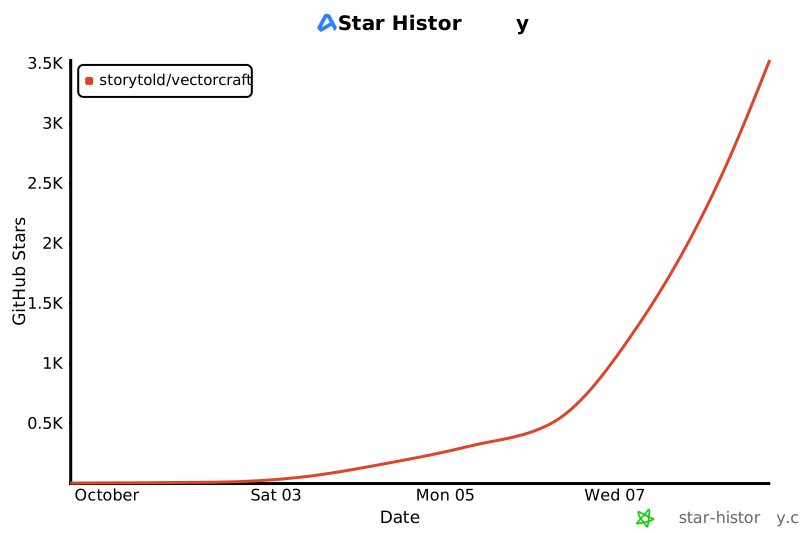](https://www.star-history.com/?repos=storytold%2Fvectorcraft&type=date&legend=top-left)
## License and credits
MIT OR Apache-2.0. Bundled fonts are OFL, Lucide icons are ISC, and all other icons and art are
original. Per-asset attribution is in [`ASSETS.md`](ASSETS.md) (see also [`NOTICE`](NOTICE)).
VectorCraft is dual-licensed under [MIT](LICENSE-MIT) or [Apache-2.0](LICENSE-APACHE), at your option.
Copyright (c) 2026 ArtCraft Team and the VectorCraft contributors. Required notices are in [NOTICE](NOTICE).
Bundled fonts, icons, images and other assets keep their own open licenses; each one is listed
with its author, source and license in [ASSETS.md](ASSETS.md). Release builds also embed the
fonts of [craft-fonts](https://github.com/storytold/craft-fonts/blob/main/ATTRIBUTION.md) (Japanese,
Simplified Chinese and Arabic faces; SIL Open Font License 1.1).
The app icon (an engraved dragon on VectorCraft red, `#e8573f`) is the owner's original artwork; its
palette and files are in [`assets/app-icon/`](assets/app-icon/README.md).
The ArtCraft name, wordmark and logos in [`docs/brand/`](docs/brand/) are trademarks of the
ArtCraft Team and are not covered by this license. They may be used only unmodified, and only as
part of this repository and VectorCraft, under [`docs/brand/LICENSE-brand.txt`](docs/brand/LICENSE-brand.txt).
Forks and modified versions must remove them.
<sub>Adobe, Photoshop, Illustrator, Premiere Pro, Lightroom, Acrobat, After Effects and InDesign are trademarks or registered trademarks of Adobe Inc. in the United States and/or other countries. VectorCraft is an independent, open-source project and is not affiliated with, sponsored by or endorsed by Adobe Inc.; these names are used only to describe the workflows it is compatible with.</sub>
@@ -4,7 +4,7 @@ VectorCraft is a clean-room, open-source, pure-Rust reimplementation of the Adob
This file tracks **how far we are and what's left**. Time estimates are wall-clock hours of continuous Claude Opus 5.5 agent work (including builds and the CI gate), given both for **one agent** and for **4–6 parallel agents** on disjoint crates. They are counted from the remaining work (see [Parity estimate](#parity-estimate)), calibrated against measured throughput, and updated as work lands.
_Last updated: 2026-10-02._
_Last updated: 2026-10-10 (after placed documents (File › Place of a `.vectorcraft` file, linked), M4.14–M4.98, M8.1–M8.20, M14.4–M14.7, the MCP prompts, resource templates, completions and logging, the 2026-10-07 issue fixes, the Layers panel rework and the 2026-10-08 community contributions: Pen and shape-tool modifiers, path editing, Layers, Artboards, Swatches/Brushes and dialogs, Japanese composition and PDF text, Hebrew/Arabic type, interface languages (Spanish among them), the font menu, saved selections, MCP and EPS, the missing-font export warning (#319), open paths in the Shape Builder (#374), PDF/`.ai` import keeping strokes live and hidden and nested layers (#372), per-corner Live Corners (#381), SVG type opening at the size it draws at (#396), the Wayland clipboard with copied-file paste (#398), ruler guides that can be selected, moved and deleted (#414), two batches of Preferences options that were stored but unused (#394), skeleton reads with `document.find` for large documents over MCP (#416) and anchors dragged with Direct Selection snapping to points, segments and smart guides, clipped SVG layers opening as clipping layers (#420), PDF/`.ai` layers read on pages of tens of millions of operators (#419), Document Color Mode putting RGB greys on the black plate on request and converting pattern tiles (#421) and movable dialogs with Offset Path's Joins dropdown (#423) and numeric fields scrubbed by dragging their label (#400), stroke weight presets in the stroke unit (#426), the Appearance panel's Opacity popup (#430), type on a path brackets, flip and Type on a Path Options that keep the type in place (#429), Layers rows dragged with a ghost and dropped on the trash or New Layer (#435), tool flyouts opening on a right or corner press (#436), tool flyouts torn off into floating toolbars (#437), the Shape Builder's erase mode deleting edges too (#439), installed fonts registered outside the font folders and fonts installed while the app runs listed in the font menus (#443), alike circular corners on rectangles that aren't square (#442), tool cursors as OS cursors so the pointer no longer trails over the canvas (#444), artboards copied and pasted with their art (#446), guides dragged out of the rulers snapping to the art's side midpoints and the artboards, artboard guides (#451), the toolbar's double arrow and Window › Toolbars › Double Column switching between one and two columns in any window height (#455), the Smart Guides display options and Snapping Tolerance (#394), Font Size and Leading combo boxes with preset lists in the Character and Properties panels and the Control bar (#458), screenshots pasted from the clipboard on macOS, Windows and the web (#457), the Properties panel's Fill and Stroke matching the Control bar's, Illustrator's Window menu panel keys (Shift+F7 for Align…) and Alt-wheel zoom whatever the wheel preference (Discord feedback), the point/area type widget (Discord feedback), groups in legacy Illustrator .ai files (Discord feedback), a rotating desktop log file (#465), image controls in the Control bar and Properties panel: Image Trace with its presets, Mask, Crop Image, Embed/Unembed, and an Image Trace object's preset, Expand and Release (Discord feedback), the Pen working as the Anchor Point tool with Alt held over a selected path's handles and anchors, and anchor buttons that convert, connect and cut paths at the selected anchors (Discord feedback), Japanese hanging punctuation (burasagari, #463), Escape leaving Presentation Mode with no screen mode saved across restarts, documents dropped on the desktop app opening as tabs of their own and a note that an `.ai` file's art off its artboards isn't in the part read (#472), Add/Delete Anchor Point tool icons drawn from the Pen tool's (#479), EPS import running more of PostScript Level 3 (patterns, Type 3 fonts, mesh shadings, masked images, VM and resource probes), and a preview that stands in saying why (Discord feedback, #466, #469, #474), chords with modifiers recorded in Edit › Keyboard Shortcuts (#487), Type Object Selection by Path Only (#394), Anti-aliased Artwork (#394), Show Pixel Grid (#394), pen and touch taps pressed and lifted within one frame clicking where they tapped and the Linux/Wayland pen-tablet workaround (#491), bounding-box resizes landing on the other objects' anchors and centres with labels, and the Rotate, Scale, Shear and Reflect tools snapping their drags (#482), Shift-drag marquees that toggle the objects or anchors they reach and a Lasso whose Alt subtraction keeps the rest of the selection (#483), the mouse wheel stepping the focused numeric field, the dialogs' and preferences' drag values made such fields (#485), Show The Home Screen When No Documents Are Open (#394), Numbers Without Units Are Points (#394), Auto-Collapse Iconic Panels (#394), the Contextual Task Bar moved by its handle and its More Options menu pinning and resetting its position, a designed macOS DMG windoLine truncated
| Feature surface vs full Illustrator (weighted, see below) | **~65%** |
| Parity including interaction fidelity and hardening ("a power user can't tell the difference, but faster") | **~50%** |
| Time to **feature parity** (every menu item, tool, panel, effect and dialog functional) | **~330–500 h** one agent · **~85–140 h** with 4–6 agents |
| Time to **full parity** (feature parity + interaction-fidelity pass + hardening) | **~440–670 h** one agent · **~115–190 h** with 4–6 agents |
| Feature surface vs full Illustrator (weighted, see below) | **~75%** on the rubric · **69–75%** honest range (self-graded, see [Honest assessment](#honest-assessment-2026-10-05)) |
| Parity including interaction fidelity and hardening ("a power user can't tell the difference, but faster") | **~40–55%** |
| Time to **feature parity** (every menu item, tool, panel, effect and dialog functional) | **~210–330 h** one agent · **~55–95 h** with 4–6 agents |
| Time to **full parity** (feature parity + interaction-fidelity pass + hardening) | **~320–500 h** one agent · **~80–145 h** with 4–6 agents |
### Shipped so far
## Honest assessment (2026-10-05)
**In one line:** about two-thirds to three-quarters of Illustrator's features exist and work, and for everyday
vector illustration (drawing, paths, paint and appearance, SVG/PDF/print) VectorCraft is close to usable. Measured
against "a power user can't tell the difference", it is closer to 40–55%. What stands between here and "anyone can
switch" is a handful of large subsystems plus a fidelity pass, not a long tail of small fixes.
**How much to trust the numbers:** area scores are graded by the agents that built the features, from behaviour docs
(`plan/illustrator/`) and tests, not by side-by-side use of Illustrator. Treat them as upper bounds. Look & feel is
the only dimension measured against the reference app. Performance budgets haven't been re-run on an idle machine
since 2026-10-01.
### By dimension
| Dimension | Estimate | Evidence and what's missing |
|---|---|---|
| **Breadth:** menus, tools and panels exist | ~90% | 13 menu items still stubbed; every tool implemented except Touch Type; 51 panel modules |
| **Depth:** each feature behaves like Illustrator | ~69–75% | Strong: paint, appearance and colour (M3), Pathfinder and booleans, selection, drawing, files (M4). Weak: advanced type (~45%; inline symbols in text are beyond parity and don't raise it), brushes and symbols (in progress), raster effects (~20%) |
| **Large missing subsystems** | 0–20% | 3D & Materials (0%), Photoshop-style raster effects and the Effect Gallery (~4 of ~56 filters), SVG Filters, CJK composition (vertical type with kinsoku, tate-chu-yoko and the font's vertical metrics; ruby, mojikumi and proportional vertical metrics open), Variables (data merge), scripting |
| **Interaction fidelity:** modifiers, cursors, small behaviours | ~30–40% | The dedicated pass hasn't started, and there has been no side-by-side session with Illustrator yet. A power user notices this first |
| **Look & feel** | ~75–80% | Measured against Illustrator 2026 screenshots (2026-10-02); the panels added since haven't been re-measured |
| **File interop** | ~85% | SVG/SVGZ, PDF and PDF-compatible `.ai`, EPS, DXF, EMF/WMF, raster formats, PSD export, Place and Links, Package, Print, clipboard flavours. Affinity documents (Affinity 1–3) open natively as editable art, checked against 51 pinned public files (33 current `.af`), with selected saved-thumbnail comparisons and every-board native/SVG/PDF/PSD checks for current files; Affinity export is missing and effects, adjustments and brushes don't import. Affinity isn't an Illustrator feature, so this doesn't raise the parity score. The editing copy inside an Illustrator EPS or `.ai` is read for its structure: layers, groups, names, hidden objects and type, colours, gradients, transparency, images and every artboard (see Out of scope for what it doesn't read yet); DWG has no open spec |
| **Bundled content:** brush, symbol, style and swatch libraries | ~30% | Ours are original and generated in code, and far fewer than Illustrator ships; brush and symbol libraries are still missing |
| **Performance** | unverified | Multithreaded, off-thread rendering and caches are in place. The last budget run (2026-10-01, loaded machine) measured 290 ms for a 50k-path fit against a 16 ms budget. Re-run `vectorcraft-cli perf` on an idle machine |
| **Robustness** | good, new | ~2,840 tests, property tests, no panics in shipped code (lints, the `guard` safety net, import fuzzing), Data Recovery. Missing: a corpus of real-world files, Windows/Linux/browser QA |
| **Platforms and 1.0 polish** | ~60% | The macOS app and the web build work, and Finder opens every readable format with the macOS app (#295, #354); on macOS the menus are in the system menu bar, laid out as a Mac app's, with the in-window menus as a fallback (`--in-window-menus`; verified on Windows and by cross-compilation, not yet by hand on a Mac); hybrid-graphics laptops render on the power-saving GPU by default on Windows and macOS (#306), and Windows renders through DX12 before Vulkan (#545: Vulkan flickered black on an Intel GPU, DX12 and OpenGL didn't; verified by unit tests and the reporter's runs with `WGPU_BACKEND`), and Linux on the GPU the desktop runs on, since a Wayland compositor may refuse frames from the other one; a window that fails on its GPU while starting up starts again on the next one instead of crashing (#502; the dual-GPU Wayland case is verified by unit tests and cross-compilation, not on such hardware); web drops land in the document they were dropped on (#359); desktop drops carry no pointer position (winit 0.30), so a dropped document opens as a tab of its own and a picture or text is placed in the middle of the view, while the web places anything dropped on the canvas and opens what is dropped off it, as Illustrator does (#472); a web page that loses its WebGPU device or WebGL context restarts its graphics with the same documents (#369); on Linux/Wayland the clipboard reads the compositor's own (data-control) and copied image files paste, but files can't be dropped on the window under Wayland until eframe moves to winit 0.31 (#398; the Wayland side is verified by compilation only); on Linux the Paste menu checks the system clipboard on a background thread, so a clipboard owner that never answers no longer freezes the window, while Windows and macOS keep their quick in-line check (#510; the X11 hang verified by the contributor, here by headless tests); on KDE Plasma 6.3+ under Wayland, pens and pen displays reach the app only under XWayland (`WAYLAND_DISPLAY=`) or with KWin's `KWIN_WAYLAND_EMULATE_TABLET=1`, since winit 0.30 has no Wayland tablet input (#491, not verified on hardware); Windows/Linux packaging and accessibility are pending; an experimental, unsupported Windows 7 x64 OpenGL build exists (community-contributed, not verified by maintainers) |
| **Agent automation** | beyond Illustrator | Every command, gesture and dialog is drivable over MCP, the CLI and the control channel |
| **Scrubby numeric fields** | beyond Illustrator | As in Photoshop, dragging a numeric field's label (`W:`, `Opacity:`, the Character panel's icons) left or right steps its value live; one undo step per drag, Escape cancels (#400) |
### Where we're lacking (in priority order)
Ordered by how much each gap blocks someone from switching. Sizes are one-agent hours from the parity table.
1.**Interaction fidelity:** go tool by tool and panel by panel against `plan/illustrator/05-tools.md`,
`06-panels.md` and `09-shortcuts.md`, covering modifier keys, cursors, the Properties panel per context and
isolation mode. The Shaper’s rough-square recognition and shape orientation steps are corrected; Shaper Groups now retain editable originals for region merges/punches and separate fill/stroke edits; their construction-mode widget and gesture refinements remain. 60–90 h.
2.**Photoshop-style raster effects and the Effect Gallery:** about 51 filters (Artistic, Brush Strokes, Distort,
Pixelate, Sketch, Stylize, Texture, Video) and the Effect Gallery. The pixel-filter pipeline is in place
(`vectorcraft_effects::pixel`: the object rendered offscreen, filtered in stack order with Gaussian Blur and
Feather, cached while panning, images in PDF/SVG/Expand Appearance) with Blur › Radial Blur and Smart Blur
(Normal mode only), Sharpen › Unsharp Mask and Stylize › Glowing Edges; each new filter is now one function, a catalogue row, menu and
translations. Parallelizes well across agents. 26–40 h.
3.**3D and Materials:** Extrude & Bevel, Revolve, Inflate and Rotate with lighting and materials, using a software
renderer in its own crate (layering allows it below L6), with output in SVG/PDF as rasters or projected vectors.
The largest single gap. 50–80 h.
4.**Advanced type:** CJK composition for vertical type (ruby, mojikumi, proportional vertical metrics, manual
tate-chu-yoko), Optical Margin Alignment, the hyphenation and justification options (the Every-line/Single-line
composer choice is done), tab leaders, a
spell-check dictionary (open licence), Touch Type and Snap to Glyph. Vertical point, area and path type have
initial support. 34–47 h across type core and advanced.
5.**Brushes, symbols and libraries:** brush options depth; original brush, symbol and graphic-style libraries
generated in code (never Adobe's); dynamic symbols; Start Global Edit; brushes driven by pen tilt, bearing and
barrel rotation (6D art pens, #372), which needs tablet input beyond pressure on every platform. 20–32 h.
6.**Automation:** Variables (data merge), a scripting surface over the command registry, batch. 8–12 h.
7.**Views and windows:** multiple windows and arrange, Consolidate All Windows, video
rulers. 15–25 h.
8.**Hardening at scale:** a corpus of real-world SVG/PDF/EPS files, Affinity files from more versions and platforms
(51 pinned files now include 28 original Affinity 3.2.3 feature probes; large interacting documents,
complex typography and independently paired `.af`/PSD renders reopened in Affinity remain missing), idle-machine perf budgets, Windows, Linux and
browser QA, pen tablets on Wayland and pen pressure beyond Windows (winit 0.31's tablet input, #491), accessibility, packaging. 50–80 h.
### Where we're going
- **Next:** start the interaction-fidelity pass (1) in parallel with the raster-effects package (2). Both are broad,
so they split well across agents, and they move the "can't tell the difference" number most.
- **Then:** 3D (3) and advanced type (4), each a focused milestone with its own plan in `plan/` before coding.
- **Alongside:** keep closing the stubbed menu items. Run `vectorcraft-cli perf` on an idle machine, and fix any
budget it misses before 1.0.
- **1.0:** feature parity plus the fidelity pass, hardening (8) and packaging for all three desktop OSes and the web.
**For agents:** pick work from the list above (or the milestone rows below), and write a task plan before coding.
When a task lands, update this section, the parity table and "Shipped so far" in the same PR. Keep the scores honest:
grade by behaviour against `plan/illustrator/`, not by whether a menu item exists.
## Shipped so far
- **Architecture:** 19+ crates with enforced layering (`cargo xtask layers`). Every action is a command (~400 engine + ~50 UI). Undo is unlimited via structural sharing. `command.batch` runs several commands as one transaction.
- **Automation:**
- Actions panel (record/playback, persisted), generic parameter dialogs for every "…" command.
- JSON-lines control channel with real egui pointer and keyboard injection.
- MCP server with 25 tools (drawing, text, effects, Pathfinder, transforms, graphs, text wrap, export, screenshots, any command), attached to the running app or headless.
- MCP server with 25 tools (drawing, text, effects, Pathfinder, transforms, graphs, text wrap, export, screenshots, any command), attached to the running app or headless. Tool descriptions and replies agree with the engine: format lists come from its format table, `save_file` says it keeps the document's own format, `inspect_document` reports the paint type's characters show, and selection exports report the encoder's warnings.
- MCP protocol: five prompts (`prompts/list` / `prompts/get`: poster, icon set, recolour, trace-and-style, export set), `completion/complete` for prompt arguments and template variables read from the live catalogues (formats, effect ids, command ids, trace presets, swatch and object ids), four resource templates (`vectorcraft://object/{id}`, `//command/{id}`, `//effect/{id}`, `//swatch/{name}`) so an agent reads one thing instead of the whole document, and `logging/setLevel` with `notifications/message`. `window.panel` ids are case-insensitive (display labels work too), `vectorcraft://object/{id}` reads through `document.node {summary: true}` (the same reply bytes from one lookup instead of summarizing the whole document: a leaf read on a 2,000-object document drops from ~20 ms to ~0.06 ms), large containers slice with `document.node {depth?, childLimit?}` (truncated levels report `childCount`), `document.inspect` and the `inspect_document` tool slice the same way so a depth-0 read is the layer skeleton (~9.7 KB instead of ~2 MB on a 2,000-object document), `document.find` locates nodes by name/kind/text with ancestor paths, and the CLI sweeps the protocol surface over stdio against the compiled binary. `docs/mcp.md` has a Protocol section covering the capability table and what is deliberately absent (subscriptions, progress, cancellation, sampling, elicitation, Streamable HTTP — all of which need the transport to interleave reads).
- Actions panel that records and plays back commands.
- **UI:** Illustrator 2026 layout restyled to measured values:
- Medium Dark theme, categorized and Advanced toolbars, 35 pt document tabs, 33 pt panel tabs.
- Medium Dark theme, categorized and Advanced toolbars (a tool group's flyout opens on a right press, a long press or a press on its corner triangle), 35 pt document tabs, 33 pt panel tabs.
- Hint bar, contextual task bar, 19 dock panels with ≡ menus.
-Native macOS menu bar, vector tool cursors, a ⌘K command palette, middle-button panning with any tool.
-The contextual task bar's handle drags it anywhere on the canvas (kept whole on it as the window resizes); unpinned it keeps that offset as it follows the selection, and its More Options menu hides it, pins its position across selection changes (`window.taskBar.pin`), resets it under the selection (`window.taskBar.reset`) and shows the Properties panel. As in Illustrator the position isn't kept across launches. Not done: the bar's tool-specific variants (only the selection tools show it).
- Tool flyouts tear off: dragging or clicking the tear-off bar on a flyout's right side (or releasing the long press over it) floats its group as a strip of tool buttons, moved by the same bar and put back in the toolbar by the × at its top (`window.floatTools`). While a group floats, the presses that would open its flyout raise the strip instead. Floating strips are kept with the preferences and in user workspaces. Not done: turning a strip vertical, docking it.
- Panels undock (#495): a dock tab, a panel icon or a popped-out panel's title dragged out of the dock floats that panel inside the window, and the strip right of the dock's tabs floats the whole tabbed group. A floating group moves by its title bar, a tab dragged out of it floats on its own, and dropped on another group's title bar or tabs it stacks with that group; dropped on the dock, which lights up under the pointer, its panels go back where they live (the tabbed group or the icon column), as its × and the panel menus' Float Panel / Dock Panel do (`window.panel.float`, `window.panel.dock`). The Tools panel floats by its title bar and docks again on the window's left edge. Floating panels and the Tools panel's position are kept with the preferences and in user workspaces, and clamped into a smaller window. Not done: panels in separate OS windows, docking a panel into a dock group it doesn't belong to, reordering tabs by dragging, collapsing a floating group to icons, resizing floating panels.
- The dock's double arrow collapses Properties, Layers and Libraries to icons at the top of the icon column, popping out like the other icon panels, and expands them again (`window.collapseDock`, kept with the preferences and in saved workspaces). The icon column's own arrow (expanding the icon panels into a full column) is not done.
- Localised UI: menus (in-window and native), panels, dialogs, toolbar and Preferences read from per-language catalogs (`crates/ui-egui/src/i18n`, see `docs/development.md`); Traditional Chinese (Taiwan), Simplified Chinese (mainland), Japanese, Spanish, French, Italian, Russian and Ukrainian ship complete, and Czech and Brazilian Portuguese cover every menu label (and more), with system-locale detection on macOS, Windows, Linux and the web (the browser's languages, or `?lang=`), a VectorCraft ▸ Language menu and a Language preference. Names are never translated (fonts and their styles, layers, artboards, saved presets, user libraries, custom workspaces, recent files, plug-ins).
- Native macOS menu bar, vector tool cursors, a ⌘K command palette, middle-button panning with any tool. Native menus explicitly end tracking on command selection, outside window presses and Escape; menu updates wait until tracking ends, and a dismissing press never starts a canvas gesture (M14.8).
- The macOS menu bar is built from the in-window menus (one model, `native_menu`) and laid out as a Mac app's: the VectorCraft menu holds About, Settings ▸ (each Preferences page, General… ⌘K), Language ▸, Appearance ▸ (UI brightness), Services, Hide VectorCraft ⌃⌘H (⌘H stays Hide Edges), Hide Others, Show All and Quit; Window gains Minimize ⌃⌘M, Zoom and Bring All to Front, and Help the system's search field. Its key equivalents go back to egui as key presses, so user shortcuts, focused text fields and the Type tool's input method behave as in the window, and nothing fires twice; enabled, check marks and labels update in place. `--in-window-menus` or `VECTORCRAFT_IN_WINDOW_MENUS=1` keeps the menus in the window; `ui.inspect` reports `nativeMenuBar`.
- macOS: Finder opens every format File › Open reads with VectorCraft (double-click, Open With, a drop on the Dock icon, `open -a`), at launch or while it runs; the release and `cargo xtask bundle` apps share one `Info.plist` that declares those document types, owning only VectorCraft's own formats. The DMG opens on a designed Finder window, VectorCraft.app beside the `Applications` link over a background with the app icon (#493).
- A canvas context menu: right-click selects the object under the pointer and lists what applies to the selection (Undo/Redo, clipboard, group, isolation, join, Remove Anchor Points when anchors are selected, masks, compound paths, guides, Transform, Arrange, Select, Export Selection), or the view commands on empty canvas.
- Save / Don't Save / Cancel before closing or quitting with unsaved documents (tabs, Close, Close All, Quit, window close).
- Four brightness themes, persistent preferences.
- Preferences that act (#394, in part): Show Tool Tips, Double Click To Isolate, Zoom with Mouse Wheel (the wheel zooms about the pointer, Shift-wheel scrolls up and down, Cmd/Ctrl-wheel sideways; Alt/Option-wheel and a trackpad pinch zoom about the pointer either way), Use Precise Cursors; Selection & Anchor Display › Tolerance (objects, anchors and handles), Object Selection by Path Only, Command Click to Select Objects Behind (cycling down the stack), Zoom to Selection, anchor Size, Highlight anchors on mouse over; Type › Number of Recent Fonts (up to 15); Guides & Grid › guide and grid Color and Style (lines or dots) and Grids In Back. Then Snap to Point (its distance, for moves, drawn points and reference points), Move Locked and Hidden Artwork with Artboard, Enable Rubber Band for the Pen and Curvature tools, Handles style, Show handles when multiple anchors are selected, Hide Corner Widget for angles greater than; General › Transform Pattern Tiles (the transforms' and dialogs' Transform Patterns) and Select Same Tint %; Type › Size/Leading, Tracking and Baseline Shift increments (`type.step`, Cmd+Shift+. and Cmd+Shift+, for the size, the Type tool's Alt+arrows), Enable Missing Glyph Protection and Fill New Type Objects With Placeholder Text. Then Smart Guides › Color, Alignment Guides, Anchor/Path Labels, Measurement Labels, Transform Tools, Object Highlighting (with Smart Guides on) and Snapping Tolerance (4 px by default, for every smart guide snap), then Construction Guides and their Angles (#506: a drawn point near a line at one of those angles through the point it leaves from lands on it). Then Type › Type Object Selection by Path Only (type is picked on the baseline of any of its lines, area type's frame or the path of type on a path, no longer anywhere in its bounds; the Type tools and the Eyedropper still take a click among the characters). Then General › Anti-aliased Artwork (off, the canvas draws the art with hard edges). Then Guides & Grid › Show Pixel Grid (Above 600% Zoom), a line at every document pixel over the art in Pixel Preview, turning with a rotated view as the document grid now does too. Then General › Show The Home Screen When No Documents Are Open (off, closing the last document leaves an empty window; the Home button still opens the screen). Then Units › Numbers Without Units Are Points (on by default: a number typed with no unit into a field in picas is read in points, a typed unit still wins; dimmed unless a unit is Picas). Then User Interface › Auto-Collapse Iconic Panels (off by default: on, a click away from a panel popped out of the icon column puts it away). Then Performance › Animated Zoom (on, with GPU Performance, which it needs and which dims it when off: the Zoom tool dragged sideways zooms about the press, right in and left out, and held still zooms on, Alt out; off, a drag zooms to the area dragged across, now drawn as a marquee), User Interface › Large Tabs (taller document tabs) and Scale Cursor Proportional to UI (off, the tool cursors keep their size whatever the UI Scaling), and File Handling › Display Bitmaps as Anti-aliased Images in Pixel Preview (off by default: Pixel Preview draws images with each pixel taking its nearest image pixel). Type › Auto Size New Area Type works too (new area type gets Auto Size). They reach agents too (`prefs.set`, then `pointer_gesture` or `press_key`; `ui.wheel` on the control channel). Then Smart Guides › Spacing Guides (moves space the selection evenly with its row or column, see Drawing aids). Then Hyphenation › Exceptions (comma-separated words that never break, or break only at their hyphens; `prefs.set` and restore push them into the hyphenator, #394). About 19 stored options still do nothing yet (the rest of #394: Show Font Names in English, Highlight Alternate Glyphs, Display Print Size at 100% Zoom, Identify Objects By, East Asian Type units, Open Documents As Tabs, Real-time Drawing and Editing, GPU Performance beyond Animated Zoom, hyphenation language, scratch disks, the legacy clipboard, Appearance of Black, Touch Workspace).
- Dialogs move by dragging their heading (the band down from the top edge, as a title bar), stay on screen and keep where they were moved for the session; the form dialogs' choices are dropdowns (Offset Path's Joins, Average's and Shear's and Reflect's axis), and Offset Path lists Offset, Joins, Miter Limit and previews (#423).
- Dialogs open with their first field focused and its value selected: type a value and press Enter (Move, Rotate, Scale…). Number fields in panels, the Control bar and dialogs (preferences too) step with Up/Down, or with the mouse wheel over the focused field (#485: a notch a step; the panel under it then stays put, and an unfocused field leaves the wheel to scrolling) (Shift: ten, Ctrl/Cmd: a tenth of their unit), applied at once.
- Scrubby labels (#400, beyond Illustrator, as in Photoshop): dragging a numeric field's label left or right (the ↔ cursor shows over it) steps the value one unit every 2 points (Shift: ten, Ctrl/Cmd: a tenth; counts stay whole), in the field's unit and within its limits, applied live as the art follows; the whole drag is one undo step and Escape puts the value back. A click on the label focuses the field; the text box itself never scrubs, and a field with no label doesn't. Text labels before a field (Transform, Properties, Control bar, Stroke, Transparency, form rows in dialogs) and the Character and Paragraph panels' icons act as labels. Preferences › General › Scrub Numeric Fields by Dragging (on by default) turns it off.
- The Control bar's underlined Transform link opens the Transform panel in a popover under it (reference point, X/Y/W/H, Rotate and Shear with their icons and angle presets, flips, shape properties, Scale Corners and Scale Strokes & Effects), as its Stroke link does the Stroke panel; X/Y/W/H also show inline while the bar has room. The reference point locator is nine squares, the outer eight joined around the box.
- Tab shows and hides the panels (in the Type tool it types a tab) without moving the keyboard focus onto a field, so the next shortcut or letter still works; in dialogs and panel fields it moves between fields.
- Cmd/Ctrl+A follows the keyboard: in a panel, dialog or search field it selects the field's text, while the Type tool edits it selects all of that text (also `select.all` over MCP), and only otherwise every object. On macOS the menu bar's Select All, Cut, Copy and Paste (keys or clicks) act on a focused field too, and elsewhere the in-window menus' do: the field that had the keyboard when the menu opened gets them, with its selection, and the keyboard back (#516). Not yet: Select All across threaded frames (one frame's text is selected).
- On Windows and Linux the app bar is the window's title bar (its own minimize, maximize and close buttons, drag to move, edges to resize), with the dragon app icon as the brand mark; dialogs and menus size to their content. As on a native menu bar, once one menu is open, moving the pointer onto another title opens that one.
- **Shapes:** all shape tools (including Flare) and the line, arc, spiral and grid tools.
- **Cutting:** Eraser, Scissors, Knife.
- **Transform:** Rotate, Reflect, Scale, Shear (click or Alt-click snaps the reference point to anchors and centres), Reshape, Free Transform (distort/perspective).
- **Live Corners:** drag a live rectangle's corner widgets (Selection or Direct Selection) to round all corners, with a radius readout.
- **Shaper:** uneven squares and rectangles become live rectangles even when drawing begins mid-edge. Recognition uses uniformly spaced samples and closed-loop corners, fits rectangle edges/angles rather than requiring a nearly perfect bounding-box fill, and includes the pointer-release position. Rectangles/squares and ellipses snap to 45° steps, hexagons to 90°, and triangles point up or down; lines keep their free angle even with Shift. Shaper Groups retain the live originals, merge regions with the gesture-origin fill, punch fills independently from strokes, remove boundaries on exiting scribbles and trim protruding stroke pieces. Source moves/resizes re-evaluate the result in the same undo step; double-click enters construction editing. Native save/reopen, face recoloring, Release and Expand are covered. The construction-mode widget and finer gesture heuristics remain.
- **Selection:** Selection, Direct/Group Selection, Magic Wand, Lasso. A Shift-drag marquee toggles what it reaches: objects with the Selection tool, anchors with Direct and Group Selection (#483); the Lasso adds with Shift and subtracts with Alt. Dragging a path segment with Direct Selection bends it when it's curved (its anchors stay) and moves its two anchors when it's straight, one undo step; the fill, Shift or Alt still pick the whole path (Alt-drag copies it).
Agent selection commands validate every object id before changing the selection and report the resulting count and ids (#784).
Clear deletes individual selected compound-path members without deleting their siblings, and explicit object ids work without a selection; Cut still removes the same objects it copies (#786).
- **Saved selections:** Select ▸ Save Selection… asks for a name and keeps the selection in the document (saved with the file, undoable, up to 25); each one is listed at the bottom of the Select menu and a click selects its objects again; Edit Selection… lists them to rename or delete, applied together on OK. A file's saved selections are capped and checked against its objects when it opens. Not yet: Update Selection and the Layers panel's saved-selection menu.
- **Drawing:** Pen, Curvature, anchor tools, Pencil, Paintbrush, Blob Brush, Smooth, Path Eraser, Join. Direction handles dragged with Direct Selection or the Anchor Point tool snap to smart guides, and Shift keeps them at 45° steps from their anchor. The Pen continues any open path from the end clicked, and while drawing, a click on an end of another open path joins the two into one (#776). Every point a drawing tool places snaps to Smart Guides through one snapper (#506): the Pen's and Curvature tool's anchors, the Pencil's ends, the shape tools' start and dragged corner or radius (Rectangle, Rounded Rectangle, Ellipse, Polygon, Star, Line Segment, Arc, Spiral, the grids), the Type tool's click and frame, a new artboard's corners.
- **Shapes:** all shape tools (including Flare) and the line, arc, spiral and grid tools. Space held while dragging out a shape, line, arc, spiral or grid moves it at its current size. While a grid is dragged out, Up/Down change its rows (concentric dividers) and Left/Right its columns (radial dividers). An ellipse's Pie Start and End Angle and Invert Pie (Transform and Properties panels' Ellipse Properties, `object.setLiveShape {pieStart, pieEnd, invertPie}`) cut it as a pie (#812; the on-canvas pie widget is still to come).
- **Cutting:** Eraser, Scissors, Knife, Mirror & Cut, Line Cut and Rectangle Cut (real geometry, compound paths keep their holes).
- **Transform:** Rotate, Reflect, Scale, Shear (click or Alt-click snaps the reference point to anchors and centres; Alt-click opens the tool's dialog, and a drag with Alt down at the release, from the press or pressed mid-drag, transforms a copy), Reshape, Free Transform (free and perspective distort and shear, switched by the keys held during a handle drag).
- **Live Corners:** drag a live rectangle's corner widgets (Selection or Direct Selection) to round all corners, with a radius readout; with Direct Selection, select corner anchors to show and round just those corners (#381). Each corner keeps its own radius and kind (Round, Inverted Round, Chamfer): Alt-click a widget to cycle the kind, double-click it for the Corners dialog, and the Properties and Transform radius fields set the selected corners (`object.setLiveShape {corners, radius, kind}`). Corners stay circular when the rectangle is scaled unevenly or along its own sides when rotated (the radius keeps its size, or scales by the mean scale with Scale Corners on); only a shear distorts them. On a rectangle that isn't square every corner is the same circle: a radius past half the shorter side stops there for all of them, the widgets sit on the corners as drawn and turn the edited corners red at that limit, CSS export writes the drawn radii, and rectangles saved stretched by older versions get circular corners when their corners are next set (#442). Live Corners work on any path's corners too, as on a rectangle's (#511): a star's, a live polygon's (which also shows them to the Selection tool, has a Corner Radius field in the Properties and Transform panels and keeps its radius as its sides change) and a pen path's, wherever two straight sides meet at an anchor. Direct Selection shows the widgets of every corner, or of the corners holding selected anchors; each corner is a circle tangent to both sides, drawn no larger than takes its cut halfway along its shorter side; a path keeps its uncut outline so its corners stay editable, and the same command, dialog, angle preference and View › Hide Corner Widget apply.
- **Pen:** Alt pressed in the middle of dragging out an anchor splits its handles and keeps the curve already shaped into it (only the outgoing handle follows the pointer); Space held while dragging out an anchor moves it, handles and all. A press on the first anchor of the path being drawn closes it whatever the drag then does: the drag shapes the closing curve (symmetric handles, Alt breaks them) and the release closes the path wherever it ends (#501). Clicking the last anchor of the path being drawn retracts its outgoing handle (convert cursor), and dragging from it pulls out a new one on its own. Auto Add/Delete: over a selected path, a click on a segment adds an anchor and a click on an anchor deletes it (add and delete cursors); Shift held, or Preferences › General › Disable Auto Add/Delete, starts a new path instead. Alt held over a handle end or an anchor of a selected path (the one being drawn too) works as the Anchor Point tool, with its convert cursor: dragging a handle moves it alone, clicking a smooth anchor makes it a corner, dragging an anchor pulls out new symmetric handles, dragging a segment reshapes it; drawing then goes on. Cmd (Ctrl) held drags with the selection tool chosen last, Direct Selection until one is (handles, anchors and segments of the path being drawn or another), and the Pen then goes on drawing its path while that stays selected; the pointer shows that tool's while Cmd is held. The same holds for agents (`pointer_gesture` with `mods.cmd`), as the borrowing now lives in the engine (#494).
- **Path editing (#494):** the handles shown are the handles that drag: Direct Selection drags those of a path selected as a whole (as the Pen leaves it), the Anchor Point tool and Pen+Alt no longer grab handles that Show handles when multiple anchors are selected hides, a handle shorter than the tolerance leaves its anchor to be picked, and the anchor tools pick within Selection & Anchor Display › Tolerance. A dragged segment keeps a smooth anchor at either end smooth. With Direct Selection, the Pen, the Curvature and the anchor tools, a path selected as a whole shows all its anchors selected, and the Control bar and the Properties panel offer Convert (corner, smooth) for them too; Remove and Cut wait for anchors direct-selected (#504). A handle drag gathers its snap targets once per drag (it took 21 ms per pointer move on a 20,000-path document, now 1 ms; `vectorcraft-cli perf` measures handle and segment drags on a 5,000-anchor path).
- **Graphs:** Column, Stacked Column, Bar, Stacked Bar, Line, Area, Scatter, Pie and Radar graph tools with Graph Data and Graph Type.
- **Drawing aids:** Smart Guides and snapping, and Draw Normal / Behind / Inside modes.
- **Other:** Eyedropper, Gradient annotator, Artboard (Alt-drag duplicates an artboard, and its art with Move/Copy Artwork with Artboard on; Copy, Cut and Paste take the artboard with its art, Paste right of the last artboard, Paste in Place where it was, into this or another document, #446; Object › Artboards › Rearrange All Artboards lays them out in a grid by row or by column, in one row or one column, left to right or right to left, from the menu, the Artboards panel or Properties' Rearrange All, #681; Scale Artwork with Artboard, in the Control bar and Properties beside Move Artwork with Artboard, resizes the artboard proportionally with the art fully inside it and its guides, strokes and corners per the Scale preferences, #602), Measure, Type, Hand, Zoom, Rotate View.
- **Editing type:** double-clicking type with a selection tool switches to the Type tool with the caret where it was clicked.
- **Temporary tools:** Cmd with any other tool drags with the selection tool used last (Selection, Direct Selection or Group Selection). Held Space pans and Cmd+Space zooms (Cmd+Alt+Space out) whatever the tool.
- **Panel drag and drop:** art dragged off the canvas onto the Symbols panel becomes a symbol, onto the Swatches panel a pattern swatch and onto the Brushes panel an Art brush; a symbol dragged onto the canvas places an instance where it is dropped, and a brush dragged onto a path is applied to it.
- **Tool double-clicks:** double-clicking a tool's button opens its options: Hand fits the artboard in the window, Zoom shows 100 %, Rotate, Scale, Reflect and Shear open their Object › Transform dialogs, the Selection, Direct Selection and Group Selection tools the Move dialog (Enter opens these seven tools' dialogs too), Gradient, Eyedropper, Blend and the Liquify tools their panels or options, and the Pencil, Paintbrush, Smooth, Blob Brush and Eraser tools their Tool Options (Fidelity, fill, the tolerances, the brush size).
- **Layers panel:** every layer, sublayer, group and object is a clickable row at any depth: a click highlights it and makes its layer current (new art goes there), Shift-click a range, Ctrl/Cmd-click toggles. Sublayers are no longer treated as objects: clicks, marquees, Select All and the Select menu take the art inside them, and each sublayer selects in its own colour. Selection squares on rows with selected art (click selects a row's art, Shift adds or removes; dragging the square moves the selection to another row, Alt copies), the eye and lock on every row with drag-down-the-column (one undo step), Ctrl/Cmd-click an eye for per-layer Outline, Alt-click an eye or lock to hide or lock the other layers (again: show or unlock them all), triangles with Alt to open or close everything inside, drag and drop rows above, below or into layers and groups with a drop line (Alt copies) and a dimmed copy of the row under the pointer (dropped on the trash rows are deleted, on New Layer duplicated, as in Illustrator), inline rename, Delete key on highlighted rows. Buttons and the full panel menu: New Layer/Sublayer (Alt: options, Ctrl: on top), Duplicate, Delete, Options for Selection, clipping mask, isolation, Locate Object, Merge Selected, Flatten Artwork, Collect in New Layer, Release to Layers (Sequence and Build), Reverse Order, Template, Hide/Outline/Lock Others and Show/Preview/Unlock All, Paste Remembers Layers, Panel Options (row size, thumbnails per kind, Show Layers Only). Layer Options: name, colour (presets, each with a chip of its colour, or custom), Template, Lock, Show, Print, Preview (outline drawing and clicking) and Dim Images to %. Every operation is a command (`layer.move`, `layer.highlight`, `layer.merge`…) with validation against cycles and invalid nesting. A document opens with only its top-level layers open; the rows left open are saved in the native file (nothing is written for the default) and reopen that way. Only the rows scrolled into view are laid out, from a row list made once per change: a layer of 5,000 groups of 10 paths, all open, draws the panel in 0.4 ms a frame instead of about 29 s (#638).
- **Drawing aids:** Smart Guides and snapping (moving, with the Selection, Group Selection or Direct Selection tool, and resizing by the bounding-box handles with the Selection or Free Transform tool, Shift and Alt too: the dragged corner or side lands on the other objects' anchors and centres ("anchor", "center") or lines up with their edges and centres (a line and "align"); with Smart Guides › Spacing Guides, a moved selection that lines up with nothing along an axis lands as far from its neighbour as two other objects of its row or column are apart, or halfway between its two neighbours, the equal gaps marked; with View › Snap to Grid on, a moved selection lands on the grid instead, by whichever of its edges or its centre is nearest a gridline on each axis, #740; the Rotate, Scale, Shear and Reflect tools drag from the anchor they grab and snap the pointer the same way, so a corner dragged onto another object's anchor scales exactly onto it, #482; anchors dragged with Direct Selection: the one pressed on lands on other anchors, its own path's that stay put among them, on path segments or in line with them, the others following, Shift keeps 45° steps, and with Smart Guides off Snap to Point pulls it onto anchors; the Artboard tool snaps artboards, and their bleed, to other artboards, bleeds and art, the grid or whole pixels while moving, copying and resizing them, and the Transform panel shows and edits the active artboard's X/Y/W/H; drawn points, #506: hovering shows where the press goes, the point lands on the other objects' anchors, centres and paths ("anchor", "center", "path") or lines up with their anchors, edges and centres ("align"), the Pen's on the path being drawn too, near a construction guide through the anchor before it on that guide (Preferences › Smart Guides › Construction Guides and Angles), and with Shift kept to its 45° step or a square's diagonal it slides along that way into line; the targets are gathered once per document state, from the art in the window, and the anchors, centres and lines near the pointer are found by bisection, so hovering never rescans the document), guides dragged out of the rulers (#451: they snap as moved guides do, Shift to the ruler's ticks; with the Artboard tool they are artboard guides, which run across their artboard only and move, copy and delete with it, `guide.add {artboard}`) that the Selection, Direct Selection and Group Selection tools then pick and drag (#414: the selected guides highlight and move together, Alt copies them, Shift snaps the dragged one to the ticks, otherwise it snaps to pixels, the grid or the edges, centres (so the sides' midpoints) and anchors of the art and the artboards, or with Smart Guides off Snap to Point pulls it onto anchors; the arrow keys nudge them, Delete deletes them, dragging one back onto its ruler deletes it, Lock Guides and Hide Guides leave them alone; `guide.list`, `guide.select`, `guide.move` and `guide.remove` reach agents), a right-click on either ruler or the origin box to pick the document's units (the current one checked; `document.setUnits`, one undo step, #528), and Draw Normal / Behind / Inside modes.
- **Views:** the status bar's artboard navigator (first, previous, next, last; `view.goToArtboard`) goes to an artboard and fits it, and Fit Artboard in Window and Actual Size show the navigator's artboard. The Artboards panel highlights that active artboard: clicking a row makes it active (the Artboard tool's too, while it is chosen) as does clicking an artboard with the Artboard tool, double-clicking its number also fits it in the window and double-clicking its name renames it. Duplicate Artboards, or a row dragged onto New Artboard, copies the artboard with its art (#446). Escape leaves Presentation Mode, F from it goes back to Normal Screen Mode, and the screen mode isn't saved with the preferences: the app always starts in Normal Screen Mode with its menus and panels (#472). View › Pixel Preview shows the art as the document pixels it rasterizes to, one per point and hard-edged when magnified, turning with a rotated view (it used to draw the smooth vectors, with only the pixel grid over them).
- Live effects with previewing dialogs: Distort & Transform, Path, Convert to Shape, 15 Warp styles, Round Corners, Scribble, Effect → Pathfinder (all 10 operations, live on groups), and raster drop shadow, glows and feather. SVG and PDF export keep live effects (geometry baked; SVG raster effects as filters).
- **Type:** Text Wrap, Type on a Path effects (Rainbow/Skew/3D Ribbon/Stair Step/Gravity), Character and Paragraph Styles (override-preserving redefine), Area Type Options (rows/columns/inset/first baseline), threaded text across any closed shapes, Fit Headline.
- Pathfinder (10 exact curve booleans), Offset, Outline Stroke, Simplify, Clean Up, Split Into Grid, Divide Objects Below. Object › Path › Remove Anchor Points (`path.removeAnchors`) removes the direct-selected anchors without opening their paths (the Delete key still deletes them with their segments): the neighbours keep their handle directions and their facing handles are refitted so one cubic follows the two old segments, and straight sides stay straight. The Delete Anchor Point tool uses the same refit. The Control bar, the contextual task bar, the Properties quick actions and the canvas context menu offer it when anchors are selected. With anchors selected, the Control bar and the Properties panel also convert them to corner or smooth (`path.convertAnchors`), connect end points (Join) and cut the path at them (`path.cutAtAnchors`, also on the task bar and the context menu): a closed path opens there and an open one becomes one path per piece, each cut leaving one of its two coincident anchors selected so a drag pulls the path apart.
- Live effects with previewing dialogs: Distort & Transform, Path, Convert to Shape, 15 Warp styles, Round Corners, Scribble, Effect → Pathfinder (all 10 operations, live on groups; several loose objects are grouped first, in one undo step), Color Adjustments (Brightness/Contrast, Curves, Levels, Hue/Saturation, Shift to Color, Temperature/Tint, on vectors, live type and embedded images), and raster drop shadow, glows and feather. SVG and PDF export keep live effects (geometry baked; SVG raster effects as filters).
- **Type:** Text Wrap, Type on a Path effects (Rainbow/Skew/3D Ribbon/Stair Step/Gravity) and Options (Flip, Align to Path, Spacing; OK keeps the type where it is), type on a path's start, centre and end brackets (Selection and Direct Selection drag them to set where the type runs, slide it along its path and, across the path, flip it: #429), Character and Paragraph Styles (override-preserving redefine), paragraph attributes per paragraph (alignment, indents, spacing, hyphenation, hanging punctuation, tab stops, paragraph style, direction, mojikumi and leading model; the Paragraph, Tabs and Paragraph Styles panels act on the paragraphs the Type tool's selection or caret touches, Return continues the paragraph's style, threads and SVG keep them), Area Type Options (rows/columns/inset/first baseline, vertical Align Top/Center/Bottom/Justify per row/column, reflowing non-rectangular frames and text wrap), threaded text across any closed shapes, Fit Headline, the Every-line Composer for justified and ragged text (paragraph-wide breaks for an even rag, Single-line per object from the Paragraph panel menu or `text.setFormat {composer}`). Area type resizes like Illustrator's type areas: a bounding-box handle drag (Selection tool) or Area Type Options Width/Height size the frame and the text reflows at its size (threads too); Direct Selection drags a frame corner or edge (`text.reshapeArea`). Point type still scales. Auto Size: the frame height follows the text after every edit, in the same undo step (rectangular frames of horizontal type in one row; columns get the least height that holds them; a height set by hand or threading turns it off), and the "Auto Size New Area Type" preference gives it to new area type. Shrink Text to Fit (beyond Illustrator): overflowing area type scales its sizes, leading and baseline shifts down by the largest factor (in 0.1 pt steps of the first run, down to a minimum percentage) that fits, at layout time so every export sees it. `text.areaOptions` and `document.inspect` report overflow and the shrink factor. The Selection tool shows the type widget beside selected type's bounding box (hollow on point type, filled on area type); double-clicking it converts between them (Type › Convert To Area Type / Convert To Point Type), keeping the text and its styles in place. Variable fonts list every named instance as a style of their family (Figtree Light to Black and their italics, Bahnschrift, Segoe UI Variable), and the instance chosen is shaped, drawn, outlined and measured at its axis settings; PDF and SVG embed it as that instance. Variation axis sliders are not done. Beyond Illustrator: inline graphics (`text.insertInline`, Type ▸ Insert Inline Symbol) set a document symbol in a run of type as one character that flows, wraps and justifies like a glyph (InDesign-style inline objects, e.g. mana symbols in card rules text): sized to a multiple of the font size, centred on the cap height, opening up tall lines, following Redefine Symbol; a character of its run's size for Character Alignment and Top-to-Top leading, placed by the bidi reordering in right-to-left text (a neutral U+FFFC); drawn on the canvas, kept as live text plus a `<use>` in SVG and as vector art in PDF; Backspace removes it whole. Hebrew and Arabic are laid out right to left with the Unicode bidirectional algorithm (embedded Latin and numbers keep their direction, lines put in visual order after wrapping) in point, area and path type, with caret, selection and arrow keys in visual order; each paragraph's direction comes from its first strong character unless Paragraph Direction sets it (Paragraph panel with Show Indic Options, `text.setFormat {direction}`), and new type aligns to the start of its direction. SVG export outlines right-to-left text. Arabic typefaces: builds made with a craft-fonts checkout that holds its Arabic families (Noto Sans Arabic, the Arabic fallback, plus Cairo, Tajawal, Almarai, IBM Plex Sans Arabic, Noto Kufi Arabic, Amiri, Alexandria, Fustat, Reem Kufi, Aref Ruqaa and Gulzar once craft-fonts adds them, storytold/craft-fonts#11; releases get them when their craft-fonts pin moves) list them in the font menus on desktop; the web build fetches them from beside the wasm (Noto Sans Arabic before start, so Arabic never shows as boxes, the rest in the background). Font Size and Leading are combo boxes in the Character and Properties panels (Font Size in the Control bar too, beside the Character link, font family and style): type, step with ↑/↓ or the spinner, scrub the label, or pick a preset (6–72 pt, shown in the type unit; Leading also Auto), each pick one undo step; Kerning and Tracking list -100…200; a size, leading, kerning or tracking the selected text doesn't share shows blank (#458). Type › Bold and Italic (beyond Illustrator, as page layout apps have them; Cmd+Shift+B / Cmd+Shift+I while the Type tool edits text) switch the selected type to its family's own Bold or Italic face and Line truncated
- **Interface languages, vertical type:** VectorCraft ▸ Language (or Preferences ▸ User Interface) picks Automatic (the system locale) or a registered language, persisted as `interfaceLanguage`. Translations come from per-language catalogs (`i18n/*.tsv`): Traditional and Simplified Chinese, Japanese, Spanish (neutral international Spanish, for every `es-*` locale), French (every `fr-*` locale), Italian (every `it-*` locale) Russian (every `ru-*` locale) and Ukrainian (every `uk-*` locale) cover the whole interface, Czech and Brazilian Portuguese every menu label, Brazilian Portuguese the shell's `tl!` literals too (tested); Spanish, French, Italian, Japanese, Russian and Ukrainian also translate status-bar and error messages as they are shown (`@msg` templates, every message literal tested; the messages themselves stay English for agents); untranslated text stays English. Japanese and Chinese glyphs come from the craft-fonts build input (release builds) or the installed fonts, Czech, Spanish, French, Italian, Russian and Ukrainian ones from the bundled UI fonts. The web app follows the browser's languages (or `?lang=`). The Basic toolbar's Type button holds Vertical Type in its flyout. Vertical Type, Vertical Area Type and Vertical Type on a Path create vertical text (columns right to left, upright CJK glyphs and marks with `vert` alternates, Latin and longer numbers on their side, two- and three-digit numbers set as tate-chu-yoko in one em of the column (kept whole when justified), upright glyphs centred on the column (tracked or justified too), point type's anchor on the first column's centre line); kinsoku applies to horizontal and vertical Japanese (Paragraph panel › Kinsoku Set, `text.setFormat {kinsoku}`: Hard, the default, keeps closing marks, iteration marks, the prolonged sound mark and small kana off the line start and opening brackets off its end; Soft lets 々, ー and small kana start a line as JLREQ's level 3 rules do; None turns it off), and justified Japanese lines spread their room between characters (not inside Latin words); Paragraph panel › Mojikumi Set (shown with Preferences › Type › Show East Asian Options, `text.setFormat {mojikumi}`): None or Line-end Punctuation Half Width (new type's default, as in Illustrator; older documents and imported text keep None) shares one half-em space between consecutive punctuation, sets a closing mark ending a line half width and an opening bracket starting a line flush with its start (a paragraph's first line at its first-line indent, JIS X 4051's principle in JLREQ 3.1.5), and puts a quarter em between Japanese and Latin letters or digits; Paragraph panel menu › Top-to-Top / Bottom-to-Bottom Leading measures leading from em box top to top (area type's first line touches the frame) or from baseline to baseline (new type in a Japanese interface starts top to top, with em box centre character alignment, #432); Paragraph panel menu › Burasagari None / Regular / Force (`text.setFormat {burasagari: "none"|"standard"|"forced"}`) hangs an East Asian comma or full stop (、。,.、。) ending an area type line outside it, Regular (new type's default) when it doesn't fit and Force always (the rest of the line then fills the measure; closing brackets and Latin punctuation don't hang); Character panel menu › Character Alignment (with the East Asian options; `text.setFormat` or `text.setRangeStyle {charAlign}`) lines characters smaller than the largest on their line up on the Roman baseline, the em box top/right, centre or bottom/left, or the ICF (ideographic character face) top/right or bottom/left, from the font's BASE table or, without one, the average ink box of some ideographs and kana; Type ▸ Type Orientation switches existing text; caret, selection, hit testing and arrow keys follow the writing direction. Vertical text exports to PDF as real text and to SVG as outlines.
- **Transparency:** opacity masks (clip/invert/disable/link), exported as SVG `<mask>` and PDF soft masks.
- **Advanced art:** live Blends (steps/distance/smooth colour, spine), Envelope Distort (warp/mesh/top object), Gradient Mesh, Shape Builder, Live Paint, Image Trace (12 presets), pattern swatches with pattern editing mode, live Repeat (radial/grid/mirror).
- **Image Trace Flat Logo mode:** a fourth mode beside Black and White, Grayscale and Color, for flat-colour logos. Each pixel is read as a blend of the logo's colours (found automatically or named), the blend is interpolated smoothly and every outline is placed where two colours are equally present, so edges are accurate to a fraction of a pixel. Outlines are then cleaned: corners the blur rounded are put back, near-straight runs and near-circular arcs become exact lines and arcs, the rest is fitted with as few Béziers as the tolerance allows, touching colours overlap by a hair so no gap opens, and an outline that strays from the raw contour is fitted plainly instead. Gradients and photos are refused with advice to use Color. *Measured* (a local experiment, not run in CI): a flat-colour logo's vector original was rendered down to a soft 199 × 100 px transparent PNG, traced, and the result compared with the original at 1600 px wide. The built-in colour presets (6 Colors, 16 Colors, High Fidelity Photo, Low Fidelity Photo) had a mean edge error of 2.5 to 3.4 px and region overlap of 0.88 to 0.91; Flat Logo had 0.78 px and 0.966 (0.48 px and 0.975 from a crisp source), in about 0.1 s. Limits: flat-colour art only; needle-thin sharp tips are shortened by about 1.7 source pixels because the blur erases them; it works at no more than 1024 px on the long side (larger images are averaged down first); only one logo family has been scored against a vector original.
- **Advanced art:** live Blends (steps/distance/smooth colour, editable spine, anchor-targeted Blend tool, faithful interpolation, knockout), Envelope Distort (warp/mesh/top object, Reset, full Envelope Options, mesh handles, Edit Contents; type, images, symbols, gradients, patterns and appearance distorted everywhere), Liquify tools with options and pen pressure, Puppet Warp with rotating pins, Perspective Grid with presets, movable planes and projected type (choosing a perspective tool shows the grid; Hide Grid hides it with the tool still chosen), Gradient Mesh, Shape Builder (stroke-only open paths and lines cut the regions they cross and enclose regions of their own; filled open paths count as closed; erase mode while Alt/Option is held: a minus pointer, red highlights of what will go, a click or drag deletes the regions touched, the pieces of open lines and the edges (outline pieces between the points where paths meet, opening their paths there) it passes over, one undo step, `shapeBuilder.merge {erase}` and `shapeBuilder.regions` edges over MCP), Live Paint (every path an edge, open lines included), Image Trace (12 presets, colour layers traced in parallel; a trace past two million anchor points or an image over 64 megapixels is refused with advice rather than running out of memory, and a selection too large to outline shows its bounds (#525); Object › Image Trace › Make and Make and Expand trace at once with the Default preset, #543; with an image selected the Control bar and the Properties panel show Image Trace, whose arrow traces with any preset, Mask (`object.maskImage`: a clipping path on the image's outline, selected so its handles crop), Crop Image (a crop box on the image, starting on its part over the artboard, dragged by its handles or inside it, the outside dimmed, with X/Y/W/H, Apply and Cancel in the Control bar, Enter and Escape, #734; `object.cropImage {rect}` for agents, `{trim: true}` cuts an image to its pixels that aren't fully transparent, pixel for pixel) and Embed or Unembed in place of Fill and Stroke; with an Image Trace object selected, its Preset (choosing another traces again), View, the Image Trace panel and Expand, plus Release in Properties; the five View modes (Tracing Result, with Outlines, Outlines, Outlines with Source Image, Source Image) redraw a trace on screen without tracing again, are saved with it and `imageTrace.setView` sets them, while exports and Expand keep the result; the panel's Advanced section is a header that stays open or closed as it was left (part of #641); Color mode's Palette: Limited, Full Tone (as many colours as the tones need, Less … More), Automatic (flat art with its own colours, else Full Tone; a heuristic) and Document Library (the most used colours of the document's swatches or a swatch library, filled with the swatch colours as they are), part of #641; Advanced › Create: Fills and/or Strokes, where lines up to the Stroke width trace as stroked centre lines (distance transform, thinning, a skeleton graph with spurs pruned, curve fitting; one width per line; without Fills, wider areas become stroked outlines), part of #641), pattern swatches with pattern editing mode, live Repeat (radial/grid/mirror).
- **Paint and appearance (M3):**
- **Swatches:** names follow the colour model and are unique; Swatch Options (process/spot, Global, Gray/RGB/HSB/CMYK/Web, live preview); editing a global or spot swatch recolours every linked fill, stroke and text run in one undo step; multi-select and delete with confirmation; New Swatch and New Color Group dialogs (a group from the selected artwork's colours); swatches in colour groups convert, separate and count like any other. The Swatches panel selects ranges and whole groups, has a find field, and drags swatches to reorder, regroup or paint art; Add Used Colors, Select All Unused, Merge, Ungroup and Sort by Kind; a CMYK document keeps applied colours in CMYK. Swatch libraries: nine generated colour libraries and five gradient libraries in a library panel, saved as `.vcswatches`, `.gpl`, swatch exchange (`.ase`) or CSS, and loaded from `.vcswatches`, `.gpl` and `.ase` files (`.ase` both ways: RGB, CMYK, Lab and Gray; global, spot and process; groups); `swatch.library.copyToUser` copies a loaded library into the User Defined folder without replacing a file, and a file with the same extension and bytes as a User Defined library opens as that library. Tints of global and spot colours ("Name 40%") stay linked and separate as a percentage of their plate. Spot colours can be defined in Lab (Spot Colors options). A built-in [Registration] swatch prints on every plate.
- **Colour:** a Color Picker (colour field, H/S/B/R/G/B channel slider, HSB/RGB/Lab/CMYK fields, hex, web-only snapping, out-of-gamut correction); the Color panel follows each colour's own model and Alt-click paints the other proxy; proxies look through groups and show "?" for mixed paint; Invert, Complement, Apply Last Color (`,`) and Apply Last Gradient (`.`) keep the colour model; every paint command feeds the recent colours. The Color Guide has 21 harmony rules, Steps and Variation options and Limit to Library. Adjust Color Balance (its Global mode shifts tints) and Saturate preview live; Edit Colors and Recolor also reach meshes, images and patterns. Recolor Artwork has colour reduction, five recolour methods, presets, Limit to Library, a colour-wheel Edit tab and Edit Color Group; a local Color Themes panel saves five-colour themes. Fill/Stroke chips open swatch and mixer popovers (the Properties panel has the Control bar's Fill and Stroke chips, Stroke link and weight spinner, with nothing selected too), panels have Illustrator's Window menu keys (Align Shift+F7, Transform Shift+F8, Pathfinder Cmd+Shift+F9, Layers F7, Character Cmd+T…; every panel can be given one in Edit › Keyboard Shortcuts), and Eyedropper Options pick up and apply chosen attributes (Alt and Shift+Alt, image pixels). An ICC CMYK profile converts straight into the RGB working space (not through sRGB, so a wider space such as Wide Gamut RGB keeps colours sRGB can't hold) with the colour settings' black-point compensation, on the canvas and in RGB exports alike. Fills and strokes can overprint (Attributes panel, Overprint Black options), and CMYK documents blend in inks on screen, in PDF and when flattening. Document Color Mode converts the art, symbols, pattern tiles and swatches through the colour settings: Gray stays Gray, RGB greys separate into four-colour greys and a rich black as Illustrator does, or go on the black plate only with `grays: "black"` (also for `document.open {colorMode}`).
- **Gradients:** lossless, validated gradient params; gradients follow rotate, reflect, shear, non-uniform scale and distortions; the Gradient tool edits the fill or stroke of the active proxy, type included; an interactive on-canvas annotator (move, length/angle, rotate, add/move/delete/duplicate stops, midpoints, a stop popover, Delete and arrow keys). The Gradient panel has the Fill/Stroke proxy, a gradient-swatch dropdown with Save to Swatches, midpoint locations, Alt-drag to copy or swap stops, swatch drops on the ramp and a stop eyedropper; copied appearances and graphic styles place gradients on each target's own bounds; gradient handles snap and honour Constrain Angle. Gradient stops stay linked to global and spot swatches. Freeform gradients (points and lines) are edited on the canvas; radial gradients have an extent ellipse, an aspect handle and an off-centre focal point (SVG `fx`/`fy`, PDF two-point radials). A stroke's gradient runs within, along or across it. Object ▸ Expand turns gradients into N objects or a gradient mesh.
- **Strokes:** one stroke-geometry module shared by the canvas, SVG, PDF and Outline Stroke; dotted lines (zero-length dashes draw dots or squares); arrowheads with hollow outlines, tip-on-end or extend-past-end alignment and one opacity for line and head. SVG and PDF export arrowheads, width profiles, brushes and aligned strokes exactly as the canvas draws them; Outline Stroke and the live Outline Stroke effect outline every stroke item as drawn (dashes, heads, profiles, alignment); dashes can be fitted to corners and path ends; width profiles carry through dashes, and their corners take the join. The Stroke panel edits type's character strokes, follows the stroke units (its weight presets are round values in that unit: `0.25 mm`, `0.0625 in`, `1 px`, #426; fields show four decimals in mm, cm and inches, three in points), shows mixed values blank and opens from the Control bar. A width profile library, thirty more arrowheads, and Width Point Edit with multi-select and discontinuous points. Visual bounds and clicks cover the whole painted stroke. Scale Strokes & Effects, Scale Corners and Use Preview Bounds work everywhere, and new art inherits stroke options, a graphic style or the whole last appearance.
- **Appearance:** the Appearance panel's selected row drives every paint, stroke, gradient and transparency edit (`item` on the commands); effects apply to one fill or stroke; per-item Opacity popups, whose blend-mode list and opacity slider stay open inside them (#430; the Control bar's Stroke popover too); Mixed Appearances, Layers target dots and basic-appearance rules. Effects can be reordered, moved between items and copied by dragging; Show All Hidden Attributes; clicking an effect edits it in place; the object thumbnail drags onto art; effects render on type, images, symbols, blends, envelopes, meshes and repeats, and per-item raster effects export. Groups, layers and type have their own fills, strokes and effects (Contents and Characters rows); the Layers panel's target circles target layers, groups and objects; Expand Appearance turns fills, strokes, effects and brushes into objects.
- **Masks and clipping:** opacity-mask controls work while the mask is being edited; transparency commands take ids and work without a selection; clipping sets clip by compound paths, even-odd paths, text and groups on screen and in raster export, matching SVG/PDF. Alt-click shows only the mask; SVG masks keep Clip and Invert; the transparency grid is per-document state; a clipping path's own fill and stroke paint behind and over the clipped art; layers can be clipping masks.
- **Transparency:** three-state Knockout Group (on, neutral, off), Opacity & Mask Define Knockout Shape, Page Isolated Blending and Page Knockout Group, on screen and in SVG/PDF. Blend modes match the standard formulas on screen, in SVG and in PDF, and non-isolated groups blend with the art below. Flatten Transparency with presets, a dialog and a Flattener Preview panel.
- **Graphic styles:** styles keep opacity and blend mode, capture groups and type, apply on top with Alt, and link to the objects using them; Redefine, Break Link, Graphic Style Options, Select All Unused, Sort by Name, and Select > Same Graphic Style / Appearance Attribute. The panel has list and thumbnail views with rendered previews, merge, reorder and drag and drop, plus a Control bar Style picker; six generated style libraries save and load as `.vcstyles`.
- **Neutral wording:** labels, MCP tool text, docs and packaging use neutral names, and `cargo xtask brands` (part of `cargo xtask ci`) fails on vendor names.
- **Colour, type and file workflows:** Recolor Artwork (dialog with harmonies), Edit Colors, Find & Replace, Change Case, Smart Punctuation, Guides, Lock/Hide Above, Transform Each, Rasterize.
- **Formats:**
-`.vectorcraft` (lossless JSON), SVG import/export, PDF export/import (including PDF-compatible `.ai`).
-PNG, JPEG and WebP export, Export for Screens, Place.
- **Fonts:** a font is found by any of its names (family and style in every language of its name table, legacy family/style pairs, PostScript name), so documents from other apps open with the font they name; Find Font and `text.fonts` say for each font whether it was found exactly, by another name, substituted or missing, and how many glyphs are missing. PDF and `.ai` import brings Japanese text back as live type: CID fonts without a ToUnicode map read through the standard CMaps, vertical columns (WMode 1) as vertical type, letter spacing as tracking; a glyph is live type only when the installed font (in the closest style of its family) draws the same glyph, and text in a font that isn't installed comes in as live type shown in the fallback font until the font is installed (exports that draw it — PDF, EPS, EMF/WMF, raster, SVG outlines or embedded fonts — warn that they wrote the fallback font; `textAs: outlines` keeps the PDF's embedded glyphs). Two installed versions of one family and style (a font library keeping an old file beside a new one) both load, the first staying the one the family and style resolve to; PDF and `.ai` import tries each version when the glyphs differ, and type set in a version other than that one names it (`CharStyle::font_version`), which layout, the substituted-glyph highlight, Find Font, Package and Document Info follow. Fonts outside the font folders are listed too: those font services such as Adobe Fonts load on Windows, through DirectWrite, and those apps and font managers register with CoreText on macOS (#579). When a document opens with fonts that aren't available, fonts used only in symbols included, a Missing Fonts dialog lists them after the linked-file questions, with Find Fonts (Type › Find Font on them) and Close. Its Find in Folder… (in Find Font too) searches a folder on several threads, reads only what the font scan reads of font files and skips app packages, the Program Files and ProgramData folders, the system's folders and the app data folders in a home folder; Add Fonts copies the font files the user chooses, suitcase fonts with their resource fork, into VectorCraft's own Fonts folder, which the desktop app and `vectorcraft-cli` read (`text.missingFonts`, `text.findFontFiles`, `text.addFontFiles`).
- **Files (M4):**
-`.vectorcraft` (lossless JSON, compressed, atomic saves, save down to v1), Save As with a format chooser, Save a Copy, Revert, templates, Data Recovery after a crash (browser tabs hold their copies with Web Locks too, so a background tab's copies are never taken for a crash's, and a tab repairs copies another removed when it resumes: #367), background save and export. The desktop app writes its warnings and errors (graphics adapter, a lost graphics device, panics the guard recovered from) to standard error and to `logs/vectorcraft.log` next to the preferences, the two previous runs kept and each file capped at 16 MiB, so a launch without a terminal still leaves something to attach to a bug report (#465).
- SVG/SVGZ in and out with SVG Options, Preserve Editing, symbols, filters, rich text and physical units (SVG type under a transform or `viewBox` scale opens at the size it draws at, the scale moved into its size, leading, baseline shift and strokes, a stretch, skew or rotation kept as its transform: #396; a top-level group with a clip path, such as a clipped Inkscape layer, opens as a layer with a clipping mask, its name kept: #420; hidden objects written hidden on Save and `convert`, and `data-*` attributes kept as the objects' own data: #522; top-level groups open as layers named from `data-name`, else the id, also when one more group (a transform on all the art, a `<switch>`) wraps them, hidden ones hidden, and a file whose art sits loose under a root `<svg>` with an id (or `data-name`), as one-layer exports write it, opens with its one layer named from it; nested groups stay groups, except the sublayers VectorCraft writes, marked `data-vc-layer`, and Inkscape sublayers, which open as sublayers in their layer's colour: #372); PDF and PDF-compatible `.ai` in and out (layers, with hidden ones kept hidden with their art and nested ones as sublayers, on pages of up to 64 million operators, art whose layer can't be told going to a hidden, non-printing layer rather than showing or printing: #419; strokes kept live, a fill and a stroke of one outline as one object; a type object's stroke written as each glyph's outline stroked back on the type, so it stays one editable object; lines wrapped in a frame (each wrapped line ending in a space, one left edge, leading and font) back as one area type object, left aligned or justified with its paragraph spacing, where laying it out breaks the lines where the file does; glyphs set apart by gaps wider than a space (a barcode's digit groups) keeping their places; layers stacked as the pages mark them even when one first paints on a later page, art ending a layer's marked content or a clip closing in a later layer kept in its own layer, and layers with no art kept empty: #508; art reaching past a plain PDF's page clipped to its crop box, as PDF viewers show it, each such object in a clip group of its own (a PDF-compatible `.ai` opens whole: #675); masks, editable text with type set along a curve coming back as type on a path, each artboard's art on its own page only, an `.ai`'s white page under its layers left out rather than coming in as art, spot colours, presets, security, marks and bleed, ICC output intents, raster effects, subset fonts, PDF/X, PDF layers, overprint, page thumbnails, fast web view, PDF 1.3). CMYK images keep their ink amounts from PDF import (and from placed CMYK TIFFs) to PDF export: a CMYK JPEG passes through unchanged, others stay CMYK (DeviceCMYK, or ICC-based CMYK in PDF/X-3/X-4) unless the Output settings convert them; the canvas shows them through the working CMYK profile (#320). A masked CMYK image (`/SMask`, `/Mask` or a colour key) keeps its inks too, its alpha coming in as a greyscale opacity mask.
- EPS and DXF in and out, EMF/WMF in and out; PNG (with PNG-8), JPEG, WebP, GIF, TIFF, BMP, Targa and layered PSD export. EPS import runs a PostScript Level 3 interpreter written from the PostScript Language Reference: resource categories and `resourceforall`, local and global VM (`currentglobal`/`setglobal`/`gcheck`), `clipsave`/`cliprestore`, subarrays and substrings that share storage, the standard dictionaries in `systemdict`, `dictstack`, `internaldict`, executable filters and strings, `load` by any key, `//name` immediate names, `token`, `execform`, user paths, `cshow`, `rootfont`, `cachestatus`, colour rendering and halftone queries, file `status` and data read with `flushfile`, and `pdfmark` marks dropped (Discord feedback, #466, #469, #474). Masked images (`ImageType 3` in its three interleavings) and reusable streams are read, and an image's several data sources are read in turn, as the reference defines (procedures that read one file get their own rows: such images came in banded, #498). `restore` puts dictionaries back as they were at the `save`, so programs that count their saves in a dictionary read to their end (part of #505). Tiling patterns come in as pattern swatches, uncoloured ones too; Type 3 fonts' glyphs as their outlines, spaced by `ashow`/`widthshow`/`xshow`/`kshow`; mesh and function-based shadings (types 1, 4–7) as gradient meshes; sampled functions (type 0) and Flate/LZW predictors are read. It is tested with programs written from the specification in the ways common generators use these features; Inkscape/cairo EPS files open as vectors. When a file's PostScript still can't be read, it opens as its TIFF preview, its Windows metafile preview (as vectors) or its EPSI preview, and the warning (in the status bar, `document.open`/`app.open`/MCP `open_file` replies and `vectorcraft-cli info`) names the error, the operator that raised it and the procedures it ran in. Legacy PostScript `.ai` files (Illustrator 3–8, written with the prolog that defines their operators) keep their groups and nested groups (`u` … `U`), between and inside clipping groups; EPS and EMF/WMF import nest clips (and groups) at most 128 deep, so a hostile file can't exhaust the stack. DXF TEXT justified Fit or Aligned spans its two points (stretched, or scaled as a whole). PDF export writes type as real, searchable text in embedded subset fonts by default, as Illustrator's PDF presets do (Convert Text to Outlines is an option; printer's marks stay shapes), so text-heavy PDFs stay small (#733). DXF export writes each fill as its outlines followed by its hatch, so laser and cutter software, which skips hatches, gets filled art and type too (#546).
- Affinity documents in (AF.1–AF.4): `.af` (Affinity 3) and `.afdesign`/`.afphoto`/`.afpub` (Affinity 1 and 2, container versions 8–12) open and place as editable art: layers and sublayers, groups (pass-through or isolated), artboards (with their names and backgrounds) and Publisher pages side by side, curves with live corners, parametric shapes (rectangles with corner radii, ellipses, polygons, stars, pies, triangles, trapezoids), compound shapes, solid/linear/elliptical gradient fills and strokes (weight, dashes, alignment, scale-with-object), clipping by nesting, vector and pixel masks, artistic and frame text with fonts, sizes, tracking, leading and alignment, placed images (their original JPEG/PNG) and pixel layers (8/16-bit RGB, CMYK), opacity, visibility, locking and blend modes, at the document's resolution in points. Effects, adjustments, brushes and pressure profiles, transparency gradients, master pages, symbol instances (imported as their cached picture), special shapes (cloud, heart, cog…, imported as ellipses) and Affinity-only blend modes are named in the import warning. A file whose native data can't be read opens as its embedded preview with the reason, and that preview can't be placed. Save never writes back over the Affinity file and there is no Affinity export. AF.4 adds Affinity 3 artboard recognition and actual-outline clipping, source-backed JPEG/PNG raster tiles, Unicode text-run recovery, stored fallback/exact installed fonts, OpenType feature flags and compound-geometry limits. 51 public CC0/MIT/Apache-2.0 files (33 current `.af`), pinned and sha256-verified (`cargo xtask corpus --affinity`), test native retention and every-board native/SVG/PDF/PSD output for current files; selected files compare their saved thumbnails. No Affinity reopen or independent paired PSD oracle was available; [source audit and complex-font gaps](docs/affinity-validation.md); [scope, provenance and limits](crates/affinity/README.md).
- Placed documents: File › Place of a `.vectorcraft` file links to it by default (`file.place`'s `link`): one locked object showing an artboard of the document (or its art's bounds), read the way placing it without Link reads it, its symbols, patterns and images kept apart from the document's; without Link (or from bytes, not a file) it is an editable copy as before. It stays vectors in every output (SVG, PDF, EPS, EMF, DXF), and so do placed documents inside it, read from their own files up to 8 levels deep (documents that place each other stop there). On screen they draw from bitmaps cached per file and zoom step, shared by every copy and made in the background (a placeholder until ready), so a sheet of them redraws in about a millisecond; exports and prints draw them exactly. Like linked images, a save keeps only a preview of each (JPEG when opaque) unless Include Linked Files; output, and zooming past the preview, read the file again, falling back to the preview with a warning when it is gone or changed. Saves for older versions write them as plain art. Links check, update, relink, Update Links on open, Link Info (the artboard's size), Placement Options, Break Link (also Embed, Object › Expand: the editable copy placing without Link gives, its resources joining the document), Edit Original (the document in a new tab) and the Links panel cover them; saving a document updates the open documents that place it. The native format (v4) keeps data of 8 KB or more after the JSON instead of base64 in it.
- Place and the Links panel, Package (placed `.vectorcraft` documents packaged with their own linked files and fonts, relinked to the copies: #777), File Info, Print with print presets, PostScript output and print tiling, slices and Save for Web, Export for Screens and Asset Export, CSS Properties, PNG/PDF/SVG/text clipboard flavours; files copied in a file manager paste as art (SVG, PDF, EMF/WMF, bitmaps) on every desktop platform, and Linux/Wayland reads the compositor's clipboard (#398); on Linux the Paste menu checks the clipboard off the UI thread, so an X11 owner that never answers can't freeze the window (#510); screenshots and other copied pictures paste as embedded images at the view centre everywhere, the web included (#457).
- **Performance:** 20k shapes + 1k texts render in 27 ms per full-retina frame (7.8 ms zoomed), 7× faster than the first version. The UI thread never blocks. The web build is 7.1 MB gzipped.
- **Tests:** ~700 automated tests: model-based property tests, a junk-parameter sweep over every command, golden renders, and MCP end-to-end tests over stdio.
- **Graphics processor:** the canvas is rasterized on the CPU and the GPU only composites it, so any GPU that can show the window will do. Preferences › Performance › Graphics Processor (`gpuPreference`) is Automatic by default: the power-saving GPU on Windows and macOS (the integrated one on hybrid-graphics laptops, where presenting from the discrete GPU made the window flicker, #306), and the GPU the desktop runs on under Linux, where KWin on an NVIDIA GPU refused frames from a Ryzen's integrated GPU and 0.5.0 crashed at startup (#502). Power Saving and High Performance pick a kind of GPU; `WGPU_POWER_PREF`, `WGPU_ADAPTER_NAME` and `WGPU_BACKEND` override them. The app picks among the adapters that can present to the window (native backends before OpenGL, hardware before software, and on Windows a GPU's DX12 adapter before its Vulkan one: Intel's Vulkan driver made the whole window flicker black, #545), and if the window fails on one while starting up it starts again without it instead of crashing; Help › About, `ui.inspect` and the log name the adapter in use. When the browser drops the page's WebGPU device or WebGL context, the web build writes recovery copies, starts again on new graphics with the same app and uploads its textures again; if it can't, it removes the stale canvas and says to reload, which offers the copies back. The desktop app writes the copies and says to restart (#369). On Windows and Linux the tools' cursors are OS cursors (bitmaps rasterized once per display scale), which the system moves itself: painted into the window, they trailed the pointer by the frames waiting to be shown, and the window now queues one frame instead of two (#444). macOS and the web still paint them (macOS sizes cursor bitmaps in points, eframe has no bitmap cursors on the web). Pens and touch drive the tools as the mouse does, and a tap pressed and lifted within one frame clicks where it tapped (#491); pen pressure reaches the Liquify tools' Use Pressure Pen on Windows, while winit 0.30 reports none on macOS or Linux and egui none on the web. On Linux, see `docs/development.md` for pens under Wayland.
- **Tests and robustness:** ~2,840 automated tests: model-based property tests, a junk-parameter sweep over every command, import fuzzing (SVG, PDF, libraries), golden renders, and MCP end-to-end tests over stdio. Shipped code never panics (workspace lints and a rollback safety net; see `docs/development.md`).
## Milestones and estimates
| # | Milestone | Status | Est. remaining, one agent (h) |
| M4 | Files (native, SVG, PDF, raster, Export for Screens, clipboard interop) | 🟡 Export for Screens (PNG/JPG/WebP/SVG/PDF × scales) done; headless CLI/MCP export every format; system clipboard: copy puts SVG markup on it, paste takes SVG from other apps (Ctrl/Cmd+C/X/V now also work off macOS); live effects now survive SVG/PDF/clipboard export (geometry baked, SVG filters for shadows/glows/blur/feather); Save / Don't Save / Cancel before closing modified documents; PDF raster effects, PNG/PDF clipboard flavours, EPS/DXF pending | 52–73 |
| M1 | Selection, transform, layers, MCP (common command tools, strict keys, session resources and version-aware result hints) | ✅ mostly done (transform reference point snaps to anchors/centres; rotated objects keep a rotated bounding box and their angle; Free Transform, Scale and Reflect along a rotated box pending) | 4–6 |
| M2 | Drawing tools + smart guides | ✅ mostly done (Flare, Reshape, Live Corners widget dragging and per-corner radii and kinds landed, on any path's corners; Shaper rough-shape recognition and orientation steps, the remaining Pen modifier nuances; Shaper Groups with editable sources and separate fill/stroke edits landed; construction widget/refinements pending) | 12–18 |
| M3 | Paint & appearance (swatches, color, gradient, stroke, appearance, transparency, styles) | ✅ done (M3.7–M3.98): swatches, groups, libraries, tints, Lab spots and Registration; Color Picker, Color panel, Color Guide, Color Themes, Edit Colors and Recolor Artwork; gradients that follow every transform, the annotator, linked stops, freeform gradients, focal points, gradients on strokes and Expand; stroke geometry, arrowheads, dashes fitted to corners, stroke on type, width profiles and the Width tool, Scale Strokes and preview bounds; Appearance targeting, container appearance, target circles, Expand Appearance; knockout, isolation, blend accuracy, CMYK blending, overprint, Attributes, masks and clipping, Flatten Transparency; graphic styles, links and libraries. Left: freeform and mixed spot/process gradients export as stops or process colours to SVG/PDF; confirm the Scale Strokes & Effects default | 4–8 |
| M4 | Files (native, SVG, PDF, raster, Export for Screens, clipboard interop) | ✅ done (M4.14–M4.98 on 2026-10-05): Save As/Save a Copy/Revert/templates, Data Recovery and background save, SVG import and export fidelity (units, text, symbols, filters, SVGZ, Preserve Editing, SVG Options), PDF import (colours, layers, masks, editable text, security) and export (presets, marks, bleed, ICC and output intent, raster effects, subset fonts, PDF/X-1a, X-3 and X-4, PDF layers, overprint, page thumbnails, fast web view, PDF 1.3), Place and Links, Package, EPS and DXF in and out, EMF/WMF, TIFF/BMP/Targa/PSD/GIF/PNG-8 export, Print and print presets, slices, Save for Web, Asset Export, clipboard flavours, File Info; AF.1–AF.4 add Affinity import (native layers, artboards, vectors, text and images from Affinity 1–3 files; the embedded preview only as a warned fallback; AF.4 expands current `.af` fixtures and every-board round-trip validation). Left: DWG (use DXF), PSD placement as layers, overprint read back from PDF, Affinity export, polish | 3–6 (existing scope; Affinity export unestimated) |
| M5 | Performance | 🟡 background render + caches + MT done; `vectorcraft-cli bench` and `vectorcraft-cli perf` (budget suite); file format v2 opens 3× faster (50k paths: 722 → 244 ms); raster effects (glows, shadows, blur, feather) no longer force the whole frame single-threaded (filtered offscreen per effect, verified equal to the single-threaded reference); effect-heavy demos need a clean-machine benchmark; dirty-region rendering, GPU backend spike pending | 15–25 |
| M7 | Type (point/area/path, editing, styles, OpenType, threading, glyphs) | 🟡 Character/Paragraph Styles, Area Type Options, threaded text, Fit Headline, Glyphs, OpenType panel, Find Font, Text Wrap (offset, invert, both sides of an object; follows edits), Type on a Path effects, tab stops + Tabs panel done; tab leaders, spell check, vertical type pending | 45–60 |
| M9 | Live effects (+ 3D & Materials) | 🟡 2D effects done incl. Effect → Pathfinder; SVG Filters, Document Raster Effects Settings, 3D pending | 86–135 |
| M6 | Path operations (Pathfinder, Shape Builder, offset…) | ✅ mostly done (Boolean precision on almost-horizontal edges fixed and the property tests made deterministic; Shape Builder gap detection, large-offset bug open) | 3–6 |
| M7 | Type (point/area/path, editing, styles, OpenType, threading, glyphs) | 🟡 Character/Paragraph Styles, per-paragraph paragraph attributes, Area Type Options (with Width/Height, Auto Size and Shrink Text to Fit; overflow reported to agents and vertical Align), type areas resized by their handles and reshaped with Direct Selection, threaded text, Fit Headline, Glyphs, OpenType panel, Find Font, installed system fonts in every font menu (fonts registered with Windows outside its font folders, the XDG and Flatpak host font folders on Linux, and fonts installed while the app runs, listed when it comes back to the front; searchable; the Character and Properties menus show each family's sample of the selected text, preview it live under the pointer or ↑/↓, filter by script and kind, list a family's styles, and star favourites; the Glyphs panel and Find Font's Replace With use the same menu without the live preview) and found by name on open/import, variable fonts' named instances as styles, CJK names in the UI, input methods (marked text in place, candidate window at the caret; Japanese IME), Text Wrap (offset, invert, both sides of an object; follows edits), Type on a Path effects and Options with draggable start/centre/end brackets (slide, flip), tab stops + Tabs panel (Above Text floats it over the selected text, its ruler at the canvas zoom so stops line up with the columns, #729), inline symbols in text (beyond parity), Hebrew/Arabic bidirectional text, Paragraph Direction, Every-line/Single-line Composer per object (ragged text too) done; tab leaders, spell check, vertical type pending | 45–60 |
| M8 | Transform & distort (Puppet Warp, Liquify tools, Envelopes, Blends, Perspective Grid) | ✅ done (M8.1–M8.20 on 2026-10-06, fidelity pass): Liquify Tool Options with one shared brush, pen pressure, hold-to-apply, a safe scope and incremental strokes; tool options that last; Puppet Warp rotation, multi-select, Control bar and a rest-shape session that follows Undo; Width tool on compound paths; Envelope dialogs with preview, Reset with Warp/Mesh, full Envelope Options, type/images/symbols/appearance/gradients/patterns distorted on canvas and in every export, warps that keep their frame, Edit Contents, mesh handles and Control bar; Blend Options, anchor-targeted Blend tool, editable spine, keys picked on the canvas, faithful interpolation and knockout; Perspective Grid with Define Grid, presets, lock/snap/rulers, widgets, the 1–4 plane switch, movable planes, Perspective Selection scale/copy/perpendicular/Transform Again, and type and symbols truly projected with Edit Text. Left: Anti-Alias and Preserve Shape output, warp-envelope point editing, brush interpolation in blends, Free Transform/Scale/Reflect along a rotated box | 2–4 |
| M9 | Live effects (+ 3D & Materials) | 🟡 2D effects done incl. Effect → Pathfinder and Color Adjustments; SVG Filters, Document Raster Effects Settings, 3D pending | 86–135 |
| M14 | 1.0 polish (preferences, shortcut editor, workspaces, accessibility, packaging for all OSes) | 🟡 Preferences, shortcut editor (chords with Shift and a punctuation key fire as typed), workspaces, a custom title bar on Windows/Linux with a Home button, content-sized dialogs, menus that scroll when longer than the window and macOS native menu dismissal done (M14.8); an experimental, unsupported Windows 7 x64 portable OpenGL build (not verified by maintainers); accessibility and broader Windows/Linux packaging/QA pending | 18–28 |
| | **Total to full parity** (one agent; sum of the rows above — matches [Parity estimate](#parity-estimate)) | | **~440–670** |
| | **Total to full parity** (one agent; re-derived from the [Parity estimate](#parity-estimate) table) | | **~320–500** |
## Parity estimate
_Method (2026-10-02):_ Illustrator's feature surface is split into 22 areas, weighted by how much of the app (and of
_Method (2026-10-02; M3 rows re-derived 2026-10-04, file, export, print, links and UI-chrome rows after M4 on 2026-10-05):_ Illustrator's feature surface is split into 22 areas, weighted by how much of the app (and of
real users' work) each represents. Each area is scored by depth of behaviour, not by presence of a menu item: an area
is 100% only when every feature in it behaves like Illustrator. Feature parity = Σ weight × score / Σ weight. Remaining
time is counted per area from what is missing, calibrated on measured throughput: in the last session one agent landed
about 20 medium features (Text Wrap, Graphs, Effect → Pathfinder, export baking…) in ~16 h wall clock including builds
and CI on a heavily loaded machine — about 0.8 h per medium feature; large subsystems (3D, raster filters, vertical type)
are counted bottom-up.
are counted bottom-up. The M3 rows (colour, strokes, appearance) come from a detailed 92-task M3 plan whose review
found more missing depth than the first estimate; all 92 tasks landed on 2026-10-04 and 2026-10-05 with 6–8 agents in parallel; its packages, planned at 5–11 h each, took
about 1–1.5 agent-hours each, so the other rows (estimated on the older scale) are likely high.
| Area | Weight | Done | Missing (main items) | One agent (h) |
| Selection, transform & align tools | 6 | 85% | Free Transform/Scale/Reflect along a rotated box, Start Global Edit, transform nuances (the rotated persistent bounding box is done) | 4–6 |
| Drawing tools | 7 | 85% | rough-square Shaper recognition and orientation steps corrected; editable Shaper Groups landed; remaining: Shaper construction widget/gesture refinements, pencil and the remaining pen modifier nuances, the freehand Tool Options' Keep selected, Alt to the Smooth tool, Blob Brush Merge Only with Selection and brush angle/roundness, Touch Type, Live Corners on corners between curved sides (and Relative rounding) | 8–13 |
| Path operations, Pathfinder, Shape Builder, Live Paint | 5 | 86% | Live Paint gap options, Shape Builder gap detection, options (Tool Options dialog, clicking a stroke in merge mode) and Shift-drag marquee | 3–6 |
| Colour, swatches, gradients, patterns, mesh, recolor | 7 | 96% | freeform and mixed spot/process gradients in SVG/PDF (exported as stops or process colours), pattern fills in Expand | 2–4 |
| Strokes, brushes, width profiles | 5 | 88% | brush options depth, brush libraries (generated in code), brushes driven by pen tilt, bearing and barrel rotation (6D art pens) | 12–20 |
| Appearance, transparency, graphic styles, masks | 5 | 98% | raster effect reach in preview bounds (flattener presets apply in PDF, EPS and print) | 1–2 |
| Type core | 9 | 80% | Middle Eastern features beyond bidi layout and Paragraph Direction (Character Direction, digit types, kashidas, the Middle Eastern composers, editable bidirectional SVG text, a split caret where directions meet); Hyphenation… and Justification… options (Every-line Composer for justified and ragged text, per object, is done; it is tuned by eye, not yet compared side by side with Illustrator; mixed type sizes in a paragraph still break single-line), Optical Margin Alignment, paragraph spacing limit for vertically justified area type, hidden characters, paragraph attributes in the Type tool's copy and paste (the characters keep their styles, the paragraphs take the destination's), mixed-value display in the Paragraph panel for a selection across differing paragraphs, Transform Again after a type-area resize (it scales the type), partial selection of type-area anchors by marquee | 14–19 |
| Type advanced | 4 | 50% | CJK composition for vertical type (ruby, mojikumi beyond Line-end Punctuation Half Width — the other sets (and their paragraph-start bracket and indent rules), custom kinsoku sets (beyond Hard, Soft and None) and the Mojikumi Settings dialog —, proportional vertical metrics, manual tate-chu-yoko), variable font axis sliders (named instances are styles), tab leaders, spell check (open dictionary), Touch Type, Retype; vertical point/area/path type and Type Orientation have initial support (beyond parity, not scored: inline symbols in text) | 20–28 |
| Symbols, blends, envelopes, Repeat, perspective | 5 | 88% | symbol libraries (original), dynamic symbols, envelope Anti-Alias/Preserve Shape output and warp point editing, brush interpolation in blends (M8 fidelity pass done) | 5–8 |
| Image Trace, graphs, image tools | 3 | 72% | graph Design/Column/Marker, Create Object Mosaic, per-feature stroke/fill choice and varying widths in Image Trace's Create Strokes (Vector Halftone and the Image Trace View modes, Palette and Create Strokes are done) | 6–10 |
| Layers, artboards, document setup | 5 | 82% | Layers panel: a confirmation before deleting layers that hold art, Collect for Export, row context menus, the Layer Options dialog for several rows with mixed values, Paste Remembers Layers for sublayers, drag-scrolling a long panel while dragging rows; artboard preset polish (Rearrange All Artboards, Document Setup, New Document and the rest of the Layers panel are done) | 4–7 |
| View & navigation | 3 | 70% | New View/Edit Views, multiple windows/arrange, Snap to Pixel/Glyph (print tiling is done) | 9–14 |
| Guides, grids, smart guides, snapping, rulers | 3 | 85% | global/video rulers, Spacing Guides' distance readouts and spacing for resized or drawn art, Smart Guides' angle and distance readouts while drawing, Alt swapping a ruler guide's orientation, ruler guides selected together with art (marquee, Shift-click), ruler guides as Layers rows with their own lock and hide (#451: Lock Guides locks them all; Make Guides paths are Layers rows already) (dragging existing guides is done, #414; new guides snapping to side midpoints and artboards, and artboard guides, #451; the drawing tools snapping, with Construction Guides, #506; Spacing Guides for moves, #394; moves snapping to the grid, #740) | 2–4 |
| File formats | 6 | 85% | Affinity export, and the rest of Affinity import (effects, adjustments, brushes, master pages, live symbol instances), DWG (no open spec: DXF instead), PSD placement as layers, EPS checked against more real files users send (Inkscape files open as vectors; other generators' constructs are tested with programs written from the PostScript Language Reference only; CID-keyed CJK type and `CCITTFaxDecode` images not read), legacy `.ai` files saved without the prolog that defines their operators (their own operator set isn't read yet), the rest of Illustrator's editing data (appearances and live effects, symbols, pattern fills, brushes, placed files: #637), the remaining fidelity polish; EPS, DXF, EMF/WMF, TIFF, BMP, Targa, PSD export, SVGZ, PDF security, PDF/X, PDF layers, presets and Affinity import are done | 6–10 (existing scope; Affinity export unestimated) |
| Export for Screens, Asset Export, slices, Save for Web | 3 | 85% | polish only (all four are done) | 2–4 |
| Print, colour management, separations, flattener | 3 | 80% | print preview fidelity (flattener presets in PDF and print, overprint in PDF and composite print, Print dialog, presets, PostScript, marks, separations, Print Tiling, print overprint/flattener/bitmap options and printer profile are done) | 1–2 |
| UI chrome (panels, contextual Properties, workspaces, prefs) | 6 | 78% | macOS native menu dismissal fixed (M14.8); remaining: Variables, SVG Interactivity, Properties per context, Consolidate All Windows, floating panels outside the app window and docked into any group, context menus beyond the canvas (Links, Asset Export, CSS Properties, Attributes and the canvas context menu are done), about 19 Preferences options stored but not yet acted on (#394: Show Font Names in English, Highlight Alternate Glyphs, Display Print Size, Open Documents As Tabs, Real-time Drawing, hyphenation language, Appearance of Black, devices…) | 14–22 |
| Libraries, Links, Package | 2 | 80% | the Libraries panel is local only (no cloud by design: libraries are files on this machine) and has no shared libraries, linked graphics or gradients and patterns as items yet; its graphics, colours and text styles are done (#745); Links and Package are done; placed VectorCraft documents are done (linked by default, vectors in every output, previews, Break Link, Expand, Edit Original, refresh on save) | 2–3 |
_Inventories (2026-10-07):_13 menu items still stubbed (`todo(…)` in `crates/ui-egui/src/menus.rs`); every tool
implemented except Touch Type; 51 panel modules; Illustrator-style live
effects ~44/54, Photoshop-style raster effects ~4/56, 3D 0/5; ~2,840 tests; ~221k lines of Rust.
_Where we already beat Illustrator:_ exact curve booleans, off-thread multithreaded rendering, undo that never runs out,
lossless SVG/PDF export of live effects with SVG filters, a documented JSON format, the same app on the web, and every
command, gesture and dialog drivable by agents (MCP, CLI, control channel).
## Out of scope (by design or by law)
- **Native `.ai` private data:** it's undocumented. We read the PDF-compatible part, so Illustrator-only live objects arrive as appearance.
- **Native `.ai` private data, beyond its structure:** the app's own editing copy of a file (an EPS after its `%%EOF`, a `.ai`'s `AIPrivateData` streams, Zstandard or zlib, the EPS's in ASCII85) is not documented as a whole. VectorCraft reads its structure: layers and sublayers (names, order, visibility, lock, printing, preview, dimming, colour), groups as they were nested, compound paths, clipping groups and layer clipping, object names, hidden and locked objects, fills and strokes (grey, CMYK, RGB, named and spot colours), linear and radial gradients, opacity, blend modes, isolation and knockout, embedded images with their alpha channel, guides, and every artboard where it is. An object with several fills or strokes, effects or a brush comes in as its drawn look (a group named after it). Type is made from the file's text document, whole and editable, shown or not: point type, area type (a story in several frames as threaded type) and type on a path, with its characters, fonts, size, leading, tracking, scaling, baseline shift, fill and stroke (grey, RGB or CMYK), alignment, indents and paragraph spacing; the page's drawing of it (often in pieces) is left out. Where the text document can't say (a frame of another kind, or a document that doesn't agree with the page), type that shows comes from the page into its text object's place (no group around it), and hidden type is left out with a note. Kerning, underline and the other character and paragraph options aren't read yet. A `.ai` saved without PDF compatibility (a placeholder page) opens from its editing data alone, its point type, area type and type on a path made from the text document. Symbols, pattern fills, placed files and anything else it doesn't read make the file come in as its page (on a layer that doesn't show, they are left out of that layer), with a warning saying what. The layers' art is also compared with the page (by lightness, so colours written as their CMYK equivalents compare alike, and by whether a pixel is inked at all); the page is used when they differ by more than 5%, where one draws an object the other doesn't (away from type, whose lines may be laid out afresh), and when an EPS whose page is its art's box has art printed outside it (#735). `textAs: "outlines"` opens a `.ai` whose type shows from its PDF part, which has the outlines; `editingData: false` opens any of them as its page or PDF part only, for print pipelines (#735). A file whose import left something out (hidden text, art or layers) is never written over by an export or Save As to its own path unless `acknowledgeLoss: true` (`convert --replace-lossy`), so the original keeps what the document lacks. Where a `.ai` can't be read that way (or its layers are turned off in the import options), we read its PDF-compatible part, so Illustrator-only live objects arrive as appearance, and plain groups arrive ungrouped: that part draws each object on its own and marks only layers, clipping groups and groups with opacity, blending or a mask (those come back). Art outside the artboards isn't in that part at all (Illustrator's PDF part leaves it out), so it doesn't open; the import says so in a note (#472). That part also has no paragraphs: area type is written line by line, and comes back as area type only where its font is installed and lays the lines out with the same breaks, else as a point type object per line (#508). Art off the page that a PDF does draw opens on the pasteboard.
- **Adobe cloud services** (Libraries sync, Adobe Fonts, Firefly/generative): these are pluggable provider APIs, not built in.
| `vectorcraft.ico` | Windows icon, 16 to 256 px | `apps/vectorcraft/build.rs` (embedded in the `.exe`) |
| `hicolor/<size>/apps/ai.storyteller.vectorcraft.png` | Linux theme icons, 16 to 512 px; the 256 one is also the runtime icon on Windows and Linux | `packaging/linux/ai.storyteller.vectorcraft.desktop` |
| `hicolor/<size>/apps/ai.storyteller.vectorcraft.png` | Linux theme icons, 16 to 512 px; the 256 one is also the runtime icon on Windows and Linux, the 128 one the brand mark in the app bar and About box (`crates/ui-egui/src/brand.rs`) | `packaging/linux/ai.storyteller.vectorcraft.desktop` |
| `hicolor/scalable/apps/ai.storyteller.vectorcraft.svg` | Linux scalable icon | as above |
An independent, bounded Rust reader for native Affinity documents: `.af` from Affinity 3 and
`.afdesign`, `.afphoto` and `.afpub` from Affinity 1 and 2 (container versions 8 to 12). It reads
the archive, the tagged object stream in `doc.dat` and the part of the document model listed below,
and hands the engine a document in pixels with every transform composed. It does not write
Affinity files.
## What is imported
| Affinity | VectorCraft |
|---|---|
| Pages, Publisher spreads (one or two pages) | artboards, spreads side by side |
| Artboards (legacy `ABEn` or Affinity 3 `phrp`/`aprp`), with name, paint and any transform | artboards plus a clip group with the actual vector outline, background and stroke |
| Layers (`Scop`), groups (`Grup`), pass-through or isolated | layers and sublayers, groups |
| Curves (`PCrv`): cubic subpaths, closed flags, live corners (`CnrD`) | paths (multi-subpath curves fill even-odd) |
| Compound shapes (`Comp`, add and subtract) | one even-odd path |
| A shape or curve with children clips them | clip group whose clipping path keeps its fill (behind) and stroke (over) |
| Vector masks (`AdCh` curves and shapes) | clip group |
| Pixel masks (`MRst`, attached or as a layer in a group) | opacity mask |
| Solid fills: RGBA, HSLA, CMYK, grey, Lab (D50) | fill appearance (alpha as fill opacity) |
| Linear, elliptical and radial gradients with Affinity's midpoint bias | gradients (the bias as the midpoint where the blend is half way) |
| Strokes: weight, scale with object, dash pattern and phase, alignment, miter limit, behind the fill | stroke appearance |
| Fill layers (`FRst`) | filled rectangles |
| Artistic and frame text: Unicode scalar-indexed runs, stored fallback font, family/weight/style, boolean OpenType features, all caps, size, tracking, fixed leading, colour, paragraph alignment, first baseline | point type and area type |
| Placed images (`ImgN`): the original JPEG/PNG embedded in the file | embedded images |
| Pixel layers (`Rstr`): RGBA 8/16-bit and CMYK 8-bit tiles, cropped to their content; source-backed RGBA8 JPEG/PNG tiles with matching dimensions and zero origin | embedded PNG images |
| Embedded documents and symbols (`EmbN`) | the picture Affinity cached of them |
| Opacity, visibility, lock, names, the blend modes VectorCraft has | the same |
Everything else is reported in the import warnings, one line per kind with a count, never
dropped silently: layer effects, adjustment layers and live filters, brush and pressure strokes,
special shapes (cloud, heart, cog, callouts, arrows…, imported as their bounding ellipse), corner
types other than round, stars with rounded points, several fills or strokes on one object (the
active one is used), outlined or scaled text, text fields such as page numbers, frames with
columns or a curved outline, paragraph indents/spacing, mixed paragraph alignments, unsupported font selectors, grey/Lab/32-bit pixels, CMYK pixels (converted to RGB without the
document's profile) and Affinity-only blend modes (Add, Linear Light… as Normal).
When the native document can't be read at all, the engine opens the embedded PNG preview instead,
with a warning that names the reason; that preview can't be placed, used as a template or mined
for swatches and styles. Save never writes back over the Affinity file.
## Provenance and clean-room
Affinity has no published file-format specification, so this reader is built only from a public
description of the format and from public files, never from Affinity itself. This is how the sibling app PhotoCraft already treats formats that
are only partly documented:
its PSD reader fills the gaps in Adobe's specification from the MIT-licensed psd-tools and
ag-psd, and its camera raw decoder recovered Nikon's compression tables by black-box analysis
of CC0 sample files.
* **No Affinity software.** Affinity was never downloaded, installed, run, scripted, screenshotted or
disassembled for this work, and nothing from an Affinity installation (program code, resources,
presets, fonts, colour profiles) was read. No file was made with Affinity for it: every sample
is a document its author published.
* **A public, permissively licensed description.** The container and object-stream layout was
learned from [VMDevCpp/afread](https://github.com/VMDevCpp/afread) (MIT, at
`04b672334a43e3e37ded6b5ffc57af231d589774`, written for container versions 7–11) and re-described
in our own words before this Rust code was written; no code was translated. No GPL/AGPL code (such
as Inkscape's Affinity extension) was read.
* **Every structure checked against public files.** afread doesn't say how its author learned the
format, so nothing here rests on it alone: each structure the reader relies on is confirmed by
the public documents. Every archive entry carries a CRC-32 that must match, and every field in
the object stream names its own type, so a misread layout fails loudly instead of producing
plausible wrong data.
* **Meaning fitted to Affinity's own pictures.** What shapes, paints, text and pixel data mean was
worked out by comparing our render with the thumbnail every Affinity document embeds (Affinity's
render of itself), on 176 public documents saved by Affinity 1.x, 2.x and 3.0/3.1 on Windows,
macOS and iPad. The collection has since grown to 189 distinct documents, and the reader opens
all of them. Most are published under CC0, MIT, BSD, Apache-2.0 or CC BY (-SA); the others
(no licence stated, or GPL or non-commercial terms) were only opened locally to compare
pictures, never committed or redistributed. The corpus test keeps the comparison for the pinned
files, which are CC0, MIT or Apache-2.0 only.
* **Nothing of Affinity's is in this repository**: no program code, assets or documents. The test
files are fetched at pinned commits and sha256-verified, never committed.
* **Read-only.** Nothing is written in Affinity's format; export waits until someone can check
written files in Affinity itself.
The reader also has an independent copy in PhotoCraft's `photocraft-affinity`.
## Validation
* Unit tests on synthetic containers built by the `synth` feature (stored, zlib and zstd entries,
checksums, budgets, cycles, hostile streams, every truncation) and property tests of random
mutations.
* `cargo xtask corpus --affinity` fetches 51 public CC0/MIT/Apache-2.0 documents at pinned
commits, SHA-256 verified against `xtask/affinity-corpus.sha256`, with upstream license notices.
Of these, 33 are current `.af`: four CC0 vector illustrations and 28 original Affinity 3.2.3
feature probes plus one separately identified derived regression input from
[SethRobinson/Patchy](https://github.com/SethRobinson/Patchy). Only document data and provenance
notices were inspected, never that project's importer or authoring scripts.
* `tests/real_files.rs` parses every file and freezes the modeled features of all 33 current
patchy-text-caps.af dpi=72;spreads=1;model_crc32=b5527e72;counts={"depth": 1, "nodes": 2, "text_chars": 21, "text_runs": 2, "texts": 2};boards=[];fonts={"Arial:ArialNarrow:400:false"};warnings=["font width variants (exact face depends on the installed PostScript font) (2×)"]
patchy-text-frame.af dpi=72;spreads=1;model_crc32=7a2cd32d;counts={"depth": 1, "nodes": 1, "text_chars": 11, "text_runs": 1, "texts": 1};boards=[];fonts={"Arial:ArialMT:400:false"};warnings=["paragraph indents or spacing (imported with defaults)"]
patchy-text-indent.af dpi=72;spreads=1;model_crc32=30ee834c;counts={"depth": 1, "nodes": 2, "text_chars": 104, "text_runs": 2, "texts": 2};boards=[];fonts={"Arial:ArialNarrow:400:false"};warnings=["font width variants (exact face depends on the installed PostScript font) (2×)", "paragraph indents or spacing (imported with defaults) (2×)"]
patchy-text-para-spacing.af dpi=72;spreads=1;model_crc32=3d580ad2;counts={"depth": 1, "nodes": 1, "text_chars": 13, "text_runs": 1, "texts": 1};boards=[];fonts={"Arial:ArialNarrow:400:false"};warnings=["font width variants (exact face depends on the installed PostScript font)", "paragraph indents or spacing (imported with defaults)"]
patchy-text-rotated.af dpi=72;spreads=1;model_crc32=ad77772a;counts={"depth": 1, "nodes": 1, "text_chars": 7, "text_runs": 1, "texts": 1};boards=[];fonts={"Arial:ArialNarrow:400:false"};warnings=["font width variants (exact face depends on the installed PostScript font)"]
patchy-text-runs.af dpi=72;spreads=1;model_crc32=a8da3052;counts={"depth": 1, "nodes": 1, "text_chars": 7, "text_runs": 5, "texts": 1};boards=[];fonts={"Arial:ArialNarrow:400:false", "Courier New:CourierNewPSMT:400:false", "Segoe UI Emoji:SegoeUIEmoji:400:false", "Times New Roman:TimesNewRomanPSMT:400:false"};warnings=["font width variants (exact face depends on the installed PostScript font)", "paragraph indents or spacing (imported with defaults)", "text uses a stored fallback font (imported with that font)"]
/// A sample stroke for previews (a gentle S-curve in a `w`×`h` box).
Loaded 100 of 1175 files, more files were not shown because too many files have changed in this diff.
Show more
Reference in new issue
Block a user
Blocking a user prevents them from interacting with repositories, such as opening or commenting on pull requests or issues. Learn more about blocking a user.

 bflatasticandClaude Opus 5.5
 Vikram Bhaskaran
 dotCooCoo
 David Campos
 fastmikey99andClaude Opus 5.5
 Reinhard SchuererandClaude Fable 5.1
 Brandon ThomasandClaude Opus 5.5
 Dylan M. Taylor

 Fabio William ConceiçãoandCursor
 Juan Manuel Verges SolanasandClaude Opus 5.5
 shmuelbiller1
 Ikki NishiharaandClaude Sonnet 5.5

 Dmytro MatviichukandCodex
 DWAA1660
 Matthew FarrowandClaude Sonnet 5.5
 Ahmed Moussa
 Riccardo Balloch
 Hal GoffandClaude Opus 5.5
 HTandClaude Opus 5.5
 imachusandClaude Opus 5.5
 callmeBallochandClaude Opus 5.5
 Jax SpenserandClaude Sonnet 5.5
 llduyll10andClaude Opus 5.5
 storybored379andOpenAI Codex
 haven
haven
 mateususaandClaude Opus 5.5
 heojunfoandClaude Opus 5.5
 Simon LeblancandClaude Opus 5.5
 Diego Gomez Garcia
 David Whiting
 Emad Fussi
 MaksPV
 Michael GiesonandClaude Opus 5.5
 David PanuschandClaude Opus 5.5
 Oscar Sebastián Mellado Bustos
 FryandClaude Opus 4.8
 Brandon ThomasandClaude Opus 5.5
 Xus BadiaandClaude Opus 5.5
 wstockandClaude Fable 5.1
 Gert Pellin
 Eliezer Hernandez
 raytheengineerandClaude Opus 4.7
 Fahri Meral
 theironchefandClaude Sonnet 5.5
 njmueller
 Coy Geek
 Pengjingyu1992
 Daniel Efrat
 RicSchonfelder
 midasdf
 EthanSuquetandClaude Opus 5.5
 Elias Witt
 Fabian GrajalesandClaude Opus 5.5
 Sarah Wesker
 Hiroshi InukaiandClaude Opus 5.5

 Luskish
 Petr Leo CompelandClaude Opus 5.5
 japbcoelhoandClaude Opus 5.5


